The cost of living in Thailand in 2026 runs about THB 24,700–28,500 (~$735–$850) a month for a single person living simply in Chiang Mai, and about THB 38,600–56,100 (~$1,150–$1,670) for a comfortable single life in Bangkok. A couple should plan on roughly THB 66,750–80,550 (~$1,985–$2,395) in Bangkok, and a family of four about THB 84,750–110,700 (~$2,520–$3,295) before international school fees. These figures use an exchange rate of about THB 33.6 per US dollar (early October 2026). Rent is the biggest swing factor: a one-bedroom outside the center averages under THB 10,000 (~$295) nationally, while central Phuket and central Bangkok average more than THB 22,000 (~$655). Below you’ll find city-by-city rents, utility and fuel prices, healthcare, taxes, the new 2026 visa rules, and sample budgets.
Quick Answer
- Single person: THB 24,700–28,500 (~$735–$850) on a lean Chiang Mai budget; THB 38,600–56,100 (~$1,150–$1,670) for a comfortable Bangkok life.
- Couple: THB 66,750–80,550 (~$1,985–$2,395) a month in Bangkok.
- Family of four: THB 84,750–110,700 (~$2,520–$3,295) before school fees.
- Rent, one-bedroom: THB 9,800–15,600 (~$290–$465) outside the center; THB 15,600–24,500 (~$465–$730) in the center, depending on the city.
- Utilities: about THB 2,100–3,600 (~$62–$107) a month for an 85 m² apartment; internet adds about THB 600 (~$18).
- Electricity: average tariff about THB 3.89 per unit from September 2026, with the first 200 units for homes capped at THB 3.
- Minimum wage: THB 337–400 a day depending on province; THB 400 in Bangkok and Phuket.
Exchange Rate, Inflation, and Wages in 2026
Three numbers shape what Thailand costs you this year.
The exchange rate. The baht traded at about THB 33.6 per dollar in early October 2026 (33.68 on October 5 and 33.61 on October 6). It was much stronger early in the year, near THB 30.9 in mid-February, and weakest around THB 33.8 in late July. For dollar earners, that swing means a THB 40,000 budget cost about $1,295 in February and about $1,190 now. The Federal Reserve’s daily baht-dollar series tracks the rate.
Inflation. Thailand’s headline inflation reached 2.53% in August 2026, a three-month high, driven by fuel and food. The Commerce Ministry expects 1.5–2.5% for the full year. That is low compared with many countries, but fuel and public transport fares rose faster than average.
Wages. Thailand sets minimum wages by province, from THB 337 to THB 400 a day. Bangkok moved to THB 400 a day on July 1, 2025, and larger hotels and entertainment venues must pay THB 400 nationwide. Phuket, Chon Buri (including Pattaya), and Rayong also pay THB 400, while central Chiang Mai pays THB 380. Over 26 working days, THB 400 a day equals about THB 10,400 (~$310) a month.
Crowd-sourced data puts the average net salary at about THB 18,900 (~$560) a month nationwide and THB 20,700 (~$615) in Bangkok. Many Thai households live on far less than the expat budgets below.
Cost of Living by City
Rents vary more between cities than any other expense. The table uses crowd-sourced averages from Numbeo (updated between September and early October 2026). Bangkok has the most price reports; Pattaya and Phuket have fewer, so treat those as rough guides.
| City | 1-Bed, City Center | 1-Bed, Outside Center | Basic Utilities (85 m²) | Inexpensive Meal |
|---|---|---|---|---|
| Bangkok | THB 22,746 (~$677) | THB 11,650 (~$347) | THB 3,611 (~$107) | THB 100 (~$3.00) |
| Chiang Mai | THB 15,580 (~$464) | THB 9,783 (~$291) | THB 2,095 (~$62) | THB 73 (~$2.15) |
| Phuket | THB 24,467 (~$728) | THB 15,600 (~$464) | THB 3,300 (~$98) | THB 150 (~$4.45) |
| Pattaya | THB 19,417 (~$578) | THB 12,750 (~$379) | THB 3,101 (~$92) | THB 110 (~$3.25) |
| Thailand average | THB 15,762 (~$469) | THB 9,853 (~$293) | THB 2,802 (~$83) | THB 100 (~$3.00) |
A few patterns stand out:
- Chiang Mai is the cheapest of the major expat hubs. Central one-bedrooms cost about a third less than in Bangkok, and utilities are lower too, though the burning-season haze from about February to April is a real drawback.
- Bangkok has the widest range. Central condos near the BTS and MRT cost twice as much as places farther out, but the city has the best jobs, hospitals, and international schools.
- Phuket is the most expensive for rent, both in and outside the center, because tourism and short-term rentals compete for housing.
- Pattaya sits between Chiang Mai and Bangkok, with beach access at lower rents than Phuket.
Housing: Rent and Leases
Most newcomers rent a furnished condo. Thai condos usually come furnished with air conditioning, so you rarely need to buy much.
Larger Homes for Families
Three-bedroom averages show how quickly family housing costs climb in Bangkok and Phuket:
| City | 3-Bed, City Center | 3-Bed, Outside Center |
|---|---|---|
| Bangkok | THB 67,500 (~$2,009) | THB 24,732 (~$736) |
| Chiang Mai | THB 30,942 (~$921) | THB 18,455 (~$549) |
| Phuket | THB 70,025 (~$2,084) | THB 40,525 (~$1,206) |
| Pattaya | THB 49,756 (~$1,481) | THB 25,425 (~$757) |
| Thailand average | THB 41,719 (~$1,242) | THB 23,214 (~$691) |
In Bangkok, moving a family from the center to the suburbs cuts rent by almost two-thirds. Many families live along the outer BTS and MRT lines or near their children’s school to keep commutes short.
Renting as a Foreigner
Foreigners can rent freely, but they generally cannot own land. They can buy condo units within the foreign-ownership quota of a building. For rentals, expect these terms:
- Deposit: commonly two months’ rent plus the first month in advance on a one-year lease.
- Short leases: three- to six-month leases exist but often cost more per month.
- Electricity billing: some condo buildings charge their own per-unit rate instead of the official tariff. Ask before you sign, because this can add hundreds of baht a month.
- Extras: check whether parking, water, internet, and the common-area fee are included.
Utilities, Internet, and Phone
Basic utilities (electricity, water, and garbage) for an 85 m² apartment average about THB 2,800 (~$83) a month nationwide. Bills run lowest in Chiang Mai and highest in Bangkok and Phuket, where air conditioning runs most of the year.
Electricity tariffs. The Energy Regulatory Commission held the average tariff at THB 3.95 per unit for September–December 2026, made up of a THB 3.78 base rate and a fuel adjustment (Ft) charge of 16.23 satang. In August the government then cut the average to about THB 3.89 per unit from September bills and capped the energy charge for a home’s first 200 units at THB 3 per unit. The cap now covers rental homes, apartments, and dormitories too. Prices exclude 7% VAT.
At these rates, a small condo using 200 units a month pays about THB 600–700 for power, while a larger home running several air conditioners can use 500 units or more. The Provincial Electricity Authority publishes the full tariff schedule outside Bangkok.
| Expense | Monthly Cost (THB) | Approx. USD |
|---|---|---|
| Basic utilities, 85 m² (national average) | 2,802 | $83 |
| Basic utilities, Bangkok | 3,611 | $107 |
| Basic utilities, Chiang Mai | 2,095 | $62 |
| Home internet, 60+ Mbps | 619 | $18 |
| Mobile plan, calls + 10 GB+ data | 418 | $12 |
Fiber internet is fast and cheap in the cities. Many condos are wired for only one or two providers, so check before you sign if you work online.
Food: Groceries and Dining Out
Food can stay cheap if you eat Thai food. A single person who cooks local staples spends about THB 5,000–7,000 (~$150–$210) a month on groceries. Imported cheese, wine, and Western brands push that up fast.
Average national supermarket prices in October 2026:
| Item | Typical Cost (THB) | Approx. USD |
|---|---|---|
| Milk (1 liter) | 60 | $1.79 |
| Bread (1 lb loaf) | 42 | $1.24 |
| Rice (1 lb) | 19 | $0.58 |
| Eggs (12) | 70 | $2.09 |
| Chicken fillets (1 lb) | 45 | $1.35 |
| Beef (1 lb) | 165 | $4.90 |
| Local cheese (1 lb) | 249 | $7.42 |
| Bananas (1 lb) | 20 | $0.58 |
| Mid-range bottle of wine | 599 | $17.83 |
Wine and cheese cost more in Thailand than in much of the US because of high import duties. Chicken, rice, eggs, and tropical fruit are where you save.
Eating out is where Thailand feels cheapest. Street stalls and food courts often serve a plate of rice or noodles for less than the inexpensive-restaurant average. Common prices:
- Meal at an inexpensive restaurant: about THB 100 (~$3.00) nationally; THB 73 in Chiang Mai and THB 150 in Phuket
- Three-course dinner for two at a mid-range restaurant: about THB 900 (~$27); THB 1,200 (~$36) in Bangkok
- Fast-food combo meal: about THB 220 (~$6.55)
- Cappuccino: about THB 68 (~$2.05); about THB 94 in Bangkok
- Domestic draft beer (pint): about THB 75 (~$2.25)
Eating one inexpensive meal out every day costs about THB 2,200–3,000 (~$65–$90) a month in Chiang Mai or Bangkok.
Transportation and Getting Around
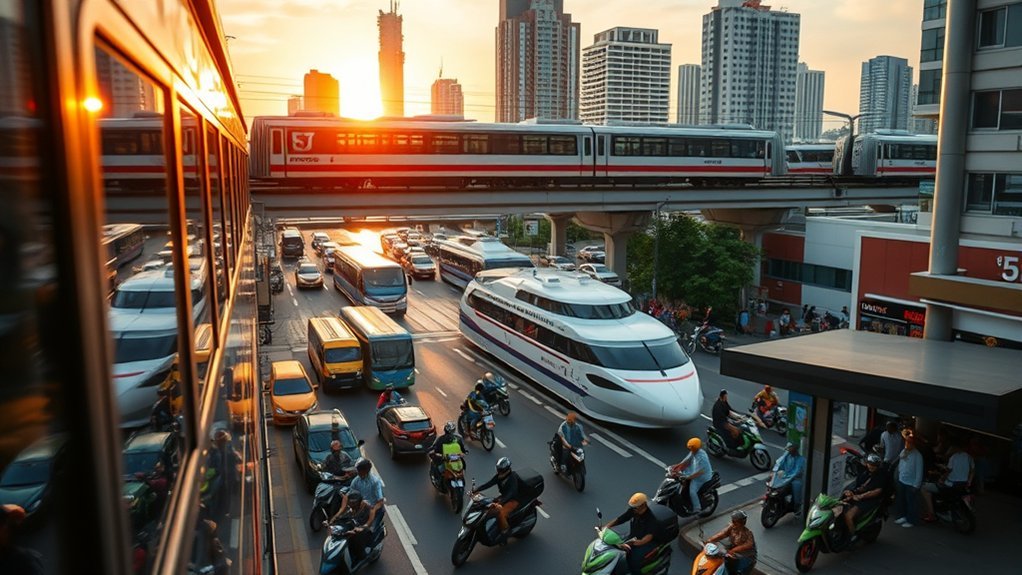
Bangkok has the only large rail network. BTS Skytrain and MRT fares are distance-based, so check your route on the BTS fare calculator and the MRT fare page. Elsewhere, people rely on songthaews (shared pickup trucks), taxis, ride-hailing apps, and scooters.
| Item | Cost (THB) | Approx. USD |
|---|---|---|
| One-way local ticket (Bangkok average) | 36.50 | $1.09 |
| Monthly transit pass (national average) | 1,155 | $34 |
| Taxi start, Bangkok | 35 | $1.04 |
| Taxi start, Phuket | 100 | $2.98 |
| Gasohol 95 (1 liter) | 40.69 | $1.21 |
| Gasohol E20 (1 liter) | 35.69 | $1.06 |
| Diesel (1 liter) | 42.19 | $1.26 |
Fuel prices are Bangkok pump prices after the October 2, 2026 increase of THB 0.75 a liter. Gasohol 95 at THB 40.69 a liter works out to about $4.60 a gallon.
A Bangkok commuter riding the train twice each workday spends roughly THB 1,500–3,000 (~$45–$90) a month, depending on distance. Other transport notes:
- Cars: a new Toyota Corolla averages about THB 900,000 (~$26,800). Bangkok traffic is heavy, so most newcomers skip owning one.
- Scooters: cheap to run but risky. Thailand’s roads are among the most dangerous in the world. Get a Thai or international motorcycle license, wear a helmet, and check that your insurance covers riding.
- Intercity travel: budget airlines connect Bangkok with Chiang Mai, Phuket, and other cities, often for less than the time cost of a long bus ride.
Healthcare and Insurance Costs

Thailand has low-cost public hospitals and high-end private hospitals that draw medical tourists. Most expats use private hospitals and pay through insurance.
Doctor visits. According to The Thaiger’s 2026 guide, a GP visit costs about THB 500–1,500 (~$15–$45) at a public hospital and THB 1,000–2,000 (~$30–$60) or more at a private one. Specialists charge about THB 1,500–3,000 (~$45–$90), and top-tier private clinics THB 5,000 (~$150) or more. Medicine, lab tests, and hospital fees come on top.
Check-ups. At Bumrungrad International, one of Bangkok’s best-known private hospitals, 2026 check-up packages start around THB 16,300 (~$485) and run to about THB 100,000 for the most detailed programs.
Insurance options:
- Social Security (employees only): workers at Thai employers pay 5% of salary, with the wage base capped at THB 17,500 from January 2026. That means a maximum of THB 875 (~$26) a month, matched by the employer. It covers treatment at a registered hospital.
- Local Thai health insurance: about THB 20,000–40,000 (~$595–$1,190) a year, according to expat-guide estimates. Premiums rise with age, and some insurers stop accepting new members in their 60s or 70s.
- International health insurance: about THB 45,000–80,000 (~$1,340–$2,380) a year for younger adults. Retirees often pay more.
Long-stay retirement visas (O-A) require health insurance covering at least THB 40,000 for outpatient and THB 400,000 for inpatient care. Price your own policy before you move, since age and pre-existing conditions change premiums a lot.
Schools and Childcare
Families face the widest cost range of any group, because school choice matters so much.
| Item | Cost (THB) | Approx. USD |
|---|---|---|
| International primary school, Bangkok (per year) | 555,418 | $16,530 |
| International primary school, Chiang Mai (per year) | 493,256 | $14,680 |
| International primary school, national average (per year) | 406,975 | $12,112 |
| Private full-day preschool (per month) | 18,181 | $541 |
The best-known international schools in Bangkok charge well above these averages, plus enrollment, capital, bus, and uniform fees. Thai public schools teach in Thai, and many middle-class Thai families choose bilingual private schools that cost much less than international ones.
For two children at an average Bangkok international school, tuition alone adds about THB 92,600 (~$2,755) a month. University fees vary by program: Chulalongkorn University’s BBA International program lists THB 1,028,850 (~$30,620) for four years for students starting in 2026.
Taxes: VAT and Income Tax
- VAT: the rate stays at 7%. The government extended the reduced rate (the legal rate is 10%) from October 1, 2026 to September 30, 2027. VAT is included in shelf prices.
- Tax residency: you become a Thai tax resident if you spend more than 180 days in Thailand in a calendar year, according to the Revenue Department.
- Foreign income: residents are taxed on foreign income they bring into Thailand. Since 2024, this applies to foreign income earned in any year, not only the year it is brought in, so talk to a tax adviser before moving savings or pension money.
- Income tax rates: progressive from 0% to 35%. The first THB 150,000 (~$4,465) of taxable income is exempt, then rates step up through 5%, 10%, 15%, 20%, 25%, and 30%, reaching 35% above THB 4 million.
Your home country’s tax rules still apply too, so check whether a tax treaty covers your pension or salary.
Visas and Income Requirements
Thailand changed its entry rules in 2026. After the Cabinet approved a tighter visa policy in May, the visa-free stay for most Western visitors, including US, UK, and EU citizens, dropped from 60 days to 30 days for arrivals from September 15, 2026. A one-time extension of up to 30 days may be possible at an immigration office. All foreign visitors must also fill in the free Thailand Digital Arrival Card online before arrival.
To live in Thailand longer, you need a visa. Applications go through the official Thai e-Visa website. The main options for foreigners with outside income:
| Visa | Financial Requirement | Validity | Key Conditions |
|---|---|---|---|
| Destination Thailand Visa (DTV) | THB 500,000 (~$14,880) in savings, held for 3 months | 5 years, multiple entry | remote workers and soft-power activities; 180 days per entry, extendable once by 180 days; fee about THB 10,000 (~$298) |
| Retirement (Non-O / O-A) | THB 800,000 (~$23,810) in a Thai bank, or pension income of THB 65,000 (~$1,935) a month | 1 year, renewable | age 50+; O-A requires health insurance (THB 40,000 outpatient / THB 400,000 inpatient) |
| Long-Term Resident (LTR) | high income or assets, set by category | up to 10 years | wealthy retirees, investors, remote professionals, skilled workers |
Visa extensions at an immigration office cost THB 1,900 (~$57) for most categories. Requirements and fees change often, so confirm with the Thai embassy or consulate that handles your application.
One-Time Setup Costs
Budget for these before your first month:
- Visa fees: about THB 10,000 (~$298) for a DTV; retirement visa fees vary by embassy.
- Rental deposit: often two months’ rent plus the first month. For a THB 15,000 condo that is THB 45,000 (~$1,340) up front.
- Visa funds: the DTV’s THB 500,000 or the retirement visa’s THB 800,000 must sit in a bank account, so plan your cash flow around them.
- SIM card and phone setup: a few hundred baht; bring your passport.
- Household items: most condos are furnished, but kitchen goods and linens can still add a few thousand baht.
- Health coverage gap: travel or international insurance for your first months, until a long-term policy starts.
Sample Monthly Budgets
These budgets combine the averages above. The lean single and retired couple columns use Chiang Mai prices; the other two use Bangkok. All figures are in Thai baht.
| Expense | Single, Lean (Chiang Mai) | Single, Comfortable (Bangkok) | Couple (Bangkok) | Retired Couple (Chiang Mai) |
|---|---|---|---|---|
| Rent | 9,800 | 11,650–22,750 | 22,750–24,750 | 15,600–18,450 |
| Utilities | 2,100 | 3,600 | 4,000 | 2,500 |
| Internet + mobile | 1,100 | 1,100 | 1,500 | 1,100 |
| Groceries | 5,000–6,000 | 7,000 | 12,000 | 10,000 |
| Eating out + leisure | 4,000–5,500 | 8,000–10,000 | 12,000–16,000 | 7,000 |
| Transport | 1,000–1,500 | 1,500–3,000 | 3,000–5,000 | 2,000 |
| Health insurance | 1,700–2,500 | 3,750–6,650 | 7,500–13,300 | 13,300 |
| Gym | — | 2,000 | 4,000 | — |
| Total (THB) | 24,700–28,500 | 38,600–56,100 | 66,750–80,550 | 51,500–54,350 |
| Total (USD) | $735–$850 | $1,150–$1,670 | $1,985–$2,395 | $1,535–$1,620 |
Family of four: crowd-sourced estimates put a family of four at about THB 86,000 (~$2,560) a month before rent in Bangkok and THB 66,300 (~$1,975) in Chiang Mai. Add a three-bedroom outside the center and the total is about THB 110,700 (~$3,295) in Bangkok or THB 84,750 (~$2,520) in Chiang Mai. Two children at an average Bangkok international school push the Bangkok figure to roughly THB 203,300 (~$6,050).
Retirees: the retired-couple column assumes a Chiang Mai apartment and international health insurance for two, which is the biggest cost for this group. Note that the retirement visa’s income option (THB 65,000 a month) sits above this budget, so retirees who qualify on income should be comfortable in Chiang Mai.
Salary vs. Cost of Living
Local wages are low compared with expat budgets. The Bangkok average net salary of about THB 20,700 (~$615) a month covers a one-bedroom outside the center plus basic living costs, but not much more. A minimum-wage worker in Bangkok earns about THB 10,400 (~$310) a month, less than the average central one-bedroom rent.
For foreigners, this means:
- Teaching English, a common first job, often pays far more than the local average at international and private schools, but less at government schools.
- Remote workers earning in dollars, euros, or pounds have the biggest advantage, especially in Chiang Mai.
- Foreigners need a work permit to work for a Thai employer, and many jobs are reserved for Thai nationals.
Entertainment and Lifestyle
Lifestyle spending is easy to underestimate in Thailand, because bars, beach clubs, and weekend trips add up. Typical prices:
- Gym membership: about THB 1,640 (~$49) a month nationally; THB 1,970 (~$59) in Bangkok and THB 1,260 (~$38) in Chiang Mai.
- Cinema ticket: about THB 220 (~$6.55); THB 255 in Bangkok.
- Imported beer at a bar: about THB 120 (~$3.55); higher in tourist areas.
- Free and cheap options: parks, temples, night markets, and festivals cost little or nothing.
Money-Saving Tips
- Live outside the center. In Bangkok, a one-bedroom outside the center costs about half as much as one downtown, and the train network keeps commutes manageable.
- Sign a one-year lease. Monthly and short-stay rentals cost more. Look at Thai-language listings and ask building offices directly.
- Eat like a local. Street food and food courts cost less than cooking Western meals at home.
- Check the electricity rate before you rent. Buildings that bill above the official tariff can add a lot to your costs once the air conditioning runs.
- Buy local brands. Imported wine, cheese, and cereal are heavily taxed.
- Use the train in Bangkok. It beats taxis stuck in traffic on both time and cost.
- Plan around the exchange rate. The baht moved about 9% against the dollar in 2026. Keep a buffer if you earn in another currency.
How Thailand Compares With Nearby Countries
Thailand sits in the middle of the range for Southeast Asia. It costs more than its smaller neighbors but offers better hospitals, transport, and international schools. If you’re comparing options, see our guides to the cost of living in Malaysia, which has similar city prices and more widely spoken English, and the cost of living in Cambodia, a cheaper option where the US dollar is widely used. For a quieter, lower-cost base, compare the cost of living in Laos. Island lovers can weigh our guides to the cost of living in the Philippines and the cost of living in Indonesia.
Frequently Asked Questions
How much money do you need to live in Thailand per month?
A single person needs about THB 24,700–28,500 (~$735–$850) a month for a simple life in Chiang Mai, and about THB 38,600–56,100 (~$1,150–$1,670) for a comfortable one in Bangkok. A couple in Bangkok should budget about THB 66,750–80,550 (~$1,985–$2,395).
Is $1,000 a month enough to live in Thailand?
Yes, outside the most expensive areas. At about THB 33.6 per dollar, $1,000 is roughly THB 33,600. That covers a lean single budget in Chiang Mai with room to spare, or a simple life outside central Bangkok. It does not cover a central Phuket or downtown Bangkok condo with frequent Western dining.
Is $2,000 a month enough to live in Thailand?
For a single person, yes. $2,000 is about THB 67,200, which covers a comfortable life in central Bangkok, including international health insurance. A couple can also live on it in Bangkok on a moderate budget, or comfortably in Chiang Mai.
Which Thai city is cheapest to live in?
Among the major expat hubs, Chiang Mai is the cheapest. A one-bedroom in the center averages about THB 15,580 (~$464), compared with about THB 22,746 (~$677) in Bangkok and THB 24,467 (~$728) in Phuket. Smaller provincial towns cost less still but have fewer international services.
How much is rent in Bangkok in 2026?
A one-bedroom averages about THB 22,746 (~$677) in the city center and THB 11,650 (~$347) outside it. A three-bedroom costs about THB 67,500 (~$2,009) in the center and THB 24,732 (~$736) outside.
How long can Americans stay in Thailand without a visa?
For arrivals from September 15, 2026, US, UK, and EU citizens get 30 days visa-free, down from 60 days. A one-time extension of up to 30 days may be granted at an immigration office. Longer stays need a visa such as the DTV or a retirement visa.
How much money do you need for a Thai retirement visa?
Applicants aged 50 or older need THB 800,000 (~$23,810) in a Thai bank account or pension income of at least THB 65,000 (~$1,935) a month. The O-A retirement visa also requires health insurance with at least THB 40,000 outpatient and THB 400,000 inpatient coverage.
Conclusion
Thailand remains one of the best-value places to live in Asia in 2026. A single person can live well for about $1,150–$1,670 a month in Bangkok, or for under $900 in Chiang Mai with local habits. Prices are fairly stable, with inflation around 2.5% and the 7% VAT extended to 2027, but the new 30-day visa-free limit makes planning your visa more important than before. Pick your city first, since rent drives most of the difference, price your health insurance personally, and check the exchange rate before you commit to a budget.
Sources
- Federal Reserve (FRED) – Thai baht to US dollar spot rate
- Exchange-Rates.org – USD to THB history, 2026
- The Nation – Thai inflation, August 2026
- Tilleke & Gibbins – Bangkok minimum wage increase
- Tilleke & Gibbins – provincial minimum wages
- Numbeo – Thailand, Bangkok, Chiang Mai, Phuket, Pattaya (crowd-sourced averages, September–October 2026)
- The Nation – electricity tariff for September–December 2026
- The Nation – September tariff cut and 200-unit cap
- Provincial Electricity Authority – tariffs
- The Nation – fuel prices, October 2026
- BTS Skytrain – routes and fares
- Bangkok MRT – fare rates
- The Thaiger – cost of seeing a doctor in Thailand
- Bumrungrad International – 2026 health check-ups
- Chulalongkorn University – BBA tuition and fees
- Forvis Mazars – 7% VAT extended to September 2027
- Revenue Department – personal income tax
- Tilleke & Gibbins – Thailand tightens visa policies
- Freaking Nomads – 30-day visa-free stay from September 15, 2026
- The Thaiger – Thailand visa requirements 2026
- Thai e-Visa – official application site