The cost of living in the Philippines in 2026 runs about PHP 40,000–51,000 (~$640–$815) a month for a single person living simply outside Metro Manila, and about PHP 85,000–100,500 (~$1,355–$1,605) for a comfortable single life in central Manila, Makati, or Cebu. A couple should plan on roughly PHP 115,600–130,900 (~$1,845–$2,090), and a family of four about PHP 133,000–173,000 (~$2,125–$2,755) before international school fees. These figures use an exchange rate of about PHP 62.7 per US dollar (October 6, 2026). The peso is near its weakest level on record, which helps anyone earning in dollars, but inflation hit 7.2% in September, so local prices are climbing fast. Below you’ll find city rents, utility and fuel costs, food prices, healthcare, taxes, visa fees, and sample budgets.
Quick Answer
- Single person: PHP 40,000–51,000 (~$640–$815) on a lean budget; PHP 85,000–100,500 (~$1,355–$1,605) for a comfortable one in a big city.
- Couple: PHP 115,600–130,900 (~$1,845–$2,090) a month in a central one-bedroom.
- Family of four: about PHP 133,000–173,000 (~$2,125–$2,755) before international school fees.
- Rent, one-bedroom: PHP 10,800–23,900 (~$170–$380) outside the center; PHP 17,300–45,700 (~$275–$730) in the center, depending on the city.
- Utilities: about PHP 6,300–9,300 (~$100–$150) a month for an 85 m² apartment; internet adds about PHP 1,700 (~$27).
- Fuel: gasoline averages about PHP 91 a liter in Metro Manila (October 2026).
- Minimum wage: PHP 755 a day in Metro Manila, or roughly PHP 19,700 (~$315) a month.
Exchange Rate, Inflation, and Minimum Wage in 2026
Three numbers shape what the Philippines costs you this year.
The exchange rate. The peso traded at about PHP 62.7 per dollar on October 5–6, 2026, according to USD/PHP history data. It hit its weakest point of the year, about PHP 62.9, on September 14. In late February it was much stronger, near PHP 57.5. If you earn in dollars, a PHP 60,000 budget cost about $1,045 in February and about $955 now.
Inflation. The Philippine Statistics Authority reported annual inflation of 7.2% in September 2026, up from 6.1% in August. Transport and housing-related costs (water, electricity, gas, and fuel) drove the jump. A global energy shock earlier in the year and the weak peso both raised the price of imported fuel and goods.
The minimum wage. Metro Manila’s daily minimum for non-agricultural workers rose from PHP 695 to PHP 755 on July 25, 2026, and will reach PHP 780 on January 20, 2027, under the latest NCR wage order. Small retail and service businesses and farm workers have a lower rate, rising from PHP 658 to PHP 743 in two steps. Regional minimums outside Metro Manila are lower still.
At PHP 755 a day, a full-time minimum-wage worker in Metro Manila earns about PHP 19,700 a month, or roughly $315. Many local households live on one or two incomes near that level.
Cost of Living by City
Rent varies more between cities than any other expense. The table uses crowd-sourced averages from Numbeo (updated between June and October 2026). Manila and Cebu have hundreds of price reports. Makati and Davao have fewer, so treat those as rough guides. “Manila” here means the capital region as reported by contributors, while Makati covers the main business district.
| City | 1-Bed, City Center | 1-Bed, Outside Center | Basic Utilities (85 m²) | Single Person, Excl. Rent |
|---|---|---|---|---|
| Manila | PHP 34,117 (~$544) | PHP 17,660 (~$282) | PHP 7,715 (~$123) | PHP 36,806 (~$587) |
| Makati | PHP 45,709 (~$729) | PHP 23,867 (~$381) | PHP 9,341 (~$149) | PHP 44,574 (~$711) |
| Cebu | PHP 31,873 (~$508) | PHP 19,050 (~$304) | PHP 7,583 (~$121) | PHP 34,371 (~$548) |
| Davao | PHP 17,300 (~$276) | PHP 10,760 (~$172) | PHP 6,750 (~$108) | PHP 33,252 (~$530) |
| Philippines average | PHP 19,744 (~$315) | PHP 11,407 (~$182) | PHP 6,336 (~$101) | PHP 31,416 (~$501) |
A few patterns stand out:
- Makati and BGC are the most expensive places to live. Central rents run more than double the national average, driven by modern condos near offices, malls, and international schools.
- Manila outside the business districts is much cheaper. A one-bedroom outside the center costs about half of a central unit.
- Cebu is no longer a bargain in the center. Central rents sit close to Manila’s, though outside-center rents and daily costs are similar or slightly lower.
- Davao has the lowest rents of the big cities, at about PHP 10,800 outside the center. It is also the main city of Mindanao, with good hospitals and an international airport.
- Smaller cities such as Dumaguete, Iloilo, and Bacolod can cost less again, but have fewer specialist hospitals, international schools, and direct flights.
Housing: Rent and Buying Property
Larger Apartments for Families
Families need more space, and three-bedroom rents show the same city gaps:
| City | 3-Bed, City Center (PHP) | 3-Bed, Outside Center (PHP) |
|---|---|---|
| Manila | 119,667 (~$1,909) | 41,800 (~$667) |
| Makati | 144,167 (~$2,299) | 67,500 (~$1,077) |
| Cebu | 67,025 (~$1,069) | 39,400 (~$628) |
| Davao | 38,900 (~$620) | 20,300 (~$324) |
| Philippines average | 40,780 (~$650) | 21,860 (~$349) |
Central Makati and Manila family units are mostly premium condos with pools, gyms, and security, which explains the high prices. A house or townhouse in a gated subdivision outside the center is often the better deal for families.
What to Check Before You Sign
Move-in costs are higher than many newcomers expect. Landlords commonly ask for one or two months of advance rent plus a security deposit of one or two months, and many want post-dated checks for the lease term. Before signing, confirm in writing:
- Who pays association dues, parking, and water, and whether electricity is billed directly by the utility or by the building.
- Whether fiber internet is available in the unit, not just the building.
- Flood exposure during the rainy season (June to November) and whether the building has backup power.
- Repair responsibilities, renewal terms, and the penalty for leaving early.
Can Foreigners Buy Property?
Foreigners generally cannot own land. Under Article XII of the 1987 Philippine Constitution, private land can only go to buyers qualified to hold public land, with an exception for inheritance. Foreigners can buy condominium units, as long as foreign ownership in the building stays within the 40% limit under the Condominium Act. Use a Philippine lawyer to check the title, any liens, and the foreign-ownership share before paying a reservation fee. Most newcomers rent for six to twelve months first.
Utilities, Internet, and Phone

Basic utilities (electricity, water, and garbage) for an 85 m² apartment average about PHP 6,336 (~$101) a month nationwide and PHP 7,500–9,300 (~$120–$150) in Manila, Makati, and Cebu. Electricity is the swing factor, because air-conditioning runs most of the year.
Meralco, which supplies Metro Manila, charged about PHP 14.78 per kWh for a typical household in August 2026, according to GMA News. Rates change every month.
| Monthly Use | Typical Situation | Approx. Bill (PHP) | Approx. USD |
|---|---|---|---|
| 100 kWh | studio, fans, little air-conditioning | 1,480 | $24 |
| 200 kWh | Meralco’s typical household benchmark | 2,960 | $47 |
| 400 kWh | one-bedroom with air-conditioning most nights | 5,910 | $94 |
| 700 kWh | family home with several air-conditioners | 10,350 | $165 |
Bills are estimates at the August 2026 rate. Provincial power cooperatives and Cebu’s Visayan Electric charge different rates.
Other monthly connections:
- Home fiber internet (60+ Mbps): about PHP 1,700 (~$27) on average, per crowd-sourced data.
- Mobile plan with 10 GB+ data: about PHP 890 (~$14). Prepaid SIMs with data promos can cost less. SIMs must be registered with a passport.
- Water: usually a few hundred pesos a month for a single person in a condo.
- Condo association dues: often billed separately from rent. Ask before signing.
Remote workers should keep a mobile data backup, since fiber outages happen during storms.
Food: Groceries and Dining Out
A single person who cooks most meals with local ingredients spends about PHP 10,000–14,000 (~$160–$225) a month on groceries. Couples should plan on about double that. Wet markets and neighborhood stores are cheapest for produce, fish, and meat. Supermarkets in malls cost more, and imported items cost the most.
Average national prices (crowd-sourced, August 2026):
| Item | Typical Cost (PHP) | Approx. USD |
|---|---|---|
| Milk (1 liter) | 108 | $1.72 |
| White bread (1 lb loaf) | 68 | $1.09 |
| Rice (1 lb) | 26 | $0.41 |
| Eggs (12) | 120 | $1.92 |
| Chicken fillets (1 lb) | 119 | $1.89 |
| Beef (1 lb) | 196 | $3.13 |
| Local cheese (1 lb) | 205 | $3.26 |
| Bananas (1 lb) | 40 | $0.63 |
| Domestic beer (0.5 liter, store) | 72 | $1.15 |
| Mid-range bottle of wine | 400 | $6.38 |
Rice, eggs, chicken, pork, fish, bananas, and local vegetables keep grocery bills low. Milk, cheese, and imported cereals, coffee, and wine are where costs climb, and the weak peso has made imports pricier this year.
Eating out remains cheap if you eat local. A meal at a carinderia (a small eatery serving home-style dishes) often costs well under PHP 200. Other common prices:
- Meal at an inexpensive restaurant: about PHP 250 (~$4)
- Three-course dinner for two at a mid-range restaurant: about PHP 1,270 (~$20)
- Fast-food combo meal: about PHP 200 (~$3.20)
- Domestic draft beer (pint, at a bar): about PHP 80 (~$1.30)
In Makati and BGC, the inexpensive-restaurant average rises to about PHP 400 (~$6.40), and Western restaurants charge close to US prices.
Transportation and Getting Around
Public transport is cheap but crowded, and Metro Manila traffic is heavy at rush hour. In late September 2026 the transport department approved the regulator’s recommended fare increase, according to GMA News. An earlier hike planned for March 2026 had been suspended by the President.
| Mode | Fare (PHP) | Notes |
|---|---|---|
| Traditional jeepney | 14 for the first 4 km | up from 13; plus PHP 2 per extra km |
| Modern jeepney | 17 for the first 4 km | up from 15; plus PHP 2.40 per extra km |
| Monthly transit spending | about 800 | crowd-sourced average for regular commuters |
| Taxi flag-down | about 46.50 | plus about PHP 22.50 per mile; increases pending |
| Gasoline (RON 91), Metro Manila | 91.45 per liter | week of October 6, 2026 |
| Diesel, Metro Manila | 94.64 per liter | week of October 6, 2026 |
Fuel prices come from GasWatch PH, which averages prices from about 960 Metro Manila stations. At PHP 91.45 a liter, gasoline costs about $5.50 per gallon. Diesel neared PHP 100 a liter during the summer price spikes.
Other transport notes:
- Trains: the MRT-3 and LRT lines are the fastest way across Metro Manila at rush hour. Fares run roughly PHP 13–35 per ride depending on distance and line.
- Ride-hailing: Grab is widely used and convenient at night or in rain, but surge pricing is common.
- Tricycles and habal-habal (motorcycle taxis): handle short trips in smaller cities and towns.
- Island travel: domestic flights and ferries connect the islands. Budget airlines often beat long ferry rides on time.
- Cars: owning one adds fuel, parking, tolls, insurance, and registration. Most newcomers in Manila skip it.
A commuter using jeepneys and trains spends roughly PHP 800–2,000 (~$13–$32) a month. Someone who relies on Grab for most trips can spend PHP 6,000–10,000 or more.
Healthcare and Insurance Costs
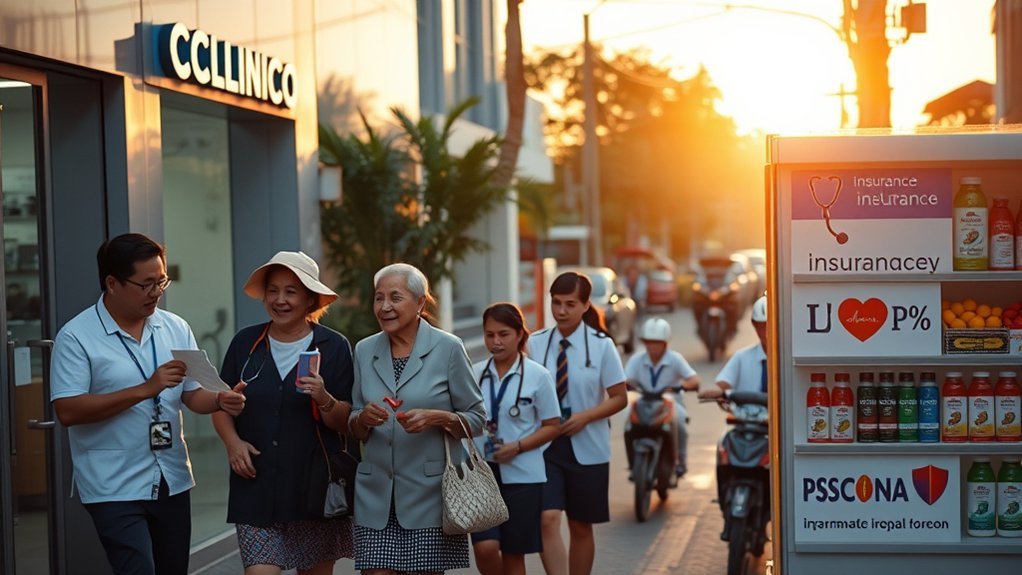
The Philippines has a public health insurer, PhilHealth, and a large private hospital sector. Private hospitals in Manila, Cebu, and Davao are where most foreigners get care.
- PhilHealth contributions: 5% of basic monthly salary, split between employer and employee, on salaries from PHP 10,000 to PHP 100,000. That means PHP 500 to PHP 5,000 a month in total, per the PhilHealth contribution table. Foreign residents with an ACR I-Card can register, but PhilHealth covers only part of a private hospital bill.
- Doctor visits: a private general practitioner costs about PHP 500–1,500 (~$8–$24) per visit and a specialist about PHP 1,500–3,000 (~$24–$48), based on 2026 price surveys.
- HMO plans: local health maintenance organizations sell plans that cover consultations and hospital stays at partner hospitals. Prices depend on age and coverage limits, and many plans cap enrollment age, so get quotes early.
- International insurance: the safest choice for retirees and families, since serious cases can exceed HMO limits. Premiums rise steeply after 60.
The sample budgets below include a monthly health allowance. Treat it as a planning figure, not a quote, and price your own coverage before you move.
Schools and Childcare
School choice is the biggest cost decision for families.
- International primary school: about PHP 343,700 (~$5,480) a year per child on average, per crowd-sourced data. The best-known schools in Taguig and Makati charge considerably more, plus enrollment fees, buses, and development fees.
- Private preschool or kindergarten: about PHP 8,700 (~$140) a month, full day.
- Private local schools: many teach in English and cost far less than international schools.
- Household help: many middle-class families employ a live-in helper. Wages vary by region and are set by regional wage boards.
For a family with two kids in an average international school, tuition alone adds about PHP 57,300 (~$915) a month.
Taxes: VAT and Income Tax
- VAT: 12% on most goods and services, included in shelf prices, under the TRAIN Law (Republic Act 10963). Some basic goods are exempt.
- Who pays: resident citizens are taxed on worldwide income. Foreigners are generally taxed on income from Philippine sources. Retirees living on a foreign pension usually owe no Philippine income tax on it, but check with an accountant.
- Income tax rates: the first PHP 250,000 (~$3,990) of annual taxable income is tax-free. Rates then rise from 15% to 35%.
| Annual Taxable Income (PHP) | Tax |
|---|---|
| Up to 250,000 | 0% |
| 250,001–400,000 | 15% of the amount over 250,000 |
| 400,001–800,000 | 22,500 + 20% of the amount over 400,000 |
| 800,001–2,000,000 | 102,500 + 25% of the amount over 800,000 |
| 2,000,001–8,000,000 | 402,500 + 30% of the amount over 2,000,000 |
| Over 8,000,000 | 2,202,500 + 35% of the amount over 8,000,000 |
Remote workers paid by foreign companies should get professional advice, since tax treatment depends on residency status and where the work is legally performed.
Visas and Residence Costs
US, Canadian, UK, Australian, and EU citizens can enter visa-free for 30 days. The Bureau of Immigration allows extensions in steps, up to 36 months in total for visa-exempt nationals. Its published fees include:
- First extension (29 days): PHP 3,030 (~$48).
- Later extensions: PHP 4,400 (~$70) for one month or PHP 4,900 (~$78) for two months, including the ACR I-Card and other charges.
- ACR I-Card: $50 plus a PHP 500 express fee, required once you stay past 59 days.
- Long-stay extension (up to six months): PHP 11,500 (~$183).
The bureau notes these fees can change without notice, so confirm the current amount before you go.
Retirement visa (SRRV). The Philippine Retirement Authority runs the Special Resident Retiree’s Visa, which lets you stay indefinitely. The main option, SRRV Classic, costs:
| Applicant | Visa Deposit | Other Requirements and Fees |
|---|---|---|
| Age 50+, with pension | $15,000 | pension of at least $800/month ($1,000 with dependents) |
| Age 50+, no pension | $30,000 | deposit can be used to buy a condo or long-term lease |
| Age 40–49, with pension | $25,000 | same pension minimum |
| Age 40–49, no pension | $50,000 | none beyond the deposit |
| All principal applicants | — | $1,500 processing fee; $360 annual fee (covers up to two dependents) |
Each dependent pays a $300 application fee, and extra dependents beyond two add $100 a year.
Salaries vs. Cost of Living
Local salaries are low compared with what an expat lifestyle costs. The crowd-sourced average net monthly salary is about PHP 20,070 (~$320) nationwide and about PHP 29,900 (~$477) in Manila. The Metro Manila minimum wage works out to roughly PHP 19,700 (~$315) a month.
That means a single person’s comfortable big-city budget of PHP 85,000 or more equals about three to four average Manila salaries. Foreigners who move for a local job should negotiate housing, health insurance, and flights into the package. Remote workers and retirees with foreign income gain the most from the weak peso.
One-Time Setup Costs
Budget for these before your first month:
- Rental move-in: commonly one to two months of advance rent plus one to two months of deposit. For a PHP 30,000 condo, that can mean PHP 60,000–120,000 (~$955–$1,915) up front.
- Visa extensions and ACR I-Card: about PHP 7,500–10,000 (~$120–$160) for your first two extensions and the card.
- SRRV, if retiring: $1,500 processing fee plus the deposit (refundable when you give up the visa).
- Furnishing an unfurnished unit: varies widely. Many newcomers rent furnished to avoid this.
- Phone and internet setup: a SIM costs little, but fiber installation can take one to three weeks.
- Health coverage gap: travel or international insurance until a local plan starts.
Sample Monthly Budgets

These budgets combine the averages above. The lean budget assumes Davao, outer Cebu, or a smaller city. The comfortable and couple budgets assume a central one-bedroom in Cebu, Manila, or Makati. The retired couple assumes an outer-area apartment in Davao or Cebu. All figures are in PHP.
| Expense | Single, Lean | Single, Comfortable | Couple | Retired Couple |
|---|---|---|---|---|
| Rent (1-bed) | 10,800–19,000 | 31,900–45,700 | 31,900–45,700 | 10,800–19,100 |
| Utilities | 4,000–6,000 | 7,600–9,300 | 8,500–10,000 | 7,000 |
| Internet + mobile | 2,600 | 2,600 | 3,500 | 3,500 |
| Groceries | 10,000 | 14,000 | 24,000 | 22,000 |
| Eating out + leisure | 5,000 | 12,000 | 18,000 | 10,000 |
| Transport | 2,000–3,000 | 5,000 | 8,000 | 4,000 |
| Health allowance | 3,000 | 6,000 | 12,000 | 20,000 |
| Gym | — | 1,900 | 3,700 | — |
| Household and other | 2,500 | 4,000 | 6,000 | 5,000 |
| Total (PHP) | 40,000–51,000 | 85,000–100,500 | 115,600–130,900 | 82,300–90,600 |
| Total (USD) | $640–$815 | $1,355–$1,605 | $1,845–$2,090 | $1,315–$1,445 |
Family of four: the crowd-sourced estimate for a family of four is about PHP 111,500 (~$1,780) a month before rent nationally and about PHP 131,000 (~$2,090) in Manila. Add a three-bedroom outside the center (PHP 21,900–41,800) and the total is about PHP 133,000–173,000 (~$2,125–$2,755). International school for two children pushes that to roughly PHP 190,600–230,000 (~$3,040–$3,670).
Retirees: the retired-couple column includes a large health allowance, which is the biggest cost for this group. The SRRV pension minimum ($1,000 a month with a dependent) sits below this budget, so a couple living on exactly the minimum would need a cheaper town, a smaller apartment, or both.
Money-Saving Tips
- Live outside the business districts. A one-bedroom outside central Manila costs about half of one in the center, and Davao costs less again.
- Control the air-conditioning. Going from 400 to 200 kWh a month saves about PHP 3,000 at Meralco’s August rate. Inverter units and fans help.
- Eat local. Carinderias and wet markets beat mall restaurants and imported groceries by a wide margin.
- Ask for a longer lease. Landlords often cut rent or cover association dues for a 12-month contract.
- Use trains and jeepneys for daily trips and save Grab for nights and rain.
- Shop for fuel. Price gaps between stations in the same city can exceed PHP 5 a liter.
- Plan around the exchange rate. The peso moved by more than 9% this year. Keep a buffer if you earn in dollars.
How the Philippines Compares With Nearby Countries
The Philippines sits in the middle of the range for Southeast Asia. English is widely spoken, which makes daily life and paperwork easier than in most neighbors, but electricity and fuel cost more than in many of them. If you are comparing options, see our guides to the cost of living in Thailand, a popular retirement and remote-work base, and the cost of living in Malaysia, which offers modern cities and strong healthcare. For lower-cost options, compare the cost of living in Indonesia and our Cambodia cost of living guide.
Frequently Asked Questions
How much money do you need to live in the Philippines per month?
A single person needs about PHP 40,000–51,000 (~$640–$815) a month living simply outside Metro Manila, and about PHP 85,000–100,500 (~$1,355–$1,605) for a comfortable life in central Manila, Makati, or Cebu. A couple should budget about PHP 115,600–130,900 (~$1,845–$2,090).
Is $1,000 a month enough to live in the Philippines?
Yes, for a single person who lives modestly. At about PHP 62.7 per dollar, $1,000 is roughly PHP 62,700. That covers a lean budget in Davao, Cebu outside the center, or a smaller city, with a local diet and controlled air-conditioning. It does not cover a central Makati or BGC condo plus private health insurance and frequent dining out.
How much is rent in Manila in 2026?
Crowd-sourced averages put a one-bedroom at about PHP 34,100 (~$545) in central Manila and PHP 17,700 (~$280) outside the center. Makati is pricier, at about PHP 45,700 (~$730) in the center. Rents in Davao run roughly half of Manila’s.
What is the minimum wage in the Philippines in 2026?
Metro Manila’s minimum wage for non-agricultural workers is PHP 755 a day since July 25, 2026, rising to PHP 780 on January 20, 2027. That is roughly PHP 19,700 (~$315) a month. Minimum wages in other regions are lower.
How much does a retirement visa cost in the Philippines?
The SRRV Classic requires a deposit of $15,000 for pensioners aged 50 and over, or $30,000 without a pension, plus a $1,500 processing fee and a $360 annual fee. Pensioners must show at least $800 a month, or $1,000 with dependents.
Which Philippine city is cheapest to live in?
Among the large cities, Davao has the lowest rents, with one-bedrooms outside the center averaging about PHP 10,800 (~$170). Smaller cities such as Dumaguete and Iloilo can cost even less, but have fewer hospitals, schools, and flights.
Why are prices rising in the Philippines in 2026?
Inflation reached 7.2% in September 2026, led by transport and by housing, water, electricity, and fuel costs. Fuel prices near PHP 91 a liter for gasoline and a weak peso pushed up costs for imports, transport, and power.
Conclusion
The Philippines remains affordable by US standards, and 2026 tilted the math toward dollar earners. The peso is near record lows, so a dollar buys more pesos than at any time in recent years. At the same time, inflation hit 7.2%, gasoline is above PHP 90 a liter, and electricity is expensive, so local prices are rising. A single person can live comfortably for about $1,355–$1,605 a month in Manila or Cebu, or for closer to $640–$815 in Davao or a smaller city with local habits. Pick your city and neighborhood first, since rent and air-conditioning drive most of the difference, and check the exchange rate before you commit to a budget.
Sources
- Exchange-Rates.org – USD to PHP history, 2026
- Philippine Statistics Authority – Consumer Price Index and inflation, September 2026
- SunStar – NCR minimum wage increase, July 2026
- GMA News – Meralco rate, August 2026
- GasWatch PH – Metro Manila fuel prices
- GMA News – DOTr approves jeepney fare increase, September 2026
- PhilHealth – premium contribution table
- Republic Act 10963 (TRAIN Law) – income tax and VAT
- Bureau of Immigration – visa waiver and extension fees
- Philippine Retirement Authority – SRRV
- 1987 Philippine Constitution – Article XII
- Numbeo – Philippines, Manila, Makati, Cebu, Davao (crowd-sourced averages)