By: Theo Ramirez
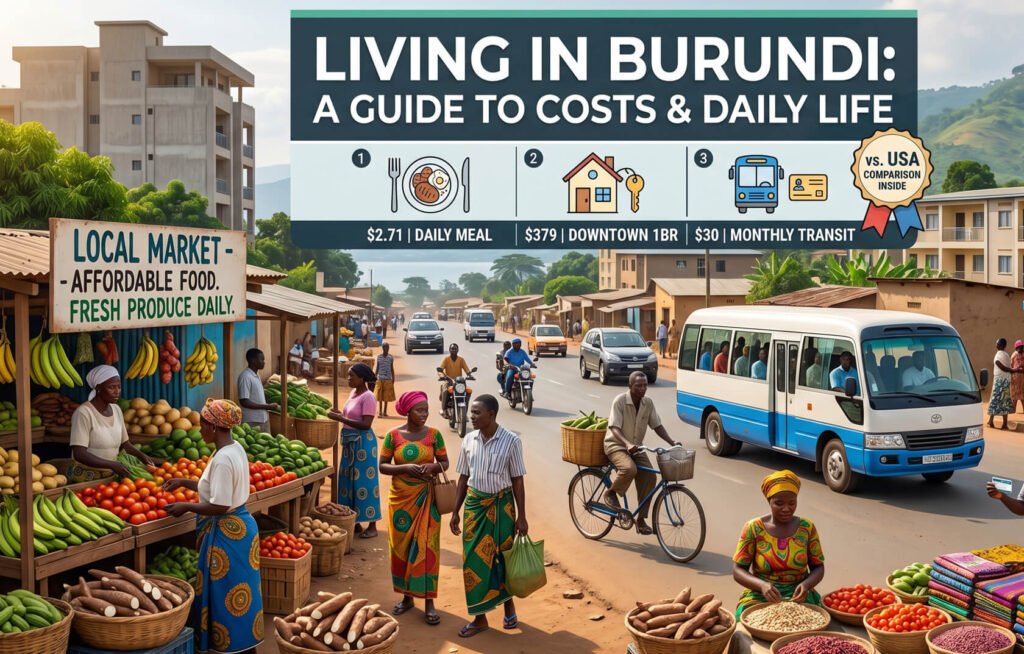
The cost of living in Burundi in 2026 runs about 0.95–1.4 million Burundian francs (BIF), or roughly $315–$465 a month, for a single person living a simple, local-style life in Bujumbura. A foreigner who wants a central apartment, reliable internet, imported food, and taxis should plan on about BIF 3.2–4.8 million (~$1,050–$1,590), before international health and evacuation insurance. These figures use the Bank of the Republic of Burundi’s official rate of BIF 3,009 per US dollar (October 2, 2026). Two warnings come before any budget. First, the IMF says the parallel-market dollar rate was about double the official rate in April 2026, so dollar costs depend heavily on how you get your francs. Second, the US government rates Burundi “Level 3: Reconsider Travel,” and fuel shortages, a cash-only economy, and limited medical care add real costs. Below you’ll find rents, food and transport prices, utilities, schools, healthcare, sample budgets, and safety context.
Quick Answer
- Single person, local-style: about BIF 0.95–1.4 million (~$315–$465) a month in Bujumbura.
- Single person, expat-style: about BIF 3.2–4.8 million (~$1,050–$1,590) a month, plus international insurance.
- Couple, expat-style: about BIF 4.0–5.9 million (~$1,340–$1,960) a month.
- Family of four: about BIF 6.1–8.9 million (~$2,010–$2,955) a month before international school fees.
- Rent, one-bedroom in Bujumbura: about BIF 273,000 (~$90) outside the center and BIF 1.3 million (~$430) in the center.
- Utilities: about BIF 211,000 (~$70) a month for an 85 m² apartment; home internet adds BIF 130,000–200,000 (~$45–$67).
- Inflation: 8.4% in August 2026, down from a 45.5% peak in April 2025.
- Entry: a one-month visa costs $90, and a yellow fever certificate is required.

The LG LT1000P is a genuine replacement refrigerator water filter designed to deliver cleaner, fresher-tasting water and ice for your household. Certified to meet NSF standards, it helps reduce a wide range of contaminants while ensuring a proper fit and reliable performance in compatible LG refrigerators. With a recommended replacement cycle of several months and support for substantial water volume, it offers dependable filtration and peace of mind.

This daily devotional helps parents pray purposefully for their children through a full year of Scripture readings, reflections, and guided prayer prompts. Written to encourage faithful family discipleship, it offers practical, biblically grounded support for parents who want to shape their prayers around God's Word. A foreword by Sinclair B. Ferguson adds trusted theological insight and encouragement.

This heartfelt memoir blends laugh-out-loud honesty with tender reflections on love, loneliness, and the unexpected healing power of rescue dogs. Isabel Klee shares her journey fostering pups in the city while navigating dating and self-discovery, offering an intimate, relatable story for readers who enjoy emotional, character-driven narratives. It is a warm, engaging read about opening your heart and finding connection in surprising places.
What Can and Cannot Be Known About Prices in Burundi
Burundi has very little published price data. There is no large rental market data set, and crowd-sourced price sites have only a handful of contributors. Numbeo’s Bujumbura page, for example, had 66 price entries from 9 people over 12 months, last updated in February 2026. That is enough to show the general level of prices, but not enough to treat any single number as exact.
Three things make dollar figures especially uncertain:
- Two exchange rates. The official rate was about BIF 3,009 per dollar on October 2, 2026. The IMF’s May 2026 mission statement said the parallel-market premium was still about 100% at the end of April 2026. In other words, a dollar could buy roughly twice as many francs on the street as at the bank. Using unofficial exchange is risky and may be illegal, so this guide uses the official rate throughout.
- High, unstable inflation. Prices rose sharply in 2024 and 2025, then slowed in 2026.
- Fuel shortages. When fuel runs short, transport, food delivery, and generator costs jump quickly.
For these reasons, every figure below is a range or a dated average. Budget in francs first, get local quotes before you sign anything, and convert to dollars only at the end.
Exchange Rate, Inflation, and Incomes in 2026
Exchange rate. The Bank of the Republic of Burundi (BRB) published a middle rate of BIF 3,009.45 per US dollar on October 2, 2026 (buying 2,985, selling 3,034). All dollar conversions in this guide use that rate.
Inflation. Burundi went through a severe inflation spike. The World Bank’s Burundi overview says inflation averaged 34% in 2025 after peaking at 45.5% in April, then eased to 15.2% by December. The IMF reported 10.8% in March 2026 and projects an average of about 14.5% for the year. More recent monthly data compiled by Trading Economics show annual inflation of 8.4% in August 2026, down from 8.7% in July and 9.9% in June, with food inflation at just 2.6%.
Incomes. Burundi is one of the poorest countries in the world. World Bank data put GDP per person at about $234 for all of 2025, and about 85% of jobs are in farming. Crowd-sourced reports from Bujumbura put average net pay for formal city jobs at about BIF 1.1 million (~$366) a month, but very few people earn that.
Minimum wage. Burundi’s legal minimum wage has not been updated since 1988. According to WageIndicator, it is still BIF 160 a day in Bujumbura and Gitega and BIF 105 a day in rural areas. These amounts are worth only a few US cents today, so actual pay is set by employers and the market, not by the legal floor.
A local-style monthly budget of about BIF 1 million is more than four times Burundi’s GDP per person for a whole month. Most households live on far less, often in shared or family housing.
Rent and Housing
Housing is the biggest variable for newcomers. Almost all foreigners live in Bujumbura, where the gap between a basic local home and a secure, furnished house in Rohero, Kiriri, or Kinindo is enormous.
Crowd-sourced averages for Bujumbura (last updated February 2026):
| Property | Average (BIF/month) | Approx. USD | Reported Range (BIF) |
|---|---|---|---|
| 1-bed, city center | 1,300,000 | $430 | 600,000–2,000,000 |
| 1-bed, outside center | 273,000 | $90 | 68,000–400,000 |
| 3-bed, city center | 4,000,000 | $1,330 | 1,000,000–7,000,000 |
| 3-bed, outside center | 800,000 | $265 | 600,000–1,000,000 |
The ranges are wide because the sample is small and housing quality varies so much. A cheap room outside the center may have no reliable water or power, while expat-standard houses usually include a wall, a guard, a water tank, and sometimes a generator. Gitega, the political capital, and other towns have even fewer listings, and foreigners there often rent through employers or personal contacts.
Before you agree to a lease, confirm in writing:
- The rent amount and the currency it must be paid in (some landlords ask for US dollars)
- How many months must be paid up front, and the deposit
- Who pays electricity, water, guards, and maintenance
- Whether there is a backup water tank or generator, and who pays for its fuel
- Whether internet can be installed at that exact address
- The notice period and what happens if you leave early
Crowd-sourced data put mortgage interest at about 14% a year, but lending to foreigners is rare. Building a house is possible, but there is no reliable public figure for construction cost per square meter. Get several dated quotes in francs for the same plan before setting a budget.
Utilities, Internet, and Phone
Basic utilities (electricity, water, and garbage) for an 85 m² apartment average about BIF 211,000 (~$70) a month in crowd-sourced data. Your real bill depends on how much you use air conditioning and water heaters, and on whether you pay for generator fuel during outages. The national utility, REGIDESO, supplies both water and power.
Internet is expensive compared with other costs:
- Home broadband: about BIF 130,000–200,000 (~$45–$67) a month. Speeds and reliability vary by neighborhood, so test before you commit.
- Mobile plan with data: about BIF 24,000–26,000 (~$8–$9) a month.
- Mobile money: widely used for small payments and accepted at some hotels.
If you work remotely, budget for a mobile-data backup and a small power backup for your router and laptop.
Food: Groceries and Dining Out
Local staples such as beans, cassava, bananas, sweet potatoes, rice, and fish from Lake Tanganyika are cheap. Imported goods, dairy, and supermarket meat cost far more. A single person eating mostly local food might spend BIF 300,000–400,000 (~$100–$135) a month, while an expat buying imported brands can easily spend BIF 600,000–800,000 (~$200–$265).
Crowd-sourced average prices in Bujumbura (converted to metric units):
| Item | Typical Cost (BIF) | Approx. USD |
|---|---|---|
| Milk (1 liter) | 3,000 | $1.00 |
| Bread (500 g) | 6,000 | $2.00 |
| Rice (1 kg) | 6,000 | $2.00 |
| Eggs (12) | 10,800 | $3.59 |
| Chicken (1 kg) | 33,600 | $11.15 |
| Beef (1 kg) | 34,100 | $11.30 |
| Tomatoes (1 kg) | 5,000 | $1.66 |
Eating out is cheap at local restaurants and expensive at hotel or expat venues:
- Meal at an inexpensive restaurant: about BIF 11,600 (~$3.85)
- Three-course dinner for two at a mid-range restaurant: about BIF 196,000 (~$65)
- Cappuccino: about BIF 9,100 (~$3.05)
- Local beer (half liter): about BIF 6,500 (~$2.15)
Food prices have been the calmest part of the budget in 2026. Food inflation was only 2.6% in August, well below overall inflation.
Transportation and Fuel
Most people in Bujumbura get around by minibus, motorbike taxi, or bicycle taxi. Crowd-sourced prices:
- Local bus or minibus ride: about BIF 3,100 (~$1.02)
- Monthly transport pass or equivalent: about BIF 90,000 (~$30)
- Taxi: about BIF 15,000 (~$5) to start, plus about BIF 10,000 (~$3.30) per km, so an 8 km ride costs roughly BIF 65,000 (~$22)
- Gasoline: about BIF 4,000 (~$1.33) per liter at the official pump price, when available
Fuel is the big problem. The UK government’s travel advice for Burundi (updated May 2026) describes severe fuel shortages with long queues, and says transport options may be limited even at the Tanzania border. The US State Department adds that service stations outside Bujumbura are scarce and often have no fuel. Expats who need to travel often tend to hire a car and driver, which can cost several hundred dollars a month, and keep spare fuel on hand.
Roads outside the capital are often poor, landslides block routes in the rainy season, and travel after dark outside Bujumbura is discouraged.
Healthcare and Insurance
Routine care is cheap, but serious care is limited. The US State Department says medical facilities in Burundi are well below US standards, hospitals ask for cash in advance, and insurers are not billed directly. Adequate trauma care is not available, so even fairly minor emergencies can require evacuation to Nairobi or farther.
For budgeting:
- Local clinic visits: inexpensive, paid in cash.
- International health insurance with medical evacuation: essential for foreigners, and usually priced in US dollars. Get quotes before you go; this can be the single largest monthly cost after rent.
- Vaccinations: a yellow fever certificate is required for entry, and malaria prevention is a recurring cost.
The UK government also flagged an Ebola outbreak declared in neighboring DRC in May 2026. Check current health advice before you travel.
Schools and Childcare
- Preschool or kindergarten: about BIF 300,000 (~$100) a month in crowd-sourced data.
- International primary school: about BIF 30 million (~$9,970) a year per child, or about BIF 2.5 million (~$830) a month.
- Public schools: teach in Kirundi and French, with limited resources.
For a family with two children in international school, tuition alone adds about BIF 5 million (~$1,660) a month, more than many family budgets combined. Most expat families in Bujumbura either have employer-paid tuition or choose another posting.

Die With Zero offers a fresh perspective on personal finance by encouraging readers to use money intentionally to create memorable life experiences instead of simply accumulating wealth. Written by Bill Perkins, this book combines practical guidance with a motivating philosophy to help readers align spending, saving, and life goals for a more fulfilling future.

The DeLonghi Water Filter helps reduce scale buildup and unwanted impurities that can affect your coffee machine's performance and taste. Its active carbon and ion-exchange technology helps improve brew consistency, maintain flavor, and reduce the need for frequent descaling. Designed as an OEM authorized replacement part, it fits select DeLonghi models for reliable everyday maintenance.

This Pokémon card bundle gives collectors and players a fun mix of 50 assorted cards plus one double rare legendary card for extra excitement. It also includes an LCC deck box that can store up to 100 cards, making it easy to organize and protect your collection at home or on the go.
Taxes, Cash, and Banking
- VAT: the standard rate is 18%, collected by the Office Burundais des Recettes (OBR).
- Cash economy: most transactions are in cash. ATMs are found mainly in Bujumbura and at the airport and give out francs only. Card acceptance outside the capital is rare.
- US dollars: widely used by hotels and some landlords. The State Department says many vendors and banks accept only near-mint US bills printed after 2009, so bring clean, new notes.
- Income tax: foreigners working locally should get tax advice from their employer or a local accountant, since published English-language guidance is limited.
Visas and Entry Costs
- Visa: the UK government’s Burundi entry requirements page says a one-month visa costs $90, paid online or in cash on arrival, after applying through the online migration portal.
- Passport: valid for at least six months after arrival, with a blank page.
- Yellow fever certificate: required for entry.
- Longer stays: residence and work permits are handled by Burundi’s immigration authorities. Most foreigners who live there long-term are sponsored by an employer, NGO, or diplomatic mission.
Sample Monthly Budgets
These budgets are built from the crowd-sourced averages above and converted at the official rate. They are planning ranges, not official figures, and they exclude international health and evacuation insurance.
| Expense (BIF, thousands) | Single, Local-Style | Single, Expat-Style | Couple, Expat-Style | Family of Four |
|---|---|---|---|---|
| Rent | 273–400 (1-bed, outside center) | 1,300–2,000 (1-bed, center) | 1,300–2,000 | 2,500–4,000 (3-bed) |
| Utilities | 100–211 | 211–300 | 250–350 | 300–400 |
| Internet + mobile | 24–50 | 156–227 | 180–250 | 250–300 |
| Groceries | 300–400 | 600–800 | 1,000–1,300 | 1,600–2,000 |
| Eating out + leisure | 60–100 | 300–500 | 500–800 | 400–600 |
| Transport | 90 | 300–450 | 400–600 | 500–800 |
| Local health, household, misc. | 100–150 | 300–500 | 400–600 | 500–800 |
| Total (BIF) | 0.95–1.4 million | 3.2–4.8 million | 4.0–5.9 million | 6.1–8.9 million |
| Total (USD) | $315–$465 | $1,050–$1,590 | $1,340–$1,960 | $2,010–$2,955 |
Family of four: the family column assumes a three-bedroom house with a guard and water tank, a car or regular taxis, and no international school. Add about BIF 2.5 million (~$830) a month per child in international school.
Local-style budget: this assumes a basic one-bedroom outside the center, local food, and minibuses. It is far above what most Burundians spend, but it is the realistic floor for a foreigner living alone.
One-Time Setup Costs
- Visa: $90 for one month, plus any residence permit fees for longer stays.
- Yellow fever vaccination and other travel vaccines.
- Rent paid in advance: landlords often ask for several months up front plus a deposit.
- Household setup: furniture, a water filter, mosquito nets, and possibly a generator or inverter battery.
- Insurance: international health cover with evacuation, bought before you arrive.
- Cash reserve: clean, recent US dollar notes for rent, hotels, and emergencies, since cards are rarely usable.
Safety and Travel Advisories
Safety affects both cost and daily life. The US State Department’s Burundi travel advisory is Level 3, “Reconsider Travel,” because of political violence, crime, and health risks. It lists these Level 4 “Do Not Travel” areas:
- The former Central Market area on Chaussée Prince Louis Rwagasore in Bujumbura (grenade attacks and armed robbery)
- Cibitoke and Bubanza provinces and Kibira National Park, near the DRC and Rwandan borders
US government staff may not travel outside Bujumbura after dark. The UK government advises against all travel to parts of Bujumbura and Butanyerera provinces because of armed groups and incursions from the DRC. It also notes that the Rwandan border is closed and the DRC border area is unstable, which limits exit routes in an emergency. Crime is high, including armed robbery, carjacking, and burglary.
In practice, safety adds to your budget: secure housing with guards, taxis instead of walking at night, and evacuation insurance.
How Burundi Compares With Nearby Countries
Burundi’s prices for local goods are among the lowest in the region, but expat-standard housing and internet are not cheap. Crowd-sourced averages in US dollars (Bujumbura from February 2026, the others from October 2026):
| City | 1-Bed, Center | 1-Bed, Outside Center | Basic Utilities | Inexpensive Meal |
|---|---|---|---|---|
| Bujumbura, Burundi | $432 | $91 | $70 | $3.84 |
| Kigali, Rwanda | $670 | $417 | $68 | $2.05 |
| Dar es Salaam, Tanzania | $562 | $196 | $57 | $1.90 |
| Kampala, Uganda | $491 | $171 | $71 | $2.51 |
| Nairobi, Kenya | $451 | $219 | $63 | $6.24 |
Bujumbura is cheaper on rent than Kigali, Dar es Salaam, or Kampala, but those cities have steadier fuel and power supplies, better healthcare, and easier banking. For more detail, see our guides to the cost of living in Rwanda, monthly expenses in Tanzania, and what it costs to live in Uganda. You can also compare the cost of living in Kenya and our DR Congo cost guide.
Frequently Asked Questions
How much does it cost to live in Burundi per month?
A single person living simply in Bujumbura needs about BIF 0.95–1.4 million (~$315–$465) a month. A foreigner wanting a central apartment, good internet, and taxis should plan on about BIF 3.2–4.8 million (~$1,050–$1,590), plus international health and evacuation insurance.
What is the exchange rate in Burundi?
The central bank’s official middle rate was about BIF 3,009 per US dollar on October 2, 2026. The IMF reported that the parallel-market rate was roughly double the official rate in April 2026, which makes dollar prices hard to pin down.
How much is rent in Bujumbura?
Crowd-sourced data put a one-bedroom at about BIF 1.3 million (~$430) a month in the center and about BIF 273,000 (~$90) outside it. A three-bedroom averages about BIF 4 million (~$1,330) in the center and BIF 800,000 (~$265) outside it.
What is the inflation rate in Burundi?
Annual inflation was 8.4% in August 2026, down from a peak of 45.5% in April 2025. The IMF projects average inflation of about 14.5% for 2026, so prices can still move quickly.
Is Burundi safe to live in?
The US State Department rates Burundi Level 3, “Reconsider Travel,” because of political violence, crime, and health risks, with some areas at Level 4. Fuel shortages, high crime, and limited medical care mean foreigners usually need secure housing and evacuation insurance.
What is the average salary in Burundi?
There is no reliable official average wage. Crowd-sourced reports for formal jobs in Bujumbura average about BIF 1.1 million (~$366) a month, but GDP per person was only about $234 for the whole of 2025, so most people earn far less.
Do you need a visa for Burundi?
Yes. A one-month visa costs $90 and can be paid online or in cash on arrival after applying through the online portal. You also need a passport valid for six months and a yellow fever vaccination certificate.
Conclusion
Burundi is cheap for local goods and very expensive in risk. A foreigner can live simply on roughly $315–$465 a month, but a secure, expat-standard life in Bujumbura costs about $1,050–$1,590 for one person before international insurance. The official exchange rate, a parallel-market rate twice as generous, recent high inflation, and fuel shortages all make dollar budgets unreliable. If you are moving to Burundi, plan in francs, get written quotes for housing and internet, carry clean US dollar notes, buy evacuation insurance, and read the latest US and UK travel advice before you commit.
Sources
- Bank of the Republic of Burundi – official exchange rate, October 2, 2026
- IMF – staff completes 2026 Article IV mission to Burundi
- World Bank – Burundi overview
- World Bank – Burundi data
- Trading Economics – Burundi inflation rate
- WageIndicator – Burundi minimum wage
- US State Department – Burundi travel advisory
- US State Department – Burundi country information
- UK FCDO – Burundi travel advice
- UK FCDO – Burundi entry requirements
- Numbeo – Bujumbura and Burundi (crowd-sourced, February 2026); Kigali, Dar es Salaam, Kampala, Nairobi (October 2026)

The Vornado 630 uses signature Vortex air circulation to move air throughout the room for more effective cooling and improved comfort. With three-speed manual controls and an adjustable tilt head, it lets you direct airflow and fine-tune performance for bedrooms, living rooms, or home offices. Built for whole-room circulation with efficient, high-velocity airflow, it also includes support backed by a multi-year replacement promise.

Come Eat offers 100 approachable recipes designed to make everyday cooking more enjoyable, nourishing, and sustainable. With a focus on flavorful meals and practical preparation, this hardcover cookbook is ideal for home cooks looking for inspiration for salads, sides, and main dishes. Author Melissa Ben-Ishay shares recipes that encourage consistent, feel-good eating without sacrificing taste.

This practical guide brings together traditional skills and self-sufficiency knowledge in one accessible reference. It helps readers learn time-tested home, craft, and survival techniques with clear guidance suited for beginners and hobbyists alike. Ideal for anyone interested in homesteading, DIY living, or preserving old-fashioned know-how.