
The cost of living in Poland in 2026 runs about PLN 4,800–6,000 (~$1,235–$1,545) a month for a single person renting a one-bedroom in a regional city such as Łódź, Katowice, or Lublin, and about PLN 6,650–8,600 (~$1,710–$2,210) in Warsaw. A couple in Warsaw should plan on roughly PLN 8,500–10,800 (~$2,185–$2,780), and a family of four about PLN 13,350–15,650 (~$3,435–$4,025) before private school fees. A student in a dormitory can get by on PLN 1,500–2,000 (~$385–$515). These figures use the National Bank of Poland rate of PLN 3.8881 per US dollar (October 2, 2026). Rent is the biggest variable: an average one-bedroom asks about PLN 3,890 in Warsaw but about PLN 2,360 in Łódź. Below you’ll find city-by-city rents, utilities, food and transport prices, wages, taxes, residence permit fees, and sample budgets.
Cost of Living in Poland: Quick Answer
- Single person: PLN 4,800–6,000 (~$1,235–$1,545) in a regional city; PLN 6,650–8,600 (~$1,710–$2,210) in Warsaw.
- Couple in Warsaw: PLN 8,500–10,800 (~$2,185–$2,780) a month in a one-bedroom.
- Family of four in Warsaw: about PLN 13,350–15,650 (~$3,435–$4,025) before private school.
- Student in a dormitory: PLN 1,500–2,000 (~$385–$515), excluding tuition.
- Rent, one-bedroom (40–59 m²): PLN 2,360–3,890 (~$605–$1,000) a month in the largest cities, plus building charges.
- Transit: PLN 110 (~$28) for a 30-day Warsaw pass.
- Minimum wage 2026: PLN 4,806 gross (~$1,235), about PLN 3,600 net.
Exchange Rate, Inflation, and Wages in 2026

Four numbers shape what Poland costs you this year.
The exchange rate. The National Bank of Poland reference rate was PLN 3.8881 per dollar on October 2, 2026. It moved between about PLN 3.84 and 3.91 in late September and early October. This guide rounds to PLN 3.89 for quick math. The złoty floats, so check the current rate before you set a dollar budget.
Inflation. Consumer prices rose 4.0% year over year in September 2026, according to the GUS flash estimate, up from 3.4% in August. Fuel was the main driver, up 36.1% from a year earlier. Household energy rose 4.9%.
The minimum wage. Since January 1, 2026, the national minimum wage has been PLN 4,806 gross a month. The minimum hourly rate for civil-law contracts is PLN 31.40. On a standard employment contract, the monthly minimum leaves about PLN 3,600 (~$925) after social contributions, health insurance, and income tax. The government’s draft for 2027 is PLN 4,950, a 3% rise, though trade unions had asked for more.
Typical pay. The average gross wage in the national economy was PLN 9,233 (~$2,375) in the second quarter of 2026, up 5.5% from a year earlier, GUS data show. In the enterprise sector the July average was PLN 9,509. After deductions, an average earner takes home roughly PLN 6,600 (~$1,700). Pay in Warsaw is well above the national figure, and crowd-sourced averages put net Warsaw salaries near PLN 8,100.
A single person on Poland’s average take-home pay can cover a one-bedroom in most cities with room to save. On the minimum wage, shared housing is the realistic option in Warsaw, Kraków, or Gdańsk.
Cost of Living by City
Rent differs far more between Polish cities than food or transport does. The table uses average asking rents from Otodom Analytics, published by Bankier.pl in July 2026. Polish listings count rooms, not bedrooms: a 40–59 m² apartment is usually two rooms, meaning one bedroom plus a living room.
| City | Studio (up to 40 m²) | 1-Bed (40–59 m²) | 2-Bed (60–89 m²) |
|---|---|---|---|
| Warsaw | PLN 2,976 (~$765) | PLN 3,888 (~$1,000) | PLN 6,056 (~$1,555) |
| Gdańsk | PLN 2,578 (~$665) | PLN 3,193 (~$820) | PLN 4,436 (~$1,140) |
| Kraków | PLN 2,463 (~$635) | PLN 3,097 (~$795) | PLN 4,130 (~$1,060) |
| Gdynia | PLN 2,309 (~$595) | PLN 2,988 (~$770) | PLN 4,364 (~$1,120) |
| Wrocław | PLN 2,411 (~$620) | PLN 2,986 (~$770) | PLN 3,990 (~$1,025) |
| Szczecin | PLN 2,221 (~$570) | PLN 2,796 (~$720) | PLN 3,848 (~$990) |
| Poznań | PLN 2,114 (~$545) | PLN 2,703 (~$695) | PLN 3,470 (~$890) |
| Lublin | PLN 2,155 (~$555) | PLN 2,643 (~$680) | PLN 2,985 (~$770) |
| Katowice | PLN 1,816 (~$465) | PLN 2,430 (~$625) | PLN 3,105 (~$800) |
| Łódź | PLN 1,848 (~$475) | PLN 2,357 (~$605) | PLN 3,160 (~$815) |
These are asking prices before the building charge and utilities. Crowd-sourced averages, updated in early October 2026, are higher for Warsaw: about PLN 4,660 (~$1,200) for a one-bedroom in the center and PLN 3,750 (~$965) outside it. Newer buildings near a metro line in Śródmieście, Mokotów, or Wola sit at the top of that range.
A few patterns stand out:
- Warsaw is in a class of its own. Its one-bedroom average is about 20% above Gdańsk and Kraków, and family-size apartments cost over PLN 6,000. For a closer look, see our full cost of living in Warsaw breakdown.
- Gdańsk and Gdynia on the Baltic coast price like Kraków, partly because of tourism and short-term rentals.
- Kraków and Wrocław are popular with students and IT workers, which keeps rents high near the center and universities.
- Łódź and Katowice are the best-value large cities, with one-bedrooms around PLN 2,400 and fast trains to Warsaw or Kraków.
- Lublin has the smallest gap between one- and two-bedroom rents, which helps families.
Housing: Rent, Building Charges, and Deposits
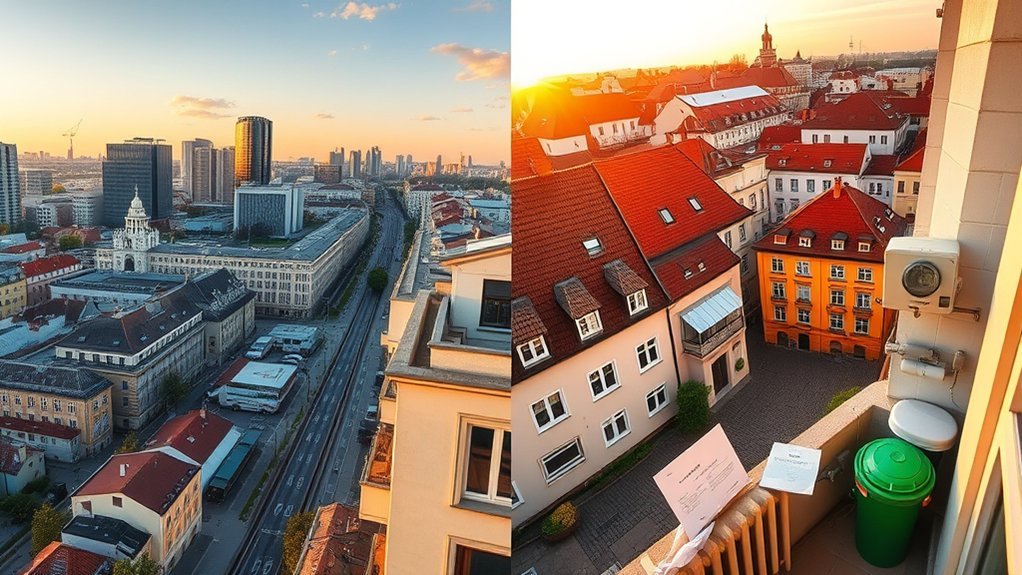
What Polish Rental Prices Include
A Polish rental listing often shows two numbers. Ask the landlord to list every payment separately before you sign.
| Charge | What It Covers | Typical Size |
|---|---|---|
| Rent to the owner (odstępne) | the landlord’s payment for use of the apartment | the main listed price |
| Building charge (czynsz administracyjny) | building upkeep, waste, often heating and water advances | often several hundred złoty a month |
| Metered electricity and gas | billed by the supplier, based on use | varies by season and appliances |
| Internet and TV | a separate contract unless stated | about PLN 65–70 a month |
The building charge is the item newcomers miss most often. In an older block with district heating, it can be a large part of the total, and it rises in winter when heating advances are adjusted.
Deposits and Lease Types
According to the EURES guide to living in Poland, a deposit (kaucja) is usually one month’s rent. The law caps it at twelve times the monthly rent for a standard lease and six times for a najem okazjonalny, the occasional-lease format many landlords prefer. The deposit must be returned within one month of moving out, minus valid claims.
Occasional leases often require a notarized statement in which the tenant agrees to leave voluntarily if the lease ends, plus the address of a place you could move to. Notary fees add a few hundred złoty. Agencies may also charge a commission, so ask about it before viewing.
Utilities, Internet, and Phone
Basic utilities for an 85 m² apartment, including heating, electricity, water, and garbage, average about PLN 1,160 (~$300) a month nationwide and about PLN 1,370 (~$350) in Warsaw, according to crowd-sourced averages from October 2026. A 40–50 m² one-bedroom usually needs PLN 650–900 (~$165–$230) for the building charge and utilities combined, more in winter.
Electricity got more expensive to plan for in 2026. The price freeze that capped household rates ended in 2025, and the regulator-approved tariffs for 2026 set an average energy price of PLN 495.16 per MWh, about PLN 0.50 per kWh. Distribution fees, other charges, and VAT come on top, so the full price per kWh is higher than the energy price alone.
Other monthly connections:
- Home internet (60+ Mbps): about PLN 67 (~$17).
- Mobile plan with 10 GB+ of data: about PLN 37 (~$9.50). Polish mobile prices are among the lowest in the EU.
- Fitness club: about PLN 150 (~$38) a month.
Food: Groceries and Dining Out

A single person who cooks most meals spends about PLN 900–1,200 (~$230–$310) a month on groceries. Couples should plan on PLN 1,800–2,200. Discount chains such as Biedronka and Lidl keep basics cheap, while imported foods and specialty products push bills up.
Average prices in October 2026 (crowd-sourced):
| Item | Typical Cost (PLN) | Approx. USD |
|---|---|---|
| Milk (1 liter) | 3.95 | $1.02 |
| Bread (1 lb loaf) | 4.67 | $1.20 |
| Rice (1 lb) | 2.58 | $0.66 |
| Eggs (12) | 13.64 | $3.51 |
| Chicken fillets (1 lb) | 11.59 | $2.98 |
| Beef (1 lb) | 22.08 | $5.68 |
| Local cheese (1 lb) | 15.44 | $3.97 |
| Mid-range bottle of wine | 26.00 | $6.69 |
Eating out is affordable by Western European standards. Milk bars (bar mleczny) and lunch menus (lunch dnia) offer set meals for well under the restaurant average. Other common prices:
- Meal at an inexpensive restaurant: about PLN 40 (~$10.30), PLN 45 in Warsaw
- Three-course dinner for two at a mid-range restaurant: about PLN 190 (~$49)
- Fast-food combo meal: about PLN 35 (~$9)
- Cappuccino: about PLN 14 (~$3.60)
- Domestic draft beer (pint): about PLN 15 (~$3.90)
Transportation and Getting Around
Public transport is cheap and reliable in Polish cities, but each city sets its own fares. In Warsaw, the city transport authority lists these personal long-term tickets:
| Warsaw Ticket | Regular (PLN) | Reduced (PLN) | Approx. USD (Regular) |
|---|---|---|---|
| 30-day, zone 1 | 110 | 55 | $28 |
| 30-day, zones 1+2 | 180 | 90 | $46 |
| 90-day, zone 1 | 280 | 140 | $72 |
| Single 75-minute ticket | 4.40 | 2.20 | $1.13 |
Reduced fares cover students under 26, among others, and children under seven ride free. Monthly passes in Kraków, Wrocław, Poznań, and Gdańsk are in a similar range.
Other transport costs:
- Fuel: the national average on October 7, 2026, was PLN 6.79 per liter for 95 gasoline (~$6.60 per gallon), PLN 7.78 for diesel, and PLN 3.25 for LPG, according to e-petrol. Prices are far above a year ago.
- Taxis and ride-hailing: the meter starts around PLN 9 (~$2.30). Ride-hailing apps are common in every large city.
- Intercity trains: express trains link Warsaw with Kraków, Gdańsk, Katowice, and Poznań in about three hours. Booking early lowers the fare.
- Cars: rarely needed in a big city. Parking zones, insurance, and fuel make a monthly pass the cheaper choice for most people.
Healthcare and Insurance Costs
Poland’s public healthcare runs through the National Health Fund (NFZ). Access depends on being insured. The NFZ insurance guide explains the main routes:
- Employees: enrolled automatically. The health contribution is 9% of salary after social contributions and is deducted from your pay.
- Voluntary insurance: for residents without another basis, such as some freelancers or early retirees. The monthly contribution is 9% of declared income, which cannot be lower than the previous quarter’s average enterprise-sector wage. With that wage above PLN 9,300 in 2026, expect roughly PLN 840–860 (~$215–$220) a month. If you were uninsured for more than three months, a one-time enrollment fee of 20% or more of the contribution base applies.
- Students: the Study in Poland guide lists PLN 40–60 a month for student health insurance.
Private options: many employers add a private medical package as a perk. Individual subscriptions to private clinic networks commonly cost about PLN 100–250 (~$25–$65) a month, depending on age and coverage. They speed up specialist visits but often exclude hospital care, so they work best on top of NFZ coverage.
Visa and residence permit applicants must show health insurance that covers them in Poland. For a long-stay visa, that means at least €30,000 of coverage.
Schools and Childcare
- Public schools: free for residents, with classes in Polish. Some public schools in large cities run bilingual or international programs.
- Private preschool: about PLN 1,630 (~$420) a month for a full day, based on crowd-sourced averages. Public preschools charge far less but can have waiting lists.
- International primary school: about PLN 34,900 (~$8,970) a year per child on average. Top schools in Warsaw charge considerably more, plus enrollment fees.
For a family with two children in international school, tuition alone adds about PLN 5,800 (~$1,490) a month.
Taxes: VAT and Income Tax
- VAT: the standard rate is 23%, with reduced rates of 8% and 5% for many foods, books, and some services. VAT is included in shelf prices.
- Income tax: under the general tax scale, income up to PLN 120,000 a year is taxed at 12% and the portion above at 32%. A PLN 3,600 tax-reducing amount means the first PLN 30,000 (~$7,715) is effectively tax-free.
- Payroll contributions: employees pay about 13.7% of gross pay in social insurance plus the 9% health contribution.
- Tax residency: you are a Polish tax resident if you spend more than 183 days a year in Poland or your center of personal or economic interests is there. Residents are taxed on worldwide income.
Self-employed people can choose a flat 19% rate or a lump-sum tax on revenue instead of the scale. Get advice from a Polish accountant before choosing, since the health contribution rules differ for each option.
Visas and Residence Permits
US, Canadian, UK, and Australian citizens can visit Poland and the rest of the Schengen Area without a visa for up to 90 days in any 180-day period. EU citizens can live and work in Poland freely and only need to register a stay longer than three months. Everyone else needs a long-stay national (D) visa or a residence permit. According to the Ministry of the Interior, D-visa applicants must show health insurance of at least €30,000 and enough money for the stay, calculated at PLN 75 (~$19) per day.
Residence permits are issued by the regional governor (voivode). The stamp duties listed by voivode offices in 2026 are:
| Permit | Stamp Duty (PLN) | Approx. USD |
|---|---|---|
| Temporary residence and work | 440 | $113 |
| Temporary residence, highly qualified work (EU Blue Card) | 440 | $113 |
| Temporary residence, other purposes (family, study, etc.) | 340 | $87 |
| Permanent residence | 640 | $165 |
| Residence card issuance | 100 | $26 |
For applications filed from March 5, 2026, the stamp duty is no longer refunded if the permit is refused or the case is closed. Waiting times for a decision can run many months in Warsaw and Kraków, so apply as early as the rules allow.
One-Time Setup Costs
Your first month costs much more than a normal one. Budget for:
- Deposit: usually one month’s rent, so about PLN 2,400–3,900 for a one-bedroom.
- First month’s rent and building charge, paid in advance.
- Agency commission and notary fee if you rent through an agent or sign an occasional lease.
- Residence permit and card: PLN 440 (~$113) plus PLN 100 (~$26) for a work-based permit.
- Temporary housing while you search, often two to four weeks.
- Household basics such as bedding, kitchenware, and cleaning supplies, even in a furnished apartment.
- Health coverage for the gap before NFZ or an employer plan starts.
A safe rule is to arrive with savings equal to two to three months of your expected budget.
Sample Monthly Budgets
These budgets combine the averages above. The regional column uses one-bedroom rents in Łódź, Katowice, and Lublin; the Warsaw columns use the Otodom average and crowd-sourced central rents. Health is shown as a range because employees are covered through payroll.
| Expense (PLN) | Single, Regional City | Single, Warsaw | Couple, Warsaw | Family of Four, Warsaw |
|---|---|---|---|---|
| Rent | 2,350–2,650 | 3,750–4,650 | 3,900–4,650 | 6,050 (2-bed) |
| Building charge + utilities | 650–800 | 750–900 | 850–1,000 | 1,350–1,450 |
| Internet + mobile | 105 | 100 | 140 | 210 |
| Groceries | 900–1,100 | 1,000–1,200 | 1,800–2,200 | 3,200–3,800 |
| Eating out + leisure | 400–700 | 600–1,000 | 1,000–1,500 | 1,200–1,800 |
| Transport | 100–120 | 110 | 220 | 330 |
| Private health top-up | 0–150 | 0–150 | 0–300 | 0–600 |
| Clothing, household, other | 300–400 | 350–500 | 600–800 | 1,000–1,400 |
| Total (PLN) | 4,800–6,000 | 6,650–8,600 | 8,500–10,800 | 13,350–15,650 |
| Total (USD) | $1,235–$1,545 | $1,710–$2,210 | $2,185–$2,780 | $3,435–$4,025 |
Students: the official budget of PLN 1,500–2,000 (~$385–$515) assumes a dormitory place at PLN 400–600, groceries at PLN 700–900, and reduced-fare transit. A private room in a shared Warsaw or Kraków flat can double the housing line.
Families: crowd-sourced estimates put a Warsaw family of four at about PLN 11,700 a month before rent, which would bring the total near PLN 17,800 (~$4,580) with a two-bedroom. That figure assumes more spending on services and private care than the table above. International school for two children adds about PLN 5,800 on top.
Salary check: the regional single budget fits within the average take-home pay of about PLN 6,600. A Warsaw single budget needs an above-average salary, which is common in the capital.
Money-Saving Tips

- Pick a second-tier city. A one-bedroom in Łódź or Katowice costs about PLN 1,500 a month less than one in Warsaw.
- Live near a tram or metro line, not in the center. Outer districts with good transit often save hundreds of złoty a month.
- Ask for winter bills. The building charge and heating can push the total well above the summer figure.
- Use long-term passes. A 90-day Warsaw ticket costs PLN 280, cheaper than three monthly ones.
- Eat at milk bars and lunch menus. A set lunch costs much less than an evening meal out.
- Shop at discount chains and markets and buy Polish brands over imports.
- Pay and earn in złoty when you can. Card and transfer fees on currency conversion add up quickly.
How Poland Compares With Nearby Countries
Poland is cheaper than Western Europe and close to its Central European neighbors. Our guide to the cost of living in Germany puts one adult at about €1,500–€2,600 a month, well above a Polish regional city. Prague is pricier than Warsaw for many renters: see the cost of living in the Czech Republic. Budapest is slightly cheaper on rent, as our guide to the cost of living in Hungary shows. Further north, compare the cost of living in Lithuania, which uses the euro, and to the south, the cost of living in Slovakia.
Frequently Asked Questions
How much money do you need to live in Poland per month?
A single person needs about PLN 4,800–6,000 (~$1,235–$1,545) a month in a regional city such as Łódź, Katowice, or Lublin, and about PLN 6,650–8,600 (~$1,710–$2,210) in Warsaw. A couple renting a one-bedroom in Warsaw should budget about PLN 8,500–10,800 (~$2,185–$2,780).
Is $1,500 a month enough to live in Poland?
Yes, outside Warsaw. At PLN 3.89 per dollar, $1,500 is about PLN 5,830. That covers a one-bedroom apartment and normal spending for one person in Łódź, Katowice, Lublin, or Poznań. In Warsaw it works only with a studio or a shared flat.
How much is rent in Poland in 2026?
Average asking rents for a 40–59 m² apartment (usually one bedroom plus a living room) ranged from about PLN 2,360 (~$605) in Łódź to PLN 3,890 (~$1,000) in Warsaw in mid-2026, according to Otodom data published by Bankier.pl. Building charges and utilities come on top.
Which Polish city is cheapest to live in?
Among the large cities, Łódź and Katowice have the lowest rents, with studios averaging about PLN 1,820–1,850 (~$470–$475) a month. Warsaw is the most expensive, followed by Gdańsk and Kraków.
What is the minimum wage in Poland in 2026?
The 2026 minimum wage is PLN 4,806 gross a month (~$1,235), or about PLN 3,600 (~$925) after tax and contributions for a standard employment contract. The government has proposed PLN 4,950 for 2027.
Do foreigners get free healthcare in Poland?
Only if they are insured with the NFZ. Employees are enrolled through payroll. Others can buy voluntary NFZ insurance, which costs 9% of a declared income no lower than the average enterprise-sector wage, or roughly PLN 840–860 a month in 2026.
How much does a student need to live in Poland?
The official Study in Poland guide puts a student budget at PLN 1,500–2,000 (~$385–$515) a month, assuming a dormitory room at PLN 400–600. Students renting a private room in Warsaw or Kraków should plan on more. Tuition is separate.
Conclusion
Poland remains good value in 2026, but the gap between cities is wide. A single person can live comfortably on about PLN 4,800–6,000 (~$1,235–$1,545) a month in Łódź, Katowice, or Lublin, while Warsaw needs PLN 6,650–8,600 (~$1,710–$2,210). Inflation picked up to 4.0% in September as fuel prices jumped, and electricity bills no longer have a price cap, so build in a buffer. Choose your city first, check what each rental price includes, and confirm the building charge and winter bills before you sign.
Sources
- National Bank of Poland – USD/PLN reference rate, October 2, 2026
- GUS – flash CPI estimate, September 2026
- Ministry of Family, Labour and Social Policy – minimum wage 2026
- XYZ.pl – draft 2027 minimum wage
- Infor – GUS average wage, Q2 2026
- Infor – GUS enterprise-sector wage, July 2026
- Bankier.pl – asking rents by city, July 2026 report
- EURES – living and working conditions in Poland
- Dziennik Gazeta Prawna – 2026 electricity tariffs
- Warszawa 19115 – Warsaw long-term transit tickets
- e-petrol – average fuel prices in Poland
- NFZ – health insurance rules
- Study in Poland – cost of living for students
- Ministry of Finance – PIT tax scale
- Ministry of the Interior – entry and residence conditions
- Warmian-Masurian Voivode Office – residence permit fees
- Numbeo – Poland and Warsaw (crowd-sourced averages, October 2026)