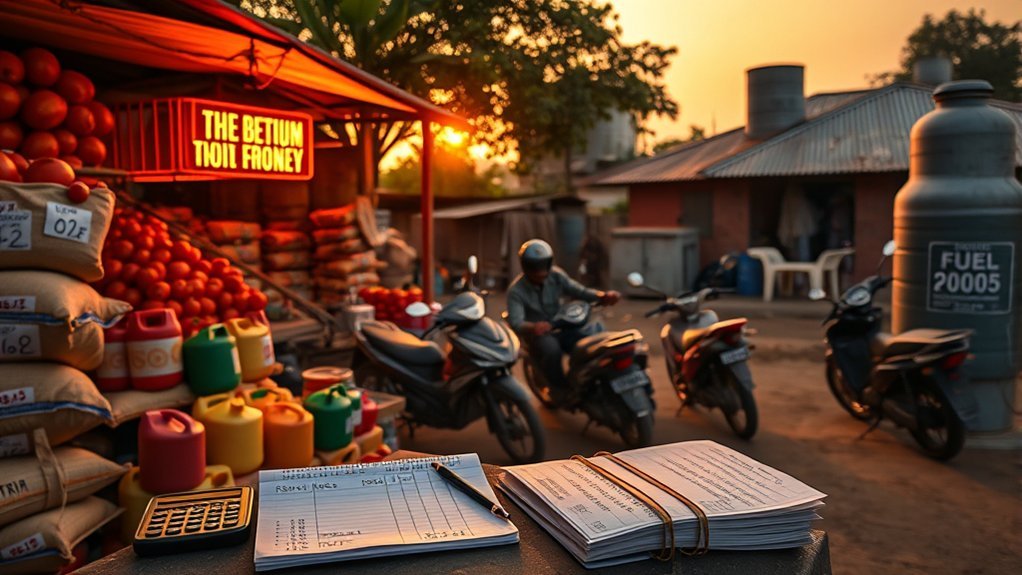
The cost of living in South Sudan in 2026 is about SSP 2.5–3.3 million (~$440–$570) a month for a single person living at local standards in Juba, about SSP 4.3–5.1 million (~$750–$880) for a couple, and about SSP 6.5–7.6 million (~$1,130–$1,320) for a family of four before school fees. These figures use the Bank of South Sudan’s indicative rate of about SSP 5,750 per US dollar in early October 2026. Living at the standard most foreign staff expect is a different budget. Secure housing, backup power, a car and driver, and medical evacuation cover can push monthly costs to several thousand dollars. Prices also move fast. The pound has lost about a fifth of its value against the dollar over the past year, and food prices jump in the lean season. Below you’ll find market prices, rent, utilities, transport, taxes, sample budgets, and safety costs.
Quick Answer
- Single person (local standard): SSP 2.5–3.3 million (~$440–$570) a month.
- Couple: SSP 4.3–5.1 million (~$750–$880) a month.
- Family of four: SSP 6.5–7.6 million (~$1,130–$1,320) a month, before school fees.
- Expat standard: housing alone is often quoted in thousands of dollars a month; budgets are usually set by the employer.
- Exchange rate: about SSP 5,750 per dollar officially (early October 2026); the parallel rate was about 40% higher in June.
- Staples (June 2026): rice, wheat flour, and sugar about SSP 10,000 (~$1.74) per kg; cooking oil SSP 14,334 (~$2.49) per liter.
- Fuel: SSP 14,000–25,000 (~$2.43–$4.35) per liter, depending on location.
- Electricity in Juba: about $0.27–$0.29 per kWh for homes.
- Income tax: 20% on almost all formal salaries; sales tax 18%.
Exchange Rate, Inflation, and Incomes in 2026
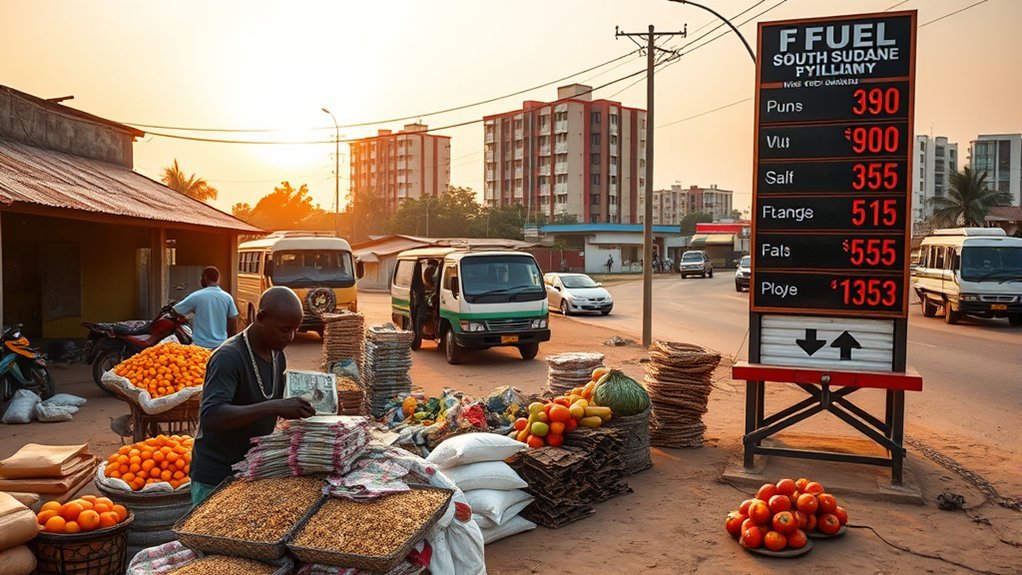
Three forces shape what South Sudan costs this year.
The exchange rate. The Bank of South Sudan’s indicative rates in early October 2026 were about SSP 5,670 buying and SSP 5,840 selling per US dollar. This article uses the midpoint of SSP 5,750. A year earlier the official rate was around SSP 4,600, so the pound has lost roughly a fifth to a quarter of its value. Most imported goods, rents for better housing, and many service fees are priced in dollars, so when the pound falls, local prices follow.
The parallel market. Cash dollars trade above the official rate. A June 2026 market survey found an official rate of SSP 4,703 and a parallel rate of SSP 6,575, a gap of about 40%. If you change dollars on the street, your money goes further, but the gap also explains why traders raise prices quickly.
Inflation. The World Bank’s South Sudan overview reports that annual average inflation, proxied by food inflation, reached 234% in FY25 and was expected to ease from that high base. Extreme poverty rose to 87% in 2025. The same source says civil servants were owed 8 to 13 months of salary as of January 2026.
Incomes. There is no reliable current figure for an average wage or a national minimum wage. Modeled estimates put average take-home pay at about $126 (~SSP 724,500) a month, while one small crowd-sourced sample of Juba salaries shows about $1,770, which reflects aid and private-sector jobs paid in dollars. Many government workers earn far less, and often late.
At local prices, the survival food basket for one household cost about SSP 585,000 (~$102) a month in June 2026. That is close to a full month of the modeled average take-home pay.
Market Prices and the Minimum Expenditure Basket
The most reliable price data for South Sudan comes from humanitarian market monitoring, not from cost-of-living websites. The REACH Joint Market Monitoring Initiative for June 2026 surveyed traders in 47 locations between June 1 and 10. It tracks the cost of a Multi-Sectoral Survival Minimum Expenditure Basket (MSSMEB), the bare minimum a household needs each month for food, water, hygiene, shelter, and basic items.
| Basket (national median, June 2026) | Monthly Cost (SSP) | Approx. USD | Change vs May |
|---|---|---|---|
| Survival basket (MSSMEB) | 737,608 | $128 | +16% |
| Food basket | 585,289 | $102 | +22% |
| Shelter basket | 720,000 | $125 | +34% |
| Non-food items basket | 396,000 | $69 | +3% |
| Water and hygiene basket | 76,249 | $13 | −5% |
USD values use SSP 5,750 per dollar. REACH itself converted at the June official rate of SSP 4,703, which gave higher dollar figures, such as $157 for the survival basket.
Juba was among the most expensive markets in June, alongside Ganyiel, Wulu Town, Bor, and Abyei. Prices rose sharply in places cut off by conflict or flooding. In Ganyiel the survival basket jumped 60% in a single month. Most traders (89%) expected food prices to keep rising over the next three months, mainly because of taxes, the falling pound, and fuel costs.
Housing and Rent in Juba
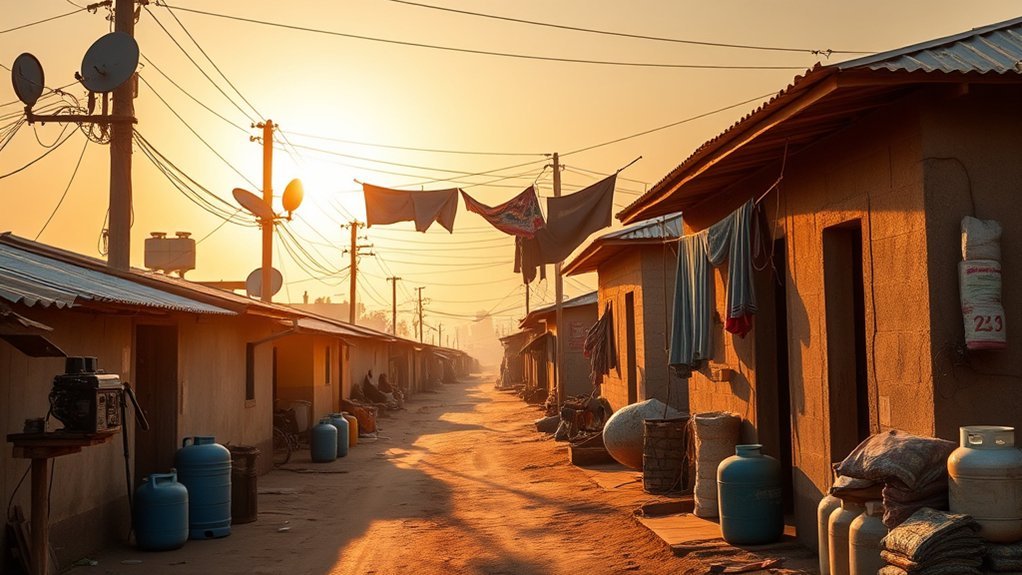
Rent is the hardest cost to pin down. There is no official rent index, few online listings, and very small crowd-sourced samples. Two very different markets exist side by side.
Local-standard housing. Most residents rent simple brick or iron-sheet homes, often paying in pounds and several months in advance. Modeled estimates, built from crowd-sourced prices and statistical modeling, look like this:
| Housing Type | Monthly Rent (SSP) | Approx. USD |
|---|---|---|
| 1-bedroom, city center | 1,161,500 | $202 |
| 1-bedroom, cheaper area | 782,000 | $136 |
| 3-bedroom, city center | 2,576,000 | $448 |
| 3-bedroom, cheaper area | 1,644,500 | $286 |
These modeled figures are national, population-weighted averages. Juba, the capital and home to about 500,000 people, sits at the top of the range.
Expat-standard housing. Foreign staff usually live in walled compounds, serviced apartments, or hotel-apartments with guards, generators, water tanks, and internet. These are priced in dollars and cost far more than local homes. Public data is thin. One spring 2026 crowd-sourced entry for Juba put a central one-bedroom at about $3,500 (~SSP 20.1 million) a month, but it came from only a couple of contributors. Treat it as a sign of the gap, not a quote.
Before you commit to a place, ask:
- Is rent in dollars or pounds, and how many months are due up front?
- Does the rent include security guards, water delivery, generator fuel, and garbage collection?
- Who pays the 20% withholding tax that tenants must deduct from rent under South Sudan’s tax rules?
- Is the building connected to the Juba grid, and how many hours of backup power does it have?
Utilities: Electricity, Water, and Internet
Electricity in Juba comes from JEDCO, the city’s private distribution company, and is among the most expensive in East Africa. After a presidential order, new tariffs announced in September 2025 cut household rates to about $0.273 per unit for homes using up to 100 kWh and $0.285 above that. The rates took effect in November 2025. The order also scrapped the $3 monthly service charge and cut the connection fee from $320 to $128.
| Electricity Use | Approx. Monthly Cost (USD) | Approx. SSP |
|---|---|---|
| 150 kWh (fans, fridge, lights) | about $42 | about 239,000 |
| 300 kWh (with some air conditioning) | about $84 | about 483,000 |
| Connection fee (one-time) | $128 | 736,000 |
Outside Juba, most households have no grid power at all. They rely on solar lamps, small generators, charcoal, and firewood. In June 2026 a solar lamp cost about SSP 37,500 (~$6.50), a bundle of firewood about SSP 11,500 (~$2), and a kilogram of charcoal about SSP 1,379 (~$0.24).
Generators. Power cuts are common, so many compounds run generators. As an example, a small generator burning one liter of diesel an hour for five hours a day uses about 150 liters a month. At June 2026 fuel prices, that is roughly SSP 2.1–3.75 million (~$365–$650) a month, so backup power can cost more than local rent.
Water. Much of Juba relies on water trucks and storage tanks rather than piped supply. Ask your landlord how often tanks are refilled and who pays.
Internet and mobile. MTN and Zain are the main mobile networks. Data is expensive by regional standards. In July 2025 MTN’s Home Starter Pack cost SSP 350,000 (about $61 at today’s rate) for a router and 20 GB of data. Prices have likely risen since then as the pound weakened, so check current bundles in store. Modeled estimates put an unlimited home plan at about $25 (~SSP 143,750) a month, but true unlimited, fast broadband is rare outside a few Juba compounds and offices.
Food: Groceries and Dining Out
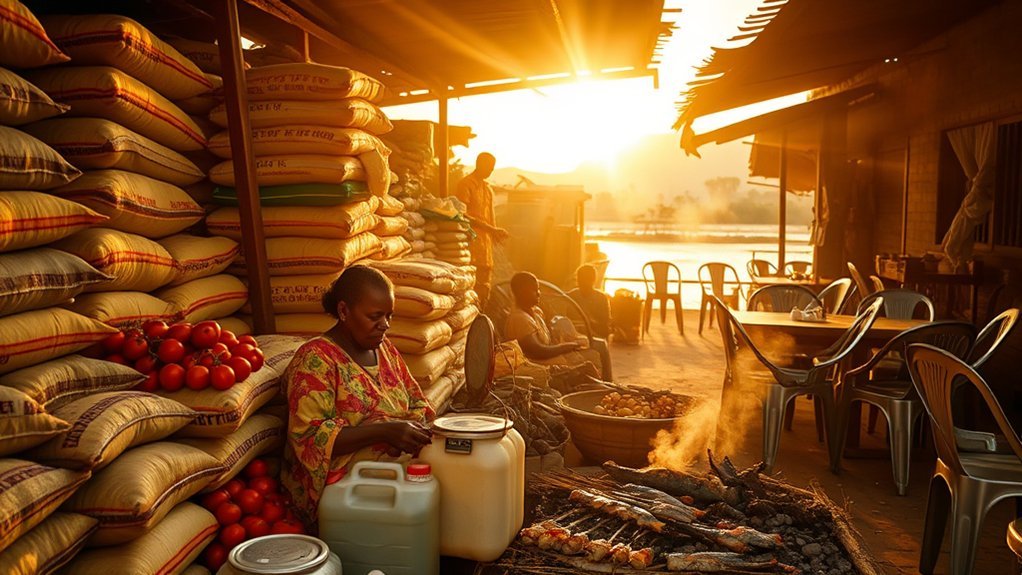
Food takes the largest share of most household budgets. The World Food Programme reports that 7.8 million people, more than half the population, face high levels of acute food insecurity. Prices rise in the lean season from about April to August, before the harvest.
Median market prices in June 2026:
| Item | Price (SSP) | Approx. USD | Change vs June 2025 |
|---|---|---|---|
| Sorghum grain (1 kg) | 3,938 | $0.68 | −2% |
| Maize grain (1 kg) | 2,916 | $0.51 | −28% |
| Wheat flour (1 kg) | 10,000 | $1.74 | +18% |
| Rice (1 kg) | 10,000 | $1.74 | +24% |
| Beans (1 kg) | 13,415 | $2.33 | +34% |
| Groundnuts (1 kg) | 4,917 | $0.86 | +2% |
| Sugar (1 kg) | 10,000 | $1.74 | +18% |
| Salt (1 kg) | 5,464 | $0.95 | +23% |
| Cooking oil (1 liter) | 14,334 | $2.49 | +13% |
| Soap (200 g) | 2,667 | $0.46 | +33% |
Imported and supermarket items cost more. Crowd-sourced averages for Juba-area supermarkets put a liter of milk at about $1.21 (~SSP 6,960), a dozen eggs at about $1.58 (~SSP 9,085), and a kilogram of chicken breast at about $4.42 (~SSP 25,400). Imported cheese, cereal, and wine cost well above prices in Nairobi or Kampala, because nearly everything is trucked in.
Eating out. Local restaurants serving beans, kisra (sorghum pancake), stews, and grilled meat are cheap. Places aimed at foreigners and hotel restaurants charge in dollars. Typical prices:
- Lunch at a local restaurant: about SSP 19,000 (~$3.33), based on modeled averages
- Meal at an inexpensive restaurant used by foreigners: about $20 (~SSP 115,000), from a small Juba sample
- Fast-food style combo: about SSP 27,000–55,000 (~$4.75–$9.50)
- Cappuccino: about SSP 11,000–20,000 (~$1.90–$3.50)
- Dinner for two at a mid-range local restaurant: about SSP 117,000 (~$20.40)
Transportation and Fuel
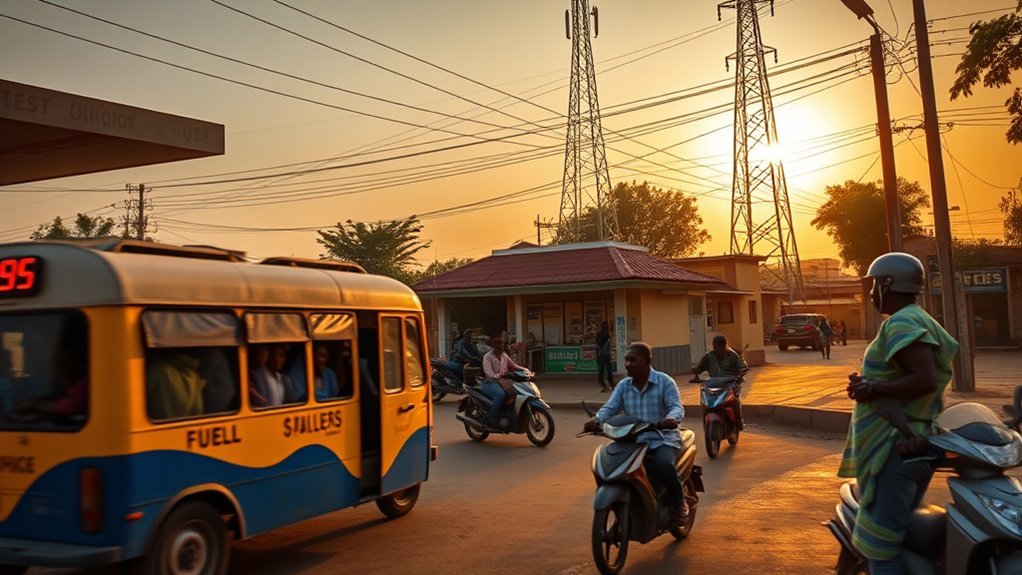
Juba has no formal public transit system. People get around by minibus, boda-boda motorcycle taxi, and private car. Fuel prices drive almost every transport cost.
| Transport Item | Typical Cost (SSP) | Approx. USD |
|---|---|---|
| Petrol or diesel (1 liter, June 2026) | 14,000–25,000 | $2.43–$4.35 |
| Minibus ride in Juba (modeled) | about 1,725 | $0.30 |
| Monthly minibus travel (modeled) | about 69,600 | $12.10 |
| Taxi, about 8 km (modeled) | about 37,500 | $6.52 |
Fuel figures come from the June 2026 REACH market survey and cover both station and parallel-market prices across the country. Juba is usually at the lower end of the range. Fuel shortages happen, and prices can jump overnight when supply trucks are delayed.
Most foreigners don’t use minibuses or boda-bodas. Employers often require armored or hard-top vehicles, a vetted driver, and movement rules. The US State Department’s travel advisory reports carjackings, ambushes, and robberies, including in Juba, and warns about unmarked landmines on and near roads. Travel between towns by road is risky, so many people fly. Domestic flights and UN Humanitarian Air Service seats add a large cost if your employer doesn’t cover them.
Healthcare and Insurance
Healthcare is one of the biggest hidden costs. The WHO’s 2026 health emergency appeal estimates that 6.3 million people will need health assistance this year, with recurring cholera, measles, and mpox outbreaks, staff shortages, and broken supply chains.
The US State Department describes medical services as extremely limited, with no ambulance service. Hospitals usually want payment up front, and medical evacuation is at your own expense. In practice this means:
- Clinic visits: modeled estimates put a private doctor’s visit at about $15 (~SSP 87,400). Better clinics used by foreigners charge more, often in dollars.
- International health insurance: you need a policy that explicitly covers South Sudan. Many standard plans exclude Level 4 countries.
- Medical evacuation cover: serious cases are usually flown to Nairobi or Kampala. Make sure your policy or employer pays for this.
- Vaccines and malaria prevention: proof of yellow fever vaccination is required to enter, and malaria tablets and repellent are a regular expense.
Schools and Childcare
Few foreign families live in South Sudan, and many international staff posts are unaccompanied, meaning families are not allowed. For those who do bring children:
- International primary school: modeled estimates put tuition at about $4,017 (~SSP 23.1 million) a year. Fees at the few English-language international schools in Juba vary, so ask the school directly.
- Preschool or daycare: about $114 (~SSP 655,500) a month, based on modeled averages.
- Public schools: fees are low, but classrooms are crowded and teachers are often unpaid for months.
Many expat families base their children in Nairobi or Kampala and commute, which adds flights and a second household.
Taxes: Sales Tax and Income Tax
South Sudan has no VAT. Instead it uses a sales tax and excise duties.
- Sales tax: generally 18% on goods produced or imported and on services such as telecom, banking, hotels, and restaurants. The Financial Act 2023/24 proposed raising some rates to 20%, but 18% remained in use.
- Excise duties: high on alcohol and tobacco. Under the 2023/24 Act, beer rose to 75%, wine to 100%, and spirits and cigarettes to 150%. That is why a beer or bottle of wine costs more than the low food prices suggest.
- Income tax on wages: monthly employment income up to SSP 20,000 is exempt. Income of SSP 20,001–40,000 is taxed at 5%, SSP 40,001–57,000 at 10%, SSP 57,001–90,000 at 15%, and above SSP 90,000 at 20%. The whole salary is taxed at its band’s rate, not on a graduated scale.
- Rent: tenants must withhold 20% tax on rent and pay it to the National Revenue Authority.
The Financial Act 2024/25 kept personal income tax bands unchanged. Because the bands are set in pounds and the pound has fallen so far, SSP 90,000 is now only about $16, so almost every formal salary falls in the 20% band. Check the current Financial Act with an accountant before you sign a contract, since rates are revised every fiscal year.
Visas and Entry Costs
Most foreigners need a visa before arrival. Applications go through the official South Sudan e-visa portal, where fees are paid online by card and approved visas can be downloaded within about 72 hours. Fees depend on visa type and nationality, and the portal does not publish a fee table, so confirm the amount at the payment step.
Other entry rules:
- Proof of yellow fever vaccination is required.
- Your passport must be valid for at least six months with two blank pages.
- Visitors staying more than three days must register with the Directorate of Immigration in Juba.
- Working legally requires a work permit, usually arranged by the employer.
Sample Monthly Budgets
These budgets are for living at local standards in Juba. They combine modeled rent, the June 2026 market prices above, and current electricity tariffs. They exclude school fees, security, generators, and international insurance.
| Expense (USD) | Single | Couple | Family of Four |
|---|---|---|---|
| Rent | $136–$202 | $202 | $286–$448 |
| Electricity, water, gas | $39–$45 | $45–$60 | $60–$85 |
| Food and groceries | $170–$211 | $340–$420 | $549 |
| Transport | $31 | $60 | $88 |
| Phone and data | $20–$30 | $40–$60 | $50 |
| Other (hygiene, clothes, extras) | $40–$50 | $60–$80 | $100 |
| Total (USD) | $440–$570 | $750–$880 | $1,130–$1,320 |
| Total (SSP) | 2.5–3.3 million | 4.3–5.1 million | 6.5–7.6 million |
Expat-standard budgets work differently. Housing in a secure compound, generator fuel, a car and driver, and medical evacuation cover are each often priced in hundreds or thousands of dollars a month. These costs depend on your employer’s security rules and the property, so get written quotes. Most international employers cover housing and security directly or pay a hardship allowance.
First-Month Setup Costs
Budget for these before you arrive:
- Visa and work permit: paid online or through your employer.
- Rent in advance: landlords often ask for three to six months up front, plus a deposit.
- Electricity connection: $128 (~SSP 736,000) for a new JEDCO connection, if the home isn’t already connected.
- Basic household items: in June 2026 a mosquito net cost about SSP 33,000 (~$5.74), a jerrycan SSP 20,500 (~$3.57), a blanket SSP 45,000 (~$7.83), and a cooking pot SSP 50,750 (~$8.83).
- SIM card and data: registration requires your passport.
- Cash reserve: card payments and ATMs are unreliable, so many people keep clean, recent US dollar notes.
Salaries and Purchasing Power
The gap between local and international pay is huge. A household living on the modeled average take-home pay of about $126 a month cannot afford the local-standard budgets above, which is why many families rely on several earners, farming, or remittances. Government salaries are fixed in pounds and often months late, so their real value falls every time the pound weakens.
If you are negotiating a job in South Sudan:
- Ask for pay in US dollars, or for a currency adjustment clause.
- Confirm in writing who pays for housing, security, generators, flights, and medical evacuation.
- Ask about paid rest-and-recuperation (R&R) breaks outside the country.
- Check how income tax will be handled, since the 20% band applies to almost all salaries.
Safety and Quality of Life
Safety shapes every cost decision in South Sudan. The US State Department has rated the country Level 4: Do Not Travel since May 17, 2026, citing armed conflict, violent crime, kidnapping, landmines, and health risks. The US Embassy can offer only limited emergency help, and its own staff follow curfews and use armored vehicles.
What this means for your budget:
- Housing with guards, walls, and safe rooms costs more than ordinary homes.
- Night movement is limited, so you’ll spend more time and money at home or in your compound.
- You need a funded plan to leave quickly, including flights and evacuation cover.
- Conflict and flooding can cut supply routes, which pushes prices up in days.
Money-Saving Tips
- Buy staples at local markets. Konyo Konyo and Custom markets in Juba are far cheaper than supermarkets for grains, beans, and vegetables.
- Buy local food, not imports. Sorghum, maize, groundnuts, and local vegetables cost a fraction of imported packaged goods.
- Stock up before the lean season. Staple prices tend to climb from April to August and fall after the harvest.
- Negotiate rent in pounds when you can. Dollar rents rise automatically when the pound falls.
- Share generator and water costs with neighbors in a compound.
- Buy data bundles, not pay-as-you-go. Bundles are much cheaper per gigabyte.
- Track the exchange rate. Change money through licensed bureaus and banks, and keep a buffer for sudden price jumps.
How South Sudan Compares With Nearby Countries
Local prices in South Sudan look low, but imported goods, fuel, data, and secure housing are expensive, and the currency is far less stable than its neighbors’. Many organizations base staff families in Kenya or Uganda and rotate them into Juba. To compare, see our guides to the cost of living in Kenya, where Nairobi has a deep rental market and reliable services, and the cost of living in Uganda, which shares a long border and supplies much of Juba’s food. For other neighbors, read about the cost of living in Ethiopia, the cost of living in Sudan, where war has also driven prices up, and the cost of living in the Democratic Republic of the Congo.
Frequently Asked Questions
How much does it cost to live in South Sudan per month in 2026?
At local living standards, a single person in Juba needs about SSP 2.5–3.3 million (~$440–$570) a month, a couple about SSP 4.3–5.1 million (~$750–$880), and a family of four about SSP 6.5–7.6 million (~$1,130–$1,320) before school fees. These figures use the Bank of South Sudan rate of about SSP 5,750 per dollar in early October 2026. Expat-standard housing, security, and medical evacuation cover can push costs several times higher.
What is the exchange rate in South Sudan in 2026?
The Bank of South Sudan’s indicative rate in early October 2026 was about SSP 5,670 buying and SSP 5,840 selling per US dollar, a midpoint near SSP 5,750. The parallel market rate is higher. In June 2026 it was about SSP 6,575 per dollar, roughly 40% above the official rate.
How much is rent in Juba?
There is no reliable public rent index for Juba. Modeled estimates put a one-bedroom apartment at about SSP 0.8–1.2 million (~$136–$202) a month at local standards. Secure, furnished housing of the kind foreign staff use is priced in dollars and costs far more. One spring 2026 crowd-sourced entry put a central one-bedroom at about $3,500 a month.
How much does food cost in South Sudan?
In June 2026, median market prices were about SSP 10,000 (~$1.74) for a kilogram of rice, wheat flour, or sugar, SSP 13,415 (~$2.33) for a kilogram of beans, and SSP 14,334 (~$2.49) for a liter of cooking oil. The national survival food basket for a household cost SSP 585,289 (~$102) a month, up 22% from May.
How much is fuel in South Sudan?
In June 2026, petrol and diesel sold for about SSP 14,000–25,000 (~$2.43–$4.35) per liter, depending on location and whether it was bought at a station or on the parallel market. Prices outside Juba are often higher because of transport costs and poor roads.
What is the income tax rate in South Sudan?
Employment income is taxed monthly in bands set in 2023: income up to SSP 20,000 is exempt, and income above SSP 90,000 a month is taxed at 20%. The whole salary is taxed at the rate for its band, not on a graduated scale. Because SSP 90,000 is only about $16, almost all formal salaries fall in the 20% band. Sales tax is generally 18%.
Is South Sudan safe for foreigners to live in?
South Sudan is a high-risk country. The US State Department has rated it Level 4: Do Not Travel since its May 17, 2026 advisory, citing armed conflict, violent crime, kidnapping, landmines, and very limited medical care. Most foreigners who live there work for aid groups, the UN, embassies, or companies that provide secure housing and evacuation plans.
Conclusion
South Sudan is cheap only on paper. A single person living at local standards in Juba needs about SSP 2.5–3.3 million (~$440–$570) a month, but most incomes are far lower, and prices rise with every drop in the pound and every lean season. For foreigners, the real costs are secure housing, backup power, transport, healthcare, and evacuation cover, which usually come to several thousand dollars a month and are best negotiated with your employer. Check the official and parallel exchange rates, get written housing quotes, and keep a cash buffer before you commit.
Sources
- Bank of South Sudan – indicative exchange rates, October 2026
- REACH – Joint Market Monitoring Initiative, June 2026
- World Bank – South Sudan country overview
- World Food Programme – South Sudan
- World Health Organization – South Sudan Health Emergency Appeal 2026
- US Department of State – South Sudan travel advisory
- Eye Radio – JEDCO electricity tariff cuts
- Radio Yei – MTN home internet packs, July 2025
- EY – South Sudan Financial Act 2023/2024
- KPMG – South Sudan Financial Act 2024/2025
- South Sudan e-visa portal
- Crowd-sourced and modeled price averages for South Sudan and Juba (Livingcost, Numbeo), accessed October 2026