
The cost of living in Hungary in 2026 runs about HUF 350,000–620,000 (~$1,070–$1,900) a month for a single person in a regional city such as Debrecen, Szeged, or Pécs, and about HUF 445,000–745,000 (~$1,360–$2,280) for a single person renting alone in Budapest. A couple in Budapest should plan on roughly HUF 655,000–1,035,000 (~$2,000–$3,165). These figures use the Magyar Nemzeti Bank’s official rate of HUF 326.94 per US dollar (HUF 367.87 per euro) on October 2, 2026. Rent is the biggest swing factor: the median advertised apartment in Budapest asks about HUF 260,000 (~$795), while Miskolc sits near HUF 130,000 (~$400). Inflation has cooled to 1.3%, and household energy is the cheapest in the EU, but restaurant meals and services keep getting pricier. Below you’ll find city-by-city rents, utility costs, salaries, taxes, visa rules, and sample budgets.
Quick Answer
- Single person, Budapest: HUF 445,000–745,000 (~$1,360–$2,280) a month renting alone; about HUF 90,000 (~$275) less if you rent a room instead of a studio.
- Single person, regional city: HUF 350,000–620,000 (~$1,070–$1,900).
- Couple, Budapest: HUF 655,000–1,035,000 (~$2,000–$3,165).
- Family of four, Budapest: about HUF 995,000–1,765,000 (~$3,045–$5,400) before international school fees.
- Rent: Budapest median HUF 260,000 (~$795); studios up to 40 m² about HUF 200,000 (~$610); a room about HUF 110,000 (~$335).
- Budapest monthly transit pass: HUF 8,950 (~$27).
- Minimum wage 2026: HUF 322,800 gross (~$987), about HUF 214,662 net (~$657).
Exchange Rate, Inflation, and Wages in 2026
Three numbers shape what Hungary costs you this year.
The exchange rate. The Magyar Nemzeti Bank’s official daily rates put the forint at HUF 326.94 per dollar and HUF 367.87 per euro on October 2, 2026. The forint spent much of the spring near HUF 397 per euro and strengthened to the HUF 360–365 range by August. If you earn in euros, that shift cut your purchasing power by roughly 7% compared with March.
Inflation. The Hungarian Central Statistical Office (KSH) reported that consumer prices rose just 1.3% in the year to August 2026, the lowest reading in close to a decade. The average hides big differences. Food prices fell 1.4% and household energy fell 4.3% (natural gas dropped 10.9%), but services rose 5.0% and restaurant meals rose 5.8%. In practice, cooking at home got cheaper while eating out, taxis (up 11.0%), and car repairs (up 8.1%) did not.
Wages. The 2026 minimum wage (minimálbér) is HUF 322,800 gross a month, up 11% from HUF 290,800. The guaranteed wage minimum for jobs that require secondary education or a vocational qualification is HUF 373,200, up 7%. After the standard 33.5% employee deductions, those come to about HUF 214,662 and HUF 248,178 net.
At HUF 326.94 per dollar, the 2026 net minimum wage is about $657 a month. A Budapest studio at the median asking rent would take almost all of it.
Salaries vs. Living Costs
According to KSH labor statistics, average gross earnings were HUF 745,500 (~$2,280) in July 2026. That works out to average net pay of HUF 523,300 (~$1,600). The median is lower, at HUF 618,200 gross and HUF 437,900 net (~$1,340). Net average earnings rose 9.1% from a year earlier, and real earnings rose 7.8%, so wages are now growing much faster than prices. Unemployment was 4.7% in August 2026.
The median is the better guide to what a typical worker takes home, because a small number of high earners pull the average up. Compare it with the budgets in this guide:
- A regional single budget (HUF 350,000–620,000) is within reach of a median earner, especially in a shared flat.
- A Budapest single budget for someone renting alone (HUF 445,000–745,000) is above the median net salary at the comfortable end. Many local workers share apartments, live with family, or own their homes.
- A two-income couple on median pay brings home about HUF 876,000 (~$2,680), which covers a mid-range Budapest couple budget.
Cost of Living by City

Rent varies far more between cities than food or transport. The table below uses ingatlan.com’s advertised medians, published in August 2026 rental market data and a July 2026 study of rooms and small flats in university cities. “All apartments” covers every size advertised, so it sits above the price of a typical studio.
| City | Median Rent, All Apartments | Studio up to 40 m² | Room in Shared Flat |
|---|---|---|---|
| Budapest | HUF 260,000 (~$795) | HUF 200,000 (~$612) | HUF 110,000 (~$336) |
| Debrecen | HUF 220,000 (~$673) | HUF 170,000 (~$520) | HUF 69,000 (~$211) |
| Szeged | HUF 215,000 (~$658) | HUF 160,000 (~$489) | — |
| Győr | HUF 200,000 (~$612) | HUF 150,000 (~$459) | HUF 90,000–99,000 (~$275–$303) |
| Székesfehérvár | HUF 200,000 (~$612) | HUF 150,000 (~$459) | HUF 90,000–99,000 (~$275–$303) |
| Pécs | HUF 183,000 (~$560) | HUF 140,000 (~$428) | — |
| Miskolc | HUF 130,000 (~$398) | HUF 110,000 (~$336) | HUF 55,000 (~$168) |
A few patterns stand out:
- Budapest is the most expensive market, but rents there have been flat for small flats this year as new supply came on the market.
- Debrecen is the priciest regional city, driven by its university and new factory jobs.
- Győr and Székesfehérvár have strong industrial employers, so rooms there cost nearly as much as in Budapest.
- Miskolc and smaller eastern cities such as Nyíregyháza and Eger are the cheapest, with rooms from about HUF 50,000–55,000.
Housing: Rent, Districts, and Buying
Budapest Rent by District
Budapest is split into 23 numbered districts. Central Pest and the green Buda hills cost the most; outer Pest is cheapest. Median asking rents for all apartment sizes looked like this in 2026:
| District | Area | Median Rent (HUF) | Approx. USD |
|---|---|---|---|
| V | Inner city (Belváros-Lipótváros) | 363,000 (January 2026) | $1,110 |
| VI | Terézváros, Andrássy Avenue | 290,000 | $887 |
| XI | Újbuda (Buda side) | 285,000 | $872 |
| XIII | Újlipótváros, Angyalföld | 270,000 | $826 |
| VII | Erzsébetváros, Jewish Quarter | 249,000 | $762 |
| VIII | Józsefváros | 240,000 | $734 |
| XXI | Csepel (outer) | 210,000 | $642 |
| XIX | Kispest (outer) | 200,000 | $612 |
| XXIII | Soroksár (outer) | 183,000 (January 2026) | $560 |
The gap between the center and the edge of the city is roughly HUF 100,000–180,000 a month. Districts VII and VIII are central but cheaper than V and VI, which is why many newcomers start there. Outer districts are well served by the metro, suburban rail (HÉV), and trams, so living farther out is practical.
The KSH–ingatlan.com rent index shows advertised rents rose 5.2% nationwide and 4.7% in Budapest between June 2025 and June 2026. Growth was strongest in the hilly districts of Buda (5.7%) and weakest in outer Pest (2.9%).
Renting Tips
- Ask for the full monthly total. Advertised rent often excludes the building’s common charge (közös költség), utilities, and internet.
- Expect a deposit. Landlords usually ask for the first month’s rent plus a deposit, commonly one to three months’ rent.
- Get receipts and a written lease. Note who pays the common charge, repairs, and meter-based bills.
- Photograph the meters on move-in and move-out day.
- Rent before late August if you can. University cities get busy as students return for the September semester.
Buying vs. Renting
Buying has become much more expensive. The MNB’s May 2026 Housing Market Report found that house prices rose 23.5% nationwide in 2025, the strongest real increase in 25 years. The central bank estimated prices were 22.5% above the level justified by fundamentals at the end of 2025. New-build apartments in Budapest averaged HUF 1.85 million per square meter (~$5,660) in March 2026, so a new 50 m² flat costs around HUF 92.5 million (~$283,000) before fees.
Renting makes more sense if you are testing a city, may move for work, or have limited savings. If you plan to buy, get current advice from a Hungarian lawyer. Non-EU buyers generally need a permit from the local government office before they can complete a purchase.
Utilities, Internet, and Phone

Hungary has the lowest household energy prices in the EU. Eurostat reported that household electricity cost €10.82 per 100 kWh in the second half of 2025, against an EU average of €28.96. Household gas cost just €3.07 per 100 kWh in the first half of 2025, the lowest in the EU and far below the €11.43 EU average. These low prices come from government-regulated tariffs (rezsicsökkentés) that apply up to average household consumption. Above that threshold, you pay much higher market rates, so a large or poorly insulated home can still produce big winter bills.
Typical monthly planning ranges for a one- or two-bedroom apartment:
| Expense | Monthly Range (HUF) | Approx. USD | What Changes the Cost |
|---|---|---|---|
| Electricity, gas, water, waste | 25,000–60,000 | $76–$184 | Size, heating type, insulation, season |
| Building common charge | 15,000–35,000 | $46–$107 | Elevator, cleaning, whether heat or water is included |
| Home internet | 5,000–12,000 | $15–$37 | Speed, promotion, contract length |
| Mobile plan, per person | 3,000–15,000 | $9–$46 | Prepaid vs. contract, data volume |
| Extra winter heating | 15,000–40,000 | $46–$122 | Heating system and consumption above the regulated cap |
The main mobile networks are Magyar Telekom, One (which took over Vodafone Hungary’s brand), and Yettel (formerly Telenor). Fixed broadband is widely available, often on fiber or cable. Compare the regular price after any promotional period, plus installation and router fees, before you sign a one- or two-year contract.
Ask the landlord for last winter’s and last summer’s utility bills for the exact apartment. That tells you more than any national average.
Food: Groceries and Dining Out

A single adult who cooks most meals can plan on about HUF 80,000–140,000 (~$245–$430) a month for groceries. A couple typically spends HUF 150,000–220,000 (~$460–$675), and a family of four HUF 230,000–360,000 (~$705–$1,100). Discount chains such as Lidl, Aldi, and Penny, plus covered markets like Budapest’s Great Market Hall, keep costs down.
Grocery prices are actually falling this year. In the year to August 2026, KSH recorded drops of 15.6% for fruit, 7.5% for vegetables, and 12.9% for pork. Reference prices from the government’s Study in Hungary cost guide look like this:
| Item | Budapest (HUF) | Regional Cities (HUF) | Approx. USD (Budapest) |
|---|---|---|---|
| Bread (500 g) | 562 | 417–576 | $1.72 |
| Chicken fillets (1 kg) | 1,920 | 1,791–2,576 | $5.87 |
| Eggs (10) | 1,126 | 992–1,137 | $3.44 |
| Meal at an inexpensive restaurant | 3,500 | 2,100–3,000 | $10.71 |
Eating out is where costs are climbing. Restaurant meal prices rose 5.8% and coffee 6.7% over the past year. A weekday set lunch (napi menü) at a neighborhood restaurant is still the best value, usually cheaper than an à la carte main. Prices in the tourist areas of Districts V and VII run well above neighborhood rates.
How your eating habits change a single person’s food budget:
- Mostly home cooking: HUF 80,000–110,000 (~$245–$335)
- Home cooking plus a few meals out each week: HUF 110,000–160,000 (~$335–$490)
- Frequent restaurants and delivery: HUF 170,000–280,000 (~$520–$855)
Transportation and Getting Around
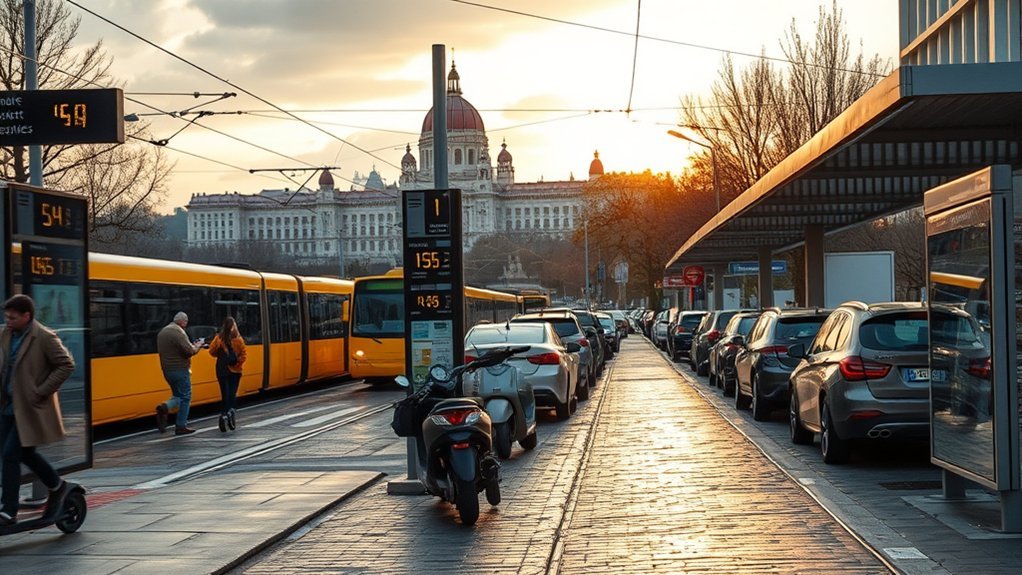
Public transport in Budapest is cheap and covers metro, tram, bus, trolleybus, HÉV suburban rail inside the city, and some ferries. Current BKK fares:
| Fare Product | Price (HUF) | Approx. USD | Notes |
|---|---|---|---|
| Single ticket | 500 | $1.53 | 700 if bought from the driver |
| Block of 10 tickets | 4,500 | $13.76 | for occasional riders |
| 90-minute ticket | 850 | $2.60 | unlimited transfers |
| 24-hour travelcard | 2,750 | $8.41 | good for visitors |
| Monthly Budapest pass | 8,950 | $27.37 | 3,450 for students; 3,330 for pensioners |
| Pest County Pass | 9,450 | $28.90 | for commuters from the suburbs |
| Hungary Pass (Országbérlet) | 18,900 | $57.81 | nationwide trains and intercity buses |
| 100E Airport Express | 2,500 | $7.65 | not covered by regular passes |
The monthly pass costs less than nine round trips on single tickets, so it pays off quickly for anyone who commutes. Regional cities run their own systems. A single ride costs roughly HUF 250–460 in Debrecen, Győr, Miskolc, Pécs, and Szeged, so check the local operator for pass prices.
Driving. On October 2, 2026, average pump prices were HUF 636 per liter for 95-octane petrol (~$1.95, or about $7.36 per US gallon) and HUF 709 for diesel (~$2.17). Owning a car adds insurance, the annual vehicle tax, a motorway vignette if you drive between cities, parking, winter tires, and maintenance. Taxi fares rose 11% in the past year. In Budapest, most residents get by without a car.
Healthcare and Insurance
Hungary’s public health insurance is run by the National Health Insurance Fund (NEAK). How you get access depends on your status:
- Employees are covered automatically. The 18.5% social security contribution taken from gross pay includes 7% for health insurance.
- Residents not otherwise insured pay a healthcare service contribution of HUF 12,300 (~$38) a month in 2026, or HUF 410 a day.
- Non-EU residents without a job in Hungary can sign a voluntary agreement (megállapodás) with the health insurance authority for a monthly fee, or buy private insurance. Residence permits generally require proof of health coverage.
- EU and EEA citizens on short visits can use their European Health Insurance Card for medically necessary care.
Many expats in Budapest also use private clinics for faster appointments and English-speaking doctors. Private consultations and insurance premiums vary widely by provider, age, and coverage, so ask for a written price before any non-emergency treatment.
Schools and Childcare
Public schools are free for residents, and lessons are in Hungarian. Families still pay for meals, supplies, activities, and transport.
International schools are the biggest expense a family can take on. The American International School of Budapest’s 2026/27 fee schedule shows:
- Annual tuition: $15,500 for early childhood up to $29,750 for the high school diploma years.
- Building fee: $3,500 per student per year, which brings the total to $19,000–$33,250.
- One-time costs for new families: a $650 application fee, a $1,500 registration fee, and a $3,000 enrollment deposit credited to the first invoice.
Other British, German, French, and bilingual schools in Budapest charge less, but two children in international school can easily add HUF 1 million (~$3,060) or more a month to a family budget. Compare each school’s fee schedule and what it includes, such as meals, buses, trips, and exams.
Leisure. A monthly gym membership costs about HUF 18,000 (~$55) in Budapest and HUF 12,000–15,500 (~$37–$47) in regional cities. A multiplex cinema ticket runs HUF 1,770–2,200 (~$5.40–$6.70).
Taxes: VAT and Income Tax
Hungary’s tax system is simple, but its VAT is the highest in the EU.
- VAT (ÁFA): the standard rate is 27%, with reduced rates of 18% and 5%, according to the EU’s VAT rates table. The 5% rate covers items such as many basic foods, while most goods and services carry the full 27%.
- Personal income tax (SZJA): a flat 15% on all employment income.
- Employee social security (TB járulék): 18.5% of gross pay (10% pension, 7% health, 1.5% labor market). Together with income tax, employees take home about 66.5% of gross pay.
- Employer social contribution tax (szocho): 13% on top of gross salary. A HUF 500,000 gross salary costs the employer HUF 565,000.
- Allowances: workers under 25 pay no income tax on earnings up to about HUF 715,765 a month. Mothers under 30 with one child, and from 2026 mothers of two children under 40, also qualify for exemptions. Family tax credits run from HUF 20,000 to HUF 66,000 per child per month.
If you will stay more than 183 days in a year or work for a foreign employer while living in Hungary, speak with a Hungarian tax adviser about residency and double-tax treaties.
Visas and Residence
Hungary is in the Schengen Area. US, Canadian, UK, and Australian citizens can visit for up to 90 days in any 180-day period without a visa. That allows tourism and short stays, not work or long-term residence.
To live in Hungary longer, non-EU citizens need a residence permit tied to a purpose, such as employment, study, family reunification, business, or research. The White Card for digital nomads is the main option for remote workers:
- Income: at least €3,000 net a month (about HUF 1.1 million, or ~$3,375) for six months before arrival, and throughout the stay.
- Validity: up to one year, renewable once for another year.
- Limits: you can’t work for Hungarian employers or own shares in Hungarian companies, and family members can’t join you on family reunification permits.
EU and EEA citizens can live and work in Hungary freely but must register their address with the immigration authority if they stay longer than three months. Application fees vary by permit type, so check the current fee on the immigration authority’s site before you apply.
First-Month Setup Costs
Budget for these before your first normal month:
- Deposit and first rent: often two to four months’ rent up front. For a Budapest studio at the HUF 200,000 median, that is HUF 400,000–800,000 (~$1,225–$2,445).
- Temporary housing: a short-term rental for two to four weeks while you look for a lease.
- Residence permit costs: application fees, official translations, and document certification.
- Health coverage: private or travel insurance until you are enrolled in the public system.
- Household setup: bedding, kitchen basics, and internet installation if the flat is not fully equipped.
- Transit: HUF 8,950 for your first monthly Budapest pass.
Sample Monthly Budgets
These budgets combine the figures above. Rent uses advertised medians: a studio to a central-district apartment for singles in Budapest, regional studio to all-apartment medians for regional cities, and a larger flat for families. Totals are rounded.
| Expense (HUF) | Single, Regional City | Single, Budapest | Couple, Budapest | Family of Four, Budapest |
|---|---|---|---|---|
| Rent | 140,000–220,000 | 200,000–290,000 | 260,000–350,000 | 390,000–650,000 |
| Utilities + common charge | 40,000–80,000 | 45,000–90,000 | 50,000–100,000 | 80,000–150,000 |
| Internet + mobile | 10,000–22,000 | 10,000–25,000 | 15,000–35,000 | 20,000–45,000 |
| Groceries | 80,000–130,000 | 90,000–140,000 | 150,000–220,000 | 230,000–360,000 |
| Eating out + leisure | 35,000–80,000 | 50,000–110,000 | 90,000–180,000 | 100,000–200,000 |
| Transport | 8,000–19,000 | 8,950 | 17,900 | 24,800–60,000 |
| Health, clothing, personal, buffer | 35,000–70,000 | 40,000–80,000 | 70,000–130,000 | 150,000–300,000 |
| Total (HUF) | 350,000–620,000 | 445,000–745,000 | 655,000–1,035,000 | 995,000–1,765,000 |
| Total (USD) | $1,070–$1,900 | $1,360–$2,280 | $2,000–$3,165 | $3,045–$5,400 |
Notes on the budgets:
- A single person who rents a room instead of a studio can cut about HUF 90,000 in Budapest and HUF 55,000–100,000 in regional cities.
- The family budget assumes a three-room apartment in a mid-priced district, two adult transit passes plus two student passes, and public school. International school fees are extra.
- Car ownership, debt payments, and frequent trips abroad are not included.
Money-Saving Tips
- Look one ring out. Districts XIII, XI, and outer Pest offer lower rents than V and VI with fast metro or tram links.
- Consider a regional city. Pécs, Szeged, and Miskolc cost far less than Budapest and have universities, hospitals, and good train links.
- Share first. A room for your first few months keeps rent, deposits, and utility risk low while you learn the market.
- Buy the monthly pass. It beats single tickets after about nine round trips.
- Cook more, eat the napi menü at lunch. Groceries are getting cheaper while restaurant prices keep rising.
- Watch your energy use. Regulated utility prices apply only up to average consumption.
- Keep a forint buffer. The forint moved about 9% against the euro this year. Hold enough HUF to cover two months of rent and bills.
How Hungary Compares With Nearby Countries
Hungary sits in the lower-middle of Central Europe on costs. It is clearly cheaper than its western neighbor, as our guide to the cost of living in Austria shows: Vienna rents and salaries both run far higher than Budapest’s. Eurostat’s July 2026 minimum wage data places Hungary in the group below €1,000 a month (HUF 322,800 is about €877), alongside Slovakia and Romania, while Croatia is at €1,050 and Slovenia at €1,482.
For a similar Central European lifestyle at similar prices, see what it costs to live in Slovakia, which uses the euro and removes currency risk. To the east, our Romania living cost breakdown shows lower rents outside Bucharest and Cluj. To the south, compare the expenses of living in Croatia, where coastal rents climb in tourist season, and the cost of living in Serbia, one of the cheapest options in the region.
Frequently Asked Questions
How much money do you need to live in Hungary per month?
A single person needs about HUF 350,000–620,000 (~$1,070–$1,900) a month in a regional city and about HUF 445,000–745,000 (~$1,360–$2,280) renting alone in Budapest. A couple in Budapest should budget about HUF 655,000–1,035,000 (~$2,000–$3,165).
How much is rent in Budapest in 2026?
The median advertised apartment in Budapest asks about HUF 260,000 (~$795) a month. Studios up to 40 m² have a median of about HUF 200,000 (~$612), and a room in a shared flat costs about HUF 110,000 (~$336). District V is the most expensive, while outer districts such as XIX and XXIII cost HUF 183,000–200,000.
Is $1,500 a month enough to live in Hungary?
Yes, for a single person. At HUF 326.94 per dollar, $1,500 is about HUF 490,000. That covers a comfortable life in a regional city or a modest life in a Budapest studio outside the most expensive districts. It is not enough for a family.
What is the minimum wage in Hungary in 2026?
The 2026 minimum wage is HUF 322,800 gross a month, or about HUF 214,662 net (~$657). The guaranteed wage minimum for skilled jobs is HUF 373,200 gross, or about HUF 248,178 net.
What is the average salary in Hungary?
In July 2026, average gross earnings were HUF 745,500 and average net earnings were HUF 523,300 (~$1,600). The median net salary was HUF 437,900 (~$1,340), which is a better guide to what a typical worker takes home.
Which city in Hungary is cheapest to live in?
Among the major university cities, Miskolc is the cheapest, with a median apartment rent of about HUF 130,000 (~$398) and rooms from about HUF 55,000. Pécs is the next cheapest large city, while Debrecen is the most expensive outside Budapest.
Conclusion
Hungary remains one of the more affordable places to live in the EU, helped by the lowest household energy prices in the bloc, falling grocery prices, and cheap public transport. The catch is housing and services. Budapest rents keep inching up, restaurant and service prices are rising faster than inflation, and the stronger forint means dollar and euro budgets buy less than they did in the spring. A single person can live comfortably on about $1,400–$2,300 a month in Budapest, or on closer to $1,100 in a regional city. Choose your city and district first, since rent drives most of the difference, and check the exchange rate before you sign a lease.
Sources
- Magyar Nemzeti Bank – official daily exchange rates
- KSH – consumer prices, August 2026
- KSH – earnings and labor market
- KSH–ingatlan.com rent index, June 2026
- Economx – rental medians by city and district, August 2026
- Economx – Budapest district rents, January 2026
- Pénzcentrum – room and studio rents in university cities, July 2026
- MNB – Housing Market Report, May 2026
- Eduline – 2026 minimum wage and guaranteed wage minimum
- Financera – 2026 payroll taxes and allowances
- Eurostat – household electricity prices, second half of 2025
- Eurostat – household gas prices, first half of 2025
- Eurostat – minimum wage statistics, July 2026
- BKK – Budapest ticket and pass prices
- Holtankoljak – average fuel prices, October 2026
- Study in Hungary – cost of living by city
- Money.hu – 2026 healthcare service contribution
- American International School of Budapest – 2026/27 fees
- Your Europe – EU VAT rates
- National Directorate-General for Aliens Policing – White Card