The cost of living in Singapore in 2026 runs about S$2,600–3,400 (~$2,035–$2,660) a month for a single person renting a room, and about S$4,500–6,400 (~$3,520–$5,010) for a single person with their own one-bedroom condo. A couple should plan on roughly S$6,100–8,900 (~$4,775–$6,965), and a family of four about S$7,800–11,200 (~$6,105–$8,765) before international school fees. These figures use an exchange rate of about S$1.278 per US dollar (October 6, 2026). Rent is the biggest swing factor by far. A one-bedroom condo averages about S$3,800 (~$2,975) in the center and S$2,730 (~$2,135) outside it, while a hawker meal still costs well under S$10. Below you’ll find rents by town and flat type, utility and transport costs, food prices, healthcare, school fees, taxes, work pass rules, and sample budgets.
Quick Answer
- Single person: S$2,600–3,400 (~$2,035–$2,660) renting a room; S$4,500–6,400 (~$3,520–$5,010) in a one-bedroom condo.
- Couple: S$6,100–8,900 (~$4,775–$6,965) a month in a one- or two-bedroom home.
- Family of four: about S$7,800–11,200 (~$6,105–$8,765) before international school fees, which can add about S$6,000 (~$4,700) a month for two children.
- Rent, one-bedroom condo: about S$2,730 (~$2,135) outside the center and S$3,800 (~$2,975) in the center.
- Utilities: about S$220 (~$175) a month for an 85 m² apartment; regulated electricity costs 31.16 cents per kWh with GST (October–December 2026).
- Transit: S$1.28–2.57 per adult card ride, or S$122 (~$95) for an unlimited monthly pass.
- Taxes: 9% GST; resident income tax from 0% to 24%.
Exchange Rate, Inflation, and Salaries in 2026
Three numbers shape what Singapore costs you this year.
The exchange rate. The Singapore dollar traded at about S$1.278 per US dollar on October 6, 2026, according to USD/SGD history data. The rate has stayed in a tight band all year, from about S$1.261 in late January to S$1.298 in late June. That stability is useful: a dollar budget you set today should still hold in six months.
Inflation. Headline inflation was 2.3% in August 2026 and MAS core inflation was 2.2%, the highest core reading since September 2024. Services, retail goods, and food drove the rise.
Salaries. Singapore has no general minimum wage. The Ministry of Manpower’s income summary table puts the median gross monthly income of full-time employed residents at S$5,775 (~$4,520) in 2025, including employer CPF contributions, up from S$5,500 in 2024. Crowd-sourced averages put typical take-home pay at about S$5,600 (~$4,400) a month.
A resident on the median income would spend most of it on a private one-bedroom condo and basic bills. That is why many locals live in HDB flats and many single expats rent a room.
Housing and Rent
Housing is the largest part of almost every Singapore budget. Private rents are near record highs. The Urban Redevelopment Authority’s Q2 2026 statistics show the private rental index up 0.7% in the quarter, after 0.3% in the first quarter. Central region (CCR) rents rose 1.2%, while suburban (OCR) rents slipped 0.3%. Sale prices rose a further 1.4% in the third quarter, according to URA’s flash estimate of October 1, 2026.
Condo and Apartment Rents
Crowd-sourced averages updated in early October 2026 give these typical rents for private apartments:
| Apartment | City Center (S$/month) | Outside Center (S$/month) |
|---|---|---|
| One-bedroom | 3,804 (~$2,975) | 2,731 (~$2,135) |
| Three-bedroom | 7,371 (~$5,770) | 5,079 (~$3,975) |
“City center” here means the Core Central Region, such as Orchard, River Valley, Tanglin, Marina Bay, and the CBD. Newer condos with pools and gyms near an MRT station sit at the top of each range. Older condos in places like Jurong, Woodlands, Pasir Ris, or Sengkang often rent for less.
HDB Flat Rents by Town
Most Singaporeans live in public HDB flats, and foreigners with a valid pass can rent a whole flat or a room in one. HDB’s Q2 2026 rental data gives these median monthly rents for whole flats:
| Town | 3-Room (2 bedrooms) | 4-Room (3 bedrooms) | 5-Room |
|---|---|---|---|
| Central Area | S$3,300 (~$2,580) | S$4,600 (~$3,600) | S$5,100 (~$3,990) |
| Queenstown | S$3,100 (~$2,425) | S$4,130 (~$3,230) | S$4,400 (~$3,445) |
| Bukit Merah | S$3,000 (~$2,345) | S$4,000 (~$3,130) | S$4,300 (~$3,365) |
| Toa Payoh | S$2,900 (~$2,270) | S$3,800 (~$2,975) | S$4,030 (~$3,155) |
| Ang Mo Kio | S$2,800 (~$2,190) | S$3,500 (~$2,740) | S$3,880 (~$3,035) |
| Tampines | S$2,800 (~$2,190) | S$3,500 (~$2,740) | S$3,650 (~$2,855) |
| Jurong West | S$2,700 (~$2,115) | S$3,500 (~$2,740) | S$3,700 (~$2,895) |
| Punggol | S$2,850 (~$2,230) | S$3,300 (~$2,580) | S$3,300 (~$2,580) |
| Woodlands | S$2,600 (~$2,035) | S$3,100 (~$2,425) | S$3,300 (~$2,580) |
A 4-room HDB flat in a suburban town often costs less than a central one-bedroom condo while giving a family three bedrooms. The trade-off is fewer facilities and, in some towns, a longer commute.
Renting a Room
Sharing is the most common way for single newcomers to keep costs down. Room listings in late 2026 commonly run about S$1,000–1,600 (~$780–$1,250) for a common room in an HDB flat and S$1,400–2,300 (~$1,095–$1,800) for a condo room, often with utilities and Wi-Fi included. A master room with its own bathroom sits at the top of each range.
Before you agree to a room, confirm:
- What is included: utilities, internet, air-conditioning servicing, and cleaning.
- Whether cooking, guests, and working from home are allowed.
- Who signs the tenancy agreement and whether the owner has approved and registered the rental.
- The minimum stay, notice period, deposit terms, and early-exit penalties.
Rental Rules and Upfront Costs
Private homes must be rented for at least three consecutive months under URA’s rental rules, so daily and weekly stays in ordinary condos are not allowed. Units under 90 m² can hold at most six unrelated people. HDB flats have their own minimum rental periods and occupancy rules.
At move-in, expect to pay:
- Security deposit: usually one month’s rent for a one-year lease, or two months for a two-year lease.
- First month’s rent in advance.
- Stamp duty: 0.4% of total rent for leases of up to four years. On a S$3,000 one-year lease, that is S$144 (~$115).
- Agent fee: landlords usually pay their own agent. If you hire your own agent, expect to pay a commission, often around half a month’s rent on a one-year lease for lower-priced units.
Check any agent on the Council for Estate Agencies public register, view the unit in person, and never transfer a deposit for a listing you have not seen.
Buying Property as a Foreigner
Most expats rent. Foreigners buying a home pay 60% Additional Buyer’s Stamp Duty on top of regular stamp duty, although US nationals and some EFTA nationals get the same treatment as citizens under free trade agreements. Foreigners can buy condo units but need approval for landed homes and cannot buy HDB flats.
Utilities, Internet, and Phone
Air conditioning drives most of the utility bill. Basic utilities (electricity, water, gas, and refuse) for an 85 m² apartment average about S$223 (~$175) a month, based on crowd-sourced data.
The Energy Market Authority sets the regulated electricity tariff at 28.59 cents per kWh before GST, or 31.16 cents with GST, for October to December 2026. That is down from 34.78 cents with GST in July–September.
| Monthly Item | Typical Cost (S$) | Approx. USD |
|---|---|---|
| Electricity, 300 kWh (small flat, moderate AC) | 93 | $73 |
| Electricity, 500 kWh (family home, heavy AC) | 156 | $122 |
| All basic utilities, 85 m² apartment | 223 | $175 |
| Home fiber broadband (60 Mbps+) | 34 | $27 |
| Mobile plan (10 GB+ data) | 16 | $12 |
Many households buy power from an open electricity market retailer instead of SP Group’s regulated tariff. Fixed-price plans can save money, but compare them with the regulated rate each quarter, since this quarter’s tariff fell. Ask for recent utility bills before signing a lease on an older or larger home.
Food: Groceries and Dining Out
Singapore imports most of its food, so groceries cost more than in neighboring countries. Eating at hawker centers is what keeps food budgets in check. A single person who mixes cooking with hawker meals spends about S$600–900 (~$470–$705) a month on food.
Typical grocery prices, based on crowd-sourced averages from October 2026:
| Item | Typical Cost (S$) | Approx. USD |
|---|---|---|
| Milk (1 liter) | 3.82 | $2.99 |
| White bread (1 lb loaf) | 2.92 | $2.28 |
| Rice (1 lb) | 1.62 | $1.27 |
| Eggs (12) | 4.65 | $3.64 |
| Chicken fillets (1 lb) | 5.67 | $4.44 |
| Beef (1 lb) | 14.85 | $11.62 |
| Local cheese (1 lb) | 12.32 | $9.64 |
| Bananas (1 lb) | 1.78 | $1.39 |
| Mid-range bottle of wine | 30.00 | $23.47 |
Alcohol, imported cheese, and Western brands are where grocery bills climb. NTUC FairPrice house brands, wet markets, and Asian produce keep them down.
Eating out covers a very wide range:
- Hawker center or coffee shop meal: about S$4.50–8 (~$3.50–$6.25)
- Meal at an inexpensive restaurant or food court: about S$15 (~$11.75)
- Three-course dinner for two at a mid-range restaurant: about S$90 (~$70)
- Fast-food combo meal: about S$11 (~$8.60)
- Cappuccino: about S$6.64 (~$5.20)
- Domestic beer (pint, at a bar): about S$10.50 (~$8.20)
Eating a hawker lunch every workday costs roughly S$130–175 (~$100–$135) a month. The same lunches at a café can cost three times as much.
Transportation and Car Costs
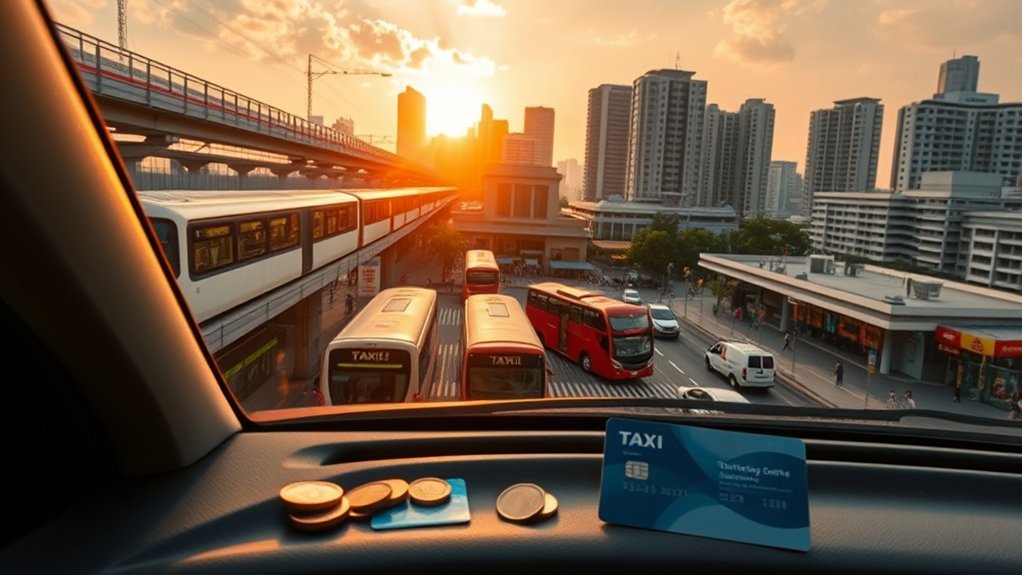
Public transport is cheap, clean, and covers the whole island. Fares are distance-based, with free transfers between buses and trains on one journey.
| Transport Item | Cost (S$) | Approx. USD |
|---|---|---|
| Adult card fare, bus or MRT | 1.28–2.57 per journey | $1.00–$2.01 |
| Adult monthly travel pass (unlimited) | 122 | $95 |
| Taxi flag-down (standard) | about 4.60 | $3.60 |
| Gasoline (1 liter, 95-octane) | about 3.18 | $2.49 (~$9.40 per gallon) |
| COE, Category A car (23 Sept 2026) | 131,890 | $103,200 |
| COE, Category B car (23 Sept 2026) | 133,000 | $104,070 |
Fares come from the Public Transport Council. A daily commuter usually spends about S$80–130 (~$65–$100) a month; the S$122 pass pays off only for heavy riders. Ride-hailing through Grab, Gojek, or TADA adds up fast, so many households cap it at a few rides a week.
Cars are a luxury. Before you can register a car, you need a Certificate of Entitlement, which gives the right to own a vehicle for 10 years, according to LTA’s OneMotoring. Category A premiums hit a record S$133,009 on September 9, 2026, before easing to S$131,890 on September 23. Add the car price, registration fees, insurance, road tax, parking, and ERP road charges, and even a small car often costs S$2,000–3,000 (~$1,565–$2,350) a month over its life. Most expats skip owning one.
Healthcare and Insurance Costs

Healthcare in Singapore is excellent but not cheap for foreigners. MediShield Life automatically covers citizens and permanent residents only. Employment Pass, S Pass, and Dependant’s Pass holders are not covered, so they rely on employer insurance, private international plans, or both.
Foreigners also pay unsubsidized rates at public clinics. At National University Polyclinics, fees updated from September 1, 2026, are:
- Singapore citizen (subsidized): S$19.60 (~$15) for a medical consultation; S$38.00 (~$30) with a family physician.
- Permanent resident (subsidized): S$43.50 (~$34); S$56.80 (~$44) with a family physician.
- Non-resident (incl. GST): S$83.71 (~$66); S$103.55 (~$81) with a family physician, plus an S$85 deposit at registration.
Private GP visits often cost a similar amount before medicine, and specialist or hospital bills can run into the thousands. Before accepting an employer plan, check inpatient and outpatient limits, deductibles, panel clinics, maternity and dental cover, and whether dependants are included. If you buy your own plan, budget roughly S$150–250 (~$115–$195) a month for a healthy adult under 40, with costs rising with age and coverage.
Schools and Childcare

For families, school choice can change the budget more than rent. Government schools are much cheaper than international schools, but places for foreign children are limited.
The Ministry of Education’s 2026 fee schedule sets these monthly school fees for non-citizens:
| Level | Permanent Resident | ASEAN International Student | Non-ASEAN International Student |
|---|---|---|---|
| Primary | S$330 (~$260) | S$595 (~$465) | S$1,035 (~$810) |
| Secondary | S$680 (~$530) | S$1,090 (~$855) | S$2,190 (~$1,715) |
| Pre-university | S$760 (~$595) | S$1,290 (~$1,010) | S$2,540 (~$1,985) |
Small monthly miscellaneous fees (about S$13–27) apply on top, and international students pay GST on them. Foreign children enter mainstream schools through the AEIS or S-AEIS tests, and a place is not guaranteed.
Other education costs:
- International primary school: about S$36,400 (~$28,460) a year per child on average, based on crowd-sourced data. Top schools charge more, plus application fees, enrolment deposits, development levies, buses, and uniforms.
- Private full-day preschool: about S$1,880 (~$1,470) a month per child.
Two children in international school add roughly S$6,000 (~$4,700) a month to a family budget. Ask employers whether an education allowance is included in the offer.
Taxes: GST and Income Tax
- GST: the current GST rate is 9%. Shop prices usually include it; many restaurants add a 10% service charge plus GST on top of menu prices.
- Tax residency: foreigners are generally tax residents if they stay or work in Singapore for 183 days or more in a calendar year. Residency for tax is separate from immigration status.
- Resident rates: progressive from 0% to 24%. The first S$20,000 of chargeable income is tax-free, 7% applies from S$40,000 to S$80,000, 11.5% from S$80,000 to S$120,000, and the top 24% rate starts above S$1 million.
- Non-residents: employment income is taxed at a flat 15% or at resident rates, whichever gives the higher tax.
- CPF: Employment Pass and S Pass holders do not pay into the CPF pension fund, so their take-home pay is usually higher than a citizen’s on the same salary.
On a S$8,000 (~$6,260) monthly salary, a tax resident pays roughly S$5,190 a year in income tax before reliefs, or about S$430 (~$340) a month. Check the full brackets on the IRAS website. Tax is billed the year after you earn the income, so set money aside each month.
Work Passes and Salary Requirements
Singapore has no retirement or digital nomad visa for most foreigners. To live there long term, most people need a work pass. The Ministry of Manpower sets these minimum monthly salaries:
| Pass | Minimum Salary Now | From January 1, 2027 (new applications) | Notes |
|---|---|---|---|
| Employment Pass | S$5,600 (~$4,380), rising with age to S$10,700 | S$6,000 (~$4,695), rising to S$11,500 | financial services: S$6,200 now, S$6,600 from 2027; must also pass COMPASS |
| S Pass | S$3,300 (~$2,580), rising with age to S$4,800 | S$3,600 (~$2,815), rising to S$5,100 | for mid-skilled staff; employer pays a levy |
Details are on MOM’s Employment Pass eligibility page. The Employment Pass costs S$105 (~$82) to apply and S$225 (~$176) when issued. Employment Pass holders earning at least S$6,000 can usually bring a spouse and children on Dependant’s Passes. These thresholds are minimums for a work pass, not a comfortable budget. A single person on S$5,600 can live well in a shared flat but would find a central one-bedroom tight.
One-Time Setup Costs
Budget for these before your first paycheck:
- Rental deposit and first month’s rent: two to three months of rent, or about S$5,500–11,500 (~$4,305–$9,000) for a one-bedroom condo.
- Stamp duty and agent fee: about S$100–2,000 (~$80–$1,565), depending on lease value.
- Temporary housing: a serviced apartment or hotel for the first two to four weeks can cost S$3,000–6,000 (~$2,350–$4,695).
- Work pass fees: S$330 (~$258) for an Employment Pass, plus fees for any dependants.
- Furniture and household items: S$1,000–5,000 (~$780–$3,910) if the unit is partly furnished. Most condos come furnished.
- Mobile SIM, transit card, and internet setup: under S$100 (~$80).
Sample Monthly Budgets
These budgets combine the figures above. Rents use crowd-sourced condo averages and HDB medians; your own lease will decide where you land in each range.
| Expense (S$) | Single, Room | Single, 1-Bed Condo | Couple | Family of Four |
|---|---|---|---|---|
| Rent | 1,100–1,600 | 2,730–3,800 | 3,000–4,500 | 3,500–5,100 |
| Utilities | 0–100 | 150–230 | 200–300 | 250–400 |
| Internet + mobile | 20–50 | 50 | 80 | 120 |
| Food (groceries + eating out) | 600–900 | 900–1,300 | 1,700–2,300 | 2,300–3,000 |
| Transport | 100–130 | 130–200 | 250–350 | 350–500 |
| Health insurance | 100–200 | 150–250 | 300–500 | 500–900 |
| Leisure, gym, personal | 300–500 | 400–600 | 600–900 | 800–1,200 |
| Total (S$) | 2,600–3,400 | 4,500–6,400 | 6,100–8,900 | 7,800–11,200 |
| Total (USD) | $2,035–$2,660 | $3,520–$5,010 | $4,775–$6,965 | $6,105–$8,765 |
Family of four: the column assumes a suburban 4-room HDB flat or a three-bedroom condo outside the center, government or local schooling, and an employer health plan with some top-up. Crowd-sourced data puts a family’s costs at about S$5,530 (~$4,325) a month before rent, which fits this range. International school for two children pushes the total to roughly S$13,900–17,300 (~$10,875–$13,535).
Salary check: a single person should aim for a gross salary of at least S$5,000 a month to rent a room and still save, and S$8,000–10,000 for a comfortable life in their own condo after tax. A family paying international school fees usually needs S$20,000 or more, or an employer package that covers housing and schooling.
Money-Saving Tips
- Rent an HDB flat or room. A suburban 4-room HDB flat can cost less than a central one-bedroom condo.
- Live near an MRT line, not the city center. Towns like Toa Payoh, Queenstown, or Tampines give quick commutes at lower rents.
- Eat at hawker centers. Lunch for under S$8 beats most home-cooked meals made with imported groceries.
- Skip the car. COE premiums above S$130,000 make public transport and occasional taxis far cheaper.
- Compare electricity plans each quarter and set air conditioning to 25°C.
- Negotiate the package. Housing, school, and medical allowances are often worth more than a salary bump.
- Shop house brands and wet markets instead of premium supermarkets.
How Singapore Compares With Nearby Countries
Singapore is the most expensive place to live in Southeast Asia, mainly because of rent. Many people who work in Singapore look at nearby options for comparison, or even live across the border in Johor Bahru. A comfortable single life costs about $3,520–$5,010 a month in Singapore. That compares with about $1,350–$1,470 in central Kuala Lumpur, according to our guide to the cost of living in Malaysia, about $930–$985 in central Jakarta or Bali in our Indonesia cost of living guide, and about $1,355–$1,605 in Manila or Cebu in our guide to the cost of living in the Philippines. For another popular regional base, see the cost of living in Thailand. For a closer look at everyday Singapore prices, read our breakdown of monthly expenses and rent in Singapore.
What Singapore offers in return is high salaries, a stable currency, low income tax, strong safety, and excellent public transport. For many professionals, the higher pay more than covers the gap.
Frequently Asked Questions
How much money do you need to live in Singapore per month?
A single person needs about S$2,600–3,400 (~$2,035–$2,660) a month when renting a room, or about S$4,500–6,400 (~$3,520–$5,010) with their own one-bedroom condo. A couple should budget about S$6,100–8,900 (~$4,775–$6,965), and a family of four about S$7,800–11,200 (~$6,105–$8,765) before international school fees.
How much is rent in Singapore in 2026?
A one-bedroom condo averages about S$3,800 (~$2,975) a month in the city center and about S$2,730 (~$2,135) outside it. Median rents for a whole 4-room HDB flat ran from S$3,100 in Woodlands and Yishun to S$4,600 in the Central Area in Q2 2026. A room in a shared flat usually costs S$1,000–2,300.
Is $3,000 a month enough to live in Singapore?
Yes, for a single person who rents a room. At about S$1.278 per dollar, $3,000 is roughly S$3,830, which covers a room in an HDB flat or condo, hawker meals, public transport, and basic insurance. It is not enough for your own one-bedroom condo plus everyday costs.
What salary do you need to live comfortably in Singapore?
A single person should aim for at least S$5,000 a month gross to rent a room and still save, and S$8,000–10,000 for a comfortable life in their own condo. Families paying international school fees usually need S$20,000 or more, or an employer package that covers housing and schooling.
Is there a minimum wage in Singapore?
Singapore has no general minimum wage. Instead, work passes have minimum salaries. In 2026 the Employment Pass requires at least S$5,600 a month (S$6,000 from January 2027) and the S Pass requires at least S$3,300 (S$3,600 from January 2027), with higher amounts for older applicants.
Are expats covered by public health insurance in Singapore?
No. MediShield Life automatically covers Singapore citizens and permanent residents only. Employment Pass, S Pass, and Dependant’s Pass holders need employer or private health insurance, and they pay unsubsidized rates at public clinics, such as S$83.71 for a polyclinic visit.
How much are school fees for foreigners in Singapore?
In 2026, government school fees for non-ASEAN international students are S$1,035 a month at primary level and S$2,190 at secondary level. Permanent residents pay S$330 and S$680. International schools average about S$36,400 a year per child.
Conclusion
Singapore is expensive, but it is predictable. The currency has barely moved this year, inflation is around 2%, and most daily costs, from transit to hawker food, are reasonable. Rent is the real test. A single person can live on about S$2,600–3,400 (~$2,035–$2,660) a month by renting a room, while their own one-bedroom condo pushes the budget to S$4,500–6,400 (~$3,520–$5,010). Families should look hard at HDB flats and school options, since international school fees can add more than S$6,000 a month. Settle your housing, health cover, and employer package first, and the rest of the budget is easy to plan.
Sources
- Exchange-Rates.org – USD to SGD history, 2026
- Business Today – Singapore inflation, August 2026
- Ministry of Manpower – income summary table
- URA – Q2 2026 real estate statistics
- URA – Q3 2026 flash estimate
- HDB – median rents by town and flat type, Q2 2026
- URA – rules for renting out private property
- Numbeo – Singapore crowd-sourced prices, October 2026
- Energy Market Authority – regulated electricity tariff
- Public Transport Council – fares and passes
- LTA OneMotoring – Certificate of Entitlement
- COE results, 23 September 2026
- CPF Board – MediShield Life
- National University Polyclinics – fees and charges
- Ministry of Education – school fees for non-citizens, 2024–2026
- IRAS – current GST rates
- IRAS – individual income tax rates
- Ministry of Manpower – Employment Pass eligibility
- Ministry of Manpower – S Pass eligibility
- Ministry of Manpower – Employment Pass fees