The cost of living in Saudi Arabia in 2026 runs about SAR 4,100–4,900 (~$1,095–$1,305) a month for a single person renting a one-bedroom outside the city center in Jeddah, Dammam, or Al Khobar, and about SAR 7,600–9,400 (~$2,025–$2,505) for a comfortable single life in Riyadh. A couple should plan on roughly SAR 9,500–11,200 (~$2,535–$2,985), and a family of four about SAR 12,500–14,700 (~$3,335–$3,920) before international school fees. All dollar figures use the Saudi Central Bank’s fixed rate of SAR 3.75 per US dollar, which still applies in October 2026. Rent is the biggest variable, and Riyadh is now far more expensive than the rest of the country. There is no tax on salaries, fuel is cheap, and VAT is 15%. Expat families also pay a monthly fee for each dependent, which many budgets forget. Below you’ll find rents by city, utility and food prices, transport, healthcare, schools, visa and residency fees, sample budgets, and a comparison with other Gulf countries.

Quick Answer
- Single person: SAR 4,100–4,900 (~$1,095–$1,305) outside Riyadh’s center; SAR 7,600–9,400 (~$2,025–$2,505) for a comfortable life in Riyadh.
- Couple: SAR 9,500–11,200 (~$2,535–$2,985) a month, including one dependent fee.
- Family of four: SAR 12,500–14,700 (~$3,335–$3,920) before school fees; about SAR 18,300–21,000 (~$4,880–$5,600) with two children in international school.
- Rent, one-bedroom: SAR 1,390–3,130 (~$370–$835) outside the center; SAR 2,170–4,450 (~$580–$1,185) in the center, depending on the city.
- Utilities: about SAR 340–480 (~$90–$130) a month for a mid-size apartment; home internet adds about SAR 255 (~$68).
- Fuel: SAR 2.18 per liter for Gasoline 91 and SAR 2.33 for Gasoline 95.
- Taxes: no income tax on employment salaries; 15% VAT on most goods and services.
Exchange Rate, Inflation, and Wages in 2026
The exchange rate. The riyal is pegged to the US dollar at SAR 3.75, a rate the Saudi Central Bank has held since 1986. That makes conversions simple: SAR 1,000 is about $267, SAR 5,000 is about $1,333, and SAR 10,000 is about $2,667. If you earn in dollars, your budget does not swing with the currency the way it does in many other countries.
Inflation. Prices are rising slowly overall. GASTAT data reported by Argaam put annual inflation at 1.8% in August 2026, unchanged from July. Housing rents rose 3.9% over the year, much faster than food (1.4%). Rent is still the main driver of higher living costs.
Wages. Saudi Arabia has no general minimum wage for foreign workers. Saudi nationals must earn at least SAR 4,000 a month to count fully toward a company’s Saudization quota. Pay gaps are wide. GASTAT figures for the second quarter of 2025, reported by Argaam, show an average monthly wage of SAR 11,034 for Saudi workers and SAR 3,933 for expatriate workers. Crowd-sourced averages put the typical net salary at about SAR 7,750 (~$2,065) in Riyadh and SAR 6,250 (~$1,665) in Jeddah.
A worker on the average expat wage of about SAR 3,900 (~$1,050) could not rent a one-bedroom in Riyadh. Most lower-paid foreign workers live in housing provided by their employer.
Cost of Living by City
Rent varies more between cities than any other expense. The table uses crowd-sourced averages updated on October 2, 2026, except Makkah (July 2026), which has few reports and should be treated as a rough guide. Utilities cover electricity, cooling, water, and garbage for an apartment of about 85 m².
| City | 1-Bed, City Center | 1-Bed, Outside Center | 3-Bed, Outside Center | Basic Utilities |
|---|---|---|---|---|
| Riyadh | SAR 4,452 (~$1,187) | SAR 3,129 (~$834) | SAR 4,595 (~$1,225) | SAR 402 (~$107) |
| Jeddah | SAR 2,991 (~$798) | SAR 1,990 (~$531) | SAR 3,107 (~$828) | SAR 338 (~$90) |
| Al Khobar | SAR 2,380 (~$635) | SAR 1,890 (~$504) | SAR 3,255 (~$868) | SAR 370 (~$99) |
| Dammam | SAR 2,167 (~$578) | SAR 1,394 (~$372) | SAR 2,494 (~$665) | SAR 484 (~$129) |
| Makkah* | SAR 2,204 (~$588) | SAR 1,193 (~$318) | SAR 1,940 (~$517) | SAR 283 (~$76) |
*Makkah figures come from very few reports. Non-Muslims cannot enter central Makkah.
A few patterns stand out:
- Riyadh is in a class of its own. A central one-bedroom costs about twice the national average, and a central three-bedroom averages about SAR 8,440 (~$2,250). Demand from new government agencies, regional headquarters, and large projects has pushed rents up for several years.
- Jeddah sits in the middle. Newer districts in the north and areas near the Corniche cost more than older neighborhoods.
- Dammam and Al Khobar in the Eastern Province are the best value among the large cities. Al Khobar has more expat-friendly compounds and costs a bit more than Dammam.
- Smaller cities are cheaper still, but they offer fewer international schools and fewer housing choices.
Housing and Rent
Apartments, Villas, and Compounds
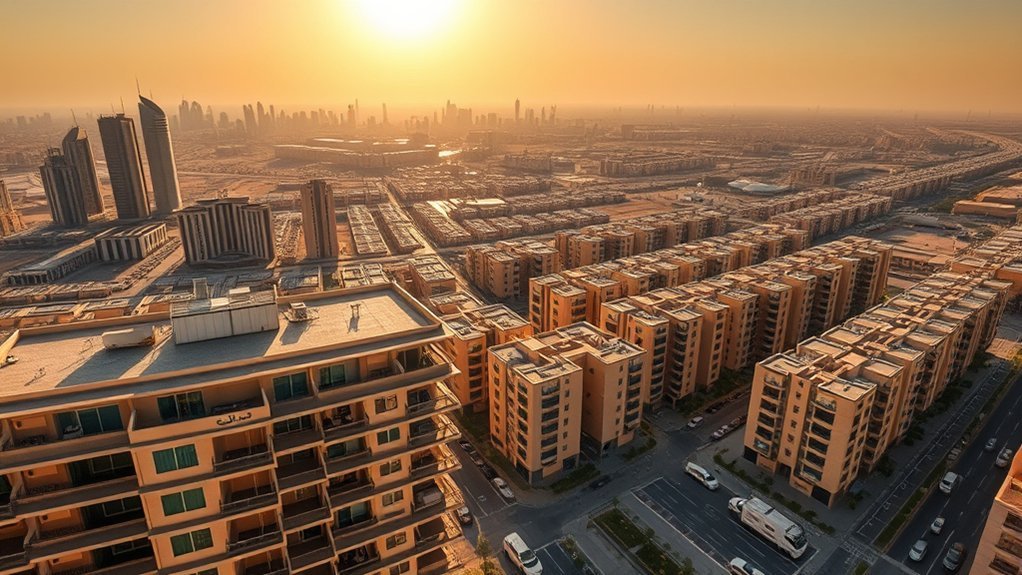
Most expats choose between three kinds of housing:
- Apartments are the cheapest option and the most common for singles and couples. Many are unfurnished and may come without kitchen appliances or air-conditioning units, so ask before you sign.
- Villas suit larger families. They give more space but mean higher cooling bills and more maintenance.
- Compounds are gated communities with pools, gyms, and often shuttle buses to schools. They cost far more than ordinary apartments, and many Western expats live in them with employer support.
Riyadh Rent Freeze
In September 2025 the government suspended annual rent increases for residential and commercial properties within Riyadh’s urban boundary for five years. According to Ejar’s rental provisions, the freeze covers both existing and new contracts longer than three months. A previously rented vacant unit is generally tied to the rent in its most recent Ejar contract. The rule caps increases, but it does not make every new or never-rented unit cheap.
Leases, Deposits, and Payment Schedules
Residential leases should be registered on Ejar, the government rental platform. The Ejar standard contract records the rent, the security deposit, the payment method, and both parties’ obligations, and it can be enforced in court. Keep proof of every payment.
Many landlords still ask for rent quarterly, every six months, or a full year in advance. A unit listed at SAR 3,000 a month may need SAR 18,000 or more up front. Confirm the schedule before you accept a job offer, and ask whether your employer will advance a housing allowance.
Utilities, Internet, and Phone
Basic utilities for a mid-size apartment average about SAR 340–480 (~$90–$130) a month, and bills peak from June to September when air conditioning runs all day.
Electricity is cheap per unit. The residential tariff, as published by the utility Marafiq, is 18 halalas per kWh for the first 6,000 kWh a month and 30 halalas above that, plus a small monthly meter charge (SAR 10 for most homes) and 15% VAT.
| Monthly Use | Energy Charge | Approx. Bill With VAT and Meter Fee |
|---|---|---|
| 500 kWh (winter, small apartment) | SAR 90 | SAR 115 (~$31) |
| 1,500 kWh (summer, apartment) | SAR 270 | SAR 320 (~$85) |
| 4,000 kWh (summer, villa) | SAR 720 | SAR 840 (~$224) |
Other monthly connections, based on crowd-sourced averages:
- Home internet (60+ Mbps): about SAR 255 (~$68), with SAR 240–270 typical in the big cities.
- Mobile plan with 10 GB or more of data: about SAR 120 (~$32).
- Water: usually a small part of the bill for apartments, but villas with gardens pay more.
Food: Groceries and Dining Out

A single person who cooks most meals spends about SAR 800–1,000 (~$215–$265) a month on groceries. A family of four spends about SAR 2,500–3,500 (~$665–$935). Local staples are reasonably priced, while imported brands, specialty diets, and frequent delivery orders raise the bill. Food prices rose only 1.4% in the year to August 2026.
National average prices from August 2026:
| Item | Typical Cost (SAR) | Approx. USD |
|---|---|---|
| Milk (1 liter) | 6.38 | $1.70 |
| Bread (1 lb loaf) | 3.49 | $0.93 |
| Rice (1 lb) | 3.76 | $1.00 |
| Eggs (12) | 9.64 | $2.57 |
| Chicken fillets (1 lb) | 13.72 | $3.66 |
| Beef (1 lb) | 22.55 | $6.01 |
| Bottled water (1.5 liters) | 2.19 | $0.58 |
Eating out costs about the same as in other Gulf countries and less than in Dubai or Doha:
- Meal at an inexpensive restaurant: about SAR 25 (~$6.67)
- Three-course dinner for two at a mid-range restaurant: about SAR 150 (~$40)
- Fast-food combo meal: about SAR 30 (~$8.00)
- Cappuccino: about SAR 14 (~$3.70)
- Cinema ticket: about SAR 54 (~$14.40)
- Gym membership: about SAR 320 (~$85) a month
Alcohol is not sold legally to the public, so there is no bar or wine budget to plan for.
A shawarma or a plate of kabsa from a neighborhood restaurant costs a fraction of a mall food court meal. Local eateries are the easiest way to keep food spending down.
Transportation and Getting Around
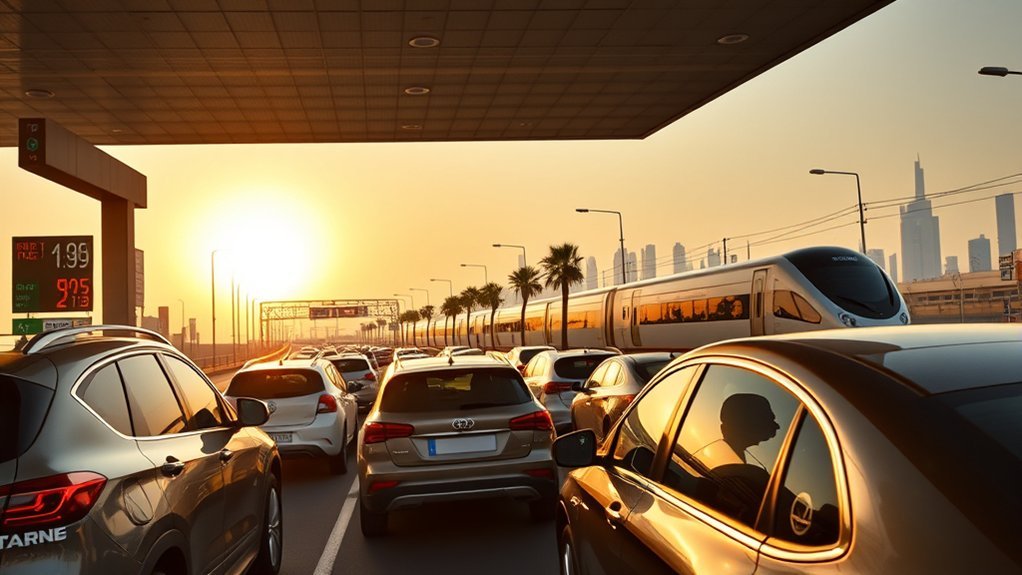
Most residents still drive, but Riyadh’s metro, which opened in stages from December 2024, has made car-free living possible along its lines.
| Option | 2026 Price (SAR) | Notes |
|---|---|---|
| Riyadh Metro and bus, 2-hour ticket | 4 | unlimited rides within two hours |
| Riyadh Metro and bus, 30-day pass | 140 (~$37) | 7-day pass SAR 40; first class costs more |
| Taxi starting fare | about 10 | ride-hailing apps are widely used |
| Gasoline 91 (1 liter) | 2.18 | about $2.20 per gallon |
| Gasoline 95 (1 liter) | 2.33 | about $2.35 per gallon |
| Diesel (1 liter) | 1.79 | about $1.81 per gallon |
Fuel prices come from Saudi Aramco’s retail fuel page for September 2026. Gasoline 98 costs SAR 4.64 per liter. Aramco reviews prices periodically, but 91 and 95 have stayed at these levels.
Fuel is cheap, but it is a small part of car costs. Driving 1,500 km a month in a mid-size car uses about 120 liters, or roughly SAR 280 (~$75). Car payments, insurance, maintenance, and depreciation usually cost several times more. A daily commuter who relies on ride-hailing can easily spend SAR 1,000–1,500 (~$265–$400) a month in Riyadh or Jeddah, so compare that with a car lease before deciding.
Healthcare and Insurance

Health insurance is mandatory for expatriates. Private-sector employers must provide and pay for cooperative health insurance for their foreign employees and, in most cases, their eligible dependents, under rules set by the Council of Health Insurance. Most expats use private hospitals and clinics within their insurer’s network.
What you actually pay depends on the policy:
- Copays: many basic policies charge a percentage of each outpatient visit or prescription, often with a cap per visit.
- Network limits: lower-tier policies may exclude the best-known private hospitals.
- Exclusions: dental, optical, and maternity care often have separate limits.
- Dependents: if your employer covers only you, buying family cover yourself can add thousands of riyals a year, and the cost rises with age.
Before you accept a job, ask for the insurer’s name, the policy class, the network list, and whether your spouse and children are covered. A good family policy can be worth more than a modest salary increase.
Schools and Childcare

Schooling is the largest cost for most expat families who do not get an education allowance.
| Education Cost | Average (SAR) | Approx. USD |
|---|---|---|
| Private preschool, full day (monthly) | 1,619 (national); 1,992 (Riyadh) | $432; $531 |
| International primary school (yearly) | 34,864 (national); 37,924 (Riyadh) | $9,297; $10,113 |
| Top-tier international schools (yearly) | 70,000 or more | $18,700 or more |
Tuition often excludes registration, buses, uniforms, books, devices, and exam fees. Ask for the full written fee schedule.
Some non-Saudi children can attend free government schools, but places are limited. Under the Ministry of Education’s admission rules, non-Saudi students are capped at 15% of places in a district, and seats go first to children of government-sector employees. Lessons are in Arabic, and documents from abroad must be certified.
Taxes: VAT and Zakat
- Income tax: Saudi Arabia does not tax salaries earned from employment, for Saudis or foreigners. Business and some investment income follow different rules, and your home country may still tax you. US citizens, for example, must file US returns.
- VAT: the standard rate is 15%, according to the Zakat, Tax and Customs Authority. It was raised from 5% in July 2020 and applies to most goods, services, and utility bills. Residential rent is exempt.
- Social insurance: expat employees do not pay pension contributions. Employers pay a 2% occupational hazards contribution on their wages.
Visas, Residency, and Dependent Fees
Most foreigners live in Saudi Arabia on an employer-sponsored work visa and residence permit (iqama). The employer usually pays the work visa, the iqama, and the monthly work permit levy, which is about SAR 800 per worker. Get this in writing, because the fees for your family often fall on you.
| Fee | Amount (SAR) | Who Usually Pays |
|---|---|---|
| Dependent fee (spouse, each child, others) | 400 per dependent per month (~$107), paid yearly at iqama renewal | employee, unless the contract says otherwise |
| Iqama issuance or renewal | about 650 per year (~$173) | employer for the worker |
| Work permit levy | about 800 per month (~$213) | employer |
| Single exit and re-entry visa | 200 for two months, plus 100 per extra month | employee or employer |
| Premium Residency, limited duration | 100,000 per year (~$26,667) | applicant |
| Premium Residency, unlimited | 800,000 one time (~$213,333) | applicant |
The dependent fee adds up fast. A family with a spouse and two children pays SAR 1,200 (~$320) a month, or SAR 14,400 (~$3,840) a year, on top of rent and school fees.
Wealthy foreigners and senior professionals can skip employer sponsorship through the Premium Residency program. According to Fragomen’s May 2026 summary, it now has several categories, including one for owners of residential property worth at least SAR 4 million. A new law on real estate ownership by non-Saudis also took effect in 2026, letting foreigners buy property in designated zones.
Safety and Regional Security
Everyday crime in Saudi cities is low. The bigger issue in 2026 is regional conflict. The US State Department rates Saudi Arabia Level 3, “Reconsider Travel” (issued September 15, 2026), citing the threat of Iranian drone and missile attacks since hostilities between the US and Iran began on February 28, 2026, and Level 4 near the Yemen border. The UK Foreign Office notes that the Houthis have launched missiles and drones at several Saudi locations since July and warns of flight cancellations and airspace closures. It advises against all travel within 10 km of the Yemen border and all but essential travel up to 80 km, including Abha and Khamis Mushait.
For anyone moving to Saudi Arabia, that means:
- Register with your embassy and follow local alerts.
- Ask your employer about its security and evacuation plans.
- Check that your health and travel insurance still covers you under a Level 3 advisory.
- Keep some savings in reserve in case flights are disrupted.
First-Month Setup Costs
Budget for these before your first paycheck:
- Rent in advance: often three to twelve months. Six months on a SAR 3,000 apartment is SAR 18,000 (~$4,800).
- Security deposit: set in the Ejar contract; often equal to one month’s rent.
- Furnishing and appliances: many apartments come empty, sometimes without air-conditioning units or kitchen appliances. Ask your employer for a furniture allowance.
- Dependent fees: SAR 4,800 (~$1,280) a year for each family member, often charged in full when the iqama is issued or renewed.
- Car: a lease deposit or down payment if you plan to drive.
- Temporary housing: a hotel or serviced apartment while you search, unless your employer provides it.
Sample Monthly Budgets
These budgets combine the averages above. The single lean budget assumes a one-bedroom outside the center in Jeddah, Dammam, or Al Khobar. The other columns assume Riyadh or central Jeddah. All assume employer-paid health insurance.
| Expense (SAR) | Single, Lean | Single, Comfortable | Couple | Family of Four |
|---|---|---|---|---|
| Rent | 1,400–2,000 | 3,130–4,450 | 3,000–4,450 | 3,100–4,600 (3-bed) |
| Utilities | 350–450 | 400 | 450 | 600–800 |
| Internet + mobile | 380 | 390 | 500 | 600 |
| Groceries | 900 | 1,000 | 1,800 | 3,000 |
| Eating out + leisure | 600 | 1,520 (incl. gym) | 1,500 | 1,500 |
| Transport | 140–300 | 800–1,200 | 1,200–1,500 | 1,500–2,000 |
| Dependent fees | — | — | 400 | 1,200 |
| Clothing + other | 300 | 400 | 600 | 1,000 |
| Total (SAR) | 4,100–4,900 | 7,600–9,400 | 9,500–11,200 | 12,500–14,700 |
| Total (USD) | $1,095–$1,305 | $2,025–$2,505 | $2,535–$2,985 | $3,335–$3,920 |
Family with school fees: two children in an average international primary school add about SAR 5,800–6,300 (~$1,550–$1,680) a month, bringing the family total to roughly SAR 18,300–21,000 (~$4,880–$5,600).
Cross-check: crowd-sourced estimates put monthly costs excluding rent at about SAR 3,380 (~$900) for a single person and SAR 12,430 (~$3,315) for a family of four in Riyadh. The family figure is higher than ours because it includes more spending on clothing, leisure, and childcare.
Salary Versus Cost of Living
Compare the full package, not only the base salary. Many Saudi job offers split pay into basic salary, housing allowance (often 25% of basic), and transport allowance (often 10%).
| Monthly Pay (SAR) | What It Covers |
|---|---|
| 3,900 (average expat wage) | only works with employer-provided housing and transport |
| 6,000–8,000 | a single person outside Riyadh’s center, with modest savings |
| 10,000–12,000 | a comfortable single life in Riyadh, or a couple outside the capital |
| 15,000–25,000 | a family of four paying rent; the top end allows international school without an allowance |
A SAR 15,000 salary with family housing, insurance, and school support can leave more money at the end of the month than a SAR 20,000 salary without them.
Money-Saving Tips

- Negotiate benefits, not just salary. Housing, school fees, family insurance, dependent fees, and annual flights can be worth thousands of riyals a month.
- Look beyond Riyadh. If your job allows it, Dammam, Al Khobar, or Jeddah can cut rent by a third or more.
- Live near a metro line in Riyadh. A SAR 140 monthly pass costs far less than a car or daily ride-hailing.
- Use Ejar and negotiate the payment schedule. Some landlords give a discount for a year paid up front; others accept monthly payments.
- Manage summer cooling. Set thermostats a few degrees higher, close curtains, and clean AC filters.
- Shop local brands and hypermarket promotions. Imported products cost much more.
- Stay inside your insurance network. Out-of-network care can lead to large bills.
- Plan for dependent fees. Set aside SAR 400 per family member each month so the yearly bill is not a shock.
How Saudi Arabia Compares With Nearby Countries
Saudi Arabia is one of the cheaper Gulf countries outside Riyadh, but its capital now rivals other Gulf cities for rent. If you’re weighing job offers in the region, compare the cost of living in the United Arab Emirates, where Dubai rents are higher still, and the cost of living in Qatar, where a lean single budget in Doha starts around $1,700. Smaller neighbors are often cheaper: see our guides to the cost of living in Bahrain, just across the causeway from Al Khobar, the cost of living in Kuwait, and the cost of living in Oman. Most of them peg their currencies to the dollar, and none currently taxes ordinary salaries.
Frequently Asked Questions
How much money do you need to live in Saudi Arabia per month?
A single person needs about SAR 4,100–4,900 (~$1,095–$1,305) a month outside Riyadh’s center, and about SAR 7,600–9,400 (~$2,025–$2,505) for a comfortable life in Riyadh. A couple should budget about SAR 9,500–11,200 (~$2,535–$2,985), and a family of four about SAR 12,500–14,700 (~$3,335–$3,920) before school fees.
How much salary is enough to live in Saudi Arabia?
A single person can live modestly on SAR 6,000–8,000 outside Riyadh’s center, or with employer housing. A comfortable single life in Riyadh needs about SAR 10,000–12,000. A family of four paying its own rent and school fees needs SAR 15,000–25,000 or more.
How much is rent in Riyadh in 2026?
A one-bedroom averages about SAR 4,450 (~$1,187) a month in the center and about SAR 3,130 (~$834) outside it. A three-bedroom averages about SAR 8,440 (~$2,250) in the center and SAR 4,595 (~$1,225) outside. Annual rent increases in Riyadh are frozen for five years from September 2025.
Is Saudi Arabia tax-free for expats?
Salaries from employment are not subject to Saudi income tax. However, a 15% VAT applies to most goods and services, and expats pay a monthly fee of SAR 400 for each dependent. Your home country may also tax your income.
How much is the dependent fee in Saudi Arabia?
The dependent fee is SAR 400 (~$107) per family member per month, usually paid for the full year when the iqama is issued or renewed. A spouse and two children cost SAR 14,400 (~$3,840) a year.
Is it safe to move to Saudi Arabia in 2026?
Everyday crime is low, but regional conflict is a real risk. The US State Department rates Saudi Arabia Level 3, “Reconsider Travel,” because of the threat of drone and missile attacks, and Level 4 near the Yemen border. Check current travel advice and your employer’s security plans before you move.
Conclusion
Saudi Arabia offers good value outside the capital: no tax on salaries, a dollar-pegged riyal, cheap fuel, and moderate food prices. A single person can live on about $1,100–$1,300 a month in Jeddah or the Eastern Province, while a comfortable life in Riyadh costs closer to $2,000–$2,500 because rents there are the highest in the country. Families should add dependent fees and school tuition, which can double the budget. Compare the full employment package, check the latest travel advice, and pick your city before you commit to a number.
Sources
- Saudi Central Bank – exchange rate
- Argaam – GASTAT inflation, August 2026
- Argaam – GASTAT labor market and wages, Q2 2025
- Numbeo – Saudi Arabia, Riyadh, Jeddah, Al Khobar, Dammam, Makkah (July–October 2026)
- Ejar – Riyadh rental provisions
- Ejar – standard rental contract
- Marafiq – electricity tariff
- Saudi Aramco – retail fuel prices
- Ministry of Education – admission of non-Saudi students
- Zakat, Tax and Customs Authority – VAT
- Fragomen – Saudi Premium Residency and property ownership, May 2026
- US State Department – Saudi Arabia travel advisory
- UK Foreign Office – Saudi Arabia travel advice