Truck frame welding cost commonly runs about $500 to $2,500 for localized crack welding. Structural rust, frame straightening, major disassembly, or rail replacement can push the total into several thousand dollars or more. The final price depends on the damage, access, alignment, frame material, and—most importantly—whether the manufacturer permits a welded repair at that location.
Quick Answer
A localized truck frame crack repair commonly costs about $500 to $2,500. Rust repair, straightening, body removal, or rail replacement can raise the bill to several thousand dollars. Treat these figures as planning ranges only: the shop must inspect the full frame, check alignment, and follow the truck maker’s repair instructions before quoting the job.
Key Takeaways
- Localized crack welding may cost $500–$2,500, while rust removal, straightening, reinforcement, or frame replacement can cost much more.
- General welding labor often runs $60–$125 per hour, but frame work may also include measuring, disassembly, fabrication, corrosion protection, and alignment.
- The correct repair depends on the frame material, damage location, and vehicle-specific manufacturer procedure—not simply on whether a shop owns a MIG welder.
- Do not drive a truck with a cracked, sagging, badly rusted, or visibly distorted frame until a qualified frame-repair shop says it is safe.
- For commercial motor vehicles, federal rules require welded frame repairs to follow the vehicle manufacturer’s recommendations.
At a Glance
| Time Required | A localized repair may be completed in a day; rust removal, straightening, body removal, or parts delays can extend the job to several days. |
| Difficulty | Expert structural repair; not a beginner welding project. |
| Tools Needed | OEM repair information, frame-measuring or straightening equipment, fixtures, suitable welding equipment and filler, grinding tools, ventilation, PPE, and fire protection. |
| Cost | About $500–$2,500 for localized crack welding; roughly $1,000–$4,000 for rust repair or $1,500–$5,000 for straightening in one 2026 commercial frame-repair guide. Local quotes vary. |
Warning: A truck frame is a safety-critical structure. Stop driving if you see a fresh crack, severe perforation, sagging, a shifted suspension mount, or sudden steering or alignment changes. Have the truck towed for inspection rather than relying on a quick patch.
What Factors Affect Truck Frame Welding Cost?
Damage Type and Location
A short fatigue crack in clean, accessible frame web material may be repairable. Rust around a suspension bracket, steering mount, crossmember, or hitch area is more serious because loads pass through those points. Damage near a flange or a material with strict heat or repair limits may also require a different procedure or replacement.
Surface Rust vs. Structural Rust
Surface corrosion does not automatically mean the frame needs welding. If cleaning exposes sound metal with no significant thinning, cracking, perforation, or damaged mounting points, the work may be limited to corrosion treatment and protection.
Structural rust is different. Holes, deep scaling, major thinning, cracks, or corrosion around suspension, steering, body, crossmember, or hitch mounting areas require a structural inspection. The shop should expose enough clean metal to determine how far the damage extends before deciding whether repair, section replacement, or full replacement is appropriate.
Rust Beyond the Visible Hole
Rust repairs often grow after the shop removes scale and coatings. A small opening can hide thin metal beyond the area you first saw. The welder needs sound base metal for a durable repair, so the final cutout may be larger than the visible damage.
Frame Material and OEM Procedure
Frame-rail material and repair limits vary by vehicle. The repairer must identify the base-rail material before choosing the welding process, filler, heat input, reinforcement, or replacement method. GM’s Chassis Best Practices tells repairers to identify the base-rail material and says fully trained, qualified specialists should perform frame straightening and other repairs.
Access and Disassembly
Fuel tanks, brake and fuel lines, wiring, exhaust parts, beds, bodies, suspension pieces, and aftermarket equipment may block the repair. Removing and reinstalling those parts adds labor. On some repairs, the body or bed must come off so the shop can reach the rail safely and measure it correctly.
Alignment and Straightening
A crack may be the result of a bent rail, loose body mount, overloaded component, collision damage, or a poor previous modification. Welding without correcting the cause can lead to another failure. Shops may need frame-measuring equipment, a rack, fixtures, or jigs to hold the structure in position before and during the repair.
Finishing and Corrosion Protection
The job is not complete when the arc stops. The shop may need to dress and inspect the weld, replace coatings or sealers, treat hidden surfaces, reinstall parts, check fastener torque, verify alignment, and perform a final roadworthiness inspection.
Pro Tip: Ask the shop to separate the estimate into inspection, disassembly, straightening, fabrication, welding, corrosion protection, alignment, and parts. That makes competing quotes much easier to compare.
How Much Does Truck Frame Welding Cost by Repair Type?
No single national price fits every truck. A clean crack in accessible, sound steel is very different from rust around a spring hanger, collision damage that needs straightening, or torn rail metal that the manufacturer says to replace.
For planning purposes, Wayne Truck & Trailer’s 2026 frame-repair cost guide lists the following commercial repair ranges. These are provider examples, not guaranteed national pickup-truck averages.
| Repair Type | Planning Range | What Usually Changes the Price |
| Localized frame crack welding | $500–$2,500 | Crack length, access, preparation, reinforcement, and inspection |
| Structural rust repair | $1,000–$4,000 | How far rust extends beyond the visible area, fabrication, component removal, and coating |
| Frame straightening | $1,500–$5,000 | Amount of twist or bend, setup time, measurements, and damaged mounts or crossmembers |
| Frame reinforcement | $1,500–$3,500 | Engineering or procedure requirements, plate or section fabrication, fasteners, and access |
| Single rail replacement | $8,000–$15,000 | Rail cost, body and drivetrain access, rusted hardware, labor, and reassembly |
| Complete frame replacement | $15,000–$30,000+ | Truck type, frame availability, extensive disassembly, labor hours, reassembly, and final checks |
Use the upper replacement figures carefully. They come from a commercial truck-frame specialist and are useful planning examples, not universal prices for every pickup. Get two or three written local estimates for the exact vehicle and repair scope.
For general welding work, Angi’s 2026 cost data lists typical professional rates of $60 to $125 per hour. Structural automotive work may also include minimum charges, shop supplies, setup, towing, or mobile-service fees. For a broader breakdown of hourly rates and common extras, see our welding cost guide.
What Will Your Final Quote Include?
The weld itself may be only one line on the estimate. A useful way to compare quotes is:
Estimated total = inspection + disassembly + straightening + fabrication + welding + corrosion protection + alignment + parts or towing.
Not every repair needs every item. The point is to make sure two shops are pricing the same scope before you compare their totals.
Related repair guides: car frame welding cost, frame welding cost and welding chassis cost.
The weld bead is only one part of the bill. Measuring, removing damaged metal, protecting nearby systems, holding the frame in alignment, inspecting the repair, and restoring corrosion protection often take more time than the actual welding.
Is It Legal and Safe to Weld a Truck Frame?
There is no useful one-word answer for every truck. The rules depend on the vehicle, its use, the damage, and the manufacturer’s instructions.
For commercial motor vehicles, 49 CFR § 393.201 says the frame cannot be cracked, loose, sagging, or broken. It also says welded repairs and welded attachments must follow the vehicle manufacturer’s recommendations. Private light trucks may also be subject to state inspection, registration, salvage-title, and insurance rules.
Safety depends on more than appearance. A smooth weld can still be wrong if it uses an unsuitable procedure or filler, damages material properties, ends at a stress concentration, covers corrosion instead of removing it, or leaves the frame out of alignment.
Note: Before authorizing work, ask the shop to identify the vehicle-specific OEM procedure or written manufacturer guidance it will follow. A general statement such as “we weld frames all the time” is not a substitute.
What Should a Professional Frame Repair Include?
Frame repair combines welding, vehicle structure, alignment, corrosion control, and safety. A qualified frame shop can decide whether a weld is allowed, whether the rail must be straightened first, and whether replacement is safer than repair.
Structural Integrity Assurance
A professional evaluation should cover the whole frame—not just the visible crack. The technician should look for a root cause, measure the rails and mounting points, identify sound metal, and check nearby crossmembers, suspension brackets, body mounts, and previous repairs.
GM guidance tells repairers to identify the base-rail material, not to patch cracks, not to weld reinforcements across frame flanges, and not to weld within 19 mm (0.75 in.) of a flange edge. Those are GM guidance examples, not universal repair dimensions for every truck. The vehicle-specific repair information controls the actual job.
Safety and Compliance Standards
Certification is useful, but it must match the process, material, position, and procedure. The AWS Certified Welder Program is performance-based and verifies that a welder can produce a sound weld to a specified procedure. It does not replace the truck maker’s repair instructions or prove experience with every frame design.
The repair area also contains fire, fume, electrical, and vehicle-system hazards. OSHA’s welding requirements address fire prevention, eye and body protection, ventilation, and related workplace controls. OEM documents may additionally require battery disconnection and removal or protection of fuel lines, tanks, wiring, hoses, and other nearby components.
What a Complete Professional Repair Should Include
- Inspection and measurement: Find all damage, check alignment, and identify why the failure happened.
- OEM procedure review: Confirm whether welding is allowed and identify the material, joint, filler, reinforcement, and no-weld zones.
- Safe disassembly: Disconnect power as directed and remove or shield fuel, brake, electrical, body, and suspension components near the work.
- Preparation and alignment: Remove rust, coatings, damaged metal, and old welds; straighten or fixture the frame as required.
- Controlled welding: Use a qualified procedure and the specified process, filler, joint preparation, and heat control.
- Inspection and finishing: Check the weld and surrounding metal, correct defects, and use additional nondestructive testing only when the OEM, engineer, contract, or inspector requires it.
- Corrosion protection and reassembly: Restore coatings and sealers, reinstall components, and torque fasteners correctly.
- Final checks: Verify frame dimensions, wheel alignment, suspension mounting, steering behavior, and roadworthiness before return to service.
When Should a Truck Frame Be Replaced Instead of Welded?
A responsible shop may refuse to weld the frame. That is often a safety decision, not a lack of skill.
- The manufacturer prohibits welding in the damaged location or calls for rail replacement.
- The rail is torn, severely buckled, crushed, or stretched.
- Rust is widespread, layered, or too thin to reach sound metal.
- Damage affects several suspension, steering, body, or drivetrain mounting points.
- A previous repair has failed or created new cracks.
- The cost approaches the truck’s safe replacement value.
GM Upfitter Bulletin 103 shows why repair limits must be read in context. For the bulletin’s covered 2011–2012 Chevrolet Silverado and GMC Sierra 2500HD–3500HD service-body condition, GM says damaged or torn frame-rail metal requires replacement of the rail assembly. That bulletin is model- and condition-specific; do not apply it as a universal crack-length or rust threshold for other trucks.
Can You Weld a Truck Frame Yourself?
Skill Level Importance
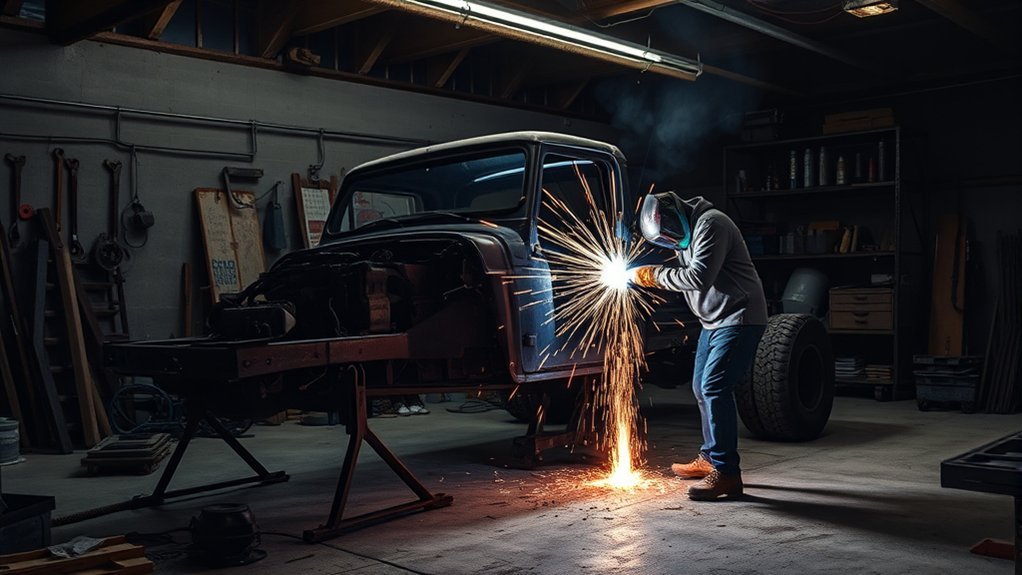
Being able to run a bead on scrap does not make a person ready to repair a load-bearing frame. The work requires material identification, crack removal, joint design, fit-up, distortion control, penetration, defect recognition, and knowledge of where welding is allowed.
Practice and mentorship are valuable for learning, but they do not make a first frame repair low-risk. Beginners can produce poor fusion, porosity, undercut, trapped slag, excessive heat, or a stress riser that looks acceptable from the outside.
Safety Precautions Needed
A welding helmet, gloves, and flame-resistant clothing are only the start. The work area needs ventilation, fire protection, safe vehicle support, and control of sparks and hot metal. Fuel vapors, undercoating, seam sealer, brake cleaner residue, wiring, batteries, airbags, electronic modules, and pressurized lines can create serious hazards.
| Safety Area | Minimum Concern | What Can Go Wrong |
|---|---|---|
| PPE and ventilation | Helmet, eye protection, gloves, protective clothing, and fume control | Arc injury, burns, or harmful fume exposure |
| Vehicle support | Rated lift or stands on a stable surface | Crushing injury or frame movement |
| Fire prevention | Remove or shield combustibles; keep extinguishing equipment and a fire watch | Hidden fire in undercoating, carpet, body cavities, or nearby parts |
| Vehicle systems | Follow OEM steps for batteries, modules, fuel, brake, and electrical components | Fire, explosion, damaged electronics, or system failure |
| Weld procedure | Correct material, joint, filler, process, and heat control | Cracking, distortion, weak fusion, or structural failure |
Get a professional frame assessment before considering any DIY work. If the repair affects a suspension mount, steering mount, hitch area, cab mount, crossmember, frame flange, or heavily rusted rail, professional repair or replacement is the prudent choice.
Equipment Investment Considerations
The welding machine itself is only one part of the DIY cost. A safe frame job may also require shielding gas, correct wire or electrodes, grinders, cutting and cleaning tools, clamps and fixtures, frame-measuring equipment, heavy vehicle support, ventilation, PPE, fire protection, corrosion coatings, and access to OEM repair information.
The tooling cost can exceed a shop quote, and buying equipment does not solve the engineering, inspection, or legal questions. For a one-time structural repair, hiring an experienced frame shop is usually the better value.
What Are the Signs Your Truck Frame Needs Repair?
- Visible cracks, split welds, or fresh rust lines around a bracket
- Rust holes, flaking layers, swelling seams, or metal that a professional finds seriously thinned or weakened
- A sagging rail, bent crossmember, shifted bed, or cab-to-bed gap that changed
- Doors, tailgate, or body panels that suddenly no longer align
- Uneven tire wear, a steering wheel that no longer centers, or a truck that pulls after an impact
- Clunks near suspension, steering, body, or hitch mounting points
- Cracks returning near an older frame repair
Some of these symptoms can come from suspension or body problems instead of the frame. A shop should measure and diagnose the vehicle before welding anything.
Community Insights on Pricing and Quality
Owners often focus on the final number, but two quotes can describe very different repairs. A low quote may cover only grinding and welding the visible crack. A higher quote may include removing the bed, measuring the frame, cutting back to sound metal, fabricating a section, reinforcing it as specified, restoring coatings, and checking alignment.
Online anecdotes can show what others paid, but they cannot tell you whether your rail material, damage location, or manufacturer procedure is the same. Use community prices as a conversation starter—not as proof that a quote is fair or a repair is safe.
How to Compare Truck Frame Welding Quotes
Ask each shop to inspect the same vehicle and provide a written scope. Then compare the repair, not just the total.
- What caused the damage? The estimate should address the cause, not only the crack.
- What OEM procedure applies? Ask for the vehicle-specific source and whether welding is permitted at that location.
- What material is the frame? The shop should identify the rail material before choosing the repair procedure.
- Will the frame be measured or straightened? Ask how alignment will be documented before and after repair.
- What will be removed or protected? Fuel, brake, electrical, body, suspension, and aftermarket components may affect labor and safety.
- What repair is included? Clarify crack removal, section replacement, reinforcement, filler, coating, sealers, and hardware.
- How will the repair be inspected? A visual check alone may not satisfy every OEM, engineering, or commercial requirement.
- Is there a written workmanship warranty? Ask for its length, exclusions, and whether commercial use, towing, rust, or overloading affects coverage.
- Will the shop document the work? Before-and-after photos, measurements, parts, procedure references, and invoices help with future service and resale disclosure.
Pro Tip: A strong estimate explains why the proposed repair is allowed, how the frame will be held and measured, and what happens if hidden rust or torn metal appears after disassembly.
Long-Term Value of Quality Repairs
A correctly designed repair can return a repairable truck to safe service, but it does not automatically raise resale value or erase a damage history. Keep the inspection report, OEM procedure, measurements, invoices, photos, and warranty. Disclose structural repairs when required by law or a sales agreement.
Compare the total repair cost with the truck’s actual value, remaining service life, rust condition, and planned use. For example, a $2,000 localized repair may make financial sense on an otherwise sound work truck. The same expense may be poor value on a heavily corroded truck with several weak areas and other costly problems nearby.
Sources
- Electronic Code of Federal Regulations, 49 CFR § 393.201 — commercial motor vehicle frame condition and manufacturer-recommendation requirements.
- GM Chassis Best Practices — frame materials, repair limits, welding precautions, reinforcement, and corrosion protection.
- GM Upfitter Bulletin 103 — battery disconnection, component protection, and a model-specific frame-rail replacement requirement.
- OSHA 29 CFR 1910.252 — welding fire prevention, protective equipment, ventilation, and related workplace requirements.
- American Welding Society Certified Welder Program — what performance-based welder certification verifies.
- Angi 2026 Welding Cost Data — general U.S. welding labor rates and common price factors.
- Wayne Truck & Trailer 2026 Frame Repair Cost Guide — commercial truck frame crack, rust, straightening, reinforcement, rail-replacement, and complete-frame planning ranges.
Frequently Asked Questions
How much does it cost to weld a truck frame?
A localized crack repair often falls around $500 to $2,500. Structural rust repair, straightening, reinforcement, body removal, or rail replacement can raise the total to several thousand dollars. The shop needs to inspect the full frame before giving a dependable price.
What materials are commonly used in truck frames?
Truck frame rails are generally steel, but the grade and strength can vary by make, model, and section. The repairer must identify the exact rail material and follow the manufacturer’s procedure instead of assuming one welding method works on every truck.
How long does a typical truck frame welding job take?
A small, accessible crack may be repaired in a day. Rust removal, frame straightening, body or bed removal, fabricated sections, coating cure time, parts delays, and alignment checks can extend the job to several days. A fixed four-to-eight-hour promise is not reliable without an inspection.
Can I weld a truck frame myself without experience?
No beginner should treat a truck frame as a first structural project. A safe repair requires material identification, an approved repair plan, correct fit-up and heat control, vehicle-system protection, inspection, and alignment verification. A poor repair can fail or damage fuel, brake, electrical, or suspension systems.
Can a rusted truck frame be repaired?
Sometimes. Surface corrosion may need cleaning and protection rather than welding. Localized structural rust may be repairable when enough sound metal remains and the manufacturer permits the proposed repair. Widespread corrosion, severely thinned metal, damaged mounting areas, or prohibited repair locations may require rail or frame replacement.
Is it safe to drive with a cracked truck frame?
Do not assume it is safe. A fresh frame crack, sagging, severe perforation, a shifted suspension or steering mount, or sudden steering and alignment changes require prompt professional inspection. If the truck shows those warning signs, have it towed rather than driving it to the shop.
What are the signs that my truck frame needs welding or repair?
Warning signs include visible cracks, rust holes, layered corrosion, bent rails, shifted mounts, changed body gaps, uneven tire wear, pulling, clunks, or a failed older repair. These symptoms require inspection; they do not prove that welding is the correct fix.
Is welding a truck frame legal?
It depends on the vehicle and applicable rules. For U.S. commercial motor vehicles, 49 CFR § 393.201 requires welded frame repairs to follow the manufacturer’s recommendations. Private trucks may face state inspection, title, registration, or insurance requirements, so check the OEM procedure and local rules before repair.
When should a damaged frame be replaced instead of welded?
Replacement may be necessary when the manufacturer prohibits welding, rail metal is torn or severely deformed, rust is widespread, several mounting points are damaged, or a previous repair has failed. The decision should come from vehicle-specific repair guidance and a qualified structural inspection.
Are there warranties for professional frame welding?
Some shops offer a workmanship warranty, but coverage is not universal. Ask for the terms in writing, including the time limit, covered welds or parts, rust exclusions, commercial-use limits, and whether towing, overloading, or later modifications affect coverage.
Conclusion
Truck frame welding cost is commonly about $500 to $2,500 for a localized, manufacturer-permitted crack repair, while structural rust, straightening, major disassembly, rail replacement, or complete frame replacement can cost far more. Do not choose a shop from price alone. Compare the OEM repair procedure, inspection and measurement scope, welding and fabrication work, corrosion protection, alignment checks, documentation, and warranty. When the rail is too damaged to repair within the manufacturer’s limits, replacement—or retiring the truck—is the safer decision.