Last updated: August 10, 2026
MIG welding gas cost depends on the gas mix, cylinder size, local refill or exchange pricing, and your actual flow rate. For mild-steel MIG, C25 (75% argon/25% CO2) is the common all-purpose choice, while 100% CO2 is usually cheaper but produces more spatter and a harsher arc. In a U.S. price check on August 10, 2026, filled C25 cylinders were listed at about $250 for 40 CF, $306 for 80 CF, and $370 for 125 CF at one online welding retailer; a participating retail exchange listed 125 CF of C25 gas at $69.99. Local prices and supplier fees can differ, so use these as current examples rather than a national average.
Quick Answer
- C25 (75% argon / 25% CO2) is a common all-purpose shielding gas for MIG welding mild steel. Pure CO2 usually costs less but creates more spatter and a rougher bead.
- Current filled-cylinder examples range from about $250 for 40 CF to about $370 for 125 CF from one U.S. online supplier, while other retail networks can charge more for the cylinder itself.
- A current 125 CF C25 fill/exchange example is $69.99 at participating Northern Tool locations; local gas suppliers may quote different prices and add handling or other fees.
- At 20 CFH, a 125 CF cylinder provides about 6.25 hours of theoretical gas-on time; at 25 CFH, about 5 hours.
- Buying can reduce long-term rental expense, but only if a nearby supplier will fill or exchange the customer-owned cylinder you plan to buy.

TERRO Multi-Surface Liquid Ant Baits provide a ready-to-use solution for managing common household ants by attracting workers and helping eliminate the colony at its source. The discreet bait stations use adhesive strips for flexible placement on walls, under cabinets, and other hidden spots, making them a convenient fit for indoor spaces. Designed for fast visible reduction in ant activity, they help keep your home protected with minimal effort.

This hardcover book celebrates the art of gathering with inspiring table settings, thoughtful traditions, and practical ideas for hosting memorable meals. Written by Shea McGee, it offers beautiful design inspiration alongside approachable guidance for creating warm, welcoming spaces for family and friends. It's a charming resource for anyone who loves entertaining, home styling, and making everyday moments feel special.

This hardcover cookbook offers fast, approachable recipes designed for busy days and low-energy nights. Caroline Chambers focuses on simple, flavorful meals that help you get dinner on the table without overthinking it. It's a practical pick for home cooks who want quick weeknight inspiration and minimal-fuss cooking.
Current MIG Welding Gas Price Examples
These are listed U.S. examples checked August 10, 2026, not guaranteed national averages. Gas pricing is local, and the same nominal cylinder size can cost very different amounts depending on whether the listing includes the cylinder, the gas, or both.
| What you are buying | Current listed example | Source / note |
|---|---|---|
| 40 CF C25 cylinder, filled | $249.95 | Weldfabulous |
| 80 CF C25 cylinder, filled | $305.99 | Weldfabulous |
| 125 CF C25 cylinder, filled | $369.95 | Weldfabulous |
| 125 CF C25 gas fill/exchange only | $69.99 | Northern Tool; participating stores |
| 125 CF C25 cylinder only | $499.99 | Northern Tool; gas sold separately |
The price spread is why you should separate cylinder acquisition cost from gas refill/exchange cost. For a narrower C25-only breakdown, see our 75/25 welding gas cost guide.
Common Gases Used for MIG Welding
Gas choice directly affects MIG performance, weld appearance, penetration, and cleanup. For mild steel, 75% argon/25% CO2 (C25) is a widely used all-purpose blend because it gives a smooth arc, relatively low spatter, and a clean bead profile.
Miller describes C25 as a common choice for mild-steel MIG and notes that 100% CO2 is a lower-cost alternative that generally produces more spatter and a more erratic arc. See Miller’s current MIG shielding-gas guidance.
For budget-focused mild-steel work, 100% CO2 can make sense if your welder is set up for it and you accept more cleanup. C25 is usually the easier choice when bead appearance and arc behavior matter more than the lowest gas cost.
Gas choice also depends on the base metal. Do not treat C25 as a universal MIG gas for aluminum or stainless steel. Follow the welder and filler-metal manufacturer’s recommendation for the material and transfer mode you are using.
When setting up equipment, match gas, voltage, wire feed speed, polarity, and flow to the machine chart or manual. There is no single flow number that fits every nozzle, draft condition, and transfer mode.
Typical Cylinder Sizes and Prices

Once you pick a gas mixture, cylinder size determines portability, theoretical gas-on time, and how often you need a refill or exchange. For home and light-shop MIG use, 40, 80, and 125 CF high-pressure cylinders are common sizes.
Current filled C25 examples checked August 10, 2026 were $249.95 for 40 CF, $305.99 for 80 CF, and $369.95 for 125 CF at Weldfabulous. Those prices show why a blanket “$100 to $725” range is not useful without saying whether the quote is for a filled cylinder, an empty cylinder, a local exchange program, or a supplier-specific ownership arrangement.
- 40 CF — compact and easier to move, but it empties quickly at normal MIG flow rates.
- 80 CF — a practical middle size for many hobby shops; theoretical runtime is about 4 hours at 20 CFH or 3.2 hours at 25 CFH.
- 125 CF — less portable but gives about 6.25 hours at 20 CFH or 5 hours at 25 CFH before real-world losses.
Larger cylinders can reduce refill trips and sometimes lower cost per cubic foot, but only if your local supplier will service that size and ownership type. Before buying online, call the supplier you expect to use and ask whether it will refill or exchange that exact customer-owned cylinder.
For a broader cylinder-price comparison, see our welding gas tank cost guide.
Refill Costs and Exchange Programs

Refill and exchange pricing is one of the most variable parts of MIG welding gas cost. A current example from Northern Tool lists a 125 CF 75/25 argon/CO2 fill or exchange at $69.99 at participating stores. That is a useful benchmark, not a national average.
Your actual invoice can differ because suppliers use different cylinder programs, account pricing, regional gas rates, testing policies, and line-item fees. A quote for “a 125 CF tank” is incomplete unless you know whether it means gas only, a cylinder purchase, a lease, or an exchange.
Compare the all-in invoice, not just the advertised gas price: cylinder ownership, refill/exchange charge, rental or lease fee, testing status, and any handling or hazardous-material fee can change the real cost.
Exchange programs can reduce downtime because you leave an empty cylinder and take a full one, but you may be limited to the program’s approved cylinder sizes and network. Some suppliers also decline customer-owned bottles that do not fit their policies.
To budget accurately, get at least two local written quotes and ask the same questions at each supplier: gas mix, cylinder size, ownership model, fill/exchange price, recurring rental fee if any, and extra fees.
Calculating Cost Per Hour and Per Project

The cleanest way to compare shielding-gas costs is to separate the one-time cylinder purchase from the recurring gas cost.
Theoretical gas-on hours = cylinder capacity (CF) ÷ flow rate (CFH).
Gas cost per gas-on hour = refill or exchange price ÷ theoretical gas-on hours.
Using the current $69.99 Northern Tool 125 CF C25 fill/exchange example:
| Flow rate | Theoretical 125 CF runtime | Gas cost per gas-on hour |
|---|---|---|
| 20 CFH | 6.25 hours | About $11.20/hour |
| 25 CFH | 5.0 hours | About $14.00/hour |
| 30 CFH | About 4.17 hours | About $16.80/hour |
Those figures are theoretical. Real cylinder life is shorter because gas can flow during starts and stops, hoses and regulators hold residual gas, and leaks or excessive flow waste contents. Shop elapsed time will usually be much longer than “gas-on” time because most welders are not holding the trigger continuously.
For project estimating, multiply the expected arc-on gas time by your calculated gas cost per hour. Keep cylinder purchase cost separate unless you specifically want a payback or total-cost-of-ownership calculation.
How Long a Tank Lasts at Different Flow Rates

Divide the cylinder’s cubic-foot rating by the selected flow rate to estimate continuous shielding-gas time. For typical mild-steel MIG work indoors, 20–25 CFH is a more useful starting range than 10–15 CFH for many standard nozzles, but your machine chart and actual conditions take priority.
| Cylinder size | 20 CFH | 25 CFH | 30 CFH |
|---|---|---|---|
| 40 CF | 2.0 hours | 1.6 hours | 1.33 hours |
| 80 CF | 4.0 hours | 3.2 hours | 2.67 hours |
| 125 CF | 6.25 hours | 5.0 hours | 4.17 hours |
These are theoretical gas-on times. Drafts, nozzle size, pre-flow or post-flow settings, leaks, and frequent starts can reduce usable time.
Do not assume every full high-pressure cylinder starts at exactly 2,015 psi. Service pressure varies by cylinder specification. For high-pressure argon/CO2 blends, the contents gauge can give a rough indication when temperature is stable, but the cylinder label and supplier data are the correct reference. For liquefied CO2 cylinders, pressure is not a reliable “fuel gauge” while liquid CO2 remains; weight is the better contents check.

The U.S. Polo Assn. Women's Analog Watch blends classic style with everyday versatility, featuring a gold-tone dial, Roman numeral markers, and a crystal-embellished bezel for a polished look. Its stainless steel bracelet adds durability and comfort, while the adjustable fit makes it suitable for wrists from 5.5" to 8". Designed to elevate both formal and casual outfits, this timepiece offers an elegant finishing touch for any occasion.

This versatile cookware set equips home cooks with essential pots, pans, and a steamer insert for everyday meals and larger gatherings. The aluminum-encapsulated base promotes quick, even heating, while Cool Grip handles and tight-fitting glass lids support comfortable, controlled cooking. Designed for stovetop, oven, broiler, and dishwasher use, it offers reliable performance across a wide range of recipes.

OFF! Backyard Mosquito Repellent Coil Refills help create a more comfortable outdoor space by repelling mosquitoes in semi-confined areas like porches, patios, and similar spots with minimal breeze. Each coil provides up to four hours of protection and helps cover an area up to 10 ft x 10 ft while leaving a Country Fresh scent behind.
Bottle Ownership vs. Leasing: Which Saves Money?
There is no universal winner because cylinder programs differ by supplier. Ownership can eliminate recurring rental charges, while leasing or rental lowers the upfront cylinder cost and leaves cylinder testing and program management with the supplier.
The best choice depends on how often you weld, how long you will keep the cylinder, and whether local suppliers will service customer-owned bottles.
Buy: Upfront Cost Higher
Buying requires more cash at the start. Current U.S. examples show a filled 125 CF C25 cylinder around $369.95 from one online welding retailer, while a separate retail network lists a 125 CF cylinder at $499.99 with gas sold separately.
After purchase, you normally pay for gas fills or exchanges rather than a recurring cylinder rental. That can lower long-term cost for a regular hobbyist or small shop, but only if your chosen supplier accepts the cylinder.
Before buying, confirm:
- The supplier will fill or exchange a customer-owned cylinder of that exact size and gas service.
- The cylinder is within the required test/requalification period and has acceptable ownership markings.
- You understand whether an exchange means receiving a different physical cylinder from the program.
Do not modify, repair, or mix gases in a cylinder yourself. OSHA rules for welding cylinders state that gas mixing in cylinders is for the gas supplier, and cylinders must meet applicable DOT requirements. See OSHA 1926.350.
Lease: Lower Initial Expense
Leasing or renting avoids the full cylinder purchase price, but the fee structure varies. Do not assume that rental automatically includes gas refills, a refundable deposit, or maintenance beyond the supplier’s cylinder program; ask for the terms in writing.
A lease can make sense when you need a larger industrial cylinder, expect short-term use, want the supplier to handle cylinder testing, or cannot find a local shop that services privately owned bottles.
For high-use shops, compare annual all-in cost rather than only the first invoice. Include rental or lease fees, gas charges, exchange charges, delivery, and supplier-specific fees.
| Factor | Leasing | Ownership |
|---|---|---|
| Initial cost | Usually lower | Higher |
| Recurring cylinder fee | Often yes | No rental fee |
| Gas/refill pricing | Supplier terms apply | Supplier terms apply |
| Testing responsibility | Supplier program | Owner must keep cylinder eligible for service |
| Supplier flexibility | Usually limited to lessor | Potentially broader, but local policies still apply |
Alternatives to Shielding Gas for MIG
When shielding-gas cost or cylinder logistics are a problem, self-shielded flux-cored wire is the closest wire-feed alternative because it does not require an external gas cylinder. Stick welding also avoids external shielding gas.
Self-shielded flux-cored wire is useful for outdoor repairs because wind that would disturb a gas shield is less of a problem. The trade-offs are process-dependent, but commonly include more smoke, slag, and cleanup than solid-wire MIG with C25.
Stick welding is another practical outdoor option and works well for many repair and fabrication jobs, especially where portability matters more than a clean, low-spatter finish.
Do not assume a “gasless MIG” setup is automatically cheaper for every job. Compare wire cost, cleanup time, deposition rate, base-metal thickness, and the type of weld you need.
- No external gas cylinder for self-shielded flux-cored wire.
- Better tolerance of outdoor air movement than gas-shielded MIG.
- Different slag, smoke, spatter, and cleanup requirements.
Where to Buy or Refill Welding Gas

Welding gas is sold through local industrial-gas suppliers, welding-supply stores, farm and tool retailers with exchange programs, and some online vendors that ship filled DOT-rated cylinders.
Do not choose a cylinder based only on the online purchase price. First verify who will service it locally, whether they refill or exchange, which sizes they accept, and what ownership paperwork or markings they require.
Local Gas Suppliers
Local gas suppliers can offer refill, exchange, rental, lease, or purchase programs. The exact model varies by branch and market, so statements such as “most suppliers only lease” are too broad to rely on.
Ask for an all-in quote that includes the gas mix, cylinder size, ownership model, refill/exchange price, recurring fees, and any handling or hazardous-material charges.
- Independent welding supplier: may offer flexible owner-cylinder service, but policies differ.
- National industrial-gas chain: may have account, lease, delivery, and exchange programs.
- Retail exchange network: convenient, but limited to participating locations and approved cylinder sizes.
Distance matters too. A slightly cheaper fill can cost more overall if it requires a long drive or causes project downtime.
Big-Box Retailers
Some large retailers participate in cylinder exchange programs, but availability and cylinder sizes vary by location. Do not assume Home Depot, Lowe’s, or another chain will refill a privately owned C25 bottle simply because it sells welding equipment.
Northern Tool currently lists a Thoroughbred 125 CF C25 gas fill/exchange for $69.99 at participating stores and a separate 125 CF cylinder listing at $499.99 with gas sold separately. That distinction shows why the shelf price alone can be misleading.
Before driving to a store, verify local stock, whether the transaction is a refill or exchange, and whether your cylinder is eligible.
Online Tank Vendors
Online vendors can be useful for buying a new, certified cylinder, especially when local cylinder purchase prices are high. Current listings from Weldfabulous and PrimeWeld show multiple C25 sizes available for purchase.
However, an online seller cannot guarantee that every local gas supplier will accept your bottle. PrimeWeld states its cylinders are DOT 3AA certified and refillable, while other retailers still advise buyers to confirm local refill policy before ordering.
Use this sequence before buying online:
- Choose the gas and cylinder size your welder and workload need.
- Call at least two nearby gas suppliers and ask whether they service customer-owned bottles of that size.
- Compare the online cylinder cost plus shipping against a local first-purchase or exchange-program price.
Tips to Reduce Gas Consumption and Waste
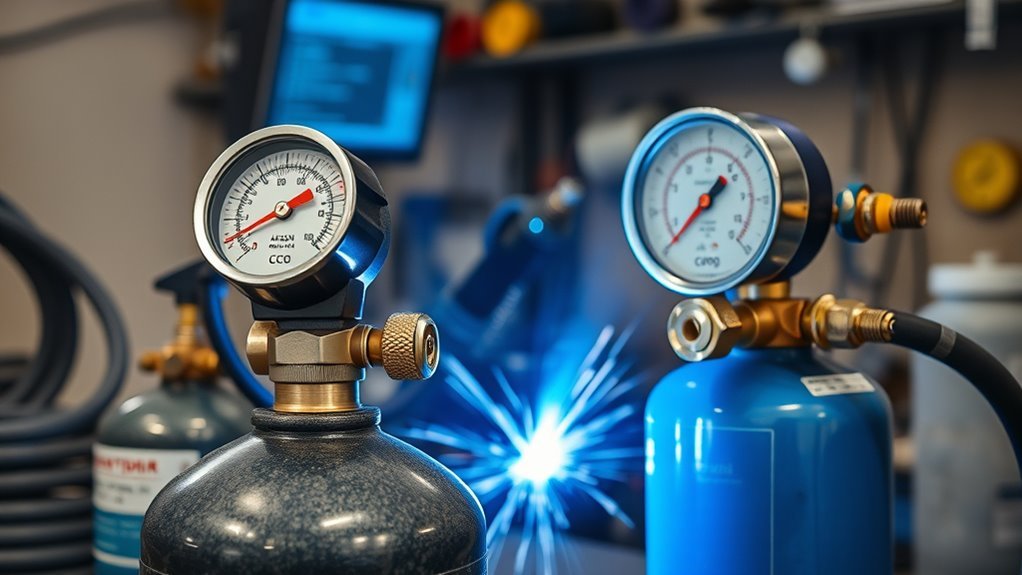
Reducing shielding-gas cost starts with using enough flow for good coverage without turning the flowmeter higher than the job needs. For many standard indoor MIG setups, 20–25 CFH is a practical starting range. Increase only when the machine guidance, nozzle size, or air movement requires it.
Too little flow can lead to porosity and oxidation. Too much flow wastes gas and can create turbulence around the nozzle. Set flow while gas is actually flowing, then make a test weld and inspect the result.
Keep the nozzle clean, use the correct nozzle size, protect the weld area from drafts, and keep the gun angle and stickout consistent. These steps help the gas shield do its job without excessive CFH.
Check hoses, regulator connections, and fittings for leaks using a method approved for your equipment. Close the cylinder valve when the system is not in use.
Operator habits matter. Repeated restarts, unnecessary trigger time, and correcting avoidable defects all consume gas. Track cylinder changes and typical settings so you can spot abnormal usage.
Hidden Fees and Supplier Policies to Watch For
The biggest cost surprise is often not the gas itself. It is the difference between a cylinder purchase, a contents-only refill, an exchange program, and a rental or lease agreement.
Before committing, ask for the full fee schedule and confirm whether the supplier charges separately for delivery, handling, hazardous materials, testing, or account service. Do not assume those fees exist everywhere or cost the same amount.
Rental and Lease Traps
A rental or lease can become expensive when recurring fees continue through long periods of light use. The opposite can also happen: buying a cylinder can be a poor choice if no nearby supplier will service it.
Compare the options over the period you expect to keep the bottle. A simple three-year model should include:
- Purchase option: cylinder price + expected fills/exchanges + any required service or testing costs.
- Rental/lease option: recurring rental/lease fees + gas charges + delivery or service fees.
- Exchange program: first-cylinder cost + exchange charges + any size or network restrictions.
Use written local quotes for the model. A forum anecdote or old national estimate is not a substitute for current supplier terms.
Hidden Refill Charges
Line-item fees can change the effective refill price. Ask whether the quoted amount already includes hazardous-material, handling, environmental, delivery, testing, or account charges.
Also ask what happens if your cylinder is out of test, damaged, from another supplier, or larger than the branch normally handles. A low advertised gas price is not useful if your bottle is not eligible for service.
Keep invoices and compare the total paid per cubic foot over time. That makes price increases and extra fees easier to spot.
Bottle Ownership Rules
Cylinder ownership is not just a receipt issue. Suppliers may use stamped markings, serial numbers, lease records, and exchange-program rules to decide whether they can accept a bottle.
Before buying a used or online cylinder, verify the ownership status, test date, gas service, valve connection, and whether your intended supplier will accept it. Never grind off, alter, or obscure cylinder markings.
OSHA welding-cylinder rules require proper handling and state that only the gas supplier should mix gases in a cylinder; cylinders also must meet applicable DOT requirements. See OSHA’s gas welding and cutting standard.
Frequently Asked Questions
How Much Does a 125 CF C25 Refill or Exchange Cost?
There is no single U.S. price. As one current benchmark checked August 10, 2026, Northern Tool lists a 125 CF 75/25 argon/CO2 fill or exchange at $69.99 at participating stores. Local industrial-gas suppliers may charge more or less, and fees can change the final invoice.
How Long Does an 80 CF MIG Gas Cylinder Last?
At 20 CFH, an 80 CF cylinder provides about 4 hours of theoretical gas-on time. At 25 CFH, it provides about 3.2 hours. Actual life is usually shorter because of starts, stops, leaks, and other losses, while elapsed shop time can be much longer because you are not welding continuously.
Is C25 or 100% CO2 Cheaper for MIG Welding?
100% CO2 is usually the lower-cost shielding-gas option for compatible mild-steel MIG work. C25 costs more but generally gives a smoother arc, less spatter, and a cleaner bead. Choose based on total job cost, including cleanup time, not gas price alone.
Should I Buy or Rent a Welding Gas Cylinder?
Buying often makes sense for regular hobby or small-shop use because it avoids recurring rental fees. Renting or leasing can make more sense for short-term use, large industrial cylinders, or suppliers that do not service customer-owned bottles. Compare local three-year all-in costs before deciding.
Can I Mix Gases Myself to Save Money Safely?
No. Do not attempt to blend welding gases inside a cylinder yourself. OSHA’s welding-cylinder rules state that no person other than the gas supplier should attempt to mix gases in a cylinder. Buy the specified premix or use an approved professional gas-supply system.
Conclusion
MIG welding gas cost is easiest to control when you separate four numbers: cylinder purchase or rental cost, refill/exchange price, cylinder capacity, and actual CFH. Current August 2026 U.S. examples put a filled 125 CF C25 cylinder around $369.95 at one welding retailer and a 125 CF C25 gas fill/exchange at $69.99 at a participating retail network. At 20–25 CFH, that 125 CF bottle provides roughly 5–6.25 theoretical gas-on hours.
For the best value, get two local all-in quotes before buying a bottle, confirm the supplier will service the cylinder you want, and calculate cost per gas-on hour with your real flow setting. Choose C25 when smoother arc behavior and lower spatter matter; consider 100% CO2 for compatible mild-steel work when the lower gas cost outweighs the extra cleanup.

This daily devotional helps parents pray purposefully for their children through a full year of Scripture readings, reflections, and guided prayer prompts. Written to encourage faithful family discipleship, it offers practical, biblically grounded support for parents who want to shape their prayers around God's Word. A foreword by Sinclair B. Ferguson adds trusted theological insight and encouragement.

This heartfelt memoir blends laugh-out-loud honesty with tender reflections on love, loneliness, and the unexpected healing power of rescue dogs. Isabel Klee shares her journey fostering pups in the city while navigating dating and self-discovery, offering an intimate, relatable story for readers who enjoy emotional, character-driven narratives. It is a warm, engaging read about opening your heart and finding connection in surprising places.

Die With Zero offers a fresh perspective on personal finance by encouraging readers to use money intentionally to create memorable life experiences instead of simply accumulating wealth. Written by Bill Perkins, this book combines practical guidance with a motivating philosophy to help readers align spending, saving, and life goals for a more fulfilling future.