The average cost of MIG welding equipment runs from a few hundred dollars for a basic home-shop machine to well over $10,000 for an industrial production system. The machine price is only part of the budget. Shielding gas, wire, PPE, a spool gun for aluminum, a cart, consumables, electrical work, and replacement parts can all increase your real cost. The best value comes from matching input power, amperage, duty cycle, material capability, and service support to the work you actually plan to do.
Quick Answer
For 2026 budgeting, expect roughly $300–$850 for many entry-level MIG machines, about $800–$2,500 for serious hobby and light-fabrication equipment, roughly $3,500–$5,000 for many professional shop machines, and $10,000 or more for industrial power sources and production packages. Accessories and shop setup can add substantially to the machine price.
Key Takeaways
- A basic 120V MIG welder can cost a few hundred dollars, while dual-voltage and professional machines commonly move into four-figure prices.
- Do not compare welders by maximum amperage alone. Check the rated output and duty cycle at the amperage you expect to use.
- Your ready-to-weld budget may also include gas, wire, PPE, a cart, a spool gun, a suitable electrical circuit, and ventilation equipment.
- Self-shielded flux-cored welding can be useful outdoors, but it is FCAW rather than gas-shielded MIG/GMAW.
- For aluminum, confirm spool-gun or push-pull compatibility before buying; the required accessories can materially change the total price.
Price note: The examples below were checked on August 10, 2026. Welding-equipment prices, rebates, packages, and availability change frequently, so treat them as current examples rather than permanent nationwide averages.
What Is a MIG Welder and How It Works
A MIG welder uses an electric arc between the workpiece and a continuously fed consumable wire electrode. The technical name for the process is gas metal arc welding (GMAW). A shielding gas flows through the gun to protect the molten weld pool from atmospheric contamination. Miller’s MIG welding guide explains the same basic process.
MIG is popular for automotive repairs, fabrication, farm work, metal art, maintenance, and light production because the wire feeds automatically and the process can be relatively quick to learn.
Do not confuse true gas-shielded MIG with self-shielded flux-cored arc welding (FCAW). Both use continuously fed wire, and many machines support both processes, but self-shielded flux-cored wire creates its own shielding system and normally does not require an external gas cylinder. That can make it more practical in windy outdoor conditions where MIG shielding gas can be disturbed.
When comparing machines, verify the supported wire diameters, input voltage, rated output, duty cycle, polarity options, spool size, shielding-gas equipment, and whether the machine supports solid wire, flux-cored wire, or both.
Warning: Welding creates intense light, sparks, hot metal, electrical hazards, and potentially harmful fumes. Keep combustible materials away, use appropriate welding PPE, secure compressed-gas cylinders, and provide suitable ventilation or fume control. Never weld a closed container or a container that previously held flammable material unless it has been properly prepared for hot work.
Average Cost of MIG Welding Equipment: Price Ranges by Tier
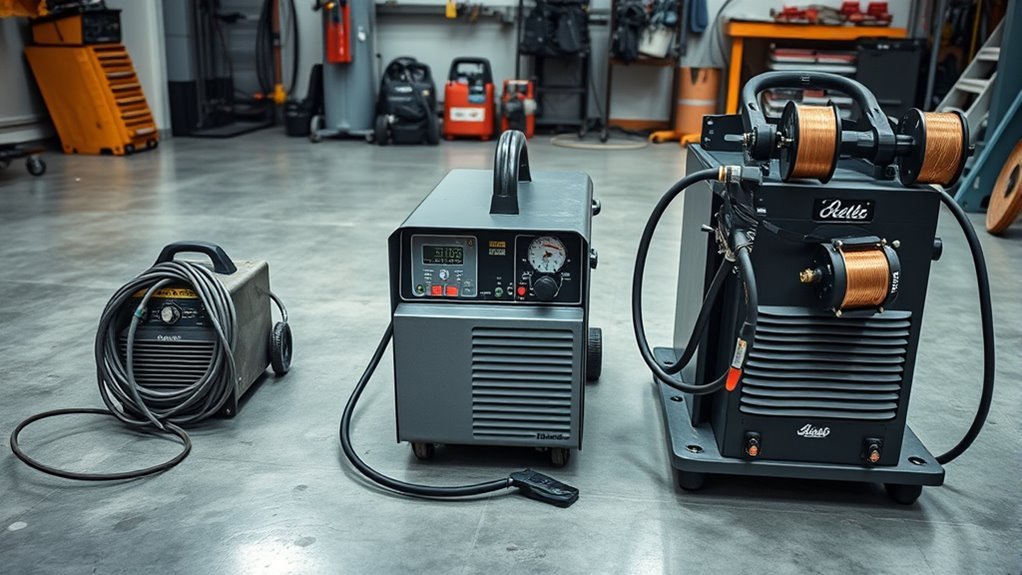
MIG welder prices cover a much wider range than one simple average suggests. A compact 120V garage machine and a 500-amp production system are both called MIG welders, but they serve completely different workloads.
| Price Tier | Planning Range | Typical Buyer / Use |
| Entry level | About $300–$850 | DIY repairs, sheet metal, occasional garage work |
| Serious hobby / light fabrication | About $800–$2,500 | Auto work, farm repairs, fabrication, dual-voltage use |
| Professional / light industrial | About $3,500–$5,000+ | Daily shop fabrication and higher-duty-cycle work |
| Industrial / production | About $10,000–$30,000+ for many configured systems | High-output manufacturing, advanced feeders, automation |
These are planning bands rather than strict category boundaries. Current examples illustrate the spread. Harbor Freight lists its Titanium MIG 140 around $500, while Home Depot has listed the Lincoln Weld-Pak 140 in roughly the $700–$800 range depending on the promotion and date.
Higher up, the Hobart Handler 210MVP has recently been listed around $1,185, while Lincoln publishes a $1,999 MSRP for the POWER MIG 215 MPi.
Professional shop equipment costs more. A Lincoln POWER MIG 260 has recently been listed around $3,899. Industrial Miller Deltaweld configurations can move beyond $10,000, with complete power-source, feeder, and production packages costing substantially more.
The useful question is not simply “How much is a MIG welder?” but “How much is a MIG setup that can perform my work at the required output and duty cycle?”
Entry-Level Price Points
At the lower end, roughly $300–$850 covers many 120V machines intended for home, auto-body, maintenance, and occasional fabrication work. Some very inexpensive units cost less, but verify whether the machine performs true gas-shielded MIG or only self-shielded flux-core welding.
A lower-cost welder may have less output, a shorter gun, smaller wire-spool capacity, fewer adjustment options, a lower duty cycle at higher amperage, or limited aluminum support. That does not automatically make it a poor purchase; those limitations may be irrelevant if you mainly weld thin steel for short periods.
Before buying, confirm:
- Input voltage and required circuit
- Rated output and duty cycle
- Minimum and maximum material thickness recommended by the manufacturer
- Supported solid and flux-cored wire diameters
- Whether a regulator and gas hose are included
- Spool-gun compatibility if aluminum is planned
- Replacement gun, liner, drive-roll, and consumable availability
- Warranty coverage and authorized service options
Professional & Industrial Ranges
Professional shop machines often cost several thousand dollars because they provide greater output, longer duty cycles, more robust wire-feed systems, larger spool capacity, better aluminum options, digital controls, saved programs, pulse capability, or support for separate wire feeders.
Industrial production systems can go much higher. A power source alone may cost around $10,000, while configured packages with advanced feeders, dual-wire setups, monitoring, push-pull guns, carts, boom systems, or automation interfaces can run well into five figures.
For production work, the cheapest purchase price may not create the lowest cost per weld. A machine that prevents overheating, feeds wire consistently, supports readily available consumables, and can be serviced quickly may reduce downtime enough to justify a higher initial price.
What Specifications Affect MIG Welder Cost Most?
Several specifications explain why one MIG welder costs $500 and another costs $4,000 even when both appear to have similar maximum amperage numbers.
120V vs. 240V Input Power
A 120V machine is convenient because it can run from an appropriate household-style circuit, making it useful for sheet metal and lighter fabrication. A 240V machine can generally deliver more useful welding output for thicker material. Dual-voltage machines provide both options and often cost more.
Remember that buying a 240V welder may create an additional shop cost if you do not already have a suitable circuit and receptacle. Electrical work should be sized and installed according to the welder manufacturer’s requirements and applicable electrical codes.
Rated Output and Duty Cycle
Maximum amperage tells you the top end of a machine’s output, but it does not tell you how long the machine can sustain that output. For that, check the duty cycle.
Duty cycle is normally expressed as a percentage of a 10-minute period at a stated output. A 60% rating at a particular amperage means the machine can weld for six minutes of that 10-minute test period at that rated output before requiring the specified cooling time. Miller provides a detailed duty-cycle explanation.
Pro Tip: Compare duty cycles only when you also compare the amperage and input voltage at which those ratings were measured. “60% duty cycle” by itself is incomplete information.
Material Thickness and Aluminum Capability
The thicker the material you need to weld in a single pass, the more output you generally need. Joint design, welding position, wire size, shielding gas, and process also affect the required settings, so use the manufacturer’s application chart rather than relying on amperage alone.
Aluminum can increase the equipment budget. Soft aluminum wire can be difficult to push through a long conventional MIG gun liner, so many home and light-fabrication setups use a compatible spool gun that holds a small wire spool close to the gun. Higher-production systems may use push-pull feeding.
Miller’s aluminum MIG equipment guidance recommends checking spool-gun compatibility before purchasing because different guns are designed for specific machines and duty cycles.
Brand Comparisons and Value by Feature
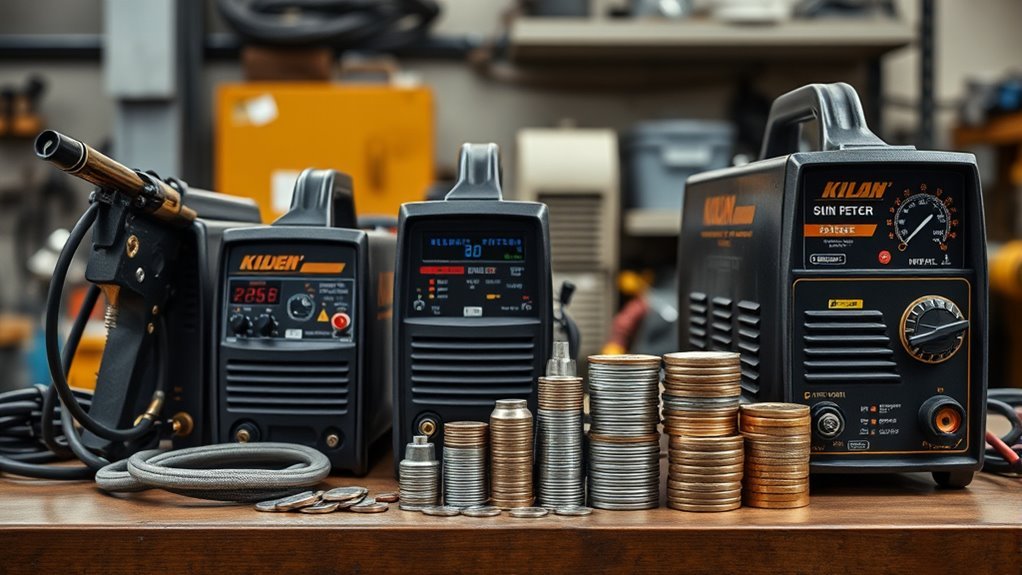
Brand alone should not decide your purchase. Compare the exact model’s output, duty cycle, input voltage, included equipment, aluminum capability, service network, warranty, and replacement-part availability.
- Miller: The current Millermatic 211 PRO is a 120/240V MIG/flux-cored machine with a published 30–230A amperage range. Miller rates it at 160 A at 22 VDC with a 60% duty cycle on 240V input. Features include Auto-Set, Dyna-Pulse, memory settings, and a 15-foot MIG gun.
- Lincoln Electric: The POWER MIG 215 MPi is a multi-process unit supporting MIG, flux-cored, stick, and DC TIG. Lincoln lists an MSRP of $1,999 for the base machine, with more expensive aluminum and TIG packages.
- Hobart: The Handler 210MVP supports 120/240V input, has a 25–210A range, and is specified for steel from 24 gauge through 3/8 inch. It is spool-gun ready for compatible Hobart equipment.
- ESAB: The Rebel EMP 205ic AC/DC is a higher-feature multi-process system supporting MIG/MAG, flux-core, stick, DC TIG, and AC TIG. ESAB lists 120/230V input and a three-year warranty for the system.
For a hobbyist, spending extra for pulse welding, large memory banks, advanced displays, or production networking may provide little value. A fabrication shop using the machine every day may reach the opposite conclusion.
Accessories and Add-Ons That Affect Total Cost
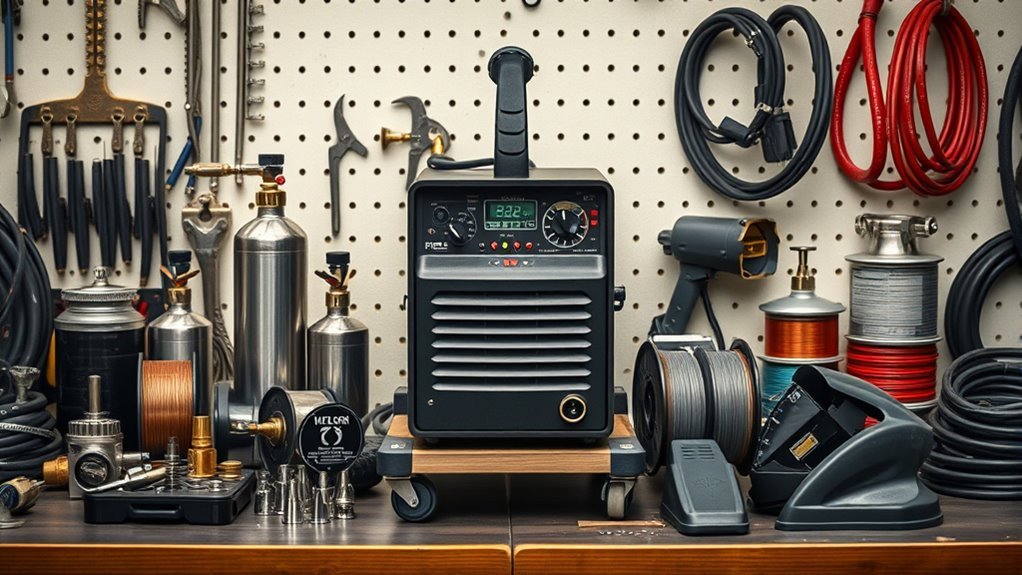
The welder is only one part of a complete setup. Accessories can turn an inexpensive machine into a much larger purchase, particularly when you need aluminum capability or a permanent fabrication station.
A machine advertised at $800 is not necessarily an $800 welding setup. Compare what is included in the box before comparing final prices.
Common additional purchases include:
- Shielding-gas cylinder, cylinder deposit, rental, lease, exchange, or refill
- Regulator or flowmeter if not included
- Solid MIG wire or flux-cored wire
- Welding helmet, gloves, jacket, safety glasses, and appropriate footwear
- Welding cart or cylinder rack
- Replacement contact tips, nozzles, diffusers, liners, and drive rolls
- Spool gun or push-pull gun for aluminum
- Longer or higher-capacity MIG gun
- Suitable extension cord when permitted by the manufacturer
- Fume extraction or other ventilation equipment
- A suitable 240V circuit and receptacle when required
A current retail example shows a Hobart SpoolRunner 100 around $250, demonstrating why aluminum capability can add a few hundred dollars even before aluminum wire and shielding gas are purchased.
Check compatibility by exact model number. A spool gun, drive roll, liner, or gun connector that physically resembles another part is not automatically compatible with your welder.
Operating Costs: Gas, Wire, Maintenance, and Duty Cycle
Your recurring MIG welding expenses come mainly from filler wire, shielding gas, gun consumables, electricity, maintenance, and labor or downtime. There is no useful nationwide flat operating-cost figure because usage and local supplier prices vary so widely.
A practical calculation is:
Project operating cost = wire consumed + shielding gas consumed + wear parts + electricity + allocated maintenance + downtime.
For home use, wire and gas may dominate the recurring material cost. For a production shop, labor and downtime can be much more important than a small difference in consumable price.
Gas and Wire Expenses
Shielding-gas pricing depends on the gas blend, cylinder size, supplier, location, and whether you own, rent, lease, refill, or exchange the cylinder. Because those arrangements differ significantly, statements such as “a gas cylinder costs $20–$50” are not dependable national estimates.
When requesting a gas quote, ask separately about:
- Cylinder purchase, deposit, lease, or rental charge
- Initial fill
- Refill or exchange price
- Hazardous-material or delivery charges
- Available cylinder sizes
- Price of the gas blend required for your work
Wire also costs far more than pennies per pound. As one current example, Tractor Supply has listed a 10-lb spool of Hobart ER70S-6 solid steel MIG wire at $79.99, or roughly $8 per pound. Different brands, alloys, spool sizes, and wire diameters can cost more or less.
For mild steel, common gas choices include 100% CO2 and argon/CO2 blends. Your wire classification, transfer mode, material, machine settings, and desired bead characteristics should determine the gas rather than price alone.
Pro Tip: Record the spool weight and gas-cylinder size along with the number of projects completed. Your own shop history will produce a far more accurate cost-per-project estimate than a national consumable average.
Maintenance and Duty Cycle
MIG guns contain wear items that need periodic attention. Contact tips wear because the energized wire passes through them continuously. Nozzles collect spatter, liners can become contaminated, and drive rolls must match the wire type and diameter.
Routine maintenance should include inspecting the gun cable, work lead, work clamp, liner, drive rolls, connections, gas hose, regulator, cooling openings, and consumables according to the owner’s manual.
Duty cycle affects operating cost through downtime. A machine with a low duty-cycle rating at the amperage required for your work may force cooling stops during long welds. A higher-capacity machine costs more initially but can be economically preferable when labor and production time are valuable.
Do not assume that every inexpensive machine has a poor duty cycle or every expensive machine has a high one. Read the exact rating on the manufacturer’s data sheet.
Hidden Setup Costs Before You Buy
A first-time buyer should budget beyond the welder itself. Some machines include a gun, regulator, gas hose, work clamp, drive rolls, contact tips, and sample wire, while others provide only part of that setup.
Potential one-time costs include a helmet and protective clothing, welding table, clamps, grinder, cylinder cart, gas cylinder arrangement, fire extinguisher, fume extractor, and electrical work.
A 240V welder can be excellent value if the circuit already exists. If it does not, the electrical installation may become one of the largest setup expenses. The required conductor size, breaker, receptacle, and circuit design depend on the welder and electrical installation, so follow the manufacturer’s instructions and applicable codes rather than copying another shop’s setup.
Note: Compare “machine only” prices carefully against packages. A higher-priced package may already include a cart, spool gun, TIG equipment, longer gun, regulator, or other accessories you would otherwise purchase separately.
Choosing the Right Welder for Your Application and Budget
Start with the work rather than the brand. Write down the material, thickness range, welding location, available electrical supply, expected arc-on time, and whether you need aluminum capability.
For occasional sheet-metal and light-steel repairs, a compact 120V machine may be sufficient. For thicker fabrication or frequent shop work, dual-voltage or 240V equipment generally provides more useful output and headroom.
Use this buying sequence:
- 1. Identify the material: mild steel, stainless steel, aluminum, or a combination.
- 2. Identify the normal thickness range: buy for the work you perform regularly, not an unlikely once-a-year maximum.
- 3. Check available power: 120V, 240V, or industrial three-phase power.
- 4. Compare rated output: do not rely only on the advertised maximum amperage.
- 5. Compare duty cycle: use the rating at an amperage close to your expected work.
- 6. Check wire and spool capacity: larger spools can reduce changeovers in regular shop use.
- 7. Verify aluminum equipment: confirm compatible spool-gun or push-pull options before purchase.
- 8. Price the complete setup: include gas, wire, PPE, cart, electrical work, ventilation, and accessories.
- 9. Check serviceability: look for replacement guns, liners, tips, drive rolls, circuit boards, and local service.
- 10. Read the warranty: coverage often differs between the power source, electronics, guns, torches, and accessories.
The lowest-priced machine can be a good buy when it comfortably covers your workload. Buying too little machine becomes expensive when you later need a spool gun the unit cannot accept, more amperage than it can deliver, or a duty cycle it cannot sustain.
Safety and Garage Setup
Cost matters, but a welding setup should not be designed around price at the expense of fire and fume control. The U.S. Occupational Safety and Health Administration’s welding, cutting, and brazing requirements cover fire prevention, PPE, ventilation, confined spaces, and hazardous coatings in covered workplaces.
NIOSH also warns that welding fumes contain metals and can present respiratory and neurological hazards depending on the process and material. Its current welding-fume guidance specifically discusses manganese exposure.
For a home garage or shop:
- Remove or protect combustible materials from sparks and hot metal.
- Do not weld near gasoline, solvents, aerosols, propane leaks, or other flammable vapors.
- Keep suitable fire-extinguishing equipment accessible.
- Use a welding helmet with the appropriate lens protection plus safety glasses and protective clothing.
- Provide effective ventilation or fume capture appropriate to the material and process.
- Be especially cautious with galvanized, painted, plated, stainless, lead-containing, or otherwise coated metals.
- Secure compressed-gas cylinders upright and protect them from damage.
- Keep the work lead and electrical connections in good condition.
- Follow the welder’s electrical requirements rather than overloading an unsuitable circuit or extension cord.
Warning: A respirator is not a universal replacement for ventilation or fume extraction. Respiratory protection must be appropriate for the actual hazard, and workplace programs may require exposure assessment, medical evaluation, fit testing, and other controls.
Financing, Warranties, and Promotions to Lower Upfront Cost
Financing can make a higher-capacity machine easier to purchase, but compare the total amount repaid rather than only the monthly payment. Check APR, loan term, fees, and deferred-interest conditions before deciding that financing lowers your cost.
Manufacturer and retailer promotions can also reduce the upfront price through rebates, package discounts, free accessories, or temporary sale pricing. These offers change frequently, so confirm the current terms on the day you buy.
Warranty coverage deserves equal attention. Do not assume every part of a welder receives the same term. For example, Hobart advertises a 5/3/1 industrial warranty in which coverage length varies by component, while Miller publishes its own True Blue warranty. ESAB lists a three-year warranty for the Rebel EMP 205ic AC/DC power source.
Before paying extra for a third-party protection plan, compare it with the manufacturer’s existing coverage, exclusions, deductible, shipping requirements, and local service options.
Frequently Asked Questions
How Much Does MIG Training or Certification Typically Cost?
Training prices vary enormously because a short introductory class, community-college course, and full welding program are different products. For AWS Certified Welder certification, the AWS 2026 price list shows a $70 Certified Welder application fee. AWS says the practical examination fee is set by the individual Accredited Test Facility, so contact the facility for its testing, plate, retest, and related charges.
Can MIG Welding Be Safely Done in a Residential Garage?
It can be possible to weld in an appropriately prepared garage, but the space must be managed as a hot-work area. Remove combustible materials and flammable vapors, provide appropriate ventilation or fume capture, use welding PPE, secure gas cylinders, use a suitable electrical circuit, and consider nearby people who could be exposed to arc radiation or fumes. Local fire, building, insurance, or property rules may also apply.
Are Used MIG Welders a Good Value Versus New Ones?
A used MIG welder can be good value when the machine can be tested under load and replacement parts remain available. Inspect the gun, liner, wire-feed drive, work lead, clamp, power cord, connectors, fan, gas system, controls, and spool-gun port. Confirm the exact model number and compare the used price with current new and factory-reconditioned prices before buying.
What Are Typical Resale Values for MIG Welders Over Time?
There is no dependable universal depreciation percentage. Resale value depends on the original brand and model, current new price, age, condition, accessories, warranty status, service history, local demand, and whether the machine is still supported with parts. Compare recent sold prices for the exact model rather than applying a fixed annual depreciation formula.
Do Insurance Policies Affect Owning or Operating a MIG Welder?
They can. Coverage and exclusions differ by insurer, property type, and whether welding is personal or commercial. If you weld regularly, operate a business from the property, or store compressed-gas cylinders, ask your insurer how the policy treats those activities rather than assuming equipment, fire, or liability losses are covered.
Should I Buy a 120V or 240V MIG Welder?
Choose 120V when portability, household-style power access, and lighter material are the priorities. Choose 240V when you regularly need more output for thicker material or longer welds. A dual-voltage machine is often the most flexible choice if your budget allows it and you have access to both power sources.
Is Flux-Cored Welding Cheaper Than MIG?
Self-shielded flux-core can reduce initial setup cost because it does not require an external shielding-gas cylinder, regulator, or refill arrangement. However, flux-cored wire itself may cost more than comparable solid wire and produces slag and different cleanup requirements. Choose the process for the material and working conditions rather than assuming one is always cheaper.
Conclusion
MIG welder prices range from a few hundred dollars for basic home-shop equipment to more than $10,000 for industrial power sources and far higher for complete production systems. For many buyers, the important number is the complete ready-to-weld cost, not the advertised machine price.
Choose the machine by material, thickness, input power, rated output, duty cycle, wire capacity, aluminum requirements, parts availability, and service support. Then add shielding gas, wire, PPE, electrical work, ventilation, a cart, spool gun, and other required accessories to your budget. A correctly sized welder that can reliably perform your normal work is usually better value than either the cheapest machine available or an expensive system filled with features you will never use.
Related cost guides: MIG welding cost breakdown, welding equipment cost, MIG welding cylinder cost and welding helmet cost.
Sources
- Miller — Understanding the Basics of MIG Welding for Mild Steel — MIG/GMAW process, wire, shielding gas, and equipment fundamentals.
- Miller — Duty Cycle: What It Is and Why It’s Important — duty-cycle definition and comparison guidance.
- Occupational Safety and Health Administration — 29 CFR 1910.252 — welding fire protection, PPE, ventilation, and hot-work safety requirements.
- NIOSH — Welding Fumes and Manganese — current welding-fume health guidance.
- American Welding Society — Certification and Education Price List — 2026 Certified Welder application and certification fee information.
- Lincoln Electric — POWER MIG 215 MPi — current multi-process capabilities and published MSRP example.