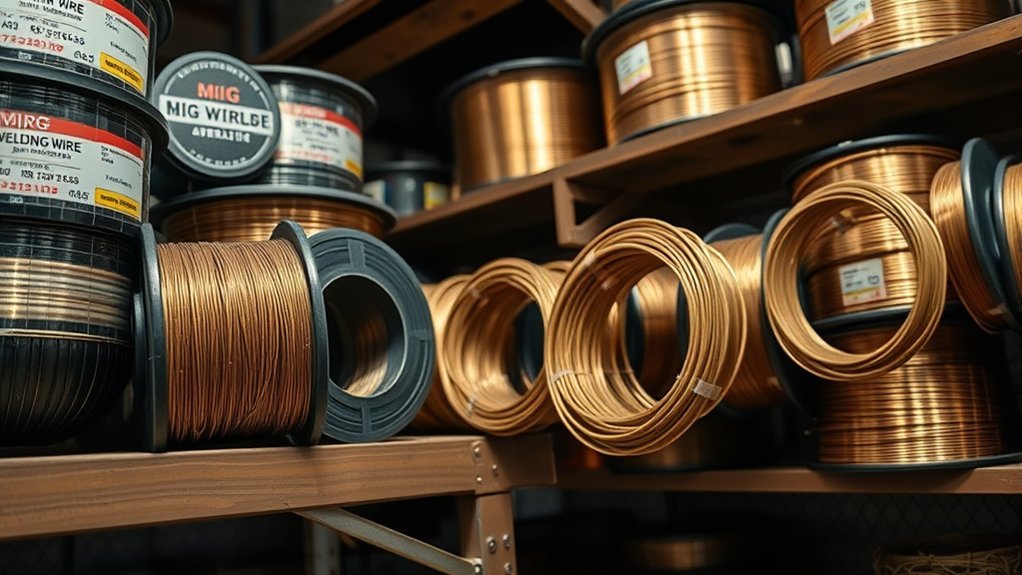
MIG welding wire cost varies sharply by classification, alloy, diameter, brand, spool weight, and purchase terms. In U.S. retail spot checks on September 7, 2026, 2-lb ER70S-6 mild-steel wire was about $8–$25, 10- to 11-lb ER70S-6 was about $25–$80, 10-lb self-shielded E71T-11 was about $94–$143 for checked one-time purchases, and 1-lb aluminum 4043 or 5356 was about $12–$38. Larger spools can cut cost per pound, but seller pricing, freight, and feeder compatibility can erase the apparent savings.
Quick Answer
As of September 7, 2026, a practical U.S. budget from the checked listings is about $8–$25 for a 2-lb ER70S-6 spool, $25–$80 for 10–11 lb of ER70S-6, $94–$143 for a one-time 10-lb E71T-11 purchase, and $12–$38 for 1 lb of aluminum 4043/5356. Compare delivered cost per pound only after matching classification, alloy, diameter, spool size, and purchase terms.
Last updated: September 7, 2026. Prices below are U.S. retail spot checks, not guaranteed national averages. Local inventory, account pricing, shipping, taxes, minimum quantities, subscriptions, and promotions can change the final total.
How prices were checked: We rechecked U.S. product and category pages from welding suppliers, industrial distributors, farm stores, and major retailers on September 7, 2026. The examples use the displayed one-time item price when the seller clearly separates it from subscription or member pricing; otherwise they use the displayed product price before location-specific tax and shipping. Member, subscription, bulk-minimum, and variant pricing are not treated as like-for-like single-spool prices.
Key Takeaways
- Match the AWS classification, alloy, diameter, and spool weight before comparing prices.
- ER70S-6 solid wire is usually the lowest-cost option for mild steel when you already have shielding gas.
- In the checked examples, self-shielded E71T-11 cost more per pound than common ER70S-6, but it avoids a shielding-gas cylinder for suitable outdoor and field work.
- Aluminum and stainless wire usually cost more per pound than common mild-steel wire.
- A bulk spool is useful only when your feeder accepts it and you can use the wire before rust, moisture, or contamination becomes a problem.
- Check minimum quantities, subscriptions, member pricing, and freight before treating a low per-spool price as the best deal.
Understanding MIG welding wire types

This cordless mini dehumidifier helps keep small spaces dry, fresh, and odor-free without spills, cords, or batteries. Its rechargeable silica gel design is ideal for closets, cabinets, cars, bathrooms, boats, and gun safes, with a moisture indicator that shows when it is ready to recharge. Compact and easy to place or hang, it offers a simple low-maintenance solution for controlling humidity in tight areas.

This versatile cookware set equips home cooks with essential pots, pans, and a steamer insert for everyday meals and larger gatherings. The aluminum-encapsulated base promotes quick, even heating, while Cool Grip handles and tight-fitting glass lids support comfortable, controlled cooking. Designed for stovetop, oven, broiler, and dishwasher use, it offers reliable performance across a wide range of recipes.

BioSilk Hydrating Therapy Pure Moisture Leave-In Spray helps replenish moisture in dry, coarse hair for a softer, smoother feel. This daily styling spray also helps control frizz, boost shine, and improve manageability while supporting hair against environmental stressors. Formulated with silk and maracuja oil, it is suitable for all hair types, including color-treated hair.
ER70S-6 solid mild-steel wire
ER70S-6 is a solid carbon-steel electrode used with the gas metal arc welding process, or GMAW/MIG. It requires an external shielding gas. Common choices include 100% carbon dioxide and argon/carbon-dioxide blends, but you should follow the wire data sheet and your welder’s setup chart.
ER70S-6 is widely used for automotive repair, brackets, farm equipment, general fabrication, structural steel, and shop projects. Cleaning the joint is still best practice, although the manganese and silicon deoxidizers in ER70S-6 make it more tolerant of mill scale than some other solid-steel wires. Lincoln Electric lists ER70S-6 under AWS A5.18.
E71T-11 self-shielded flux-cored wire
E71T-11 is a tubular, self-shielded carbon-steel wire used with flux-cored arc welding, or FCAW-S. Its internal flux produces shielding and slag, so it does not need an external gas cylinder. That makes it useful for many repairs outside or where transporting gas is inconvenient.
Lincoln Electric classifies its NR-211-MP product as self-shielded E71T-11 FCAW-S wire. Follow the product’s limits for plate thickness, polarity, welding position, and number of passes.
Note: “Flux-core” does not always mean gasless. E71T-11 is self-shielded, but many other flux-cored classifications require external shielding gas. Check the complete classification before buying.
Aluminum 4043 and 5356
Aluminum MIG wire is softer than steel wire and can buckle or birdnest in a long conventional gun liner. A spool gun or push-pull feeder shortens and controls the feed path. Some compatible machines can feed aluminum through other dedicated setups, so a spool gun is common rather than universally mandatory.
For many home projects, 4043 offers easy puddle control. A 5356 filler may be selected when higher strength, different finishing characteristics, or improved corrosion performance is required. The base-metal alloy and service conditions must guide the final choice. Miller’s aluminum MIG wire guide explains the main equipment and filler-wire considerations.
Stainless and specialty wire
ER308L is a common retail choice for joining many 304-series stainless steels. ER309L is often used for certain dissimilar-metal joints, while ER316L is chosen for compatible molybdenum-bearing stainless grades and service conditions. Hobart’s stainless filler guidance distinguishes these common 300-series filler families. Do not select a stainless filler from price alone; match it to the base metal, project specification, corrosion exposure, and required weld properties.
Silicon bronze, hardfacing wire, nickel alloys, gas-shielded flux-core, and other specialty products cost more and may require different gases, liners, drive rolls, procedures, or equipment. Supplier quotes are often more useful than broad retail averages for these products.

How much does MIG welding wire cost by type and spool size?
| Wire type | Small spool | 10–13 lb | 25–44 lb |
|---|---|---|---|
| ER70S-6 solid mild steel | About $8–$25 for checked 2-lb examples | About $25–$80 for checked 10–11 lb examples | About $50–$196 in checked 33-lb listings |
| E71T-11 self-shielded flux-core | About $30 for checked 2-lb Hobart examples | About $94–$143 for checked one-time 10-lb examples | Supplier-specific; request a current quote |
| Aluminum 4043 or 5356 | About $12–$38 for 1 lb | Less common in DIY retail; compare by alloy, diameter, and brand | Industrial or supplier-specific; request a current quote |
| ER308L stainless steel | About $23–$45 in checked 2-lb examples | Supplier-specific; request a current quote | Supplier-specific; verify alloy, certification, and packaging |
| Specialty alloys and gas-shielded flux-core | Varies widely | Varies widely | Request a current industrial-supplier quote |
In September 7 spot checks, two .030-in, 33-lb ER70S-6 listings were $49.95 at JFI and $196.23 at Grainger—about 3.9 times apart before shipping. Even after classification, diameter, and spool weight match, seller and brand can dominate the final cost.
Current retail price examples
The following listings were rechecked on September 7, 2026. Prices can change after you enter a delivery ZIP code, sign in, choose a subscription, meet a minimum quantity, or add the item to the cart. Where a retailer showed a separate one-time purchase price, that one-time price is used below.
- ER70S-6 .030, 2 lb at JFI — listed at $7.95.
- Hobart ER70S-6 .030, 2 lb at Tractor Supply — listed at $24.99.
- ER70S-6 .035, 11 lb at Welders Helper — listed at $24.97.
- Hobart ER70S-6 .030, 10 lb — one-time purchase listed at $79.99.
- ER70S-6 .030, 33 lb at JFI — listed at $49.95.
- Westward ER70S-6 .035, 33 lb — listed at $179.89.
- Westward ER70S-6 .030, 33 lb — listed at $196.23.
- Lincoln Electric E71T-11 .035, 10 lb — listed at $94.45.
- Hobart E71T-11 .035, 10 lb — one-time purchase listed at $119.99 in the checked location context.
- Hobart E71T-11 .030, 10 lb — one-time purchase listed at $142.99 in the checked location context.
- Blue Demon 4043 .035 aluminum, 1 lb — listed at $11.79 sale / $22.17 regular.
- Hobart ER5356 .035 aluminum, 1 lb — listed at $34.99.
- Lincoln Electric SuperGlaze ER4043 .030 aluminum, 1 lb — listed at $37.98.
- ER308L stainless .035, 2 lb at JFI — listed at $22.96.
- Hobart ER308L stainless .030, 2 lb — listed at $44.99.
How to compare MIG wire cost per pound
Cost per pound is more useful than shelf price, but only after you match the classification, alloy, diameter, spool size, packaging, and seller terms.
Delivered cost per pound = (item price + shipping − discounts) ÷ spool weight.
Pro Tip: Calculate cost per pound from the final cart total, not the product-page headline. A low listed price can lose its advantage after shipping, minimum-order quantities, or account restrictions are added.
A useful cross-check is the order-level cost: multiply the advertised per-spool price by any required minimum quantity before comparing sellers. Also separate subscription or member pricing from a one-time purchase so the comparison reflects what you will actually pay.
| Example wire | Checked price | Spool weight | Approx. cost per pound |
|---|---|---|---|
| JFI ER70S-6 .030 solid steel | $49.95 | 33 lb | About $1.51/lb |
| ER70S-6 .035 solid steel at Welders Helper | $24.97 | 11 lb | About $2.27/lb |
| Westward ER70S-6 .030 solid steel | $196.23 | 33 lb | About $5.95/lb |
| Hobart ER70S-6 .030 solid steel | $79.99 | 10 lb | $8.00/lb |
| Lincoln Electric E71T-11 .035 | $94.45 | 10 lb | About $9.45/lb |
| Hobart E71T-11 .030, one-time purchase | $142.99 | 10 lb | About $14.30/lb |
| Blue Demon 4043 .035 aluminum | $11.79 sale | 1 lb | $11.79/lb |
| JFI ER308L .035 stainless | $22.96 | 2 lb | $11.48/lb |
| Hobart ER308L .030 stainless | $44.99 | 2 lb | About $22.50/lb |
The closest apples-to-apples price check in this sample is especially useful: JFI listed .030-in ER70S-6 on a 33-lb spool at $49.95, or about $1.51/lb, while Grainger listed Westward .030-in ER70S-6 on a 33-lb spool at $196.23, or about $5.95/lb. That is roughly a 3.9× spread before shipping even though the classification, diameter, and spool weight match. Compare equivalent wire first; then compare the seller and delivered total.
Factors influencing MIG welding wire costs
Wire classification and alloy
Common ER70S-6 mild-steel wire is produced in high volume and is often the least expensive option per pound. Stainless, aluminum, nickel, silicon-bronze, and hardfacing alloys cost more because of their raw materials, manufacturing requirements, and lower retail volume.
Wire diameter
Diameter affects availability, packaging, machine compatibility, and price. Common hobby sizes include .023/.024, .030, .035, and .045 inch. Do not select a diameter only because one spool is cheaper. The welder’s output, drive system, contact tip, metal thickness, joint design, and transfer mode must support it.
Spool weight and packaging
A larger spool often costs less per pound because the manufacturer uses less packaging for each pound of wire. However, 2-lb, 10-lb, 12.5-lb, 25-lb, 33-lb, and 44-lb packages are not interchangeable in every feeder. Check the maximum spool diameter, width, arbor or hub, and weight listed in your welder manual.
Brand, certification, and traceability
Premium wire can cost more because of tighter manufacturing controls, consistent cast and helix, cleaner surfaces, certification documents, lot traceability, packaging, and distribution support. Those features may matter more in production or code work than they do for a noncritical home repair.
Inventory, promotions, and seller terms
Retail prices can move because of promotions, local stock, minimum quantities, business-account discounts, freight, free-shipping thresholds, and marketplace competition. Some industrial sellers hide the final price until you enter a ZIP code or sign in.
Costs beyond the wire spool
The cheapest spool does not always produce the lowest total job cost. Include the following items when you compare solid wire with self-shielded flux-core:
- Shielding gas: Solid steel, stainless, and aluminum wire normally require a compatible gas, cylinder, regulator or flowmeter, and hose.
- Consumables: Contact tips, nozzles, liners, drive rolls, diffusers, and anti-spatter products wear or must change with the wire.
- Preparation and cleanup: Self-shielded flux-core produces slag that must be removed, while solid wire depends more heavily on stable gas coverage.
- Shipping: A heavy industrial spool can have a low unit price but a high freight charge.
- Downtime: Poor feeding, tangled wire, damaged packaging, or an incompatible spool can cost more than the original price difference.
- Productivity: Deposition rate, number of passes, travel speed, slag removal, and cleanup time can outweigh a small difference in wire price on larger jobs.
If shielding gas is part of your budget, compare cylinder and refill costs in our MIG welding gas cost guide and 75/25 welding gas cost guide.
For a broader budget that includes equipment, labor, and other consumables, see our total MIG welding cost guide. This page focuses specifically on wire price, spool economics, and wire-selection costs.
Comparing brands and their pricing
Compare brands only after matching the complete wire description. ER70S-6 should be compared with ER70S-6 of the same diameter and similar spool weight. E71T-11 should not be compared directly with E71T-GS, gas-shielded flux-core, or solid steel wire as though the products are identical.
After matching the classification, review feedability, packaging condition, manufacturing origin, certificates, return policy, seller reputation, and shipping. A low-cost spool is a poor value when it arrives rusty, bent, loosely wound, or damaged.
Which MIG wire should you buy?
| Job type | Common starting point | Why |
|---|---|---|
| Clean or lightly scaled mild steel indoors | ER70S-6 solid wire with compatible shielding gas | Common, versatile, and often the lowest wire cost per pound. |
| Outdoor repair or field work | Self-shielded E71T-11 when permitted by the job and machine | Avoids an external shielding-gas cylinder and is less vulnerable to ordinary outdoor air movement. |
| Thin automotive steel | Small-diameter ER70S-6 supported by the welder | Can provide better low-amperage control when paired with correct settings and technique. |
| Common aluminum repair | Compatible 4043 or 5356 wire with a spool gun, push-pull feeder, or approved feed setup | The alloy and feed system must match the base metal and machine. |
| 304-series stainless | ER308L when allowed by the project requirements | A common filler for compatible 304-series stainless applications. |
| High-volume production | Largest approved spool or bulk package the feeder supports | Can reduce changeovers and cost per pound when storage and usage are controlled. |
| Structural, pressure, marine, or code work | Wire specified by the approved procedure, engineer, code, or manufacturer | Price must not override required classification, properties, certification, or procedure limits. |
How much wire should you buy at one time?
Buy the smallest spool size that fits your real usage and still gives you a worthwhile cost per pound. For occasional repairs, a 2-lb spool can limit money tied up in wire and reduce the chance that an opened spool sits long enough to rust or become contaminated. If you weld regularly and your feeder accepts it, a 10- or 11-lb spool usually reduces changeovers. A 33- or 44-lb package makes sense only when the feeder supports it, your usage is high enough, and you have dry storage. The September 7 price checks also show why size alone is not a value guarantee: two same-size .030 ER70S-6 33-lb listings differed by about 3.9× before shipping.
Check machine compatibility before buying
Before ordering a spool, confirm all of the following:
- The machine supports the wire process: GMAW, FCAW-S, or gas-shielded FCAW.
- The feeder accepts the spool’s diameter, width, hub, and weight.
- The drive rolls match solid steel, tubular wire, or soft aluminum wire.
- The liner and gun are suitable for the alloy and wire diameter.
- The installed contact tip matches the wire size.
- The machine can supply the required amperage and wire-feed speed.
- The polarity matches the wire manufacturer’s instructions.
- The shielding gas, when required, matches the wire data sheet and transfer mode.
Note: Solid ER70S-6 commonly runs electrode-positive, while many self-shielded E71T-11 products run electrode-negative. Never assume the polarity; read the wire label and machine chart.
Discounted and promotional offers
Sales are common on popular ER70S-6 and self-shielded wire sizes. A bundle may also reduce the cost of tips, nozzles, liners, drive rolls, or other consumables. Compare the same quantity before treating a multipack as a discount.
Do not buy a large spool only because it is cheaper per pound. The smaller spool may be the better value when you weld infrequently, have limited dry storage, or own a machine that cannot accept an industrial package.
Quality vs. cost: finding the right balance
- Match the wire to the base metal: Do not substitute an alloy or classification merely because it costs less.
- Check the procedure: Critical work may require a specific classification, brand approval, certificate, shielding gas, or lot traceability.
- Reduce waste: Buy a spool size you can use and store correctly.
- Check feed quality: Smooth feeding and consistent winding reduce stoppages and birdnesting.
- Use delivered cost: Add shipping and required accessories before calculating cost per pound.

This DEWALT 20V MAX combo kit delivers reliable drilling and fastening power in a compact, jobsite-ready package. The lightweight drill/driver and impact driver are built to fit into tight spaces, while integrated LED work lights help improve visibility in dim areas. With two batteries, a charger, and a storage bag included, it is a convenient solution for professionals and DIY users alike.

This versatile Cuisinart cookware set provides essential pots and pans for everyday cooking, from sauces and soups to sautéing, simmering, and frying. The aluminum-encapsulated base promotes fast, even heating, while cool-grip handles and tight-fitting glass lids support comfortable, efficient cooking. Designed for broad compatibility, it is dishwasher safe and oven safe for flexible use across many recipes.

The Armor All AA255W wet/dry utility vac delivers strong 2 peak HP suction in a compact, portable design for quick cleanup of wet and dry messes. Its 2.5-gallon tank, wheel base, top handle, and built-in storage make it easy to move, organize, and use around the garage, car, or jobsite. It also converts to a blower and comes with multiple accessories for versatile cleaning tasks.
Applications of MIG welding wire
Automotive and general fabrication
ER70S-6 works for many mild-steel repairs, brackets, frames, carts, farm equipment, panels, and shop projects. A smaller supported diameter may help on thin sheet, but heat input also depends on voltage, wire speed, travel speed, joint design, and technique.
Outdoor repair and construction
Self-shielded E71T-11 can suit many outdoor repairs because it does not rely on an external gas cloud. It still has classification, thickness, position, and procedure limits. Do not assume that every self-shielded hobby wire is approved for structural work.
Aluminum and marine work
Aluminum 4043 and 5356 are used for compatible aluminum alloys. Marine or corrosion-exposed work requires careful filler selection because strength, corrosion behavior, anodizing response, and service temperature differ by alloy.
Stainless fabrication
ER308L is common for compatible 304-series stainless work. Other stainless grades may require ER309L, ER316L, or another filler. Verify the base-metal grade rather than relying only on appearance.
Tips for purchasing MIG welding wire
- Identify the base metal and required welding process first.
- Match the complete AWS classification rather than shopping by the word “MIG” alone.
- Choose a diameter listed on the welder’s setup chart.
- Confirm spool size, hub, drive-roll, liner, contact-tip, polarity, and gas compatibility.
- Compare delivered cost per pound across genuinely equivalent products.
- Review recent feedback for feeding problems, damaged packaging, rust, and inconsistent winding.
- For critical work, request the product data sheet, safety data sheet, and certificate of conformance when required.
- Reject wire that arrives wet, rusty, contaminated, kinked, or poorly wound.
How to store welding wire
Keep wire indoors in a clean, dry area with stable temperatures. Leave unused spools in their sealed packaging or place them in a closed container with suitable desiccant. Avoid touching the wire with dirty or oily gloves.
Solid steel wire can rust when exposed to humidity. Rust and dirt can damage liners, clog contact tips, destabilize the arc, and contaminate the weld. Flux-cored wire can also be affected by poor storage and moisture. Follow the manufacturer’s storage and reconditioning instructions rather than attempting to dry wire with an improvised heating method.
Safety considerations when using welding wire
Warning: Welding fumes and gases can be hazardous. Use adequate ventilation or local fume extraction, keep your head out of the plume, review the wire’s safety data sheet, and do not weld in a confined space without the required assessment, monitoring, ventilation, and rescue controls.
- Wear a properly shaded welding helmet, safety glasses, welding gloves, hearing protection when needed, and flame-resistant clothing.
- Remove combustible materials and keep suitable fire-control equipment nearby.
- Clean paint, oil, plating, galvanizing, and other coatings when the approved procedure requires removal and when doing so can be performed safely.
- Use ventilation or local exhaust to control fumes at the source.
- Keep your breathing zone away from the plume and position yourself upwind outdoors.
- Secure gas cylinders upright and protect valves when shielding gas is used.
- Disconnect power before servicing the feeder, drive rolls, liner, or gun.
- Store wire dry and keep the work area free of trip hazards and loose coils.
Review OSHA’s Controlling Hazardous Fume and Gases during Welding fact sheet for workplace exposure guidance.
Where to find the best deals
Compare local welding suppliers, farm stores, industrial distributors, big-box retailers, and established online welding stores. Local pickup can beat a lower online price when freight is high. An industrial supplier may offer better documentation, fresher stock, and technical support for specialty alloys.
Check the final delivered price, return policy, minimum order, packaging condition, and product data before paying. Skip listings that do not clearly show the classification, alloy, diameter, spool weight, and manufacturer.
Sources
- Lincoln Electric SuperArc L-56 — ER70S-6 classification, shielding gases, packaging, and applications.
- Lincoln Electric Innershield NR-211-MP — E71T-11 self-shielded FCAW-S classification and operating limits.
- Miller aluminum MIG selection guide — spool-gun, wire-diameter, and 4043/5356 guidance.
- OSHA welding-fume fact sheet — ventilation, fume, and gas hazards.
- American Welding Society standards — welding-consumable classification standards and publications.
- Hobart stainless filler guidance — 308/308L, 309/309L, and 316/316L application distinctions.
- JFI ER70S-6 listings — September 7, 2026 retail spot checks by diameter and spool size.
- Tractor Supply Hobart welding-wire listings — September 7, 2026 spot checks for ER70S-6, E71T-11, aluminum, and ER308L.
- Grainger Westward ER70S-6 .030, 33 lb — September 7, 2026 price and product-specification check.
Bottom line
For routine mild-steel projects, ER70S-6 solid wire is often the lowest-cost choice when you already have the correct shielding-gas setup. In the September 7 checks, 10- to 11-lb ER70S-6 examples were about $25–$80, while checked one-time 10-lb E71T-11 examples were about $94–$143. Self-shielded E71T-11 can still be more practical for suitable outdoor or gasless work because it removes the external shielding-gas requirement. Aluminum and stainless wire require closer attention to alloy, equipment compatibility, and seller-specific pricing.
Start with the correct classification and diameter, confirm that the spool fits your feeder, and then compare the delivered cost per pound. That approach prevents a cheap listing from becoming an expensive mistake.
Frequently Asked Questions
What drives MIG wire price the most?
The main factors are classification, alloy, diameter, spool weight, brand, certification, packaging, seller, and shipping. Compare products only after matching those details.
Is flux-cored wire always more expensive?
No. Self-shielded flux-cored wire often costs more per pound than common ER70S-6, but sales, brands, diameters, and spool sizes can reverse the comparison. It may also reduce equipment and transport costs when a shielding-gas cylinder is impractical.
How much does a 10- to 11-lb spool of ER70S-6 cost?
September 7, 2026 spot checks found 10- to 11-lb ER70S-6 listings from about $25 to $80. Shipping, diameter, brand, seller terms, and local stock affect the final price.
Do I need a spool gun for aluminum MIG?
Not always, but many hobby MIG setups need a spool gun or push-pull feeder because soft aluminum wire is difficult to push through a long conventional liner. Follow the welder and gun manufacturer’s approved setup.
Is self-shielded flux-core technically MIG welding?
No. MIG is gas metal arc welding, or GMAW, and uses an external shielding gas. Self-shielded E71T-11 uses flux-cored arc welding, or FCAW-S. Both are wire-feed processes, which is why casual product descriptions sometimes group them together.
What size MIG wire should I use?
Use a diameter listed in your welder’s manual or setup chart for the material thickness and process. Common hobby sizes include .023/.024, .030, .035, and .045 inch, but not every machine supports every size.
Can MIG wire go bad?
Wire can become unusable after rust, moisture exposure, dirt, oil, physical damage, or poor storage. Keep spools clean, dry, sealed, and protected from large temperature changes. Follow the manufacturer’s storage instructions.
What is the smartest way to compare MIG wire prices?
Match the classification, alloy, diameter, spool size, packaging, and seller terms. Then divide the delivered total by the spool weight. Confirm that the spool and wire are compatible with your machine before choosing the lowest cost per pound.
What is a fair cost per pound for ER70S-6 MIG wire?
There is no single fair national rate because seller, diameter, spool size, freight, and purchase terms differ. In September 7, 2026 checks, an 11-lb .035 ER70S-6 listing was about $2.27/lb, while two .030 33-lb listings were about $1.51/lb and $5.95/lb. Match classification, diameter, and package size before treating the lowest cost per pound as the better deal.

This hardcover cookbook offers fast, approachable recipes designed for busy days and low-energy nights. Caroline Chambers focuses on simple, flavorful meals that help you get dinner on the table without overthinking it. It's a practical pick for home cooks who want quick weeknight inspiration and minimal-fuss cooking.

This heartfelt memoir blends laugh-out-loud honesty with tender reflections on love, loneliness, and the unexpected healing power of rescue dogs. Isabel Klee shares her journey fostering pups in the city while navigating dating and self-discovery, offering an intimate, relatable story for readers who enjoy emotional, character-driven narratives. It is a warm, engaging read about opening your heart and finding connection in surprising places.

OGX Extra Strength Damage Remedy + Coconut Miracle Hair Oil helps hydrate dry, coarse hair while smoothing frizz and flyaways for a silky finish. This nourishing leave-in treatment blends coconut oil, vanilla bean extract, and tiare essence to add softness, shine, and a pleasant scent. It is paraben-free and designed to support a restorative hair care routine for medium to coarse hair types.