MIG welding cylinder cost can run from about $250 for a small online cylinder to $500 or more for a larger exchangeable bottle, while a refill or exchange commonly adds about $60–$100 or more. Your actual cost depends on cylinder ownership, size, gas mix, local supplier rules, and added fees.
Quick Answer
For a typical home MIG setup, plan on roughly $370–$500 or more for a filled 125-cu-ft 75/25 argon-CO2 cylinder, based on current online examples. Refills and exchanges often run about $60–$100 or more, but local fees and cylinder policies can change the total substantially.
Key Takeaways
- A 125-cu-ft cylinder is often the best balance of portability, runtime, and refill frequency for a home shop.
- At a 20–25 CFH flow rate, a 125-cu-ft cylinder provides about 5–6.25 hours of ideal arc-on time.
- C25 gas is a common all-purpose choice for mild steel; pure CO2 costs less but usually creates more spatter.
- Before buying a cylinder online, confirm that a nearby supplier will refill or exchange that size and certification.
- Never transport a compressed-gas cylinder loose or with the regulator attached.
Price check: The examples in this guide were checked on July 28, 2026. Welding-gas prices vary by region and can change without notice, so treat the ranges as planning figures rather than guaranteed quotes.
MIG Welding Gas Cost at a Glance
Current online listings show how wide the market can be. PrimeWeld lists a filled 40-, 80-, or 125-cu-ft C25 cylinder product at $369, while Northern Tool lists a filled 125-cu-ft exchangeable C25 cylinder at $499.99. Local shops may quote lower or higher prices depending on whether the price includes the cylinder, the gas contents, a deposit, or an exchange fee.
| Cost Item | Useful Planning Range | What Changes the Price |
|---|---|---|
| Small customer-owned cylinder | About $250–$400+ | Capacity, whether it arrives filled, certification, and shipping |
| 125-cu-ft cylinder | About $370–$500+ | Brand, ownership model, included gas, exchange network, and local availability |
| Refill or exchange | Often $60–$100+ | Gas mix, cylinder size, supplier, HAZMAT/environmental charges, and tax |
| Rental or lease | Supplier-specific | Deposit, monthly or annual rent, demurrage, delivery, and account terms |
Ask for an itemized quote. A low advertised refill price may exclude a cylinder exchange charge, HAZMAT fee, delivery fee, tax, or overdue-cylinder fee.
The Types of Gases Used in MIG Welding
The gas must match the base metal, filler wire, transfer mode, and settings supported by your welder. The three options below cover many home-shop jobs, but stainless steel and specialized spray-transfer work may require other blends.
| Gas | Common Use | Main Trade-Off |
|---|---|---|
| 75% argon / 25% CO2 (C25) | General mild-steel MIG welding, especially short-circuit transfer | Smooth arc and low spatter, but usually costs more than pure CO2 |
| 100% CO2 | Mild steel when low gas cost and deeper penetration are priorities | More spatter and a rougher, less stable arc than C25 |
| 100% argon | MIG welding aluminum; also common for TIG | Not a good all-purpose choice for MIG welding mild steel |
| 90% argon / 10% CO2 | Spray-transfer steel applications when the machine and material support it | Less universal for hobby work and may cost more |
| Stainless-specific blend | Stainless steel with the gas recommended for the wire and welder | The correct blend varies; too much CO2 can harm weld quality and corrosion performance |
Miller’s shielding-gas guide identifies C25 as a common mild-steel choice, 100% CO2 as a lower-cost alternative with more spatter, and 100% argon as the usual choice for aluminum. Always check the chart inside your welder or its owner’s manual before changing gases.
How Tank Size Affects Price and Value
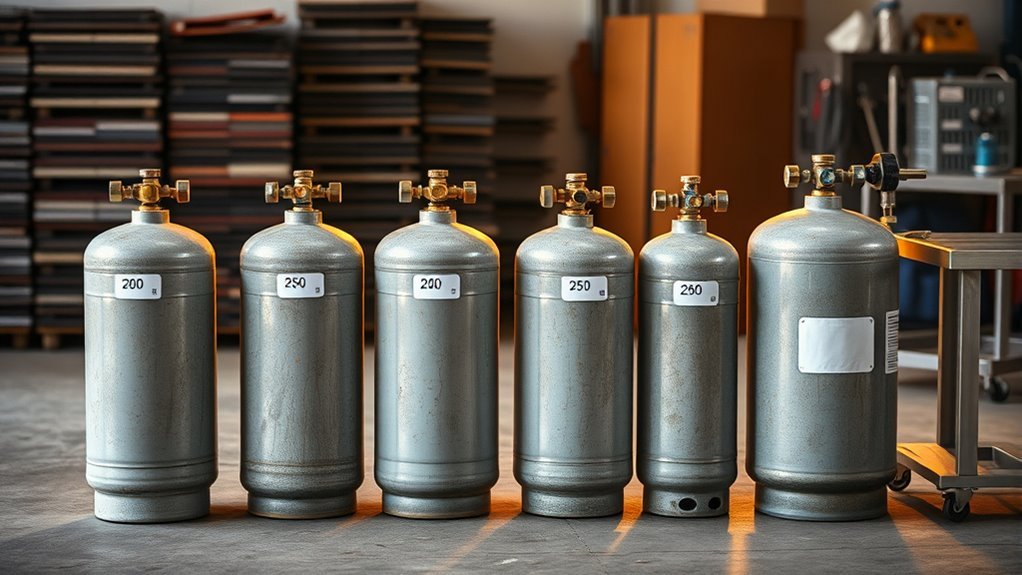
A larger cylinder normally costs more to acquire, but it reduces trips to the supplier and often lowers the gas cost per cubic foot. The best size is not simply the biggest bottle you can afford. It must also fit your cart, vehicle, storage area, and local exchange program.
For mild-steel MIG welding, Miller gives a typical starting flow of 20–25 cubic feet per hour (CFH). Use this formula:
Estimated arc-on hours = cylinder capacity in cubic feet ÷ flow rate in CFH.
| Cylinder Capacity | Ideal Runtime at 20 CFH | Ideal Runtime at 25 CFH | Best Fit |
|---|---|---|---|
| 40 cu. ft. | 2 hours | 1.6 hours | Portable repairs and very occasional welding |
| 80 cu. ft. | 4 hours | 3.2 hours | Light hobby use with limited storage space |
| 125 cu. ft. | 6.25 hours | 5 hours | Regular home-shop use |
| 250–300 cu. ft. | 12.5–15 hours | 10–12 hours | Frequent shop use where large exchanges are available |
Real runtime is usually lower because of pre-flow, post-flow, tack welding, purging, leaks, wind, and gas left in the cylinder when you exchange it. Do not estimate refill frequency by calendar months unless you also know your actual arc-on hours.
Pro Tip: Check which sizes your nearest supplier routinely exchanges before buying. A less common bottle can become expensive if you must drive farther or wait for a refill.
MIG Welding Cylinder Cost: Purchase and Refill Prices by Size
Exact national averages are difficult to defend because suppliers use different cylinder programs and often do not publish local refill prices online. The table below gives practical planning ranges, not fixed market prices.
| Size | Typical Purchase Planning Range | Refill/Exchange Planning Range | Value Notes |
|---|---|---|---|
| 40 cu. ft. | About $250–$400+ | Often $50–$80+ | Easy to move, but the shortest runtime and usually the highest cost per arc-on hour |
| 80 cu. ft. | About $300–$500+ | Often $60–$90+ | A portable middle size, although local exchange pricing may make it less attractive than a 125 |
| 125 cu. ft. | About $370–$500+ | Often $70–$100+ | A strong balance for regular hobby and repair work |
| 250–330 cu. ft. | Usually quoted locally | Usually quoted locally | Lower refill frequency, but heavy, harder to transport, and often tied to lease programs |
Pure CO2 can cost less than argon-rich blends and stores more usable gas in a cylinder because it is supplied as a liquefied gas. However, the welding characteristics are different, and you need a regulator or flowmeter suitable for CO2 service. Do not choose gas on price alone.
Calculating Real Cost: Tank Price, Refills, and Usage
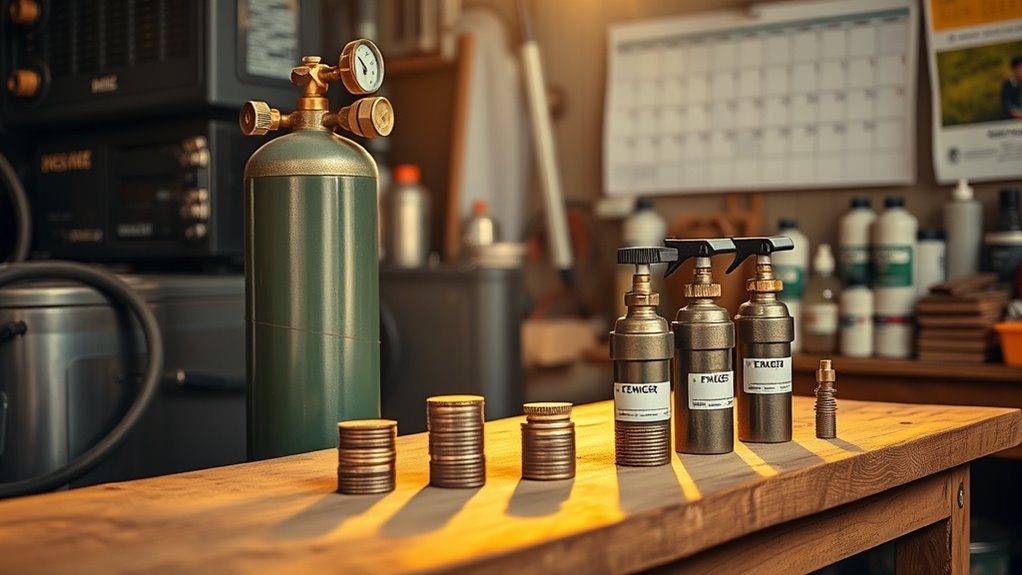
Your true first-year cost includes more than the bottle and gas:
First-year cost = cylinder purchase or deposit + refill/exchange charges + rental fees + HAZMAT/environmental fees + delivery or travel + tax.
For example, assume you buy a filled 125-cu-ft C25 cylinder for $369 and use four $80 refills during the first year:
$369 + (4 × $80) = $689 before tax, travel, or added supplier fees.
To estimate shielding-gas cost per arc-on hour, divide the refill price by the usable runtime:
Gas cost per arc-on hour = refill price ÷ estimated usable hours.
If a 125-cu-ft refill costs $80 and you run 20 CFH, the ideal runtime is 6.25 hours. The ideal gas cost is $12.80 per arc-on hour. If leaks, purging, and interruptions reduce usable runtime to five hours, the real gas cost rises to $16 per arc-on hour.
Hidden Costs to Include
- HAZMAT or environmental fees: These may appear as separate line items.
- Rental or demurrage: A leased cylinder can continue generating charges while it sits unused.
- Hydrostatic requalification: An out-of-date customer-owned bottle may need testing before a supplier will fill it.
- Delivery or travel: A cheaper refill is not always cheaper after mileage and time.
- Lost gas: Leaks, excess flow, drafts, and long post-flow settings raise operating cost.
- Regulator and hose maintenance: Faulty equipment can waste gas and create a safety risk.
Should You Buy, Rent, Lease, or Exchange a Cylinder?
| Option | Best For | Main Advantage | Main Risk |
|---|---|---|---|
| Buy customer-owned | Long-term hobby use | No recurring cylinder rent | Some suppliers may refuse unfamiliar or out-of-date bottles |
| Rent or lease | Frequent users and larger cylinders | Supplier manages cylinder testing and replacement | Ongoing rent, deposits, and possible demurrage |
| Exchange program | Users who value fast turnaround | No wait for your exact bottle to be filled | You may receive a different bottle, and provider rules vary |
Ask whether the cylinder is truly customer-owned or remains the supplier’s property. Keep receipts, lease documents, and account records. Do not remove or alter ownership marks.
Where to Buy, Refill, or Exchange Welding Cylinders
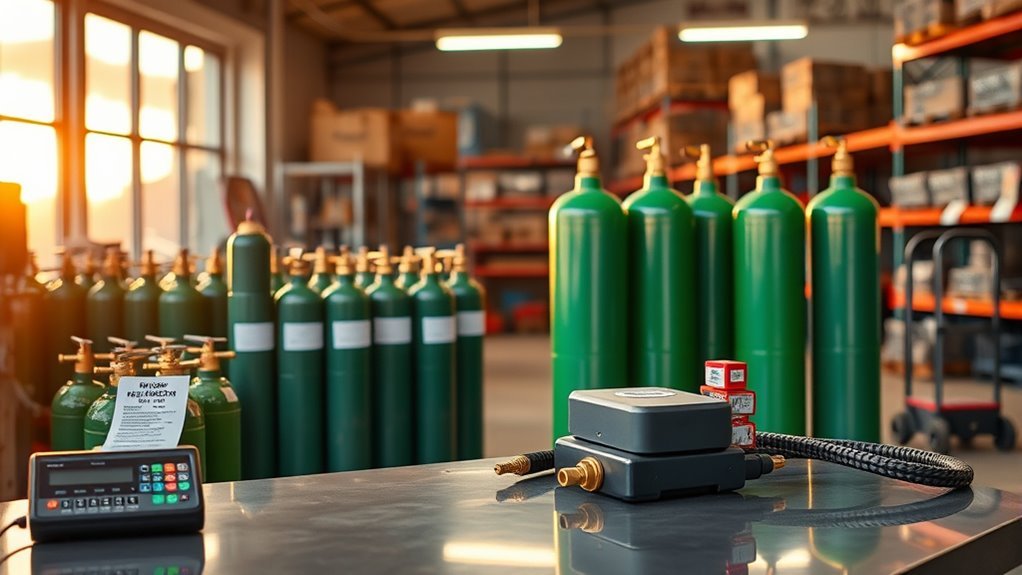
Compare at least two suppliers before committing to a cylinder program. The cheapest bottle can become a poor value if nearby shops will not service it.
Local Gas Suppliers
Local welding and industrial-gas suppliers may offer customer-owned refills, cylinder exchanges, rentals, or long-term leases. Policies vary by branch, cylinder size, ownership mark, and test date.
Ask these questions before visiting:
- Will you fill or exchange a customer-owned cylinder in this exact size?
- Do you require a receipt, account, deposit record, or ownership proof?
- Is the quote for gas contents only, or does it include the cylinder and exchange?
- Are HAZMAT, environmental, handling, delivery, and tax charges included?
- Will you accept a DOT-3AA or UN-marked online cylinder?
- What happens if the hydrostatic test date has expired?
Big-Box and Farm-Supply Retailers
Retail chains can be convenient when they participate in a recognized exchange program. Selection and stock vary by location, so confirm that the store carries your gas mix and cylinder size before driving there.
Read the product listing carefully. “Cylinder only,” “gas contents only,” and “filled cylinder” are different purchases. A low contents-only price assumes that you already have an accepted exchange cylinder.
Online Cylinder Vendors
Online sellers can provide a new, filled cylinder when local stock is limited. Before ordering, verify the cylinder’s DOT or UN certification, valve connection, current test marking, return restrictions, and whether your local supplier will refill or exchange it.
Warning: PHMSA has warned consumers about unauthorized cylinders sold online. Buy only a cylinder with valid DOT-specification or UN-standard markings, and confirm supplier acceptance before filling or transporting it.
How to Inspect a Used Welding Cylinder Before Buying
A cheap used cylinder is not a bargain if it cannot be legally transported or accepted for filling. Check the following before money changes hands:
- Permanent specification mark: Look for a valid DOT or UN marking, not only a seller-applied sticker.
- Requalification stamp: Confirm the most recent month and year. Required intervals depend on cylinder specification, service, and qualifying marks.
- Legible serial and service-pressure markings: Do not buy a bottle with ground-off or unreadable identification.
- Physical condition: Reject cylinders with deep dents, gouges, severe rust, fire damage, bulges, a damaged neck, or a questionable valve.
- Correct valve: Many argon and argon-CO2 shielding-gas cylinders use a CGA-580 connection, but verify compatibility with the gas and regulator.
- Supplier acceptance: Call the shop with the markings and size before buying.
PHMSA maintains a locator for approved cylinder requalifiers. Do not stamp, repair, repaint over required markings, or attempt to requalify a cylinder yourself.
Safe Storage, Handling, and Transport
Compressed shielding gases are nonflammable, but a damaged high-pressure cylinder can release tremendous energy. Argon and CO2 can also displace oxygen in a small enclosed space.
- Secure the cylinder upright to a wall, cart, rack, or other solid support.
- Close the valve when the cylinder is not in use.
- Remove the regulator and install the valve-protection cap before moving the cylinder.
- Keep the cylinder away from heat, sparks, impact, standing water, and electrical circuits.
- Use a suitable cylinder cart. Do not drag, drop, or lift a cylinder by its cap.
- Open the valve slowly and stand to the side of the regulator.
- Check fittings and hoses with an approved leak-detection solution. Never use a flame.
- Remove a leaking, damaged, or faulty regulator from service; use a qualified repair facility.
OSHA’s cylinder-handling rules require valve caps during movement, securement during vehicle transport, and upright storage in covered construction work. Local rules and supplier instructions may add requirements.
Can You Carry a MIG Cylinder in a Car?
Avoid placing a compressed-gas cylinder in a sealed trunk or unventilated passenger compartment. A ventilated cargo vehicle or open pickup bed with strong tie-down points is safer. Keep the valve closed, remove the regulator, install the cap, secure the bottle against movement, take the most direct route, and unload it promptly.
Lawrence Berkeley National Laboratory’s compressed-gas guidance specifically advises against putting cylinders in car trunks or unventilated passenger areas when a leak could create an oxygen-deficient atmosphere. Check federal, state, local, and supplier requirements for your trip.
Tips to Reduce Your Welding Gas Expenses
- Choose a practical cylinder size. A 125-cu-ft bottle often reduces refill trips without becoming as difficult to handle as a shop-size cylinder.
- Fix leaks immediately. Check the regulator connection, hose, solenoid path, gun, and fittings.
- Use only the flow you need. Excessive CFH wastes gas and can create turbulence that pulls air into the shielding zone.
- Protect the weld from drafts. Wind can strip away shielding gas and force you to raise flow unnecessarily.
- Close the valve after welding. Bleed line pressure according to the equipment manual before storage.
- Compare complete quotes. Include fees, travel, rent, and cylinder size rather than comparing only the posted refill price.
- Track arc-on time. Record refill dates, cylinder size, flow rate, and project hours to find your real cost.
- Consider self-shielded flux-cored wire outdoors. It requires no external shielding gas, but it creates slag and more fumes and is not a direct replacement for every MIG application.
Pro Tip: Perform a pressure-decay check according to your regulator and welder manuals. A cylinder that loses pressure while every downstream valve is closed may have a leak that is quietly raising your cost.
Frequently Asked Questions
Can I transport a MIG gas cylinder in a regular car trunk?
Avoid a sealed trunk or any unventilated passenger area. Use a ventilated cargo space or open pickup bed when possible. Close the valve, remove the regulator, install the protective cap, secure the cylinder so it cannot move, drive directly to your destination, and unload it promptly.
Are rental options available for welding cylinders and regulators?
Yes. Industrial-gas suppliers may offer cylinder rental, annual lease, deposit, or exchange programs. Regulators may be rented with welding equipment, but availability and terms vary. Compare the total contract cost, including deposits, rent, demurrage, delivery, and return rules.
Do cylinder exchange programs require proof of ownership?
Some do, and some rely on an account, receipt, lease record, deposit record, or accepted customer-owned cylinder. A supplier-owned or branded lease cylinder remains the supplier’s property. Call the specific branch before arriving because exchange rules are not universal.
How long do welding regulators and hoses last?
There is no reliable universal age limit for every regulator or inert-gas hose. Inspect them regularly and follow the manufacturer’s maintenance instructions. Remove a regulator from service if it leaks, creeps, has a faulty gauge, or is damaged. Replace a hose that leaks, cracks, hardens, burns, or has damaged fittings.
What markings should I check on a used cylinder?
Check for a valid DOT specification or UN standard mark, serial number, service pressure, manufacturer or requalifier identification, and a legible requalification date. Also inspect the valve, neck, body, and base for damage. Confirm that your supplier will accept the cylinder before buying it.
How long will a 125-cu-ft MIG gas cylinder last?
At 20 CFH, the ideal runtime is about 6.25 arc-on hours. At 25 CFH, it is about five hours. Real runtime is lower when you include purging, tack welding, post-flow, leaks, and gas left in the cylinder at exchange.
Can I use pure argon to MIG weld mild steel?
Pure argon is not the normal all-purpose gas for MIG welding mild steel and can produce poor arc behavior and penetration. C25 or 100% CO2 is usually more suitable for mild steel. Use pure argon for aluminum MIG welding and follow the welder and wire manufacturer’s recommendations.
Conclusion
A MIG welding gas cylinder is not a one-price purchase. For a home shop, a filled 125-cu-ft C25 bottle commonly requires a budget of roughly $370–$500 or more, plus refill or exchange costs that often run $70–$100 or more. Compare the complete local cost, confirm refill acceptance, choose the correct gas, and calculate runtime from your actual flow rate. Safe handling, leak control, and the right cylinder program can save more money than chasing the lowest advertised refill price.
Related cost guides: MIG welding gas cost, welding gas tank cost, welding gas bottle rental cost and MIG welding equipment cost.
Sources
- Miller: What Type of Gas Is Best for MIG Welding? — gas selection for mild steel, aluminum, stainless steel, and silicon bronze.
- Miller: MIG Welding for Mild Steel — common C25 and CO2 characteristics and a 20–25 CFH starting flow rate.
- OSHA 29 CFR 1926.350 — compressed-gas cylinder movement, securement, valve caps, and handling.
- PHMSA Safety Advisory on Unauthorized Cylinders — DOT/UN marking and online-cylinder safety.
- PHMSA Cylinder Requalifier Locator — approved facilities and requalification information.
- Lawrence Berkeley National Laboratory: Compressed Gases — vehicle ventilation, securement, labeling, and transport precautions.