
Price note: School prices and aid figures below come from the cited pages and may change. For more cost context, see our guides to the cost to learn welding and welding class costs.
Welding school cost per month has no single national answer: how much welding school costs per month depends on the school. Schools may charge by program, semester, clock hour, or payment period, so a simple national monthly average can be misleading. Current published costs vary widely. For example, Moore Norman Technology Center lists $2,625 in tuition and resource fees plus $190 in required clothing and gear for its 2026–2027 in-district adult 960-hour welding program. Tulsa Welding School lists welding-related tuition from $17,500 to $22,700 for non-military students, with welding programs ranging from 7 to 14 months depending on the track. Your real monthly budget also depends on grants, scholarships, required gear, transportation, and living costs.
Quick Answer
- There is no reliable national monthly welding-school price because billing methods, program lengths, residency rates, and included costs differ.
- Use this planning formula: (direct program cost − confirmed grants and scholarships) ÷ months enrolled.
- Check whether tuition includes lab fees, books, tools, PPE, testing, technology fees, and other mandatory charges.
- For the 2026–2027 award year, the maximum Federal Pell Grant is $7,395 for eligible students attending qualifying programs.
- The U.S. Bureau of Labor Statistics reports a $53,750 median annual wage for welders, cutters, solderers, and brazers in May 2025. That is a national median, not a guaranteed starting salary.
Welding School Cost per Month: Published Examples

The most accurate way to estimate monthly welding-school cost is to start with the school’s current published direct cost instead of relying on one national average. Tuition alone may not include the charges you must actually pay to finish the program.
Monthly planning cost = (direct program cost − confirmed grants and scholarships) ÷ months enrolled. Add your own transportation and living expenses separately.
| Current Published Example | Published Cost Information | What It Shows |
|---|---|---|
| Moore Norman Technology Center adult welding program | $2,625 in in-district tuition/resource fees plus $190 in required clothing and gear for 2026–2027; 960 class hours | A public technical-school program can have relatively low direct school charges, but optional tools and personal living costs are separate. |
| Tulsa Welding School welding-related programs | $17,500–$22,700 in listed non-military tuition; welding tracks range from 7 to 14 months depending on the program | Accelerated private training can require a much larger monthly cash commitment even when the program is shorter. |
These are examples, not a national price range. See the current Moore Norman Technology Center welding cost page and Tulsa Welding School tuition and program-length information before using either example for your own budget.
When comparing schools, ask for the total direct program cost, the exact training length, the billing schedule, and a written list of what is included. Then calculate your monthly planning amount from the price you would actually owe after confirmed aid.
What Extra Welding-School Costs Should You Budget?

Tuition is not always the full price of welding school. One school may include a helmet, gloves, lab materials, and books in its program total, while another may require you to buy some of those items separately.
- Tuition and mandatory school fees: Ask whether registration, lab, technology, resource, and insurance charges are included in the advertised price.
- PPE: You may need welding gloves, protective clothing, safety glasses, and suitable boots.
- Tools and supplies: Schools differ on whether students buy their own hand tools, welding hood, grinder, consumables, or course materials.
- Books and testing: Confirm whether textbooks, qualification tests, certification-related charges, and retests are included.
- Transportation: Fuel, parking, public transit, and commuting time can become a meaningful monthly expense.
- Housing, food, and personal expenses: Include these only if attending the program changes what you would otherwise spend.
- Loan interest: Borrowing can make the final cost higher than the school’s sticker price.
Current school examples show how much these categories can differ. Moore Norman Technology Center lists $190 in required clothing and gear for its 2026–2027 in-district adult welding program and $450 in optional tools and supplies. Tulsa Welding School publishes separate charges for items such as lab fees, course materials, gear, technology, and accident insurance on its school cost page.
Do not automatically budget for a personal welding machine unless your program specifically requires one. Ask the school for a written equipment list before buying expensive gear.
How Does Program Type Change Monthly Welding-School Cost?
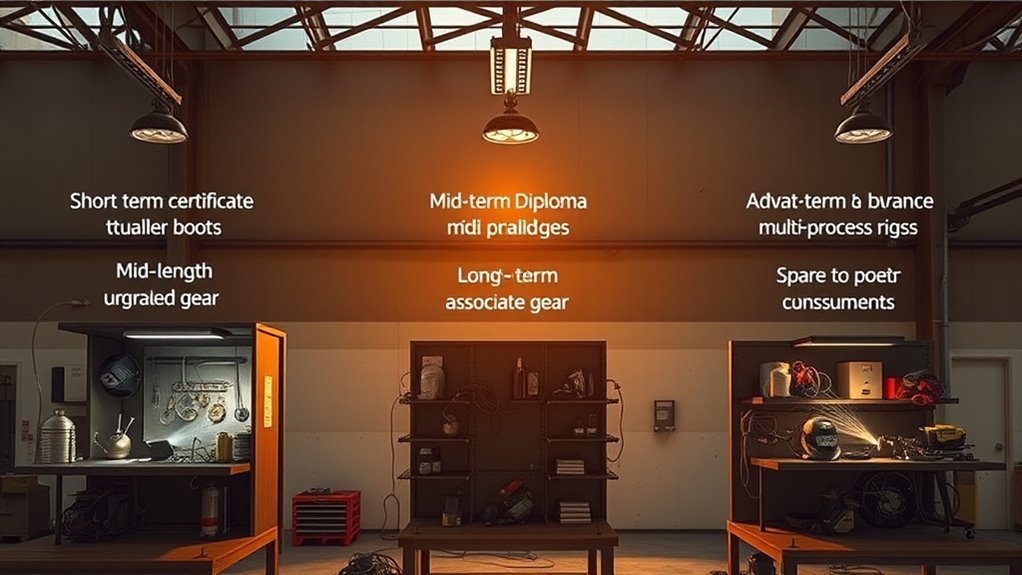
Program length affects your monthly budget, but a shorter program is not automatically cheaper. An accelerated private program may concentrate a large tuition bill into several months, while a public technical or community-college route may spread lower tuition across a longer schedule.
| Training Route | Typical Billing Issue to Check | Best Comparison Question |
|---|---|---|
| Short certificate | Large direct cost compressed into a short period | How many hands-on training hours do I receive for the full price? |
| Private trade school | Tuition may be only part of the published total | What mandatory fees, gear, materials, and testing are added? |
| Community college or public technical school | Residency status and per-credit or per-term charges can change the price | What is my exact in-district/in-state cost for this welding program? |
| Associate degree | Longer enrollment can add more living and transportation expenses | Do I need the degree for my career goal, or would a shorter certificate qualify me? |
Location matters too. Public tuition structures and private-school prices can differ substantially by state. For location-specific examples, see our California welding school cost guide and Missouri welding school cost guide.
Before enrolling, compare total direct cost, training hours, program length, included equipment, financial-aid eligibility, completion information, and the welding processes taught. A low monthly payment is not automatically a good value if it stretches an expensive program over a longer period.
How Can You Lower Your Welding-School Cost?

Start with money that does not normally have to be repaid before relying on loans. Eligible students can use the FAFSA to apply for federal aid for qualifying college, career-school, and trade-school programs.
For the 2026–2027 award year, the maximum Federal Pell Grant is $7,395. Your actual award depends on federal eligibility rules, your FAFSA information, enrollment, and the school’s cost of attendance. Federal Student Aid explains current Pell Grant rules in its Federal Pell Grant guide.
The American Welding Society Foundation is another source worth checking. Its Welder Training Scholarship is designed for students in certificate programs shorter than two years and offers $1,000 awards (check the AWS page for the current number of awards). AWS also offers National Scholarships for qualifying welding and related students.
Reduce the price first with confirmed grants and scholarships. Then compare the remaining net cost before deciding whether a payment plan or loan is affordable.
- Complete the FAFSA and review the aid offer from each eligible school.
- Apply for welding-specific scholarships, including AWS opportunities for programs that match the eligibility rules.
- Ask about state workforce funding, veterans benefits, or employer assistance if you may qualify.
- Compare the school’s net price, not only its advertised tuition.
- Review loan interest and repayment terms before borrowing.
- Ask about payment plans, including due dates and any added fees, before signing an enrollment agreement.
Is Welding School Worth the Monthly Cost?

Welding school can be worth the cost when the program teaches skills employers in your area need and you can complete it without taking on unmanageable debt. Do not judge the decision from a national salary figure alone.
The U.S. Bureau of Labor Statistics reports that welders, cutters, solderers, and brazers earned a median annual wage of $53,750 in May 2025, equal to $25.84 per hour. The lowest 10 percent earned less than $39,240, while the highest 10 percent earned more than $77,530. These are national occupational figures, not guaranteed starting wages.
BLS projects employment in the occupation to grow 2% from 2025 to 2035, which is slower than the average for all occupations. However, it projects about 40,300 openings per year on average over that period, largely because workers will leave the occupation or retire.
Before enrolling, compare the program’s net cost with local welder wages, the training processes covered, employer requirements, graduation/completion information, and the amount of debt you would carry. A useful personal payback calculation is:
Estimated payback months = net program cost ÷ the amount you can realistically set aside each month after graduation.
This is more conservative than comparing tuition directly with gross salary because your wages, taxes, housing costs, transportation, debt payments, and starting pay are personal.
Frequently Asked Questions
How Much Does Welding School Cost per Month?
There is no single national monthly price. Schools may bill by program, term, credit, clock hour, or payment period. Calculate your own planning amount by subtracting confirmed grants and scholarships from the direct program cost and dividing the remainder by the months you will be enrolled. Add transportation and living expenses separately.
How Long Does Welding School Take?
Program length varies by credential and school. Current training options range from short certificates to programs lasting a year or longer. For example, Tulsa Welding School lists welding-related programs ranging from about 7 months to 14 months depending on the track. Confirm the exact clock hours and calendar length before comparing monthly costs.
Can a Pell Grant Pay for Welding School?
Yes, if you meet Federal Pell Grant eligibility rules and enroll in an eligible program and school. The maximum Federal Pell Grant for the 2026–2027 award year is $7,395, but your individual award may be lower. Complete the FAFSA and review the aid offer from your school to learn your actual amount.
Do You Need a Degree to Become a Welder?
Not necessarily. The Bureau of Labor Statistics says welders typically need a high school diploma or equivalent along with technical and on-the-job training. Employers may also require applicants to pass job-specific welding tests or hold particular qualifications, so check local job requirements before choosing a certificate or degree program.
What Costs May Not Be Included in Welding-School Tuition?
Depending on the school, separate costs can include registration or lab fees, books, PPE, tools, materials, testing, technology charges, transportation, housing, food, and loan interest. Ask for an itemized written cost sheet so you can compare the same categories at every school.
Is Welding School Worth the Cost?
It can be, but the answer depends on your net program cost, local wages, training quality, employer requirements, completion prospects, and debt. The national median welder wage was $53,750 in May 2025, but starting pay and local wages can be lower or higher. Compare the program with real jobs in your area before enrolling.
Conclusion
There is no dependable one-size-fits-all monthly price for welding school. Start with the school’s current direct program cost, subtract confirmed grants and scholarships, and divide the remaining amount across your enrollment period. Then add only the transportation, housing, food, and other expenses that apply to you. Compare that net cost with local welder wages, training hours, program outcomes, and employer requirements before enrolling. A lower sticker price is useful only when the program gives you the skills and qualifications needed for the work you plan to pursue.