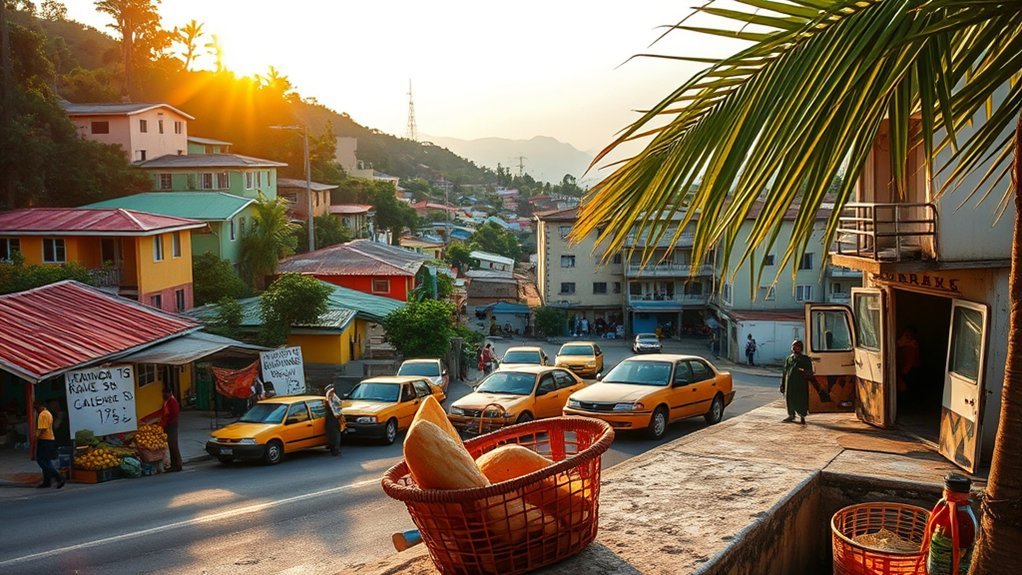
The cost of retiring in Jamaica in 2026 starts at about J$224,000–J$316,000 (~$1,405–$1,985) a month for one person, including a one-bedroom apartment, before private health insurance. A retired couple should plan on roughly J$346,000–J$430,000 (~$2,170–$2,700). These figures use the Bank of Jamaica rate of J$159.37 per US dollar on October 2, 2026. Rent is the biggest swing factor: a one-bedroom averages about J$69,000 (~$435) outside city centers nationwide and about J$153,000 (~$955) in central Kingston. Inflation is also running high, at 7.9% in August 2026, so prices are rising faster than in most of the past few years. Below you’ll find rents by city, food, utilities, transport, healthcare, taxes, residency rules, and sample budgets.
Quick Answer
- Single retiree: about J$155,000–J$164,000 (~$970–$1,030) a month before rent; J$224,000–J$316,000 (~$1,405–$1,985) with a one-bedroom apartment.
- Retired couple: about J$346,000–J$430,000 (~$2,170–$2,700) a month with a one-bedroom apartment.
- Family of four: about J$564,000 (~$3,540) before rent; J$747,000–J$900,000 (~$4,690–$5,650) with a three-bedroom.
- Rent, one-bedroom: J$69,000 (~$435) outside city centers to J$153,000 (~$955) in central Kingston.
- Utilities: about J$24,000–J$27,000 (~$150–$170) a month for an 85 m² apartment; internet adds about J$8,000 (~$50).
- Minimum wage: J$17,000 (~$107) per 40-hour week since July 1, 2026.
- Residency: US citizens can visit without a visa; retirees can apply for permanent residence for J$100,000 (~$630).
Exchange Rate, Inflation, and Wages in 2026
Three numbers shape what Jamaica costs this year.
The exchange rate. The Bank of Jamaica reported a weighted average selling rate of J$159.37 per US dollar on October 2, 2026. The rate moves slowly, so a budget set in Jamaican dollars holds its dollar value fairly well from month to month. All dollar figures in this guide use that rate.
Inflation. According to the Statistical Institute of Jamaica (STATIN), consumer prices rose 7.9% in the 12 months to August 2026, above the central bank’s 4–6% target range. Rebuilding after Hurricane Melissa, which hit western Jamaica in late October 2025, has pushed up demand for materials, labor, and housing. The Bank of Jamaica set its policy rate at 6.00% in late September 2026.
Wages. The national minimum wage rose to J$17,000 per 40-hour week on July 1, 2026, up from J$16,000, according to the Jamaica Information Service. That’s J$425 an hour, or roughly J$73,700 (~$460) a month. Crowd-sourced averages put the typical net salary at about J$124,000 (~$780) a month nationally. Unemployment was 4.2% in July 2026.
A central Kingston one-bedroom costs more than a full average local salary. Retirees with US pensions or Social Security are far better placed than local earners.
Cost of Living by City
Kingston, the capital, has the most reliable price data. Montego Bay and other tourist towns have far fewer reports, so treat their figures as rough guides. The table uses crowd-sourced averages updated October 2, 2026.
| Area | 1-Bed, City Center | 1-Bed, Outside Center | Basic Utilities (85 m²) | Single Person, Without Rent |
|---|---|---|---|---|
| Kingston | J$152,563 (~$957) | J$90,417 (~$567) | J$26,700 (~$168) | J$163,812 (~$1,028) |
| Montego Bay* | J$50,000 (~$314) | J$35,000 (~$220) | J$26,700 (~$168) | limited data |
| Jamaica average | J$130,198 (~$817) | J$69,107 (~$434) | J$24,227 (~$152) | J$154,744 (~$971) |
*Montego Bay rents come from very few reports and likely understate what foreigners pay for furnished or gated apartments near the tourist strip.
A few patterns stand out:
- Kingston is the most expensive place to rent, especially in uptown areas such as New Kingston, Liguanea, Barbican, and Cherry Gardens.
- Montego Bay, Ocho Rios, and Negril have cheaper local rents, but furnished, secure apartments aimed at foreigners can cost as much as Kingston.
- Mandeville, in the cooler central hills, has long been popular with returning residents and retirees for its milder climate.
- Western parishes such as Westmoreland, Hanover, St. Elizabeth, and Trelawny are still rebuilding after Hurricane Melissa, which affects housing supply and repair costs.
Housing: Rent and Buying
Housing is the biggest adjustable part of a Jamaica budget. National crowd-sourced averages in October 2026 were:
| Rental | Jamaica Average (JMD) | Kingston (JMD) |
|---|---|---|
| 1-bedroom, city center | 130,198 (~$817) | 152,563 (~$957) |
| 1-bedroom, outside center | 69,107 (~$434) | 90,417 (~$567) |
| 3-bedroom, city center | 281,211 (~$1,765) | 335,695 (~$2,106) |
| 3-bedroom, outside center | 182,972 (~$1,148) | 222,681 (~$1,397) |
Gated communities, furnished apartments, and homes with backup water tanks, generators, or ocean views cost more than these averages. Many landlords ask for a security deposit plus the first month’s rent, so budget for at least two months’ rent up front.
Buying property. Foreigners can buy property in Jamaica. Mortgage rates average about 9.6%, so many foreign buyers pay cash. A 2% transfer tax applies on most property sales. After Hurricane Melissa, the government cut transfer tax by 50% for two years on properties in Trelawny, Hanover, Westmoreland, and St. Elizabeth, the parishes hit hardest, to support relocation and rebuilding. Check whether any home you consider was damaged in the storm and how it was repaired.
Utilities, Internet, and Phone
Basic utilities (electricity, water, and garbage) for an 85 m² apartment average about J$24,000 (~$150) a month nationally and about J$26,700 (~$170) in Kingston and Montego Bay. Electricity from JPS is expensive by regional standards, and air conditioning is the main reason bills rise. Some homes use solar water heaters or panels to cut costs.
- Home internet (60+ Mbps): about J$7,900 (~$50) a month on average, and about J$8,400 (~$53) in Kingston.
- Mobile plan with data: about J$4,400–J$4,700 (~$27–$29) a month. Digicel and Flow are the main networks.
- Water: supplied by the National Water Commission. Outages happen in dry periods, so many homes have storage tanks.
Ask the landlord for recent JPS bills before you sign. A home that runs air conditioning in several rooms can pay double the average.
Food: Groceries and Dining Out
Local produce, chicken, rice, and fish are reasonably priced. Imported foods, dairy, and wine cost more than in the US because of import duties and the 15% General Consumption Tax (GCT) on many items.
Average prices in October 2026, based on crowd-sourced data:
| Item | Typical Cost (JMD) | Approx. USD |
|---|---|---|
| Milk (1 liter) | 605 | $3.80 |
| Bread (1 lb loaf) | 476 | $2.99 |
| Rice (1 lb) | 115 | $0.72 |
| Eggs (12) | 617 | $3.87 |
| Chicken fillets (1 lb) | 601 | $3.77 |
| Beef (1 lb) | 624 | $3.92 |
| Local cheese (1 lb) | 865 | $5.43 |
| Tomatoes (1 lb) | 188 | $1.18 |
| Mid-range bottle of wine | 1,900 | $11.92 |
Eating out:
- Meal at an inexpensive restaurant or cookshop: about J$1,750 (~$11) nationally, J$2,150 (~$13.50) in Kingston
- Three-course dinner for two at a mid-range restaurant: about J$12,000 (~$75)
- Fast-food combo meal: about J$1,300 (~$8)
- Cappuccino: about J$710 (~$4.45)
- Local beer (pint): about J$350 (~$2.20)
Jerk chicken stands, patty shops, and local cookshops are the cheapest way to eat out. Farmers’ markets in Kingston, Mandeville, and other towns are the best value for fruit and vegetables.
Transportation and Getting Around
- Buses: Kingston’s JUTC buses cost about J$125–J$150 per ride, with monthly passes around J$6,000–J$7,400 (~$38–$47). The US State Department advises visitors to avoid public buses for safety reasons.
- Route taxis and licensed taxis: route taxis are cheap and widely used. Licensed taxis (red plates marked PPV) and ride-hailing apps cost more but are safer, especially at night. A taxi meter starts around J$150–J$190.
- Gasoline: about J$220–J$227 per liter (~$5.20 per gallon), based on crowd-sourced data.
- Cars: imported cars carry high duties. Roads outside main highways can be narrow and rough, and night driving isn’t recommended.
Many retirees budget J$25,000–J$50,000 (~$160–$315) a month for taxis if they don’t own a car.
Healthcare and Insurance Costs
Healthcare deserves its own line in any Jamaica budget.
- Public care: Jamaica has a no-user-fee policy for public patients at government facilities. According to the Ministry of Health and Wellness, non-residents, private patients, and patients with insurance are charged. Under the fee schedule set in 2018, a general visit for non-residents cost J$3,000 and a specialty clinic visit J$7,500.
- Private care: Kingston and Montego Bay have private hospitals and specialists. Many private hospitals ask for payment or a deposit before admission.
- Medical evacuation: the US State Department says an air ambulance to the United States costs at least about $30,000.
- Medicare: generally doesn’t pay for care in Jamaica. Many US retirees keep Medicare for trips home and buy separate coverage in Jamaica.
Private international health insurance prices depend heavily on age, deductible, and pre-existing conditions. Get written quotes for your age before you move, and make sure the policy includes evacuation.
Taxes: GCT and Income Tax
- General Consumption Tax (GCT): the standard rate is 15%. Phone services are taxed at 25%, and tourism services at a reduced 10%.
- Income tax: the tax-free threshold rose to J$1,902,360 a year on April 1, 2026. For the full 2026 calendar year the effective threshold is J$1,876,614. Pensioners and people aged 65 and over get an extra J$250,040 exemption, for combined tax-free income of J$2,376,654 (~$14,915) in 2026, according to the Jamaica Information Service. Income above the threshold is taxed at 25% up to J$6 million and 30% above that.
- US Social Security: under Article 19 of the US–Jamaica income tax treaty, Social Security paid to a resident of Jamaica is generally taxable only by the United States. Private pensions, IRA withdrawals, and investment income follow different rules.
Jamaican residents are taxed on worldwide income, but non-domiciled residents are generally taxed on foreign income only when it’s brought into Jamaica. Get advice from someone who knows both US and Jamaican tax rules before you move.
Visas and Residency for Retirees
US, Canadian, and UK citizens don’t need a visa to visit Jamaica. The Passport, Immigration and Citizenship Agency (PICA) lists the US as visa-exempt for up to six months, but the officer at the border decides how long you can stay, and the US State Department describes stays of 90 days or less as visa-free. Check the date stamped in your passport.
- Extension of stay: apply to PICA before your permitted stay ends. The processing fee is J$10,000 (~$63).
- Permanent residence (retirement category): PICA’s permanent residence page lists proof of pension or bank statements, a local medical certificate, police certificates, references, and a statement of purpose. Applications take about three to six months and include an interview.
- Fees: PICA’s fee schedule lists J$100,000 (~$630) for a permanent residence application.
Jamaica doesn’t publish a fixed minimum income for retirees. Officers look at whether your pension or savings can support you, so bring clear proof of stable income.
Safety and Hurricane Risk
The US State Department’s advisory, updated June 23, 2026, rates Jamaica Level 2: Exercise Increased Caution because of crime and health risks. It names specific neighborhoods in Kingston, St. James, St. Catherine, and other parishes where travelers should reconsider going. Violent crime is concentrated in certain communities, and most retirees live in gated or well-established areas.
Hurricanes are a real cost factor. Hurricane Melissa in October 2025 caused severe damage in western Jamaica, and the government secured up to $6.7 billion in international financing for recovery. For your budget, that means:
- Home insurance with hurricane coverage costs more than in many inland places.
- Building materials and contractors are in high demand while rebuilding continues.
- A home with storm shutters, a water tank, and a generator is worth paying more for.
One-Time Setup Costs
- Permanent residence application: J$100,000 (~$630).
- Extension of stay while you wait: J$10,000 (~$63).
- Rental deposit: usually one month’s rent plus the first month in advance.
- Furnishing and appliances: many long-term rentals are unfurnished. Air conditioners and a water heater are the costly items.
- Medical certificate and police certificates: required for residency.
- Health insurance: private coverage with evacuation should start before you arrive.
Sample Monthly Budgets
These budgets combine crowd-sourced estimates of everyday spending with average rents. They don’t include private health insurance, a car, or flights home.
| Household | Before Rent (JMD) | Rent (JMD) | Total (JMD) | Total (USD) |
|---|---|---|---|---|
| Single, 1-bed outside center (national) | 154,744 | 69,107 | about 224,000 | ~$1,405 |
| Single, 1-bed central Kingston | 163,812 | 152,563 | about 316,000 | ~$1,985 |
| Couple, 1-bed outside center (national)* | about 277,000 | 69,107 | about 346,000 | ~$2,170 |
| Couple, 1-bed central Kingston* | about 277,000 | 152,563 | about 430,000 | ~$2,700 |
| Family of four, 3-bed outside center | 564,043 | 182,972 | about 747,000 | ~$4,690 |
| Family of four, 3-bed city center | 564,043 | 335,695 (Kingston) | about 900,000 | ~$5,650 |
*The couple estimate doubles the single non-rent figure and subtracts one set of utilities and internet, since a couple shares a home.
For families, international primary school averages about J$808,000 (~$5,070) a year per child, and private preschool about J$53,600 (~$335) a month.
Money-Saving Tips
- Look beyond uptown Kingston. Mandeville and smaller towns often cost less for the same space.
- Cut the power bill. Choose a home with good airflow, ceiling fans, or solar water heating.
- Buy local. Markets, local brands, and in-season produce cost far less than imported goods.
- Use the over-65 tax break. If you become a Jamaican tax resident, the extra exemption raises your tax-free income.
- Try before you commit. Rent for a few months before buying, and track your real spending in Jamaican dollars.
How Jamaica Compares With Nearby Countries
Jamaica sits in the middle of the Caribbean range. To the north, the cost of living in the Bahamas is much higher, with most goods imported. To the east, the Dominican Republic budget guide shows a popular lower-cost option for retirees, while our guide to living costs in Haiti covers a country facing serious security problems. For English-speaking alternatives, compare what it costs to live in Belize and the monthly expenses in Trinidad and Tobago.
Frequently Asked Questions
How much money do you need to retire in Jamaica?
A single retiree needs about J$224,000–J$316,000 (~$1,405–$1,985) a month, including a one-bedroom apartment, before private health insurance. A couple needs about J$346,000–J$430,000 (~$2,170–$2,700).
How much is rent in Jamaica in 2026?
A one-bedroom averages about J$69,000 (~$435) outside city centers and J$130,000 (~$815) in city centers nationwide. In central Kingston, one-bedrooms average about J$153,000 (~$955).
What is the minimum wage in Jamaica in 2026?
The minimum wage is J$17,000 (~$107) per 40-hour week, or J$425 an hour, since July 1, 2026. It was J$16,000 before that.
Is public healthcare free for foreigners in Jamaica?
Not always. Jamaica’s no-user-fee policy covers public patients, but the Ministry of Health charges non-residents, private patients, and insured patients. Most foreign retirees carry private insurance with medical evacuation.
Does Jamaica tax US Social Security?
Generally no. Under Article 19 of the US–Jamaica tax treaty, US Social Security paid to a Jamaica resident is taxable only by the United States. Other pensions and investment income can be treated differently.
How do you get residency in Jamaica as a retiree?
Apply to PICA for permanent residence under the retirement category. You’ll need proof of pension or savings, a local medical certificate, police certificates, and references. The fee is J$100,000 (~$630), and processing takes about three to six months.
Conclusion
Jamaica can be an affordable place to retire if you choose your area carefully. A single retiree should budget about J$224,000–J$316,000 a month with rent, and a couple about J$346,000–J$430,000, before private health insurance. Inflation near 8% and post-hurricane rebuilding are pushing costs up in 2026, so leave room in your budget. Pick a neighborhood with good security and nearby medical care, get insurance quotes with evacuation cover, and spend a few months there before you commit.
Sources
- Bank of Jamaica – exchange rate, inflation, and policy rate
- STATIN – consumer price index and labour force data
- Jamaica Information Service – 2026 minimum wage
- Jamaica Information Service – 2026 income tax threshold
- Jamaica Information Service – transfer tax break for hurricane-hit parishes
- Jamaica Information Service – post-hurricane recovery financing
- Ministry of Health and Wellness – fees for non-residents and private patients
- PICA – permanent residence
- PICA – immigration fees
- PICA – entry visa requirements
- PwC – Jamaica GCT and transfer tax
- IRS – US–Jamaica tax treaty documents
- US Department of State – Jamaica travel advisory
- Numbeo – Jamaica, Kingston, Montego Bay (crowd-sourced averages, updated October 2, 2026)