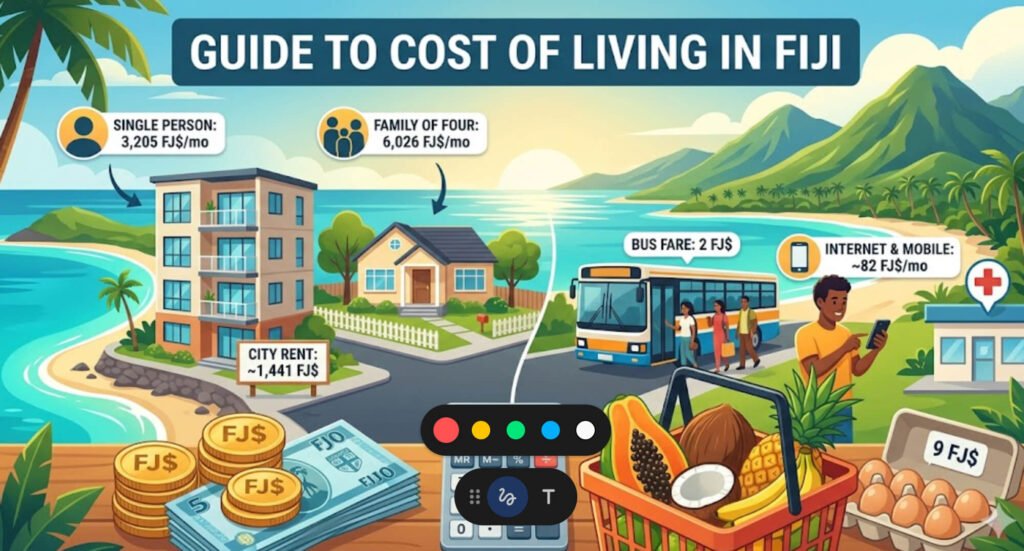
The cost of living in Fiji in 2026 runs about FJ$1,655–2,190 (~$730–$965) a month for a single person living simply, and about FJ$3,530–4,070 (~$1,555–$1,795) for a comfortable single life in central Suva. A couple should plan on roughly FJ$4,200–5,020 (~$1,855–$2,215). These figures use the Reserve Bank of Fiji’s rate of about US$0.4412 per Fijian dollar (October 2, 2026), or roughly FJ$2.27 per US dollar. Rent is the biggest swing factor: a one-bedroom in central Suva averages about FJ$1,990, while one outside the center averages about FJ$730. Prices are rising again after a year of falling prices in 2025. Inflation reached 7.6% in August 2026, led by food, fuel, and utilities. Below you’ll find city rents, utility and fuel prices, taxes, permit costs, and sample budgets.
Quick Answer
- Single person: FJ$1,655–2,190 (~$730–$965) on a lean budget; FJ$3,530–4,070 (~$1,555–$1,795) for a comfortable one in central Suva.
- Couple: FJ$4,200–5,020 (~$1,855–$2,215) a month in a central one-bedroom.
- Family of four: about FJ$7,000–7,200 (~$3,090–$3,175) before international school fees.
- Rent, one-bedroom: FJ$730–1,450 (~$325–$640) outside the center; FJ$1,990–2,500 (~$880–$1,105) in the center, depending on the town.
- Utilities: about FJ$100–150 (~$45–$65) a month for a small apartment; broadband adds about FJ$47–54 (~$21–$24).
- Fuel: petrol FJ$3.15 a liter on Viti Levu from October 1, 2026.
- Minimum wage: FJ$5.00 an hour since April 2025. VAT: 12.5% since August 1, 2025.

This hardcover cookbook offers fast, approachable recipes designed for busy days and low-energy nights. Caroline Chambers focuses on simple, flavorful meals that help you get dinner on the table without overthinking it. It's a practical pick for home cooks who want quick weeknight inspiration and minimal-fuss cooking.

This daily devotional helps parents pray purposefully for their children through a full year of Scripture readings, reflections, and guided prayer prompts. Written to encourage faithful family discipleship, it offers practical, biblically grounded support for parents who want to shape their prayers around God's Word. A foreword by Sinclair B. Ferguson adds trusted theological insight and encouragement.

This hardcover book celebrates the art of gathering with inspiring table settings, thoughtful traditions, and practical ideas for hosting memorable meals. Written by Shea McGee, it offers beautiful design inspiration alongside approachable guidance for creating warm, welcoming spaces for family and friends. It's a charming resource for anyone who loves entertaining, home styling, and making everyday moments feel special.
Exchange Rate, Inflation, and Wages in 2026
Three numbers shape what Fiji costs you this year.
The exchange rate. The Reserve Bank of Fiji sets the official rate each business morning against a basket of currencies. On October 2, 2026, FJ$1 bought about US$0.4412, or roughly FJ$2.27 per US dollar. At the end of August it was US$0.4507, so the Fijian dollar has weakened a little in the past month. That makes Fiji slightly cheaper for people earning in US, Australian, or New Zealand dollars.
Inflation. Prices fell in 2025, when average inflation was about -1.4%. That reversed in 2026. The Reserve Bank’s September 2026 Economic Review reports annual inflation of 7.6% in August, up from 5.7% in July. It names food (especially cassava, dalo, and potatoes), transport (fuel and taxi fares), kava, and utilities as the main drivers, and expects inflation to stay above 6% through the end of the year.
Wages. The national minimum wage is FJ$5.00 an hour. It rose from FJ$4.00 in August 2024 to FJ$4.50 and then to FJ$5.00 in April 2025, according to a September 2026 Fiji Times analysis. Unions are now campaigning for an FJ$8 living wage. On a 40-hour week, FJ$5 an hour works out to about FJ$867 (~$380) a month. Crowd-sourced data puts the average net salary at about FJ$1,754 a month nationally and FJ$2,157 in Suva.
A full-time minimum-wage job pays about FJ$867 a month, which is less than the average rent for a one-bedroom outside central Suva. Most local households share housing or live with family.
Cost of Living by City
Most expats live in Suva, the capital, or on the west side of Viti Levu around Nadi and Lautoka, close to the international airport and the tourist belt. The table uses crowd-sourced averages updated in October 2026. Suva has far more price reports than other towns, so treat the Nadi and Lautoka figures as rough guides.
| City | 1-Bed, City Center | 1-Bed, Outside Center | 3-Bed, Outside Center | Basic Utilities |
|---|---|---|---|---|
| Suva | FJ$1,992 (~$880) | FJ$733 (~$325) | FJ$2,220 (~$980) | FJ$102 (~$45) |
| Nadi | FJ$2,500 (~$1,105) | FJ$1,450 (~$640) | FJ$2,250 (~$995) | FJ$150 (~$65) |
| Lautoka* | FJ$1,000 (~$440) | — | — | — |
| Fiji average | FJ$2,051 (~$905) | FJ$929 (~$410) | FJ$2,048 (~$905) | FJ$126 (~$56) |
*Lautoka’s figure comes from a single contributor and was last updated in March 2025.
A few patterns stand out:
- Suva has the widest gap between central and outer rents. Central one-bedrooms cost almost three times as much as those in suburbs such as Nasinu or Nausori, but you’ll pay more in bus fares and taxis.
- Nadi rents are high for its size because tourism, airline staff, and short-term rentals compete for housing.
- Lautoka, Fiji’s second city, looks cheaper than Nadi in the little data available. Check local listings before you plan around it.
- Vanua Levu towns such as Labasa and Savusavu have smaller rental markets. Good expat-standard houses there can be hard to find.
Housing: Rent and Property Rules
What Rent Buys
Three-bedroom homes average about FJ$4,500 (~$1,985) in city centers and FJ$2,048 (~$905) outside them. Central Suva three-bedrooms average about FJ$5,936 (~$2,620), which reflects a small supply of secure, modern family homes near the embassies and international schools.
Expat-standard rentals often include security grilles, a water tank, and air conditioning, and these push rents up. Ask whether the rent includes furniture, water, garden care, and a security guard. Ask about lease length, the bond, and how much rent is due in advance.
Buying Property as a Foreigner
Most land in Fiji is iTaukei (customary) land, which can be leased but not bought. Freehold and state land make up a smaller share. Non-residents face restrictions on buying freehold or state residential land inside town and city boundaries, with exceptions for strata-title apartments. Rules differ for land outside those boundaries. Talk to a Fiji lawyer before you sign anything, and confirm the land type and lease terms.
Crowd-sourced purchase prices average about FJ$254 per square foot (~$112) in city centers and FJ$171 (~$75) outside them. The 20-year fixed mortgage rate averages about 7.4%.
Utilities, Internet, and Phone
Basic utilities (electricity, water, and garbage) for an 85 m² apartment average about FJ$126 (~$56) a month nationally and FJ$102 (~$45) in Suva. Heavy air conditioning use can double that.
Electricity. Energy Fiji Limited’s tariff page lists the domestic rate at 34.01 cents per kWh before VAT. Households that use 100 kWh or less a month and earn under FJ$30,000 a year can register for a subsidized rate of 17.67 cents per kWh on the first 100 units. The Fijian Competition and Consumer Commission announced a revised electricity tariff in December 2025, so check the rate on your first bill.
At 34.01 cents, 300 kWh a month costs about FJ$102 before VAT, or about FJ$115 with 12.5% VAT. Running air conditioning most nights can push a bill to 500 kWh or more.
Cooking gas. Regulated LPG prices rose on October 1, 2026, to FJ$42.16 for a 12 kg cylinder and FJ$15.81 for a 4.5 kg cylinder.
Internet and mobile.
- Home broadband (60+ Mbps): about FJ$47 (~$21) on average; about FJ$54 (~$24) in Suva.
- Mobile plan with 10 GB+ data: about FJ$32 (~$14) a month.
- Coverage: the UK Foreign Office warns that mobile service in rural areas and outer islands is limited or missing. SIM cards must be registered when bought locally.
Food: Groceries and Dining Out
A single person who cooks most meals spends about FJ$450–600 (~$200–$265) a month on groceries. Local produce at municipal markets is cheap. Imported cheese, wine, meat, and packaged foods are where bills climb. Many basic foods are zero-rated for VAT.
Average national prices in October 2026:
| Item | Typical Cost (FJD) | Approx. USD |
|---|---|---|
| Milk (1 liter) | 2.97 | $1.31 |
| Bread (1 lb loaf) | 1.39 | $0.61 |
| Rice (1 lb) | 1.13 | $0.50 |
| Eggs (12) | 7.52 | $3.32 |
| Chicken fillets (1 lb) | 9.57 | $4.22 |
| Beef (1 lb) | 8.33 | $3.68 |
| Local cheese (1 lb) | 9.43 | $4.16 |
| Bananas (1 lb) | 2.66 | $1.17 |
| Tomatoes (1 lb) | 2.96 | $1.31 |
| Mid-range bottle of wine | 18.50 | $8.16 |
Eating out is affordable if you stick to local food:
- Meal at an inexpensive restaurant: about FJ$12 (~$5.30)
- Three-course dinner for two at a mid-range restaurant: about FJ$90 (~$40)
- Fast-food combo meal: about FJ$16 (~$7)
- Cappuccino: about FJ$6.77 (~$3)
- Domestic beer (pint, at a bar): about FJ$7 (~$3.10)
Resort and hotel restaurants charge far more. Curry houses, Chinese restaurants, and market food stalls keep costs low.
Root crops and greens at the local market cost a fraction of imported food, but food prices are the fastest-rising part of Fiji’s 2026 inflation.
Transportation and Fuel
Buses are cheap and run on most main roads of Viti Levu. Crowd-sourced fares average about FJ$1.80 (~$0.80) a ride and FJ$50 (~$22) for a monthly pass. Taxis start at about FJ$2 and charge about FJ$1.61 per mile (about FJ$1.00 per km).
Fuel prices are regulated. According to a Fiji Times report on the October 2026 price review, maximum prices on Viti Levu from October 1, 2026, are:
| Fuel (Viti Levu) | Price per Liter (FJD) | Approx. USD |
|---|---|---|
| Petrol | 3.15 | $1.39 (~$5.26 per gallon) |
| Diesel | 3.41 | $1.50 |
| Kerosene | 2.67 | $1.18 |
Remote areas pay more. Cars are expensive to buy: a new Toyota Corolla averages about FJ$58,300 (~$25,740). The 2026–2027 budget raised excise duty on new passenger vehicles from 5% to 10% and on used vehicles from 5% to 15%, so car prices are likely to rise further.
The UK Foreign Office describes Fiji’s roads as poorly maintained and dangerous after dark, with poor lighting and animals on the road. Many newcomers rely on taxis in town and rent a car for trips.
Healthcare and Insurance
Fiji has public hospitals in the main towns and private clinics and hospitals in Suva and Nadi. According to the UK government’s Fiji health guidance:
- Healthcare facilities are limited in range and availability.
- Hospitals usually ask for immediate cash payment.
- People with serious conditions are often evacuated to another country for treatment.
Prices for private consultations and local health insurance plans are not published in a reliable public form. Budget for an international health policy that includes medical evacuation, and keep cash or a card with a high limit for upfront payments. Prescription medicines are zero-rated for VAT.
Schools and Childcare
School choice drives family budgets more than anything else.
- Private full-day preschool: about FJ$433 (~$190) a month, with reports from FJ$200 to FJ$780.
- International primary school: about FJ$29,900 (~$13,200) a year per child, with reports from about FJ$23,700 to FJ$35,000.
- Public and church schools: teach in English and charge low fees, but class sizes and resources vary.
For two children in international school, tuition alone adds about FJ$5,000 (~$2,200) a month.
Taxes: VAT and Income Tax
- VAT: the standard rate fell from 15% to 12.5% on August 1, 2025, according to the Fiji Revenue and Customs Service VAT guide. Zero-rated items, including certain basic foods and prescription medicines, carry no VAT.
- Income tax (residents): under Fiji’s personal tax rates, the first FJ$30,000 a year is tax-free. Income from FJ$30,001 to FJ$50,000 is taxed at 18%, and from FJ$50,001 to FJ$270,000 at 20%, rising in steps to 39% above FJ$1 million. Non-residents pay higher rates starting at 20%.
- Example: a resident earning FJ$60,000 a year pays FJ$3,600 on the band from FJ$30,000 to FJ$50,000, plus FJ$2,000 on the rest, for FJ$5,600, or about 9.3%.
- Pension (FNPF): employees contribute 8% of wages and employers 10%. Expatriate employees can join only if both they and the employer agree.
- New in 2026: a 5% Tourism Services Tax applies from September 1, 2026, to large tourism operators, which may show up in hotel and tour prices.

These colorful answer buzzers turn lessons, review games, and family activities into lively game-show style challenges that boost participation and make learning more interactive. Each buzzer has a distinct sound to clearly identify who buzzed in first, while the durable, palm-sized design makes them easy for kids and adults to use in classrooms, homeschools, and group settings.

Die With Zero offers a fresh perspective on personal finance by encouraging readers to use money intentionally to create memorable life experiences instead of simply accumulating wealth. Written by Bill Perkins, this book combines practical guidance with a motivating philosophy to help readers align spending, saving, and life goals for a more fulfilling future.

Velveeta Shells and Cheese Original Cup delivers a creamy, comforting mac and cheese experience in convenient single-serve cups. Made with real cheese and shelf-stable for easy storage, it’s a quick microwave meal or side that works for busy nights, kids’ meals, and snack cravings. Each cup includes shell pasta and cheese sauce for rich flavor with minimal prep.
Visas and Residence Permits
Visitors from the US, UK, Australia, New Zealand, the EU, and many other countries get a visitor permit on arrival for up to four months. You need a passport valid for six months, an onward ticket, and proof that you can support yourself. You can extend once, by up to two months, for a fee of FJ$93 (~$41). Visitors can’t work.
Longer stays need a permit from the Ministry of Immigration:
| Permit | Main Requirement | Government Fees |
|---|---|---|
| Residence on assured income (retirement) | age 45+; outside income; remit FJ$100,000 (~$44,120) or buy property of that value for the full 3-year permit | FJ$650.05 + FJ$185 per dependent |
| Work permit | job offer from a Fiji employer; a bond may be required | FJ$650.05 + FJ$185 issue fee |
| Investor permit | approved investment in a Fiji business | check with the Ministry |
| Student permit | enrollment at an approved institution | FJ$136 + FJ$185 issue fee |
Details for the retirement option are on the Ministry of Immigration’s assured income permit page. The first six months are granted on approval, and the remaining two and a half years follow once you meet the FJ$100,000 requirement. Work permits typically take 30 working days or more to process.
One-Time Setup Costs
Budget for these before your first month:
- Permit fees: FJ$835 (~$370) for a work or residence permit including the issue fee; more with dependents.
- Assured income deposit: FJ$100,000 to be remitted or invested in property if you take the retirement route.
- Rental bond and advance rent: often one month each, so FJ$1,460–4,100 (~$645–$1,810) for a one-bedroom.
- Furnishing an unfurnished home: appliances and furniture are mostly imported and cost more than in Australia or New Zealand.
- Car: new compact cars cost FJ$55,000–60,000; used cars are cheaper but will carry higher duty after the 2026 budget.
- Health and evacuation insurance: buy it before you arrive.
Sample Monthly Budgets
These budgets combine the averages above. The lean budget assumes a one-bedroom outside the center; the others assume central Suva. Health insurance is left out because international policy prices depend on age and coverage.
| Expense (FJD) | Single, Lean | Single, Comfortable | Couple |
|---|---|---|---|
| Rent (1-bed) | 730–930 | 1,990–2,050 | 1,990–2,050 |
| Utilities | 100–125 | 125–200 | 150–200 |
| Internet + mobile | 75–85 | 85 | 110–120 |
| Groceries | 450–600 | 600–700 | 1,000–1,200 |
| Eating out + leisure | 150–200 | 350–450 | 500–700 |
| Transport | 50–100 | 150–300 | 200–400 |
| Gym | — | 82 | — |
| Personal + other | 100–150 | 150–200 | 250–350 |
| Total (FJD) | 1,655–2,190 | 3,530–4,070 | 4,200–5,020 |
| Total (USD) | $730–$965 | $1,555–$1,795 | $1,855–$2,215 |
Cross-check: crowd-sourced data estimates a single person’s non-rent costs at about FJ$1,338 (~$590) a month. Adding a one-bedroom outside the center (FJ$733–929) gives about FJ$2,070–2,270, close to the top of the lean range.
Family of four: the same data estimates about FJ$4,968 (~$2,190) a month before rent. Add a three-bedroom outside the center (FJ$2,048–2,220) and the total is about FJ$7,000–7,200 (~$3,090–$3,175). International school for two children pushes that to roughly FJ$12,000–12,200 (~$5,295–$5,385).
Money-Saving Tips
- Live just outside the center. In Suva, a one-bedroom outside the center costs about a third of a central one.
- Shop at municipal markets. Local fruit, vegetables, fish, and root crops beat imported supermarket goods on price.
- Look for zero-rated items. Many basic foods and prescription medicines carry no VAT.
- Use buses for daily trips. A monthly pass costs about FJ$50, far less than daily taxis.
- Limit air conditioning. Ceiling fans and good ventilation keep power bills near the national average.
- Check the subsidized power rate. If your household uses under 100 kWh a month and earns under FJ$30,000, register for EFL’s subsidy.
- Plan for inflation. With prices rising above 6%, build a buffer into any fixed-income budget.
Safety and Practical Tips
The UK Foreign Office says the risk of serious crime in Fiji is generally low, though there are occasional incidents including sexual assault. Petty theft happens in cities and tourist areas, so take care with belongings and avoid walking alone at night. Cyclone season runs from November to April, and storms can bring flooding, landslides, and road closures. Check drainage, roof condition, and storm shutters before you rent, and follow alerts from the Fiji Meteorological Service.
How Fiji Compares With Nearby Countries
Fiji has the largest economy and the widest choice of housing, shops, and services among the Pacific island nations, which keeps many prices lower than on smaller islands. Crowd-sourced data for Vanuatu (August 2026) shows one-bedroom rents of about $1,200 outside the center and $1,580 in the center, well above Suva. Its utility and internet costs are also far higher. If you’re comparing Pacific options, see our guides to the cost of living in Samoa, monthly expenses in Tonga, and the Solomon Islands budget guide. For a larger nearby market, compare living costs in Papua New Guinea and our New Zealand cost guide, where many Fiji residents go for work and medical care.
Frequently Asked Questions
How much money do you need to live in Fiji per month?
A single person needs about FJ$1,655–2,190 (~$730–$965) a month for a simple life outside central Suva, and about FJ$3,530–4,070 (~$1,555–$1,795) for a comfortable one in the center. A couple should budget about FJ$4,200–5,020 (~$1,855–$2,215).
Is $1,000 a month enough to live in Fiji?
Yes, for a simple life. At about FJ$2.27 per US dollar, $1,000 is roughly FJ$2,270. That covers a lean budget with a one-bedroom outside central Suva, buses, and home cooking. It does not cover a central apartment, a car, private health insurance, or international school.
What is the average rent in Fiji?
A one-bedroom averages about FJ$2,051 (~$905) in city centers and FJ$929 (~$410) outside them nationally. In Suva, it’s about FJ$1,992 in the center and FJ$733 outside. Nadi is pricier, at about FJ$2,500 central and FJ$1,450 outside.
What is the minimum wage in Fiji in 2026?
The national minimum wage is FJ$5.00 an hour, in place since April 2025. On a 40-hour week that is about FJ$867 (~$380) a month. Unions are campaigning for an FJ$8 living wage.
What is the VAT rate in Fiji?
The standard VAT rate is 12.5%, down from 15% since August 1, 2025. Certain basic food items and prescription medicines are zero-rated, and residential rent is exempt.
How much money do you need to retire in Fiji?
The residence permit on assured income requires you to be 45 or older, show outside income, and remit FJ$100,000 (~$44,120) or buy property of that value. For living costs, a retired couple should plan on at least FJ$4,200–5,020 a month plus private health and evacuation insurance.
Conclusion
Fiji is affordable by Australian, New Zealand, and US standards, but 2026 has brought rising prices. Inflation jumped to 7.6% in August, fuel and gas prices rose again in October, and new vehicle duties will make cars dearer. On the other side, VAT dropped to 12.5% last year and the Fijian dollar has eased a little against the US dollar. A single person can live simply for about FJ$1,655–2,190 (~$730–$965) a month or comfortably in central Suva for FJ$3,530–4,070 (~$1,555–$1,795). Choose your town and neighborhood first, since rent drives most of the difference, and budget separately for health insurance and school fees.
Sources
- Reserve Bank of Fiji – exchange rate and key indicators, October 2, 2026
- Reserve Bank of Fiji – September 2026 Economic Review
- Fiji Times – minimum wage history and living wage debate, September 2026
- Fiji Times – fuel and LPG prices from October 1, 2026
- Energy Fiji Limited – electricity tariffs and rates
- Fiji Revenue and Customs Service – VAT guide
- FRCS – 2026–2027 National Budget, summary of revenue policies
- PwC – Fiji personal income tax rates
- PwC – Fiji FNPF contributions
- Fiji Ministry of Immigration – residence on assured income
- Fiji Ministry of Immigration – forms and fees
- Fiji Ministry of Immigration – visitor permits
- UK FCDO – Fiji health
- UK FCDO – Fiji safety and security
- Fiji Meteorological Service
- Numbeo – Fiji, Suva, Nadi, Lautoka, and Vanuatu (crowd-sourced prices, October 2026)

Miracle-Gro Water Soluble All Purpose Plant Food helps feed a wide range of indoor and outdoor plants, including flowers, vegetables, houseplants, roses, trees, and shrubs. Its water-soluble formula starts working instantly to support bigger, more beautiful growth when used as directed, and the included scoop makes mixing easy for both indoor and outdoor feeding.

Come Eat offers 100 approachable recipes designed to make everyday cooking more enjoyable, nourishing, and sustainable. With a focus on flavorful meals and practical preparation, this hardcover cookbook is ideal for home cooks looking for inspiration for salads, sides, and main dishes. Author Melissa Ben-Ishay shares recipes that encourage consistent, feel-good eating without sacrificing taste.

This heartfelt cookbook shares the kitchen wisdom of a Korean mom alongside 100 family recipes that bring comforting, authentic flavors to your table. Blending personal stories with practical guidance, it offers home cooks approachable ways to explore Korean cooking with confidence. The hardcover format and trusted editorial guidance make it a beautiful and reliable addition to any cookbook collection.