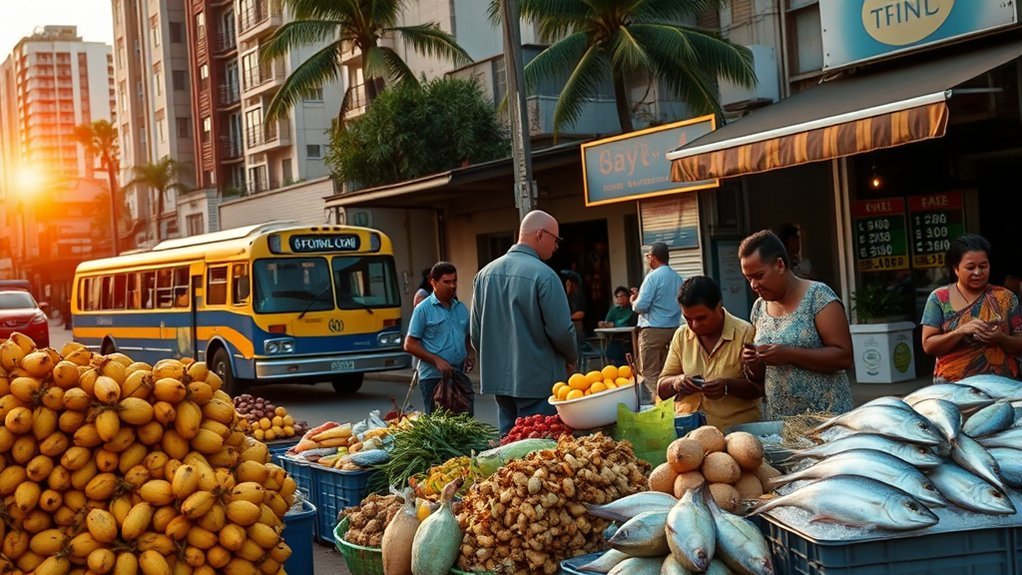
The cost of living in Papua New Guinea in 2026 runs about K6,370–6,650 (~$1,430–$1,490) a month for a single person in a modest Port Moresby apartment outside the center, and about K11,090–13,810 (~$2,485–$3,095) for a single person in a secure central unit. A couple should plan on roughly K11,900–16,600 (~$2,665–$3,720), and a family of four about K19,100–27,900 (~$4,280–$6,265) before school fees. These figures use the Bank of Papua New Guinea rate of US$0.2243 per kina on October 6, 2026, or about K4.46 per US dollar. Housing and security drive most of the cost. Fuel also jumped by K1 a litre in October as a government subsidy began to wind down. Below you’ll find rents, utilities, food and transport prices, the new 2026 minimum wage, income tax, school fees, and sample budgets.
Quick Answer
- Single person: K6,370–6,650 (~$1,430–$1,490) a month outside the center; K11,090–13,810 (~$2,485–$3,095) in a secure central apartment.
- Couple: K11,900–16,600 (~$2,665–$3,720) a month.
- Family of four: K19,100–27,900 (~$4,280–$6,265) a month before international school fees.
- Rent, one-bedroom in Port Moresby: about K2,500 (~$560) outside the center and K7,217 (~$1,620) in the center.
- Utilities: about K528 (~$118) a month for a standard apartment; home internet adds about K413 (~$93).
- Fuel: K5.90 (~$1.32) a litre for petrol and diesel in Port Moresby from October 8, 2026.
- Minimum wage 2026: K5.00 an hour, up from K3.50.
Exchange Rate, Inflation, and Minimum Wage in 2026

Three numbers shape what Papua New Guinea (PNG) costs you this year.
The exchange rate. The kina (PGK, written K) is managed by the central bank and has been sliding slowly against the US dollar. The Bank of Papua New Guinea listed K1 at US$0.2243 on October 6, 2026, down from US$0.2271 in late July. That works out to about K4.46 per dollar. All USD figures in this guide use that rate. If you earn in dollars or Australian dollars, your money stretches a little further each quarter. If you earn in kina and need to send money abroad, it buys a little less.
Inflation. Bank of PNG data put annual inflation at about 2.2% in the June 2026 quarter, with food inflation at about 3.6%. That figure predates the October fuel increase, so transport and freight-heavy goods are likely to rise later in the year.
The minimum wage. The national minimum wage rose to K5.00 an hour on January 1, 2026, from K3.50, the rate that had applied since 2016. The Minimum Wages Board also set steps to K5.25 in January 2027 and K5.50 in January 2028. On a 40-hour week, K5.00 an hour equals about K400 (~$90) a fortnight, or about K867 (~$194) a month.
Crowd-sourced data puts the average net salary in Port Moresby at about K1,930 (~$433) a month. A modest one-bedroom outside the center costs more than that, which is why most foreign workers in PNG live on employer packages that include housing.
Cost of Living by City
Port Moresby is where most foreigners live and where nearly all reliable price data comes from. The table uses crowd-sourced averages from Numbeo, updated October 7, 2026 for Port Moresby. The Lae figures come from only two contributors and were last updated in September 2025, so treat them as a rough guide.
| City | 1-Bed, City Center | 1-Bed, Outside Center | 3-Bed, City Center | 3-Bed, Outside Center |
|---|---|---|---|---|
| Port Moresby | K7,217 (~$1,620) | K2,500 (~$560) | K13,960 (~$3,130) | K5,124 (~$1,150) |
| Lae* | K2,000 (~$450) | K1,200 (~$270) | K5,500 (~$1,235) | K2,800 (~$630) |
*Lae data is thin. Secure, modern housing in Lae is scarce, and units that meet employer security standards often cost far more than these averages.
A few patterns stand out:
- Port Moresby is among the most expensive cities in the Pacific for secure housing. The gap between a basic suburban unit and a guarded compound apartment is close to threefold.
- Lae, the industrial and port hub, is cheaper on paper, but the choice of compound housing is small.
- Mount Hagen, Goroka, and Madang have too little public price data to publish averages. Rents are usually lower, but imported goods cost more because of freight.
- Mine and energy project sites almost always house staff in company camps, so rent is not a personal cost there.
Housing: Rent and Secure Compounds

Rent is the largest expense for anyone not on an employer housing package. In Port Moresby, a one-bedroom in the center averages about K7,217 (~$1,620) a month, while one outside the center averages about K2,500 (~$560). A three-bedroom in the center averages about K13,960 (~$3,130). For more detail on suburbs and lease terms, see our guide to expat housing costs in Papua New Guinea.
Where Foreigners Live
Most foreign professionals live in secure compounds in Town (downtown), Ela Beach, Touaguba Hill, Boroko, or Waigani. These buildings have perimeter walls, guards around the clock, controlled gates, backup generators, and water tanks. Rents in these compounds carry a large premium over open-market housing, and the averages above blend both types.
Lease Terms to Check
- Billing period: some listings quote rent weekly or fortnightly. Confirm the monthly figure before you compare.
- Deposit and advance rent: landlords often ask for one to three months up front.
- Generator and water: ask whether diesel for the generator and water tank top-ups are included in the service fee.
- Security: confirm guard hours, alarms, and whether the location is approved by your employer’s security adviser.
Utilities, Internet, and Phone
Power cuts and water outages are common in PNG towns, so many homes pay twice: once for the grid and once for backup. Average Port Moresby monthly costs:
| Item | Monthly Cost (PGK) | Approx. USD |
|---|---|---|
| Basic utilities (electricity, water, garbage) for an 85 m² apartment | 528 | $118 |
| Home internet (60+ Mbps) | 413 | $93 |
| Mobile plan with 10 GB+ data | 104 | $23 |
| Gym membership | 277 | $62 |
A few things the averages leave out:
- Generator diesel: if it is not included in your rent, each outage burns fuel at K5.90 or more a litre. Ask the landlord for recent outage history.
- Drinking water: many households buy bottled water. A 1.5-liter bottle costs about K5.90 (~$1.32).
- Air conditioning: Port Moresby is hot year-round, and cooling is the main reason power bills rise.
- Internet: Digicel, Vodafone PNG, and Telikom sell mobile and home plans. Speeds and reliability vary by suburb, so test coverage before you sign a lease.
Food: Groceries and Dining Out

Food costs depend on where you shop. Local produce from markets such as Gordons Market is cheap and fresh. Imported goods from Australia and New Zealand in supermarkets carry heavy freight markups. Average Port Moresby prices in October 2026:
| Item | Typical Cost (PGK) | Approx. USD |
|---|---|---|
| Milk (1 liter) | 8.50 | $1.91 |
| Bread (1 lb loaf) | 6.20 | $1.39 |
| Rice (1 lb) | 2.80 | $0.63 |
| Eggs (12) | 16.61 | $3.73 |
| Chicken fillets (1 lb) | 11.62 | $2.61 |
| Beef (1 lb) | 19.96 | $4.48 |
| Local cheese (1 lb) | 17.63 | $3.95 |
| Tomatoes (1 lb) | 13.15 | $2.95 |
| Bananas (1 lb) | 6.50 | $1.46 |
| Mid-range bottle of wine | 49.00 | $10.99 |
Eggs, dairy, cheese, and wine are where grocery bills climb. Rice, bananas, sweet potato (kaukau), greens, and local fish keep them down. A single person who cooks most meals with a mix of local and imported food should plan on about K1,500 (~$335) a month; a couple about double that.
Typical restaurant and cafe prices in Port Moresby:
- Meal at an inexpensive restaurant: about K35 (~$7.85)
- Three-course dinner for two at a mid-range restaurant: about K200 (~$45)
- Fast-food combo meal: about K25 (~$5.60)
- Cappuccino: about K11 (~$2.50)
- Domestic draft beer (pint): about K13.50 (~$3.05)
Transportation, Fuel, and Safety

Getting around is where PNG costs more than its prices suggest. Public motor vehicles (PMVs) are cheap, but most foreigners don’t use them for safety reasons.
| Item | Cost (PGK) | Approx. USD |
|---|---|---|
| PMV (bus) ride | 2.00 | $0.45 |
| Taxi flag fall | 25.00 | $5.61 |
| Taxi per km | about 10.00 | $2.24 |
| Petrol or diesel, 1 liter (Port Moresby, from October 8, 2026) | 5.90 | $1.32 |
| New Toyota Corolla or similar | 79,000 | $17,720 |
Fuel prices jumped in October. The Independent Consumer and Competition Commission raised the Port Moresby retail price of petrol, diesel, and kerosene from K4.90 to K5.90 a litre on October 8, 2026. Global oil prices stayed high because of the US-Iran conflict, and the government is phasing out a direct fuel subsidy over two months. Fuel is also exempt from the 10% GST until at least December 31, 2026. Without both measures, the October price would have been about K6.57 for petrol and K7.31 for diesel. Other towns are seeing similar increases. Budget for higher fuel costs in 2027 if the GST exemption ends.
Safety shapes the transport budget. The US State Department rates PNG at Level 3, “Reconsider Travel,” and Level 4 for most of the Highlands and parts of Bougainville. It advises against PMVs and street taxis and recommends transport arranged through a hotel or employer. In practice, foreign residents budget for a company car, a vetted car service, or a private driver. A few hired car trips a week can cost K1,000 (~$225) a month or more. Owning a four-wheel drive means paying for insurance, secure parking, and fuel on top of the purchase price.
Salaries and Expat Packages
Local pay is low next to the cost of the housing foreigners use. The minimum wage is about K867 (~$194) a month, and crowd-sourced data puts the average net salary in Port Moresby at about K1,930 (~$433). In Lae the reported figure is far lower, though it rests on very few reports.
That gap is why most expatriate jobs in PNG come as a package rather than a cash salary alone. When you compare offers, check whether the employer covers:
- Furnished, secure housing, including generator fuel and utilities
- A company vehicle or driver
- Health insurance with medical evacuation
- International school tuition for children
- Home-leave flights and work permit and visa costs
- Part of the salary paid offshore in foreign currency (see the currency section below)
A cash salary that looks generous can shrink fast if you have to pay for compound rent, a car, and school fees yourself.
Taxes: GST and Income Tax
- GST: 10%, included in shelf prices. Fuel is temporarily exempt until at least the end of 2026.
- Salary and wages tax: employers withhold income tax from each pay. Residents pay nothing on the first K20,000 (~$4,485) a year. Non-residents pay 22% from the first kina.
Resident income tax rates, according to PwC’s PNG tax summary (reviewed September 2026):
| Annual Taxable Income (PGK) | Rate on This Band | Approx. USD Band |
|---|---|---|
| 0–20,000 | 0% | $0–$4,485 |
| 20,001–33,000 | 30% | $4,485–$7,400 |
| 33,001–70,000 | 35% | $7,400–$15,700 |
| 70,001–250,000 | 40% | $15,700–$56,075 |
| Over 250,000 | 42% | over $56,075 |
Example: a resident earning K120,000 (~$26,915) a year pays about K36,850 in tax, leaving roughly K6,930 (~$1,555) a month. Rates climb quickly, so housing and car benefits provided in kind can be worth more than the same amount in cash. Ask a local tax adviser how benefits are taxed under your contract.
Schools, Childcare, and Healthcare

International Schools
School fees are one of the biggest costs for families. The Ela Murray International School fee schedule lists these 2026 annual tuition rates:
| Level | Annual Tuition (PGK) | Approx. USD | Per Term (PGK) |
|---|---|---|---|
| Early Learning and Preschool | 39,648 | $8,895 | 9,912 |
| Prep to Grade 5 | 59,304 | $13,300 | 14,826 |
| Grades 6 to 8 | 64,724 | $14,520 | 16,181 |
The school lists a family discount of about 5% on these rates. Crowd-sourced averages for international primary schools across Port Moresby are lower, at about K27,800 (~$6,235) a year, because they include smaller private schools. Ask each school about enrollment fees, levies, uniforms, and transport.
Childcare
Full-day private preschool in Port Moresby averages about K3,790 (~$850) a month per child, with a wide range depending on the center and its facilities.
Healthcare and Medical Evacuation
Public hospitals are under strain, and medicines can be scarce. Foreign residents use private clinics and hospitals in Port Moresby, such as Pacific International Hospital. Hospitals may ask for payment up front. Serious cases are usually evacuated to Australia, most often Cairns or Brisbane, or to Singapore. Health insurance that includes medical evacuation is essential. Premiums vary widely with age and cover, so get quotes before you move, or confirm that your employer’s plan covers your whole family.
Currency and Money Transfers
PNG has had foreign exchange shortages for years. Converting large sums of kina into US or Australian dollars can involve waiting in bank queues, and transfers abroad need supporting documents. The central bank has been letting the kina weaken gradually to ease the backlog.
To avoid problems, many expatriates split their pay. Part is paid in kina for local spending, and the rest goes straight to an offshore account in foreign currency. If you are negotiating a contract, ask for this early.
Visas and Work Permits
Most foreigners, including US citizens, need a visa or eVisa before arrival. To work, you need both a work permit and an employment visa. The Immigration and Citizenship Authority (ICA) requires the employer to apply for both together through its online Sponsor Portal or at an ICA office.
Typical documents include:
- Signed employment contract and job description
- Qualifications and CV
- Police clearance certificate
- Medical examination report
- Passport copy and photo
- Employer company records and a maintenance guarantee bond
ICA charges visa fees in US dollars under its migration service fee schedule, and the work permit fee is paid at the same time. Fees change, so confirm the current amounts on the ICA site. Employers usually pay them. Apply well ahead of your start date, since processing times are not published.
One-Time Setup Costs
Budget for these before your first month:
- Rent up front: one to three months is common. That is about K2,500–7,500 (~$560–$1,680) outside the center and K7,200–21,650 (~$1,620–$4,855) for a central one-bedroom.
- Visa and work permit fees: usually covered by the employer; check ICA’s schedule if not.
- Transport: hired cars until you have a company car or your own vehicle.
- SIM card and home internet setup: costs vary by provider and suburb.
- Health and evacuation cover: in place before you land.
- Household items: imported furniture and appliances cost more than in Australia. Ask for a furnished unit if you can.
Sample Monthly Budgets
These budgets combine the Port Moresby averages above with a few assumptions: hired cars or a vehicle for transport, home internet and a mobile plan, and a mix of local and imported food. They exclude health insurance, which employers often provide, and school fees.
| Expense (PGK) | Single, Outside Center | Single, Secure Central | Couple, Secure Central |
|---|---|---|---|
| Rent (1-bed) | 2,500 | 7,217 | 7,217 |
| Utilities and backup power | 530 | 800 | 900 |
| Internet + mobile | 515 | 515 | 620 |
| Groceries | 1,500 | 1,800 | 3,000 |
| Eating out + leisure | 500 | 1,200 | 1,800 |
| Transport | 1,000 | 2,000 | 2,500 |
| Water, gym, other | 100 | 277 | 553 |
| Total (PGK) | 6,645 | 13,809 | 16,590 |
| Total (USD) | $1,490 | $3,095 | $3,720 |
Lower end of each range: Numbeo’s estimate for a single person is about K3,870 (~$868) a month before rent. Add a one-bedroom outside the center and the total is about K6,370 (~$1,430); add a central one-bedroom and it is about K11,090 (~$2,485). A couple who rents outside the center instead of in a compound can cut the couple budget to about K11,900 (~$2,665).
Family of four: Numbeo’s estimate for a family of four is about K13,960 (~$3,130) a month before rent. Add a three-bedroom outside the center (K5,124) and the total is about K19,100 (~$4,280). In a central three-bedroom (K13,960), it rises to about K27,900 (~$6,265). Two children at Ela Murray in Prep to Grade 5 add about K9,885 (~$2,215) a month.
Money-Saving Tips
- Negotiate the package, not just the salary. Employer-paid housing, a car, and school fees are worth more than the same amount in taxable cash.
- Shop at local markets for fruit, vegetables, and fish, and save imported brands for items you can’t replace.
- Ask what the rent includes. A compound that covers generator diesel, water, and security can cost less overall than a cheaper unit with extra bills.
- Share transport. Colleagues often pool vetted drivers or car services for school runs and commutes.
- Plan for fuel costs. Prices rose K1 a litre in October, and the GST exemption on fuel runs only through December 2026.
- Move money offshore regularly in smaller amounts rather than waiting to convert a large sum.
How Papua New Guinea Compares With Nearby Countries
For a foreigner who needs secure housing, PNG is one of the most expensive places to live in the Pacific, even though local wages are low. A single person in a basic Port Moresby unit still spends less than someone renting in Australia, but far more than in most of Southeast Asia. See our guide to the cost of living in Australia, where most PNG expats fly for medical care and shopping. Closer to home, the cost of living in Fiji is lower, and Suva has a wider choice of secure housing. The cost of living in the Solomon Islands faces a similar island premium on imports and fuel. Across the land border, the cost of living in Indonesia is far lower in most cities.
Frequently Asked Questions
How much money do you need to live in Papua New Guinea per month?
A single person needs about K6,370–6,650 (~$1,430–$1,490) a month in a modest Port Moresby apartment outside the center, and about K11,090–13,810 (~$2,485–$3,095) in a secure central apartment. A couple should budget about K11,900–16,600 (~$2,665–$3,720).
Is Papua New Guinea expensive for expats?
Yes. Local produce and bus fares are cheap, but secure housing, backup power, private transport, imported food, medical evacuation cover, and international schools make PNG expensive for foreigners. Most expats rely on employer packages that cover housing and a car.
How much is rent in Port Moresby in 2026?
A one-bedroom averages about K7,217 (~$1,620) a month in the center and about K2,500 (~$560) outside it. A three-bedroom averages about K13,960 (~$3,130) in the center and K5,124 (~$1,150) outside it.
What is the minimum wage in Papua New Guinea in 2026?
The minimum wage is K5.00 an hour from January 1, 2026, up from K3.50. On a 40-hour week that is about K867 (~$194) a month. It is set to rise to K5.25 in 2027 and K5.50 in 2028.
How much is fuel in Papua New Guinea?
From October 8, 2026, petrol and diesel cost K5.90 (~$1.32) a litre in Port Moresby, up from K4.90. The price is still subsidized, and fuel is exempt from GST until at least December 31, 2026.
How much income tax do you pay in Papua New Guinea?
Residents pay no tax on the first K20,000 a year, then 30%, 35%, 40%, and 42% on higher bands. Non-residents pay 22% from the first kina. GST is 10%.
Can foreigners buy property in Papua New Guinea?
Only in a limited way. About 97% of land in PNG is customary land owned by clans, which foreigners cannot buy. Foreigners can hold leases over state land, but they should verify the title and use a local lawyer.
Conclusion
Papua New Guinea is cheap for local food and expensive for almost everything a foreign resident needs. A single person can manage on about $1,430–$1,490 a month in a basic Port Moresby apartment, but secure compound living pushes that to about $2,485–$3,095. Families face $4,280–$6,265 a month before school fees. Fuel rose sharply in October 2026, and the kina keeps weakening slowly, so check the latest prices and exchange rate before you sign a contract. Above all, compare job offers by the full package, since housing, transport, and schooling decide what PNG really costs you.
Sources
- Bank of Papua New Guinea – kina exchange rate, October 6, 2026
- ICCC – retail fuel prices, October 2026
- Business Advantage PNG – minimum wage increase from 2026
- PwC – Papua New Guinea personal income tax
- The Ela Murray International School – 2026 fees
- Immigration and Citizenship Authority – employment visa
- US Department of State – Papua New Guinea country information
- Numbeo – Port Moresby and Lae crowd-sourced prices (October 2026 and September 2025)