Welding insurance costs depend on much more than the word “welder” on an application. Insurers look at the work you perform, where you perform it, annual revenue, payroll, vehicles, equipment values, claims history, and requested limits. A one-person ornamental welding business may need a very different policy package from a structural welding company with employees and mobile rigs.
For more detail on liability cover, see our guides to welders liability insurance and welding contractor liability insurance, or see what it costs to start a welding business.
Quick Answer
Insureon reports a $123 monthly median for general liability among welders who bought policies through its marketplace. Other published contractor benchmarks include $98 for a BOP, $254 for workers’ compensation, $173 for commercial auto, and $14 for tools coverage. Your actual welding insurance cost depends on payroll, location, services, vehicles, limits, and claims history.
Key Takeaways
- “Welding insurance” is not one standardized policy. It is usually a package of liability, property, workers’ compensation, auto, and equipment coverage.
- The often-quoted $123 general-liability figure is a marketplace median for welders, not a guaranteed rate for every business.
- Businesses with employees, mobile welding trucks, structural work, high payroll, or previous claims usually face more coverage needs and higher premiums.
- Compare limits, deductibles, exclusions, endorsements, and contract requirements—not just the monthly price.
Understanding Welding Insurance Basics
Welding insurance is a general name for the business insurance policies used to protect a welding contractor or shop. There is no single standard policy that covers every welding risk.
At minimum, many welders consider general liability insurance. Depending on the operation, they may also need commercial property coverage, tools and equipment insurance, workers’ compensation, commercial auto insurance, professional liability, umbrella insurance, or a surety bond.
This matters because welding creates several distinct exposures. A spark can damage a customer’s building, a finished weld can allegedly fail after the job is complete, equipment can be stolen from a truck, and an employee can be injured by fumes, heat, radiation, electricity, or moving materials. The Occupational Safety and Health Administration identifies metal fumes, ultraviolet radiation, burns, eye damage, electrical shock, cuts, and crushing injuries among the hazards associated with welding, cutting, and brazing.
Note: The prices in this guide are published benchmarks, not quotes. Insurance forms, exclusions, rates, and legal requirements vary by state and carrier. Review your operation with a licensed commercial insurance professional before buying or changing coverage.
Average Costs of Welding Insurance
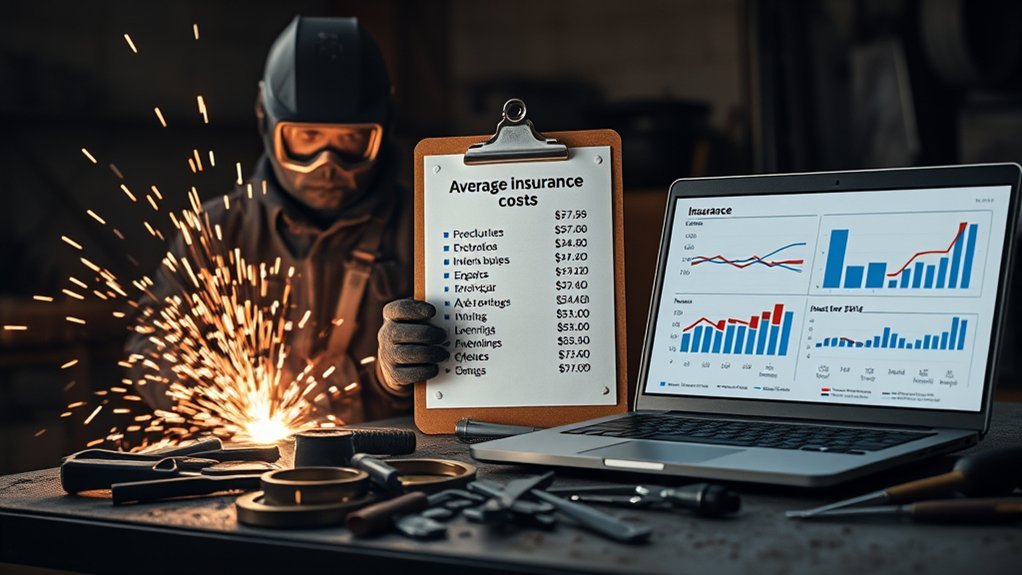
The most useful cost data separates each policy instead of presenting one broad “welding insurance” price. The following figures come from Insureon’s published policy data. Insureon says it uses median premiums from customers who purchase through its marketplace, which reduces the effect of unusually high and low premiums.
| Coverage | Published Monthly Benchmark | Purchaser Group | Main Purpose |
|---|---|---|---|
| General liability | $123 | Welders buying through Insureon | Third-party injury, property damage, and related lawsuits |
| Business owner’s policy | $98 | Construction businesses and contractors | General liability plus property and usually business-income coverage |
| Workers’ compensation | $254 | Construction businesses and contractors | Employee work injuries and occupational illnesses |
| Commercial auto | $173 | Construction businesses and contractors | Business-owned trucks, vans, trailers, and road accidents |
| Tools and equipment | $14 | Construction businesses and contractors | Portable tools and equipment in storage, transit, or at jobsites |
| Professional liability | $74 | Construction and contracting businesses | Claims involving alleged professional mistakes, designs, advice, or specifications |
| Commercial umbrella | $81 | Construction businesses and contractors | Additional limits above qualifying underlying policies |
Warning: Do not add every number in this table and treat the result as a standard package price. The figures come from different policies and purchaser groups. Your business may need only some of these policies, and one major payroll, vehicle, or project exposure can change the total substantially.
The $123 general-liability benchmark is a useful starting point, but the correct budget is the price of the policies, limits, and endorsements your actual contracts and risks require.
Breakdown of General Liability Insurance Costs
General liability is often the first policy a welding contractor buys. It may help with legal defense, settlements, judgments, and medical costs when a third party alleges bodily injury or property damage caused by the business.
Examples include a customer tripping over welding leads, sparks damaging a client’s property, or a completed project allegedly causing covered property damage. Coverage depends on the event, policy wording, exclusions, endorsements, and applicable limits.
General liability normally does not replace workers’ compensation, commercial auto, or insurance on your own tools and property. It may also exclude or limit professional errors, pollution, damage to your own work, and other specialized exposures.
Coverage Limits Impact Premiums
Insureon reports that a common policy in its welder dataset had a $1 million per-occurrence limit and a $2 million aggregate limit. These limits are common examples, not a legal standard for every welder.
A commercial customer, landlord, general contractor, or government project may request different limits. Some contracts also require an additional insured endorsement, waiver of subrogation, primary and noncontributory wording, completed-operations coverage, or an umbrella policy.
Higher limits generally cost more because the insurer accepts a larger potential loss. The deductible, aggregate structure, classification, subcontractor use, and requested endorsements can also affect the premium.
Pro Tip: Send the insurance section of a customer contract to your agent before accepting the job. It is cheaper to identify an unavailable endorsement or expensive limit before signing than after the project has been awarded.
State-Specific Rate Variations
There is no reliable one-size-fits-all table of welding premiums by state. Rates may change because of state insurance rules, workers’ compensation systems, lawsuit patterns, repair and medical costs, local weather risks, and the insurers willing to write welding businesses in that market.
State location is only one part of the quote. Two welders in the same city may receive very different prices if one performs ornamental shop work and the other welds structural steel, pipelines, tanks, or industrial equipment.
Use the National Association of Insurance Commissioners’ state department directory to find your insurance regulator. Workers’ compensation requirements should also be checked with the appropriate state authority listed by the U.S. Department of Labor.
Business Size Considerations
A solo welder with no payroll may pay less than a shop employing several welders, helpers, drivers, and office staff. However, employee count is not the only measure of size.
Insurers may ask about:
- Annual gross revenue and projected revenue
- Employee and subcontractor payroll
- Percentage of shop work versus work at customer locations
- Residential, commercial, structural, industrial, marine, or pipeline projects
- Maximum height and depth of work
- Hot-work controls and fire-watch procedures
- Use of cranes, lifts, compressed gases, or confined spaces
- Past claims and prior insurance cancellations
- Value of buildings, stock, machinery, and portable tools
A smaller company can still have a high premium when its projects create severe fire, structural, environmental, or bodily-injury exposure.
Workers’ Compensation Insurance Pricing
Workers’ compensation can pay eligible medical expenses, wage benefits, rehabilitation expenses, and death benefits when an employee suffers a covered work-related injury or illness. Most policies also include employer’s liability coverage for certain employee injury lawsuits.
There is no dependable national welding rate per $100 of payroll. A simplified pricing formula is:
Classification rate × experience modification factor × annual payroll divided by $100
The final premium can also include state assessments, minimum premiums, schedule credits or debits, and adjustments after a payroll audit.
| Pricing Factor | Why It Matters |
|---|---|
| Job classification | Employees performing hazardous welding work generally have a different rate from office or sales employees. |
| Payroll | More payroll creates more insured exposure. Estimated payroll is normally reconciled during an audit. |
| Claims experience | Eligible businesses may receive an experience modifier reflecting how their loss history compares with similar operations. |
| State rules | Requirements, benefits, approved rates, assigned-risk programs, and owner exemptions differ by state. |
| Safety controls | Training, ventilation, PPE, hot-work permits, housekeeping, and documented incident procedures can improve the risk presented to an insurer. |
Do not classify a working welder as office staff merely to reduce premiums. Incorrect payroll or job classifications can create audit charges, denied expectations, penalties, or disputes after a loss.
Business Owners Policy (BOP) Expenses
A business owner’s policy, or BOP, normally combines general liability, commercial property, and business-income coverage in one package. The National Association of Insurance Commissioners notes that a BOP can be less expensive than buying comparable policies separately and may be customized for certain small businesses.
Insureon publishes a $98 monthly benchmark for construction businesses and contractors buying a BOP through its marketplace. That figure is not specific to every welding shop and does not mean every welder qualifies.
A BOP may help cover:
- A covered fire or theft loss involving business property
- Damage to machinery, office contents, stock, or furnishings at an insured location
- General-liability lawsuits involving covered third-party injuries or property damage
- Lost business income following qualifying physical property damage
A standard BOP normally does not include workers’ compensation or commercial auto insurance. Portable welding equipment taken to jobsites may also need tools and equipment or inland marine coverage rather than relying only on property coverage at the shop.
Some businesses with extensive off-site work, high fire exposure, specialized fabrication, large premises, or other unusual risks may need a commercial package policy instead of a standard BOP.
Factors Influencing Insurance Premiums
Insurers price welding businesses according to the expected frequency and severity of claims. The following details commonly affect the result:
- Type of welding work: Ornamental railings, automotive repairs, structural steel, pressure vessels, pipelines, marine work, and industrial shutdowns do not present identical risks.
- Work location: Shop-only operations differ from contractors working inside occupied buildings, factories, refineries, construction sites, or confined spaces.
- Revenue and payroll: Higher sales and payroll generally create greater exposure to customer and employee claims.
- Subcontractors: Insurers may request certificates, policy details, written agreements, or payroll information for subcontracted work.
- Claims history: Frequent or severe liability, property, auto, or workers’ compensation claims can increase premiums or reduce carrier options.
- Vehicles and drivers: Vehicle type, radius of operation, driver records, garaging location, trailers, and transported materials affect commercial auto pricing.
- Property and tools: Replacement values, building construction, fire protection, security, and tool storage affect property premiums.
- Limits and deductibles: Higher limits usually cost more, while a higher deductible may reduce the premium if the business can absorb the added out-of-pocket risk.
- Safety program: Training, ventilation, PPE, hot-work permits, cylinder storage, fire watches, inspection records, and incident reporting help show how the business controls hazards.
OSHA’s welding standard requires precautions for fire hazards, ventilation, eye protection, protective clothing, confined spaces, and other workplace risks. For example, combustible materials may need to be moved or protected before hot work begins. Review the applicable requirements in 29 CFR 1910.252.
State-by-State Cost Variations
State-by-state insurance comparisons are useful only when they use the same business profile, coverage limits, payroll, revenue, vehicles, deductible, and policy date. A list of isolated state averages can create a false impression because those inputs are rarely identical.
Geographic differences may affect:
- Workers’ compensation rates and required coverage
- Minimum auto-liability requirements
- Medical, repair, and litigation costs
- Natural-hazard exposure
- Availability of insurers willing to cover particular welding classes
- State assessments and assigned-risk programs
There is also no universal employee threshold for workers’ compensation. Requirements and owner exemptions vary. Check the current law in every state where employees work, not only the state where the company was formed.
Warning: A low online estimate does not prove that a policy satisfies your state law, license, lease, or customer contract. Confirm the carrier, policy form, limits, endorsements, and effective dates before work begins.
Bundling Policies for Savings
Buying several policies from one insurer can simplify billing, renewals, certificates, and claim coordination. A BOP may also cost less than comparable general-liability and property policies purchased separately.
However, there is no guaranteed welding-industry bundle discount. A lower package price is worthwhile only when the coverage remains suitable.
Before bundling, compare:
- Total annual premium rather than only the monthly installment
- Per-occurrence and aggregate limits
- Property valuation and coinsurance terms
- Deductibles
- Products-completed operations coverage
- Tool limits away from the insured premises
- Business-income waiting periods and limits
- Pollution, professional-services, hot-work, and designated-operations exclusions
- Additional insured and waiver-of-subrogation options
A standalone policy may be better when one insurer offers strong liability terms but will not insure the company’s vehicles, property, or specialized operations competitively.
Tips for Obtaining Affordable Quotes
Accurate information is one of the best ways to obtain useful quotes. Insurers may increase a price, change terms, or decline coverage when important operations are disclosed late.
Prepare the following before requesting quotes:
- Legal business name, entity type, address, and years in operation
- Detailed description of every welding and fabrication service
- Projected annual revenue and payroll
- Employee duties and subcontractor costs
- Percentage of residential, commercial, industrial, and structural work
- Maximum project size, height, and depth
- Vehicle identification, use, radius, drivers, and trailers
- Replacement value of buildings, machinery, inventory, and portable equipment
- Five years of available loss runs or claims history
- Copies of customer contracts and required insurance endorsements
- Written safety, hot-work, training, and incident-response procedures
Use these strategies to control cost without creating a dangerous gap:
- Compare equivalent quotes. Ask each agent to quote the same limits, deductibles, operations, and endorsements.
- Correct classification errors. Separate office payroll from welding payroll when permitted, but classify every worker honestly.
- Consider pay-as-you-go workers’ compensation. This can reduce large audit surprises when payroll changes during the year.
- Protect equipment. Secure storage, alarms, inventory records, serial numbers, and vehicle security can reduce theft exposure.
- Strengthen safety documentation. Keep training, ventilation, inspections, PPE, fire-watch, and near-miss records.
- Choose deductibles carefully. Raise a deductible only when the business can pay it after a loss.
- Review coverage annually. New employees, vehicles, contracts, locations, and welding processes can make an old policy inaccurate.
Pro Tip: Ask for the annual premium, installment fees, taxes, policy fees, audit terms, and minimum earned premium. A low monthly payment can hide a higher total cost or a policy that is difficult to cancel without owing additional premium.
Common Coverage Types for Welders
| Coverage | Who Commonly Needs It | Important Question to Ask |
|---|---|---|
| General liability | Most welding contractors and shops | Are my exact welding operations and completed-work exposures covered? |
| Commercial property or BOP | Businesses with a shop, building, machinery, inventory, or business-income exposure | Are property limits based on realistic replacement costs? |
| Workers’ compensation | Businesses with employees and owners who elect or must obtain coverage | Are all workers, locations, payroll, and state requirements listed correctly? |
| Commercial auto | Businesses owning trucks, vans, or other road vehicles | Are trailers, permanently attached equipment, drivers, and operating radius covered? |
| Hired and non-owned auto | Businesses using rented vehicles or employees’ personal vehicles for work | Does the policy cover liability arising from vehicles the company does not own? |
| Tools and equipment | Mobile welders and contractors transporting equipment | What are the per-item, theft, transit, and unscheduled-property limits? |
| Professional liability | Businesses providing designs, specifications, inspection, consultation, or other professional services | How does the policy coordinate with general liability when faulty work is alleged? |
| Commercial umbrella | Businesses needing higher limits for contracts or severe-loss protection | Which underlying policies and exposures are eligible beneath the umbrella? |
| Contractors pollution liability | Operations involving hazardous coatings, contaminated sites, fumes, chemicals, tanks, or environmental cleanup exposure | Could a pollution exclusion affect the materials and processes used on my jobs? |
| Surety bond | Contractors whose license, permit, or customer contract requires a bond | What bond form and amount does the obligee require? |
Coverage by Business Profile
Solo shop welder: General liability plus property or a BOP may form the core package. Tools coverage may be needed for equipment taken away from the shop.
Mobile welder: General liability, commercial auto, tools and equipment coverage, and possibly hired and non-owned auto become especially important.
Welding business with employees: Workers’ compensation and employer’s liability should be reviewed alongside general liability, property, auto, and equipment coverage.
Structural or industrial contractor: Larger limits, completed-operations protection, umbrella insurance, pollution coverage, professional liability, bonds, and project-specific endorsements may be required.
Certificates and Additional Insured Requirements
A certificate of insurance, commonly called a COI, summarizes active policies and limits. Customers and general contractors often request one before allowing work to start.
A certificate alone does not change the insurance policy or automatically make the certificate holder an additional insured. Additional insured status generally requires the appropriate policy endorsement. Read the contract and endorsement together to understand who is covered, for which operations, and for how long.
Frequently Asked Questions
What types of welding work require specialized insurance coverage?
Structural, pipeline, pressure-vessel, oil and gas, marine, underwater, aerospace, industrial, and confined-space work may require specialized underwriting, higher limits, or additional policies. The correct package depends on the job, contract, location, materials, and applicable state or federal rules.
Can I insure my welding equipment separately?
Yes. Contractor’s tools and equipment coverage, also called inland marine coverage in many policies, can insure portable welders, torches, cutters, grinders, generators, fume extractors, and safety gear. Check theft conditions, transit coverage, per-item limits, deductibles, and whether expensive items must be scheduled individually.
How can I lower my welding insurance premiums?
Compare equivalent quotes, classify employees correctly, maintain accurate payroll, document safety procedures, secure tools and vehicles, review claims, and remove coverage that no longer applies. Bundling can help, but compare the total premium and policy terms before assuming it is cheaper.
Is welding insurance mandatory for a small business?
There is no single policy legally called welding insurance. However, workers’ compensation, auto liability, disability coverage, bonds, or other insurance may be required by state law. General liability and additional insured endorsements may also be required by a lease, license, lender, customer, or project contract.
What is the claims process for welding insurance?
Address immediate safety and emergency needs first. Notify the insurer or agent promptly, preserve damaged property when safe, take photographs, collect witness and contract information, and keep receipts and repair estimates. Do not alter evidence or promise payment before speaking with the insurer. Cooperate with the assigned adjuster and track every communication.
Does a business owner’s policy include workers’ compensation or commercial auto?
Usually not. A BOP commonly combines general liability, commercial property, and business-income coverage. Workers’ compensation and commercial auto are normally purchased separately, although the same insurer or agent may package them into one account.
How quickly can a welder get proof of insurance?
A straightforward business may receive a quote and certificate quickly after underwriting is complete. Specialized work, poor claims history, unusual contracts, high limits, or missing information can take longer. A certificate should be issued only after the required policy is active and any requested endorsements have been approved.
Conclusion
The most useful answer to “How much does welding insurance cost?” is not one package number. Insureon’s $123 monthly general-liability median offers a starting benchmark, while workers’ compensation, vehicles, property, tools, employees, project types, limits, and endorsements determine the larger budget.
Start by listing every service, work location, employee, vehicle, tool, and contractual requirement. Then compare several quotes using the same information and limits. A cheaper policy is not a bargain when an exclusion, missing endorsement, or inadequate limit prevents it from responding to the risks your welding business actually faces.
Sources
- Insureon: Welder Insurance Cost — published premium benchmarks, sample limits, and pricing factors.
- Insureon: Welder Insurance Coverage — common welding-business policies and coverage uses.
- Occupational Safety and Health Administration: Welding Hazards and Solutions — welding health and safety hazards.
- U.S. Department of Labor: State Workers’ Compensation Officials — state program contacts and requirement verification.
- National Association of Insurance Commissioners: Small Business Insurance — BOP, property, liability, and business-income guidance.
- NAIC State Insurance Department Directory — current state insurance regulator contacts.