Welding school cost in Washington varies by credential: current published public-college examples range from about $2,187 in tuition and required fees for a short certificate to $20,538 in estimated program charges for a comprehensive 98-credit AAS. Bellingham Technical College lists $19,800 in tuition and fees for its six-quarter AAS before separate tools, materials, clothing, and other costs. Specialized commercial-diving training costs more. These examples are not a statewide minimum or maximum, so compare the credential, program length, and what each quote includes before deciding which school is actually cheaper.
Price note: Program costs and Washington aid figures below come from the cited school and state pages and may have changed. See also our California welding school cost guide and Missouri welding school cost guide.
Quick Answer
There is no single statewide welding-school price. Washington Career Bridge lists Everett Community College’s 17-credit Entry Level Welding certificate at $2,009.57 tuition plus $177.50 in required fees. LWTech lists $9,500 for its 39-credit Welding Introduction certificate, $14,545 for its 72-credit Welding Technology certificate, and $20,538 for its 98-credit AAS. BTC lists $19,800 in tuition and fees for its six-quarter AAS before separate tools, materials, clothing, and other program costs.
Key Takeaways
- Published Washington examples run from about $2,187 in tuition and required fees for a short entry-level certificate to about $20,500 in estimated program charges for a comprehensive welding AAS.
- Do not compare tuition-only figures with bundled program estimates. Books, lab fees, mandatory campus fees, tools, protective clothing, and testing may be included or listed separately.
- Housing is normally separate from tuition. A cost-of-attendance budget may include estimated food and housing without providing on-campus housing.
- FAFSA, WASFA, Washington College Grant, workforce funding, scholarships, approved apprenticeship aid, and eligible VA benefits may reduce out-of-pocket cost.
- Placement and wage figures describe past graduates or related occupations. They are not guarantees of employment, salary, or a fixed payback period.
How Much Does Welding School Cost in Washington?
The best way to estimate welding-school cost is to compare the exact credential you plan to earn and the expense categories included in each quote. Current official examples differ by more than $18,000 before living expenses because a short skills certificate, a comprehensive certificate, and an associate degree require very different amounts of training.
| Program example | Length | Published estimate | What the estimate includes |
|---|---|---|---|
| Everett Community College Entry Level Welding certificate | 17 credits; about six months | $2,009.57 tuition + $177.50 required fees | Career Bridge currently lists $0 for books and supplies; classes are offered during the day and evening |
| Big Bend Community College Welding Certificate of Achievement | 45 credits; about six months | $5,741.55 tuition + $158 fees + $593 books/supplies | Career Bridge listing; WABO testing is available |
| LWTech Welding Introduction certificate | 39 credits | $9,500 | Estimated tuition, books and supplies, class or lab fees, and mandatory campus or technology fees |
| BTC Basic Welding Skills | 55 credits; approximately three quarters | $10,200 tuition and fees | Tools, materials, clothing, and other program expenses are listed separately |
| LWTech Welding Technology certificate | 72 credits | $14,545 | Estimated tuition, books and supplies, class or lab fees, and mandatory fees |
| BTC Welding and Fabricating Technology AAS | 98 credits; approximately six quarters | $19,800 tuition and fees | Tools, materials, protective clothing, and other costs are separate |
| LWTech Welding Technology AAS | 98 credits | $20,538 | Estimated tuition, books and supplies, lab fees, and mandatory campus or technology fees |
These figures are not directly interchangeable. Career Bridge listings commonly separate tuition, required fees, and books, while LWTech publishes a bundled estimate that includes tuition, books and supplies, class or lab fees, and mandatory campus or technology fees. BTC lists tuition and fees first and then gives separate ranges for tools, materials, clothing, and other program expenses. Compare the same cost categories before ranking one program as cheaper.
For a broader benchmark outside Washington, see our 2026 welding school cost guide. Keep the Washington figures on this page as the deciding numbers for local programs.
The Bellingham Technical College AAS estimate averages $3,300 per quarter and $19,800 over six quarters. BTC separately estimates $60–$275 for tools, $110–$300 for materials, $85–$300 for protective clothing, and $110–$550 for other program expenses. That produces a direct program estimate of approximately $20,165–$21,225 before housing, food, transportation, and personal spending.
The Lake Washington Institute of Technology estimates combine more expenses into each program total. Its published figures include estimated tuition, books and supplies, class or lab fees, and mandatory campus or technology fees. LWTech notes that these program estimates are calculated for Washington residents attending full time, exclude prerequisites, and can change.
Note: These are examples, not a mandatory statewide price schedule. Tuition depends on the school, credential, residency classification, credit load, prerequisites, and academic year. Ask for a personalized cost sheet before enrolling.
Specialized Underwater Welding and Commercial Diving Programs
Commercial-diving schools belong in a separate cost category. They teach diving physics, underwater construction, rigging, salvage, cutting, and underwater welding rather than only standard shop welding.
For example, the Divers Institute of Technology currently lists $29,000 in tuition and a $48,800 total cost-of-attendance budget for an independent student living away from home. That broader figure includes off-campus food and housing, travel, personal expenses, gear, and a required physical. DIT lists an intended program length of 28 weeks. It should not be used as the typical price of a community-college welding certificate.
If commercial diving is your goal, compare those specialized expenses separately in our underwater welding school cost guide.
Resident and Nonresident Tuition
Washington public colleges normally publish different resident and nonresident tuition rates, and some students may qualify for a nonresident operating-fee waiver. The size and eligibility rules for a waiver vary by college. Confirm the residency category that will appear on your actual bill before comparing program quotes; do not assume that a resident estimate or another college’s waiver applies to you.
Housing and Living Costs to Budget For

Housing is usually the largest expense outside the welding program itself. Do not assume that “cost of attendance” means the school gives you a room. Cost of attendance is a financial-aid budget that may include estimated living expenses even when students must find housing independently.
BTC publishes an average annual Bellingham living allowance of:
- $16,512 for housing and food
- $1,935 for transportation
- $1,800 for miscellaneous and personal expenses
- $20,247 total for the year
This $20,247 figure is not rent alone and is not included in BTC’s $19,800 tuition-and-fee estimate. Your actual cost depends on how many months you are enrolled, whether you already live nearby, whether you share housing, and how far you commute.
Cost-of-attendance allowances are budgeting figures, not a promise that a school provides a room. For 2026–27, LWTech’s nine-month budget for a student not living with a parent lists $20,085 for food and housing, $3,075 for transportation, $2,166 for miscellaneous personal expenses, and $38,310 total after its budgeted tuition, fees, books, and supplies are included. Use those figures as planning benchmarks rather than a rent quote, because your program length and actual living costs may differ.
Build a Monthly Living Budget
Estimate each of these expenses for the months you expect to attend:
- Rent, security deposit, application fees, and renter’s insurance
- Electricity, water, internet, and other utilities not included in rent
- Groceries and meals purchased near campus
- Fuel, parking, public transportation, or vehicle maintenance
- Phone service, health expenses, and personal items
- Emergency savings for an unexpected repair, move, or reduced work schedule
Pro Tip: Compare schools twice: first by direct program cost and then by total monthly cost. A program with slightly higher tuition may cost less overall if you can live at home or avoid a long commute.
Financial Aid, Scholarships, and Veteran Benefits

Financial aid can reduce your net cost, but there is no universal scholarship amount or automatic military discount for every Washington welding program.
FAFSA and WASFA
Complete the Free Application for Federal Student Aid if you may qualify for federal aid. The FAFSA can connect eligible students with grants, work-study, and federal student loans for participating colleges and career schools.
Washington residents who are ineligible to file the FAFSA, or who choose not to file it, may be able to use the Washington Application for State Financial Aid (WASFA) to apply for state aid. The school’s financial-aid office can help you confirm which application fits your circumstances.
Washington College Grant
The Washington College Grant provides need-based aid to eligible Washington residents in financial-aid-eligible programs at participating schools, as well as eligible apprentices in approved programs. For 2026–27, an eligible student from a family of four with income of $83,500 or less can qualify for a full award; some aid may be available up to $139,500 for a family of four. The maximum annual full-time award listed for community and technical colleges is $5,095, although the actual award depends on individual eligibility.
Check the participating-institution list before assuming a school qualifies. WSAC states that private for-profit two-year career colleges, including Divers Institute of Technology, are no longer eligible to offer Washington College Grant funding as of the 2026–27 academic year.
Workforce and School-Based Funding
Washington technical colleges may offer or administer programs such as Worker Retraining, Opportunity Grant, Basic Food Employment and Training, WorkFirst, school foundation scholarships, emergency aid, and work-study. The available programs and eligibility rules differ by school.
Apply early because some school and workforce funds are limited. Ask whether an award can cover only tuition or can also help with books, tools, protective equipment, transportation, or living expenses.
Military and Veteran Education Benefits
Do not assume that showing a DD-214 produces a standard 10% discount. Veterans, service members, and eligible dependents should use the VA GI Bill Comparison Tool to verify that the school and specific program are approved and to estimate how benefits may apply.
A school’s veteran-services office can also explain enrollment certification, prior military credit, payment timing, housing allowances, and costs that may not be covered.
Accreditation and Aid Eligibility
Institutional accreditation is one useful quality check, but accreditation alone does not guarantee that every program or expense qualifies for every form of aid. Confirm all of the following:
- The institution’s current accreditation status
- The welding credential’s eligibility for federal and state aid
- Whether the program meets the enrollment requirements for your grant or benefit
- Whether credits are likely to transfer to another school
- Whether the school has any warning, probation, or approval restriction relevant to your program
Tools, Materials, and Additional Student Fees
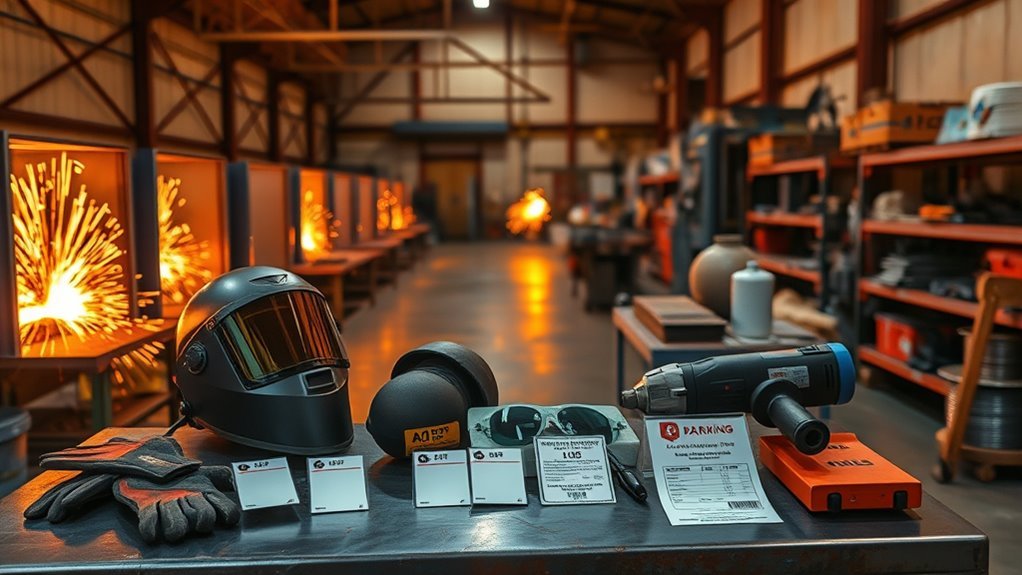
Tuition is only one part of a welding student’s direct cost. Depending on the school, some equipment may be included in a bundled program estimate while other items must be purchased separately.
Typical Expense Categories
- Hand tools: pliers, wire brushes, chipping hammers, squares, measuring tools, soapstone holders, and wrenches
- Protective clothing: welding jacket, leather gloves, work boots, safety glasses, hearing protection, and flame-resistant clothing
- Helmet: a school-approved passive or auto-darkening welding helmet
- Books and supplies: textbooks, workbooks, blueprint-reading materials, calculators, and notebooks
- Consumables and lab charges: electrodes, wire, shielding gas, metal coupons, abrasives, and equipment-maintenance fees
- Testing: school practical exams, employer qualification tests, WABO testing, or AWS Certified Welder testing
- Other charges: parking, student fees, replacement equipment, transcripts, background checks where required, and graduation fees
For its six-quarter AAS, BTC currently estimates $60–$275 for tools, $110–$300 for materials, $85–$300 for clothing, and $110–$550 in other costs. Its shorter Basic Welding Skills program has a different equipment profile, including a higher published tool estimate.
LWTech estimates $1,200 in books and supplies for its welding certificates and $1,600 for its welding AAS. These figures are program-specific and should not be replaced with a books estimate from another department.
Certification and Qualification Testing
A fixed statewide certification price does not exist. The American Welding Society Certified Welder program explains that testing cost varies by Accredited Testing Facility, welding process, and qualification requirements. AWS’s 2026 price list shows a $70 Certified Welder application fee and directs candidates to the testing facility for the exam price.
Washington schools and testing sites may also charge their own WABO-related testing, application, materials, or retest fees. Ask the specific test site for a current written total before scheduling.
Washington students may also encounter WABO structural-welder testing or employer-specific qualification tests. Ask the school for a written answer to these questions:
- Which certification or qualification tests are included?
- Does the quoted amount include test plates, inspection, facility fees, and registration?
- Who pays if a student must retest?
- Does the qualification require renewal or continuity documentation?
- Is the test recognized by the employers you want to work for?
Warning: Do not reduce your budget by buying damaged helmets, cracked protective lenses, worn electrical equipment, or clothing that is not suitable for welding. Ask the instructor for the required safety specifications before purchasing used gear.
Employment Outcomes and a Realistic Payback Estimate

Employment data can help you compare schools, but it must be read carefully. BTC currently publishes the following figures for its welding program:
| Published BTC metric | Current value | How to interpret it |
|---|---|---|
| Graduate placement rate | 83% | A three-year average for credentialed BTC students included in the school’s employment measure |
| Starting wage figure | $60,324 | The 25th-percentile regional occupational wage used by BTC, not a guaranteed offer for every graduate |
| Average wage figure | $75,473 | The school’s weighted median figure for occupations associated with the program |
| Wage-potential figure | $96,763 | The 75th-percentile occupational figure, which may reflect experienced workers as well as graduates |
These figures do not mean every student will find a job immediately or begin at $60,324. Outcomes vary with location, specialization, certifications, prior experience, shift schedule, overtime, union status, employer demand, and economic conditions.
A wage figure is not a tuition-repayment budget. Calculate payback from the money you can actually set aside after taxes and normal living expenses.
How to Estimate Your Own Payback Period
Use this simple formula:
Net education cost ÷ monthly amount available for repayment = estimated repayment months
For example, if your net direct cost after grants is $20,000 and you can consistently devote $1,000 per month to repayment, the simple estimate is 20 months. If only $500 per month is available, the estimate is 40 months. Add loan interest when borrowing and allow for job-search time or periods of reduced work.
For a fair comparison, calculate at least two totals:
- Direct program cost: tuition, mandatory fees, books, tools, clothing, and required testing
- Full attendance cost: direct program cost plus housing, food, transportation, childcare, and lost income while attending class
How to Compare Washington Welding Programs
Request the same information from every school so you are comparing equivalent totals.
- Choose the credential. Decide whether you need a short skills certificate, a comprehensive certificate, an associate degree, or specialized diving training.
- Confirm the program length. Ask how many quarters or months a full-time student normally needs and whether prerequisites add time.
- Request an itemized cost sheet. It should identify tuition, program fees, books, lab charges, tools, protective clothing, testing, and other mandatory expenses.
- Check the live class schedule. Confirm that required welding labs are offered at times you can attend, not merely that the college offers some evening general-education classes.
- Verify certification coverage. Find out which tests are included, which are optional, and what retesting costs.
- Review accreditation and aid eligibility. Verify the institution and the exact credential, especially if you plan to use federal aid, Washington aid, or VA benefits.
- Study outcome definitions. Ask which graduates are counted, what time period is measured, whether employment must be related to welding, and whether wages come from graduates or regional occupation data.
- Ask about employer connections. Look for documented internships, employer visits, job fairs, apprenticeships, and placement assistance without assuming employment is guaranteed.
Welding School Versus a Registered Apprenticeship
A college program is not the only route into welding-related work. Registered apprenticeships combine paid on-the-job training with classroom or related instruction. Welding may be part of ironworker, pipefitter, sheet-metal, shipyard, manufacturing, or other trade pathways.
Use the Washington Apprenticeship Registration and Tracking System to search by occupation and county. Applications are normally made directly to the apprenticeship program, and admission is not guaranteed.
Compare the two routes carefully:
- College program: usually provides concentrated lab training, broader process exposure, and a certificate or degree, but you normally pay tuition while studying.
- Registered apprenticeship: provides wages and structured work experience, but openings, application periods, physical requirements, employer placement, and covered welding processes vary.
For 2026–27, the Washington Student Achievement Council lists a maximum full WA Grant for Apprenticeship award of $2,548 for eligible participants in approved non-college-based apprenticeship programs. Actual awards can be lower based on income and eligibility.
Frequently Asked Questions
Do Washington welding programs require a high school diploma or GED?
Requirements vary. BTC’s welding pages list a college application and English and math placement rather than a universal diploma rule. Specialized private programs may require a diploma, transcript, or GED. Review the exact admissions page and ask whether prerequisites or placement courses will add time and cost.
Are night or weekend welding classes available?
Yes, some Washington programs have evening or weekend options, but availability varies by school and term. Career Bridge currently lists Everett Community College’s Entry Level Welding classes as offered during the day and evening, and its Big Bend welding listing marks evening/weekend availability as yes. Check the live schedule for every required welding lab before enrolling.
Can I transfer prior welding credits between schools?
Possibly, but technical credits do not transfer automatically. The receiving school normally reviews official transcripts, course descriptions, grades, lab hours, and learning outcomes. Obtain a written credit evaluation before paying a deposit or assuming that prior courses will shorten the program.
Do programs include AWS or WABO certification fees?
Some programs include selected test preparation, materials, or qualification testing, while others charge separately. AWS Certified Welder pricing varies by testing facility, welding process, and qualification. Ask about test plates, inspection, registration, retesting, and renewal or continuity costs.
Will the school arrange an internship or apprenticeship?
Some schools have employer partnerships, internships, job fairs, or placement support, but availability is not universal and placement is rarely guaranteed. Registered apprenticeships generally require a separate application directly to the apprenticeship sponsor.
How long does welding school take in Washington?
Program length varies widely. Career Bridge lists some targeted welding certificates at about three to six months, BTC’s Basic Welding Skills program at about three quarters, and BTC’s welding AAS at about six quarters. Prerequisites, course sequencing, enrollment status, and class availability can extend the timeline.
Is underwater welding school the same price as a regular welding program?
No. Commercial-diving programs include diving medicine, physics, underwater work, specialized equipment, rigging, salvage, and other training beyond standard welding. Their tuition and cost-of-attendance budgets can be much higher than those of public-college welding certificates or degrees.
Conclusion
Published Washington examples in this guide run from about $2,187 in tuition and required fees for Everett Community College’s short Entry Level Welding certificate to $20,538 in LWTech’s estimated program charges for a welding AAS. BTC lists $19,800 in tuition and fees for its six-quarter AAS before separate tools, materials, clothing, and other costs. Specialized commercial-diving training is substantially more expensive.
Before enrolling, ask each school for the same itemized list: tuition, mandatory fees, books, lab charges, tools, protective clothing, testing, and expected program length. Then add your housing and transportation budget, check the live class schedule, and confirm your actual FAFSA/WASFA, Washington College Grant, workforce, apprenticeship, or VA eligibility. Treat placement and wage figures as comparison evidence—not as guarantees.
Sources
- Washington Career Bridge — Everett Community College Entry Level Welding — short-certificate tuition, required fees, program length, and day/evening availability
- Washington Career Bridge — Big Bend Community College Welding — certificate tuition, fees, books and supplies, program length, and WABO testing availability
- Bellingham Technical College — Welding and Fabricating Technology AAS — program length, tuition, tools, materials, living-cost allowance, entry requirements, placement, and wage methodology
- Lake Washington Institute of Technology — Estimated Cost by Program — welding certificate and AAS cost estimates
- Lake Washington Institute of Technology — Cost of Attendance — 2026–27 nine-month student budget estimates
- Divers Institute of Technology — Cost of Attendance — commercial-diving tuition, 28-week program length, and attendance budget
- Washington Student Achievement Council — WA Grant Eligibility & Awards — 2026–27 income thresholds and maximum award amounts
- Washington Student Achievement Council — Participating Institutions — state-aid participation and 2026–27 private for-profit restrictions
- Federal Student Aid — FAFSA Steps — federal aid application for colleges and career schools
- American Welding Society — Certified Welder Program — testing process and facility-specific exam pricing
- American Welding Society — 2026 Certification & Education Price List — Certified Welder application and maintenance fees
- U.S. Department of Veterans Affairs — GI Bill Comparison Tool — approved programs and benefit comparison
- Washington State Department of Labor & Industries — ARTS — registered apprenticeship search by occupation and county