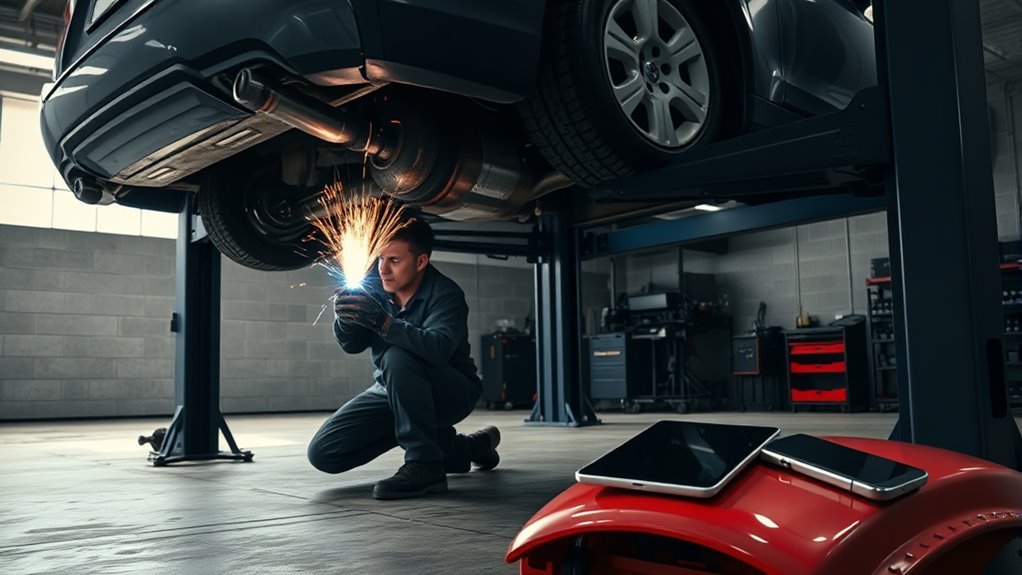
The cost to weld a car exhaust depends less on the length of the weld than on the preparation required to reach clean, solid metal. A small accessible crack may need only a quick repair, while a rusted flange, flex pipe, or damaged section may have to be cut out and fabricated before any welding begins.
Quick Answer
A simple professional exhaust weld typically costs about $75–$200. Expect roughly $150–$400 when the shop must cut out corrosion and weld in a new pipe or flex section. Stainless steel, difficult access, seized hardware, sensor removal, custom fabrication, or widespread rust can raise the bill further.
Key Takeaways
- A small, accessible crack or broken joint generally costs less than a corroded section that must be cut out and replaced.
- Many shops apply a minimum labor charge even when the actual weld takes only a few minutes.
- MIG welding is common for ordinary steel exhaust repairs, while TIG is often used for cleaner stainless-steel or custom fabrication work.
- Welding is worthwhile only when enough strong metal remains around the damaged area.
- Get a written, itemized quote that identifies the leak, repair method, added parts, total price, and workmanship warranty.
At a Glance
| Time Required | About 30–90 minutes for an accessible weld; one to three hours or more when cutting and fabrication are required |
| Difficulty | Moderate to advanced; thin, corroded tubing is easy to burn through |
| Tools Needed | Vehicle lift or rated stands, welder, shielding gas where required, grinder, cutting tools, PPE, fire protection, and leak-testing equipment |
| Cost | About $75–$200 for a simple weld and $150–$400 for a cut-and-weld pipe section; extensive replacement may cost much more |
Typical Exhaust Welding Price Ranges
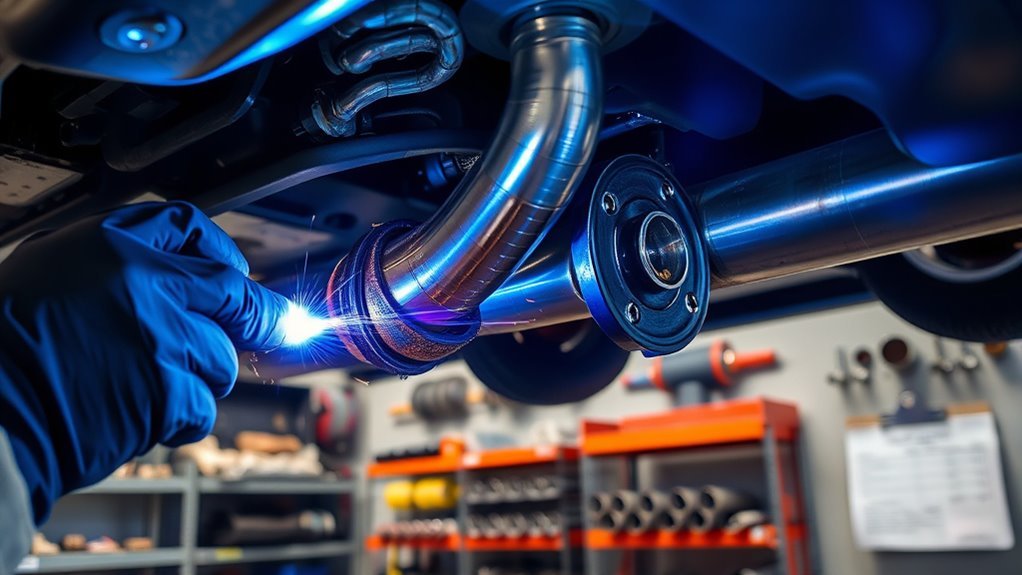
Most drivers should budget about $75–$200 for a small, accessible exhaust weld. That range can cover a cracked seam, separated pipe joint, minor hole, or simple bracket repair when the surrounding metal is still strong.
A repair usually moves into the $150–$400 range when a technician must cut away damaged metal, shape a replacement pipe, align the exhaust, and weld the new section at both ends. Stainless-steel fabrication, multiple leaks, difficult access, seized fasteners, or work near oxygen sensors and catalytic converters can increase the total.
| Repair Type | Typical Professional Price |
| Small crack, seam, or accessible joint | About $75–$200 |
| Hanger, bracket, or minor flange repair | About $75–$250, depending on access and added hardware |
| Flex pipe or short pipe section cut out and replaced | About $150–$400 |
| Stainless-steel or custom exhaust fabrication | Often $200–$600 or more |
| Muffler, catalytic converter, manifold, or major pipe replacement | Vehicle-specific; often several hundred dollars and sometimes more than $1,000 |
These are planning ranges rather than fixed national prices. A specialist muffler shop may complete a clean, easy repair for less, while a dealership or general repair facility may recommend replacing a complete factory assembly instead of fabricating one small section.
The visible crack may take minutes to weld, but the bill also covers diagnosis, lifting the vehicle, cleaning the metal, fitting the parts, leak testing, and the shop’s minimum labor charge.

This hardcover cookbook offers fast, approachable recipes designed for busy days and low-energy nights. Caroline Chambers focuses on simple, flavorful meals that help you get dinner on the table without overthinking it. It's a practical pick for home cooks who want quick weeknight inspiration and minimal-fuss cooking.

The Armor All AA255W wet/dry utility vac delivers strong 2 peak HP suction in a compact, portable design for quick cleanup of wet and dry messes. Its 2.5-gallon tank, wheel base, top handle, and built-in storage make it easy to move, organize, and use around the garage, car, or jobsite. It also converts to a blower and comes with multiple accessories for versatile cleaning tasks.

Drop Stop provides complete coverage for the gap around your seat belt catch, helping keep keys, phones, and other small items from slipping into hard-to-reach spaces. Designed to move with your seat, it installs easily and stays in place without constant readjustment. This original, patented seat gap filler comes with bonus accessories for added convenience and a cleaner, safer driving experience.
What Changes the Final Price?
- Damage size: A hairline crack costs less than a missing or collapsed pipe section.
- Metal condition: Rust, scale, coatings, and contamination must be removed before a sound weld can be made.
- Access: Work above a crossmember, heat shield, fuel tank, or suspension component takes longer.
- Material: Mild steel, aluminized steel, and stainless steel require different preparation, filler material, and technique.
- Fabrication: Bending, trimming, expanding, or reducing pipe adds labor.
- Extra parts: Flex pipes, flanges, hangers, gaskets, clamps, and replacement tubing increase the total.
- Nearby components: Oxygen sensors, wiring, heat shields, and catalytic converters may need added protection or removal.
- Number of welds: A replacement section normally requires a weld at each end rather than one small bead.
Regional Differences and Shop Labor Rates
Location affects the price because shops must cover technician wages, rent, insurance, equipment, waste handling, and other business costs. According to AAA’s 2026 automotive labor-rate overview, repair-shop rates can range from below $100 to above $200 per hour, while almost half of shops charge between $120 and $159 per hour.
That does not mean a 20-minute weld will be billed as exactly one-third of an hourly rate. Many facilities have a half-hour, one-hour, or fixed exhaust-work minimum to cover inspection, setup, lifting, preparation, welding, and testing.
Independent exhaust specialists often have an advantage because they bend and weld pipe every day. They may repair one damaged section that a dealership would replace as a larger factory assembly. National chains and dealerships are not automatically worse, but their labor structure and parts policies can produce a higher quote.
Note: Compare estimates only when they describe the same repair. A $125 weld and a $900 assembly replacement are not equivalent if one shop plans to patch weakened metal while the other plans to remove every corroded section.
Welding Methods and Material Differences
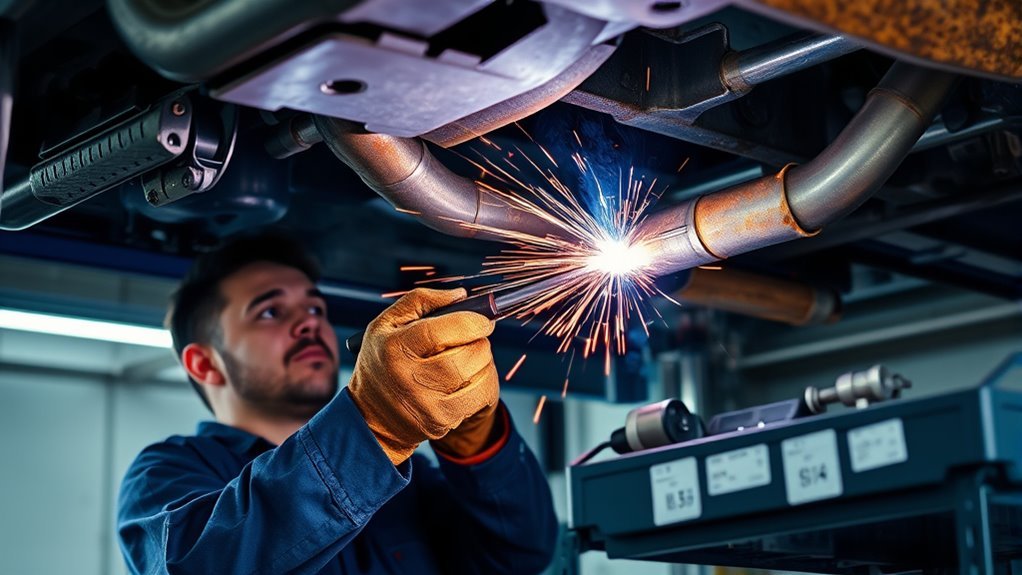
The best welding process depends on the exhaust material, tubing thickness, access, and the quality expected from the finished joint. The method affects both labor time and the risk of burning through thin metal.
MIG Welding
MIG welding is common for mild-steel and many aluminized-steel exhaust repairs. Its continuous wire feed allows a technician to work quickly, and it is relatively forgiving on thin automotive metal. Miller Electric’s automotive welding guidance identifies MIG as suitable for common automotive metals and thin repair work.
Because MIG is fast, it is often the least expensive professional option for ordinary pipe, muffler, and bracket repairs. The technician must still match the wire, gas, heat, and travel speed to the tubing.
TIG Welding
TIG welding provides close control over heat and filler metal. It is often selected for stainless-steel exhausts, visible custom fabrication, collectors, and high-quality performance systems.
TIG work normally takes more preparation and welding time than a routine MIG repair. That extra labor can make the finished job more expensive, although TIG is not automatically necessary simply because a repair shop offers it.
Stick and Flux-Core Welding
Stick welding is rarely the first choice for thin exhaust tubing because the concentrated heat and larger electrode make burn-through harder to control. Flux-core wire can join steel, but it creates more spatter and fumes than a properly shielded MIG setup and may require more cleanup.
An experienced technician may use another process for a specific situation, but the process name alone does not prove that a repair is better. Proper cleaning, fit-up, penetration, material matching, and leak testing matter more than choosing the most expensive welding method.
A clean weld on solid, compatible metal usually provides more value than a polished-looking bead attached to rust that is already thinning around the joint.
Mild Steel, Aluminized Steel, and Stainless Steel
- Mild steel: Usually straightforward to weld but vulnerable to corrosion when uncoated.
- Aluminized steel: Common in replacement exhaust parts. The coating must be prepared correctly, and the repaired area may need corrosion protection.
- Stainless steel: More corrosion resistant but requires compatible filler material, controlled heat, and appropriate shielding gas.
- Mixed materials: Joining different alloys can require special filler and technique. Ask the shop what material it is adding and whether it matches the existing system.
DIY vs. Professional Exhaust Welding
DIY welding can reduce the immediate bill only when you already own suitable equipment, can identify the metal, know how to support the vehicle safely, and have experience welding thin tubing. Wire, gas, grinding discs, replacement pipe, clamps, and other consumables may be inexpensive, but they are not the full project cost.
A first-time DIY setup may require a welder, shielding gas, regulator, helmet, gloves, jacket, grinder, cutting tools, fire extinguisher, rated jack stands, and leak-testing supplies. Buying those items for one repair can cost more than professional service.
Professional exhaust shops also provide equipment that many home garages lack, including vehicle lifts, pipe benders, expanders, saws, extraction systems, and replacement tubing in several diameters.
Warning: Welding beneath a vehicle can cause fire, burns, eye injury, electrical damage, and exposure to hazardous fumes. Never work beneath a vehicle supported only by a jack. Keep sparks away from fuel lines, the fuel tank, brake lines, wiring, interior insulation, oil residue, and dry debris. OSHA requires adequate ventilation for welding fumes, especially when welding coated or stainless metals.
Do not assume that disconnecting the battery is the only electrical precaution required. Modern vehicles may have model-specific procedures for protecting computers, sensors, hybrid components, and stored settings. A technician should follow the applicable service information and place the welding ground close to the repair area.
When Is Welding Worthwhile?
Welding is usually a good option when the damage is local and the technician can reach strong metal around it. Typical candidates include:
- A clean crack in otherwise solid pipe
- A separated joint or flange with usable metal remaining
- A damaged flex pipe that can be cut out and replaced
- A broken hanger or bracket
- A small corroded area surrounded by thick, stable metal
- A custom exhaust section that needs to be fitted to the vehicle
The shop may recommend replacement when corrosion extends beyond the visible hole, the muffler shell is flaking, several joints are failing, the pipe wall collapses during cleaning, or there is not enough strong metal to hold a weld.
RepairPal’s exhaust-pipe guidance notes that corrosion in one area can signal damage elsewhere and recommends inspecting the complete system, including its brackets and supports. A full inspection can prevent paying for a patch that fails beside the new weld.
Welding, Clamping, or Replacement?
- Welding: Creates a permanent joint and works well when the metal is clean, compatible, and structurally sound.
- Sleeve and clamps: Can be suitable for a straight, accessible pipe section and may be easier to service later. They require the correct diameter and enough sound pipe for sealing.
- Component replacement: Usually makes more sense when corrosion is widespread, an internal muffler baffle has failed, a flange has disappeared, or the damaged part is covered by warranty.
Pro Tip: Ask the technician to show you the damaged area before approving the work. Sound metal should remain on both sides of the proposed repair. If the pipe flakes, crumbles, or develops new holes while being cleaned, replacing a longer section is usually better value.
Exhaust Leaks, Emissions, and Driving Safety
A properly completed weld that restores the factory exhaust path should not cause an emissions-test failure. Problems arise when a leak remains, an oxygen sensor is damaged or moved, exhaust flow reaches a sensor incorrectly, or a catalytic converter is removed or bypassed.
EPA guidance on emissions tampering states that removing or defeating required emissions controls is prohibited under the Clean Air Act. A repair shop should preserve the catalytic converter, sensor positions, and other required emissions equipment unless it is installing a lawful replacement.
An exhaust leak can also allow harmful gases to enter the passenger compartment. Do not continue driving when:
- You smell exhaust inside the cabin
- You develop a headache, dizziness, nausea, weakness, or confusion while driving
- A pipe or muffler is dragging or could fall into traffic
- The leak is near the exhaust manifold, firewall, or passenger compartment
- The exhaust is contacting fuel lines, wiring, the floor, or another heat-sensitive part
- The vehicle becomes dramatically louder after an impact or component separation
Move to fresh air and arrange a tow when fumes are entering the cabin or a loose exhaust component creates a road or fire hazard. Do not idle a leaking vehicle inside a garage or another enclosed area.

Come Eat offers 100 approachable recipes designed to make everyday cooking more enjoyable, nourishing, and sustainable. With a focus on flavorful meals and practical preparation, this hardcover cookbook is ideal for home cooks looking for inspiration for salads, sides, and main dishes. Author Melissa Ben-Ishay shares recipes that encourage consistent, feel-good eating without sacrificing taste.

This two-in-one kitchen cleaning tool helps keep countertops and sinks tidy by handling both wet and dry messes with ease. One side works as a squeegee to push spills into the sink, while the other uses nylon bristles to sweep up crumbs and debris. Its ergonomic, balanced design is comfortable to hold, easy to store, and simple to clean in the dishwasher.

Nature Made Burp Less Fish Oil provides omega-3 support for heart health in easy-to-take softgels designed to help reduce fish burps. Each serving delivers concentrated EPA and DHA from purified fish oil sourced from wild-caught ocean fish, with no artificial colors, flavors, or preservatives. This gluten-free, dairy-free supplement is a trusted daily option for adults looking to support overall cardiovascular wellness.
Could the Repair Be Covered by a Warranty?
Independent or aftermarket exhaust work does not automatically cancel the entire vehicle warranty. The Federal Trade Commission explains that a manufacturer or dealer may deny coverage for related damage when a defective aftermarket part or improper installation caused that damage, but using an independent repair facility does not by itself void the warranty.
Before authorizing welding near a catalytic converter or another emissions component, check the vehicle’s warranty booklet. The EPA’s federal emissions-warranty guidance states that catalytic converters, the electronic emissions control unit, and the onboard diagnostic computer generally receive federal coverage for eight years or 80,000 miles, whichever comes first. Other emissions-related parts may have shorter federal coverage, and state or manufacturer coverage may be longer.
Note: If the vehicle may still be under an emissions or manufacturer warranty, contact an authorized facility before approving an outside repair. The manufacturer normally must be given an opportunity to diagnose a warranty claim.
How to Get a Fair Exhaust-Welding Quote
Obtain two or three quotes when the vehicle is safe to drive. Include at least one dedicated muffler or exhaust shop because specialists may be more willing to fabricate a small section instead of replacing a complete assembly.
Ask each facility to identify:
- The exact leak or failed joint
- Whether the surrounding metal is strong enough to weld
- Whether the repair is a patch, sleeve, flange repair, flex-pipe replacement, or full component replacement
- The metal type and replacement-pipe material
- The number of cuts and welds required
- Any charge for diagnosis, sensor removal, seized hardware, hangers, clamps, gaskets, or pipe bending
- Whether taxes and shop-supply fees are included
- The workmanship and parts warranty
- Whether the repair preserves the original emissions equipment and sensor locations
Customer reviews can help, but give more weight to detailed feedback describing exhaust fabrication, leak-free results, accurate estimates, and how the shop handled a problem after the repair.
A low price is not a bargain when a shop welds directly over rust without removing weakened metal. A slightly higher quote may provide better value if it includes a longer replacement section, new hangers, proper material matching, and a written warranty.
What to Check After the Repair
- Listen for ticking, hissing, or popping around the repaired area.
- Confirm that the exhaust does not rattle against the body, suspension, or heat shields.
- Check that hangers support the system without pulling sideways on the new weld.
- Make sure no warning light appeared after work near an oxygen sensor.
- Return to the shop promptly if exhaust odor enters the cabin.
- Keep the invoice and written warranty with the vehicle’s maintenance records.
Sources
- AAA Automotive — Average Mechanic Labor Rate in 2026 — supports current automotive labor-rate ranges and regional price variation.
- RepairPal — Exhaust Pipe Replacement Cost and Repair Guidance — supports inspection, fabrication, replacement, and corrosion considerations.
- Miller Electric — MIG Basics for Automotive Welding Repair — supports MIG use on thin automotive metals.
- Occupational Safety and Health Administration — Welding Safety Requirements — supports ventilation and welding-fume precautions.
- U.S. Environmental Protection Agency — Emissions Tampering and Defeat Devices — supports catalytic-converter and emissions-control compliance.
- Federal Trade Commission — Auto Warranties and Service Contracts — supports warranty guidance for independent repairs and aftermarket parts.
Frequently Asked Questions
Will welding affect my car’s emissions test results?
A properly completed repair should restore the exhaust seal and should not cause an emissions failure. The vehicle may still fail if a leak remains, an oxygen sensor or its wiring is damaged, sensor placement changes, the catalytic converter is defective, or required emissions equipment has been removed or bypassed.
How long does an exhaust weld usually last?
A correctly prepared weld on solid metal can last for years. A patch welded to thin, heavily corroded metal may fail much sooner because rust continues beyond the bead. Material quality, road salt, moisture, vibration, hanger condition, weld penetration, and the amount of sound metal around the repair all affect longevity.
Can welding damage nearby sensors or wiring?
Yes. Welding heat, sparks, and electrical current can damage oxygen sensors, wiring, electronic modules, fuel-system parts, interior insulation, and nearby hoses when the work is not prepared correctly. A technician should follow vehicle-specific service procedures, protect nearby components, and place the ground clamp close to the repair.
Is welded exhaust work covered by a vehicle warranty?
Coverage depends on the failed part, the warranty terms, and the cause of the damage. Independent or aftermarket work does not automatically void the entire warranty. However, coverage for related damage may be denied when poor workmanship or an unsuitable part caused it. Check for manufacturer, service-contract, and federal emissions coverage before approving the repair.
What safety precautions should I take after exhaust welding?
Allow the exhaust to cool before touching it. Confirm that the repair is leak-free, the pipe has clearance from the body and fuel system, all hangers are secure, and no heat shield is loose. Stop driving and return to the shop if you hear a new leak, smell exhaust inside the cabin, see a warning light, or notice a pipe dragging.
Can a badly rusted exhaust always be welded?
No. Welding requires enough solid metal to support the new joint. If cleaning the area exposes additional holes, the pipe wall is paper-thin, the muffler shell is flaking, or several nearby joints are failing, replacing a longer section is usually safer and more economical than adding another patch.
Conclusion
Most simple professional exhaust welds cost about $75–$200, while a corroded pipe or flex section that must be cut out and replaced commonly costs around $150–$400. Difficult access, stainless steel, custom fabrication, sensor work, and widespread rust can raise the price. Get at least two itemized quotes, confirm that the shop will weld to sound metal, and choose a repair that includes leak testing and a written workmanship warranty.

The ANCEL AD310 is a compact OBD II scanner designed to quickly diagnose check engine light issues by reading and clearing emission-related trouble codes. It also provides live data, freeze frame, I/M readiness, and vehicle information, making it a practical tool for drivers and home mechanics. With broad compatibility across many 1996 and newer OBD2 vehicles, it is a simple, fast, and portable way to check engine problems.

The Veepeak OBDCheck BLE is a Bluetooth OBD-II scanner designed for iOS and Android users who want an easy way to read and clear check engine light codes. It supports generic diagnostics such as freeze frame data, I/M readiness, and live sensor readings through compatible third-party apps. Built for most 1996+ vehicles in the US, it connects over Bluetooth LE and works with popular apps for everyday vehicle troubleshooting and monitoring.

These Stanley MaxSteel straight aviation snips are built for clean, controlled cutting through sheet metal and other tough materials. Serrated cutting edges help prevent slippage for more accurate results, while the double pivot action delivers increased cutting power with less effort. Designed for dependable performance, they are a practical choice for metalworking, HVAC tasks, and general workshop use.