Byline: Theo Ramirez
The cost of living in Namibia in 2026 is about N$14,000–15,000 (~$845–$905) a month for a single person living simply in Windhoek, and about N$23,000–24,000 (~$1,385–$1,445) for a comfortable single life with a car and medical aid. A couple should plan on roughly N$29,000–31,000 (~$1,745–$1,870), and a family of four on N$54,000–59,000 (~$3,255–$3,555) before private school fees. These figures use an exchange rate of about N$16.6 per US dollar (October 5, 2026). The Namibia dollar is tied one-to-one to the South African rand, so your dollar budget moves with the rand. Rent, medical aid, and school fees drive most of the difference between a cheap and an expensive budget. Below you’ll find Windhoek and coastal rents, utility tariffs, food prices, fuel, taxes, visa fees, and sample budgets.
Quick Answer
- Single person: N$14,000–15,000 (~$845–$905) on a lean budget; N$23,000–24,000 (~$1,385–$1,445) for a comfortable one.
- Couple: N$29,000–31,000 (~$1,745–$1,870) a month in a central Windhoek apartment.
- Family of four: N$54,000–59,000 (~$3,255–$3,555) before school fees.
- Rent, one-bedroom in Windhoek: about N$5,900 (~$355) outside the center and N$8,300 (~$500) in the center.
- Utilities: about N$1,500–2,350 (~$90–$140) a month for an apartment; internet adds N$575–1,200 (~$35–$73).
- Petrol: N$26.58 per liter at Walvis Bay from October 7, 2026 (~$1.60).
- Minimum wage: N$18 an hour, or about N$3,500 (~$211) a month full time.
Exchange Rate, Inflation, and Wages in 2026
Three numbers shape what Namibia costs you this year.
The exchange rate. The Namibia dollar (N$, NAD) trades at par with the South African rand, and rand is also accepted in shops. According to 2026 USD/NAD history data, the rate was about N$16.6 per dollar on October 5–6, 2026. It moved between roughly N$15.8 (late January) and N$17.2 (late March) this year. A N$20,000 budget cost about $1,160 in March and about $1,205 now.
Inflation. Annual inflation reached 5.0% in August 2026, the highest since early 2024, according to August 2026 CPI figures from the Namibia Statistics Agency. Transport was the main driver at 13.2%, with fuel prices up about 25% on the year. Food rose 4.0% and housing and utilities 4.3%.
Wages. The national minimum wage is N$18 an hour. Sector rates rose on January 1, 2026, to N$15 for domestic workers, N$14 for farm workers, and N$16 for security guards, as reported by The Brief. At 45 hours a week, the national rate works out to about N$3,500 (~$211) a month. Crowd-sourced averages put the typical net salary at about N$16,600 (~$1,000) a month, with mining, banking, and government jobs in Windhoek paying more.
Unemployment is high. The Namibia Statistics Agency’s 2023 census put it at 36.9%, so most foreigners who work in Namibia arrive with a job offer or remote income.
Cost of Living by City
Windhoek, the capital, has most of the jobs and the highest rents. The coastal towns of Swakopmund and Walvis Bay are popular with retirees and remote workers, and northern towns such as Oshakati are cheaper still. The Windhoek figures are crowd-sourced averages updated in early October 2026 from about 33 contributors. The other towns use listing ranges from our average rent in Namibia guide, so treat them as rough guides.
| City | 1-Bed, City Center | 1-Bed, Outside Center | 3-Bed, Outside Center |
|---|---|---|---|
| Windhoek (average) | N$8,325 (~$500) | N$5,890 (~$355) | N$14,345 (~$865) |
| Swakopmund | N$5,500–10,000 (~$330–$600) | N$4,500–7,500 (~$270–$450) | N$10,000–14,000 (~$600–$845) |
| Walvis Bay | N$5,000–9,000 (~$300–$540) | N$4,000–6,500 (~$240–$390) | N$9,500–13,500 (~$570–$815) |
| Oshakati and the north | N$3,500–6,000 (~$210–$360) | N$2,800–4,500 (~$170–$270) | N$6,500–10,000 (~$390–$600) |
A few patterns stand out:
- Windhoek is the most expensive place to rent. Klein Windhoek, Eros, and Ludwigsdorf are the priciest suburbs. Pionierspark, Academia, and Olympia cost less.
- Swakopmund has a cool, foggy climate and a large expat community. Holiday rentals compete with long-term leases, which keeps prices up in good areas.
- Walvis Bay is a working port town and usually a little cheaper than Swakopmund, about 35 km away.
- Northern towns such as Oshakati, Ongwediva, and Rundu have the lowest rents, but fewer furnished or high-end units.
Housing and Renting
Crowd-sourced national averages are close to Windhoek’s, because most price reports come from the capital:
| Rental Type | Monthly Rent (N$) | Approx. USD |
|---|---|---|
| 1-bed, city center | 8,205 | $495 |
| 1-bed, outside center | 5,860 | $355 |
| 3-bed, city center | 19,565 | $1,180 |
| 3-bed, outside center | 14,410 | $870 |
Security is part of the rent. Units with electric fencing, an alarm linked to armed response, and secure parking cost more, but most expats treat these as essential in Windhoek. Before you sign, ask:
- Is water, refuse, and sewerage included, or billed separately by the municipality?
- Is electricity on a prepaid meter? Most rentals use one.
- Is there a backup water tank or solar geyser? These cut bills and help during water restrictions.
- How much is the deposit? One month’s rent is common.
Foreigners can rent and can also buy urban houses and apartments. Buying farmland needs government approval.
Utilities, Internet, and Phone
Crowd-sourced averages put basic utilities (electricity, water, and refuse) for an 85 m² apartment at about N$2,350 (~$140) a month. A small flat that uses less power can get by on about N$1,500 (~$90).
Electricity. The City of Windhoek raised electricity tariffs by an average of 3.6% from September 2026. After the increase, N$100 buys about 37.6 units (kWh) of prepaid power, or about N$2.66 per kWh. A one-bedroom using 300 kWh a month pays about N$800 (~$48). Air conditioning, an electric geyser, and a pool push that higher.
Water, sewerage, and refuse. Windhoek’s 2026/27 tariff booklet sets these monthly charges:
| Service | 2026/27 Charge (N$) | Approx. USD |
|---|---|---|
| Water basic charge (15 mm meter) | 53.84 a month | $3.25 |
| Water, first 6 m³ | 26.66 per m³ | $1.61 |
| Water, 6–30 m³ | 41.31 per m³ | $2.49 |
| Water, 30–50 m³ | 82.63 per m³ | $4.98 |
| Sewerage, flat | 215.84 a month | $13 |
| Refuse, 130-liter bin weekly | 141.96 a month | $8.55 |
A household using 10 m³ of water pays about N$380 (~$23) for water alone. Rates per cubic meter jump fast above 30 m³, so gardens and pools get expensive in a dry country.
Internet and mobile.
- Home internet: Telecom Namibia’s uncapped home plans run from N$499 to N$1,055 a month before VAT on a 12-month contract (about N$575–1,215, or $35–$73, with 15% VAT). Fiber from private providers covers parts of Windhoek and the coast. Crowd-sourced averages put a 60 Mbps+ line at about N$840 (~$51).
- Mobile plan with 10 GB+ data: about N$440 (~$26) a month. MTC is the largest network; prepaid bundles are common.
Food: Groceries and Dining Out
Namibia imports much of its food from South Africa, and supermarkets such as Shoprite, Checkers, Pick n Pay, Spar, and Woermann Brock carry familiar South African brands. A single person who cooks most meals spends roughly N$3,000–3,500 (~$180–$210) a month on groceries. A couple should plan on about double.
Average prices in early October 2026 (crowd-sourced):
| Item | Typical Cost (N$) | Approx. USD |
|---|---|---|
| Milk (1 liter) | 26.92 | $1.62 |
| Bread (1 lb loaf) | 13.82 | $0.83 |
| Rice (1 lb) | 15.88 | $0.96 |
| Eggs (12) | 47.26 | $2.85 |
| Chicken fillets (1 lb) | 50.35 | $3.03 |
| Beef (1 lb) | 56.29 | $3.39 |
| Local cheese (1 lb) | 67.99 | $4.10 |
| Potatoes (1 lb) | 16.69 | $1.01 |
| Mid-range bottle of wine | 110 | $6.63 |
Namibian beef is excellent and fairly cheap, and South African wine costs much less than in Europe or North America. Imported specialty goods and fresh produce in remote towns cost more.
Eating out:
- Meal at an inexpensive restaurant: about N$150 (~$9)
- Three-course dinner for two at a mid-range restaurant: about N$600 (~$36)
- Fast-food combo meal: about N$100 (~$6)
- Cappuccino: about N$35 (~$2.10)
- Local draft beer (pint): about N$25 (~$1.50)
Transportation and Fuel
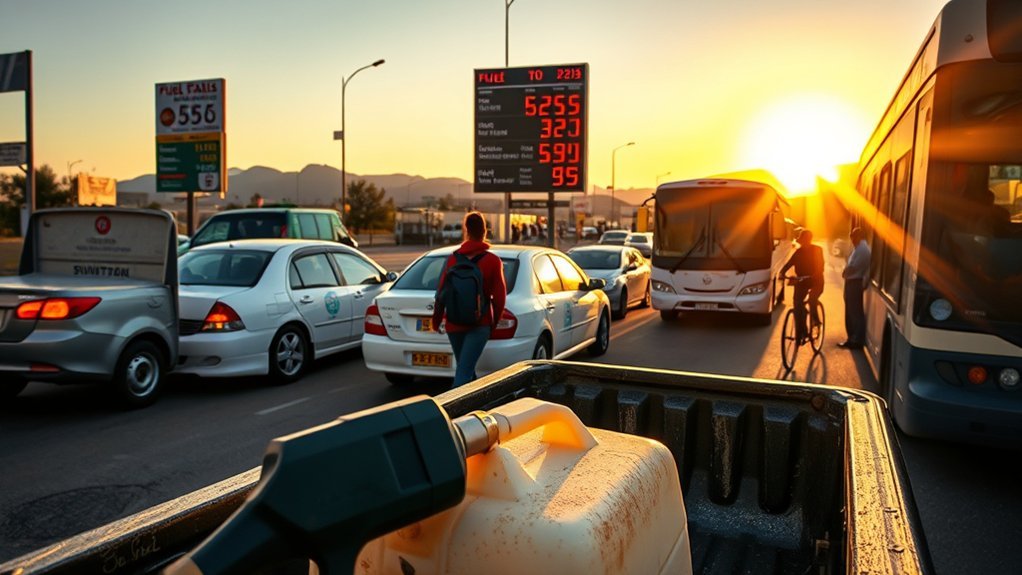
Namibia is large and thinly populated, so most expats end up owning a car. Inside Windhoek, shared taxis are the main public transport. Crowd-sourced averages put a ride at about N$13 (~$0.78) and a month of commuting at about N$800 (~$48). Ride-hailing apps operate in Windhoek.
Fuel. The government sets pump prices monthly. From October 7, 2026, petrol at Walvis Bay rose by N$1.50 to N$26.58 per liter, while diesel held at N$27.86 (50 ppm) and N$27.96 (10 ppm). Inland prices, including Windhoek, are a little higher to cover transport.
| Transport Cost | Price (N$) | Approx. USD |
|---|---|---|
| Petrol, per liter (Walvis Bay, Oct 2026) | 26.58 | $1.60 |
| Diesel 50 ppm, per liter (Walvis Bay) | 27.86 | $1.68 |
| Shared taxi ride, Windhoek | about 13 | $0.78 |
| Monthly commuting by taxi | about 800 | $48 |
| New Toyota Corolla or similar | about 448,000 | $27,000 |
A driver who uses 60 liters a month spends about N$1,600 (~$96) on petrol. Add insurance, servicing, and tires, and many car owners spend N$2,500–3,500 (~$150–$210) a month before any car loan. Long gravel roads wear tires quickly, so budget for them.
Healthcare and Medical Aid
Public hospitals are cheap but crowded, and most expats and middle-income Namibians use private clinics through a medical aid fund. Contributions depend on the plan, age, and number of dependants.
| Fund and Plan | Monthly, Main Member (N$) | Approx. USD |
|---|---|---|
| NHP Litunga (primary care) | 352 | $21 |
| Nammed Basic (income-qualified, state facilities) | from 825 | $50 |
| NHP Hospital plan | 1,812 | $109 |
| Nammed Trauma (hospital plan) | from 1,977 | $119 |
| Nammed Comprehensive | from 5,017 | $302 |
| NHP Gold (full cover) | 5,237 | $315 |
Figures come from Nammed’s 2026 benefit guide and the Namibia Health Plan’s published options. Each spouse or child adds to the cost, and new members often face waiting periods. Check hospital cover, chronic medicine, and co-payments, not just the monthly price. Many newcomers keep international insurance until local cover starts.
Schools and Childcare
- State schools: the Basic Education Act of 2020 bans compulsory tuition fees at state schools. Families still pay for uniforms, stationery, and transport. Teaching is in English.
- Private schools: a 2026 survey of selected private schools found annual fees of roughly N$40,000–160,000 (~$2,410–$9,640), depending on the school and grade.
- International school: crowd-sourced averages put international primary school at about N$88,700 (~$5,340) a year per child. Windhoek International School publishes its fee schedule online, with enrolment fees and an annual levy on top of tuition.
- Private preschool: about N$3,470 (~$210) a month, full day.
Two children in international school add about N$14,800 (~$890) a month to a family budget.
Taxes: VAT and Income Tax
- VAT: the standard rate is 15%, according to the Namibia Revenue Agency. Some basic foods are zero-rated.
- Income tax: rates are progressive from 0% to 37%. The first N$100,000 (~$6,025) of taxable income a year is tax-free.
- Interest paid to non-residents: 10% withholding tax.
Current brackets, per PwC’s Namibia tax summary:
| Taxable Income (N$ a year) | Tax |
|---|---|
| 0–100,000 | 0% |
| 100,001–150,000 | 18% above 100,000 |
| 150,001–350,000 | 9,000 + 25% above 150,000 |
| 350,001–550,000 | 59,000 + 28% above 350,000 |
| 550,001–850,000 | 115,000 + 30% above 550,000 |
| 850,001–1,550,000 | 205,000 + 32% above 850,000 |
| Over 1,550,000 | 429,000 + 37% above 1,550,000 |
The 2026/27 budget announced plans to revise these brackets over two years, but no new rates had been enacted as of October 2026. Namibia also runs exchange controls: the Bank of Namibia requires foreign-currency transfers to go through authorized dealers, so expect paperwork when you send money abroad.
Visas and Work Permits

Since April 1, 2025, citizens of the US, UK, Japan, and many other countries need a visa for Namibia. A visa on arrival or e-visa costs N$1,600 (~$96) for non-African nationals and N$1,200 (~$72) for African nationals. Fees are reviewed every year.
| Permit | Fee | Notes |
|---|---|---|
| Visa on arrival / e-visa | N$1,600 (~$96) | non-African nationals; N$1,200 for African nationals |
| Short-term employment permit, up to 3 months | N$1,600 (~$96) | applied for online |
| Short-term employment permit, up to 6 months | N$3,200 (~$193) | medical and X-ray reports needed |
| Digital nomad visa | reported at about $200 | reported income floor of about $2,000 a month (~N$33,200) |
Short-term permit fees come from the Home Affairs e-services portal. Work beyond six months needs a full employment permit, and employers must show why a Namibian cannot fill the job. The digital nomad visa is promoted by the Namibia Investment Promotion and Development Board (NIPDB). Confirm its current income rule and fee with the Ministry of Home Affairs, Immigration, Safety and Security before you apply.
One-Time Setup Costs
Budget for these before your first month:
- Visa or permit: N$1,600–3,200 (~$96–$193), plus a full employment permit if you stay longer.
- Rental deposit: usually one month’s rent, so N$5,900–8,300 (~$355–$500) for a Windhoek one-bedroom.
- Prepaid electricity: a first top-up of N$500–1,000 (~$30–$60).
- Internet installation: Telecom Namibia charges N$950 (~$57) for fiber installation in fiber-ready areas.
- Car: a used car, or a few weeks of car hire while you look. Many newcomers buy within the first month.
- Health cover gap: international insurance until medical aid waiting periods end.
Sample Monthly Budgets
These budgets combine the averages above for Windhoek. Coastal and northern towns cost less on rent.
| Expense (N$) | Single, Lean | Single, Comfortable | Couple |
|---|---|---|---|
| Rent (1-bed) | 5,900 (outside center) | 8,300 (center) | 8,300 (center) |
| Utilities | 1,500 | 2,350 | 2,350 |
| Internet + mobile | 1,000 | 1,280 | 1,720 |
| Groceries | 3,000 | 3,500 | 6,000 |
| Eating out + leisure | 1,200 | 2,500 | 3,500 |
| Transport | 800 (taxis) | 2,500–3,500 (car) | 2,500–3,500 (one car) |
| Medical aid | 825–1,800 | 2,000 | 3,600–4,000 |
| Gym | — | 650 | 1,300 |
| Total (N$) | 14,000–15,000 | 23,000–24,000 | 29,000–31,000 |
| Total (USD) | $845–$905 | $1,385–$1,445 | $1,745–$1,870 |
Family of four: crowd-sourced estimates put a family of four at about N$39,700 (~$2,390) a month before rent. Add a three-bedroom in Windhoek (N$14,400–19,600) and the total is about N$54,000–59,000 (~$3,255–$3,555). International school for two children pushes that to roughly N$69,000–74,000 (~$4,155–$4,460).
Salary vs. costs: the average net salary of about N$16,600 (~$1,000) covers a lean single budget, but not a comfortable one with a car and medical aid. The minimum wage of about N$3,500 a month would not cover rent on an average one-bedroom.
Safety and Practical Tips
Namibia is one of the more stable countries in southern Africa, but petty crime and house break-ins are common in Windhoek. Use secure parking, keep car doors locked, and avoid walking alone at night. Water is scarce, and towns can impose restrictions in dry years, so a backup tank is useful.
Money-saving tips:
- Rent outside the center or at the coast. A one-bedroom outside central Windhoek saves about N$2,400 (~$145) a month.
- Buy local beef and South African brands. Imported specialty goods cost much more.
- Watch your geyser. A solar geyser or a timer cuts prepaid electricity bills.
- Compare medical aid plans. A hospital plan plus cash GP visits can cost less than a comprehensive plan.
- Track fuel announcements. Prices change monthly, and fuel inflation hit 25% this year.
- Plan around the rand. If you earn in dollars, the rate swung about 9% this year. Keep a buffer.
How Namibia Compares With Nearby Countries
Because the Namibia dollar is pegged to the rand and most goods come from South Africa, prices in Windhoek track those across the border. Compare our guide to the cost of living in South Africa, which has more variety and lower prices in big-city supermarkets, and the cost of living in Botswana, another stable, sparsely populated neighbor. To the north, see the cost of living in Zambia and the cost of living in Angola, where expat housing in Luanda can cost far more than in Windhoek.
Frequently Asked Questions
How much money do you need to live in Namibia per month?
A single person needs about N$14,000–15,000 (~$845–$905) a month for a simple life in Windhoek, and about N$23,000–24,000 (~$1,385–$1,445) for a comfortable one with a car and medical aid. A couple should budget about N$29,000–31,000 (~$1,745–$1,870).
Is Namibia expensive to live in?
Namibia is cheaper than the US or Western Europe, but not cheap by African standards. Prices are close to South Africa’s because most goods come from there. Rent, medical aid, cars, and private schools are the costs that add up.
How much is rent in Windhoek in 2026?
A one-bedroom averages about N$8,300 (~$500) a month in the city center and about N$5,900 (~$355) outside it. A three-bedroom averages about N$19,200 (~$1,160) in the center and N$14,300 (~$865) outside.
What is the minimum wage in Namibia in 2026?
The national minimum wage is N$18 an hour, or about N$3,500 (~$211) a month for a 45-hour week. Domestic workers earn at least N$15 an hour, farm workers N$14, and security guards N$16 from January 1, 2026.
Do Americans need a visa for Namibia?
Yes. Since April 1, 2025, US citizens need a visa. A visa on arrival or e-visa costs N$1,600 (~$96). Working in Namibia needs a separate employment permit.
What is the income tax rate in Namibia?
Income tax is progressive from 0% to 37%. The first N$100,000 (~$6,025) of taxable income a year is tax-free, and the top rate of 37% applies above N$1,550,000. VAT is 15%.
What currency is used in Namibia?
Namibia uses the Namibia dollar (N$), which is pegged one-to-one to the South African rand. The rand is also widely accepted. In early October 2026, one US dollar bought about N$16.6.
Conclusion
Namibia is affordable for people earning in dollars or euros, but it is not a bargain destination. A single person can live simply in Windhoek for about $845–$905 a month, or comfortably with a car and medical aid for about $1,385–$1,445. Families should budget most carefully for rent, medical aid, and school fees. Fuel rose sharply in 2026 and the rand swings, so check pump prices and the exchange rate before you lock in a budget. Living at the coast or outside central Windhoek is the easiest way to cut costs.
Sources
- Exchange-Rates.org – USD to NAD history, 2026
- Trading Economics – Namibia inflation, August 2026
- The Brief – 2026 minimum wage rates
- Namibia Statistics Agency – 2023 census labour force results
- Numbeo – Namibia and Windhoek (crowd-sourced averages, October 2026)
- GetCostIdea – Average Rent in Namibia
- The Namibian – Windhoek electricity tariffs up 3.6%
- City of Windhoek – Tariffs 2026/2027
- Telecom Namibia – residential internet packages
- The Namibian – October 2026 fuel prices
- Nammed Medical Aid – 2026 benefit guide
- Namibia Health Plan – benefit options
- Windhoek International School – fees
- Namibia Revenue Agency – taxes
- PwC – Namibia personal income tax
- PaySpace – 2026/27 budget and tax brackets
- Bank of Namibia – exchange control FAQ
- Embassy of Japan in Namibia – visa on arrival notice
- Ministry of Home Affairs – short-term employment permit
- NIPDB – digital nomad visa