Friction stir welding equipment cost starts below €100,000 for a CNC-mounted head and can reach seven figures for a long, purpose-built gantry. The right budget depends on the parts you weld, required process force, joint length, production volume, automation, fixturing, inspection, and the equipment you already own. The figures below are supplier-published planning benchmarks, not universal market prices or firm quotations.
Quick Answer
One supplier comparison (Stirweld) lists CNC friction stir welding heads below €100,000, complete robotic workstations near €400,000, and dedicated machines from about €600,000 to €2 million. Treat these as budgetary examples. Your installed cost can rise with fixturing, guarding, integration, tooling, qualification, inspection, training, freight, and site work.
Key Takeaways
- Published equipment benchmarks range from below €100,000 for some CNC heads to roughly €2 million for long, custom dedicated systems.
- The machine price is only one part of the budget. Fixturing, process development, guarding, installation, qualification, tooling, and inspection can materially change the total.
- Choose equipment by required force, thickness, work envelope, tool orientation, host-machine stiffness, and production volume, not by price alone.
- Ask every supplier for the same scope, acceptance criteria, lead time, warranty, service plan, and production-rate assumptions before comparing quotes.
Friction stir welding equipment cost at a glance
The table below summarizes figures published by Stirweld for three common equipment routes. These numbers are useful for early planning, but they do not represent every manufacturer, region, configuration, or application.
| Equipment type | Published equipment benchmark | Best fit | Main budget risks |
|---|---|---|---|
| CNC-mounted FSW head | Below €100,000 for the head in the cited supplier comparison | Prototypes, low-to-medium volumes, and shops with a suitable rigid CNC machine | Host-machine suitability, adapter, cooling, fixturing, guarding, process development, and lost CNC capacity |
| Robotic FSW workstation | About €400,000 for a complete workstation in the cited comparison; the robot arm alone is listed near €100,000 | Complex 3D paths, flexible cells, and parts needing changing tool orientation | FSW spindle, integration, force compensation, safety cell, fixtures, positioners, software, and commissioning |
| Dedicated FSW machine | About €600,000 for a roughly 2-meter system and up to about €2 million for systems longer than 10 meters in the cited comparison | Long seams, high process force, repeat production, and purpose-built workflows | Custom engineering, foundation, large fixtures, material handling, factory acceptance testing, freight, installation, and long lead time |
Note: The cited values come from a supplier comparison, not an independent market survey. Get written quotes from multiple qualified vendors and confirm exactly what each quote includes.
Investment cost and delivery time
When you plan an investment in friction stir welding equipment, compare both the initial capital cost and the time needed to reach accepted production.
A Stirweld equipment comparison lists dedicated FSW machines from about €600,000 for weld lengths near 2 meters. It gives an example of roughly €2 million for a custom system longer than 10 meters. Those figures should be treated as examples from one supplier, because machine builders use different architectures, scopes, and commercial terms.
The same comparison lists an industrial robot arm near €100,000 and a complete robotic FSW workstation near €400,000. The difference reflects the FSW spindle or head, cell guarding, controls, software, integration, fixtures, and other system work that turns a robot into a welding cell.
CNC-mounted heads can provide a lower entry cost when you already own a compatible machining center. The supplier comparison lists its FSW head below €100,000. However, the head price does not automatically include every adapter, fixture, tool, cooling connection, safety upgrade, feasibility trial, or production qualification your project may need.
Published lead-time examples also vary by architecture. The cited supplier lists 12 to 18 months for a dedicated machine, about 6 months for a robotic solution, and approximately 1 to 3 months for a standard CNC head depending on stock. Add time for internal approvals, site preparation, process development, installation, training, acceptance testing, and production qualification.
The lowest equipment price is not always the lowest production cost. Compare the cost per accepted part after fixtures, tools, inspection, cycle time, scrap, maintenance, and machine availability.
Costs that may sit outside the machine quote
A complete FSW budget should separate the base equipment price from the costs needed to install, qualify, and operate the process.
Application engineering and feasibility trials
FSW performance depends on material, thickness, joint design, tool geometry, rotational speed, travel speed, plunge depth or force, and clamping. A feasibility study and sample weld program can show whether the process meets your strength, leak-tightness, appearance, and cycle-time targets before you purchase a full system.
Fixturing, backing, and material handling
FSW creates substantial downward and travel forces. The parts need rigid backing and strong clamping, and joint gaps must be controlled because the process normally adds no filler metal. Large panels may also require cranes, conveyors, positioners, or automated loading.
Integration, guarding, and site preparation
Budget for electrical work, compressed air, cooling water or a chiller, networking, floor space, foundations where required, extraction for machining debris, guards, interlocks, emergency stops, and safe access. A CNC-head project may use an existing machine, but it can still require a dedicated fixture and safety review.
Tools, spares, and service
Include the initial tool set, spare tools, holders, sensors, cooling components, planned maintenance, calibration, software support, and critical spare parts. Tool life is application-specific, so ask the supplier to state the assumed material, thickness, weld length, and parameters behind any tool-life estimate.
Qualification and inspection
Production projects may require procedure qualification, operator qualification, destructive testing, non-destructive testing, metallography, leak testing, dimensional inspection, or customer approval. For aluminum FSW, ISO 25239-4:2020 covers welding-procedure specification and qualification, while ISO 25239-5:2020 addresses quality and inspection requirements. Aerospace work may also have customer or sector-specific requirements.
Pro Tip: Send every bidder the same part drawings, alloys, thicknesses, annual volume, takt-time target, acceptance tests, floor-space limits, and required standards. Quote comparisons are unreliable when the scopes are different.
FSW welding thickness and accuracy
Weld thickness, process force, stiffness, and control capability are closely connected, but no single force-to-thickness rule fits every alloy, tool, and joint.
In its comparison, Stirweld lists a dedicated machine with up to about 60 kN of process force and an example capacity up to roughly 30 mm. It lists a conventional robotic solution near 10 kN and roughly 5 mm for aluminum, while its CNC-mounted head is listed up to 12 mm single-sided and 20 mm with double-sided welding. These are supplier-specific capability examples, not universal limits for every machine or material.
The same supplier publishes nominal positioning figures of about 0.01 mm for its dedicated machine and CNC-head comparison and about 1 mm for a conventional robot under load. Do not treat a positioning specification as a guaranteed weld tolerance. Final joint quality also depends on calibration, deflection compensation, part fit-up, tool runout, thermal movement, fixture stiffness, control mode, and the qualified process window.
A standard CNC-head product page lists practical host-machine checks such as spindle power, torque, attachment size, clearance, force capability, and cooling. Confirm these requirements against your exact machine model and duty cycle before assuming that an existing CNC is suitable.
Questions to answer before selecting force capacity
- What alloys and thickness range must the system weld?
- Is the joint welded from one side or both sides?
- What backing support and clamp spacing can the part accept?
- What weld strength, leak rate, surface finish, and dimensional limits apply?
- Does the process need position control, force control, or a combined strategy?
- What force and torque can the machine sustain continuously without shortening component life?
Footprint and work envelope of FSW machines
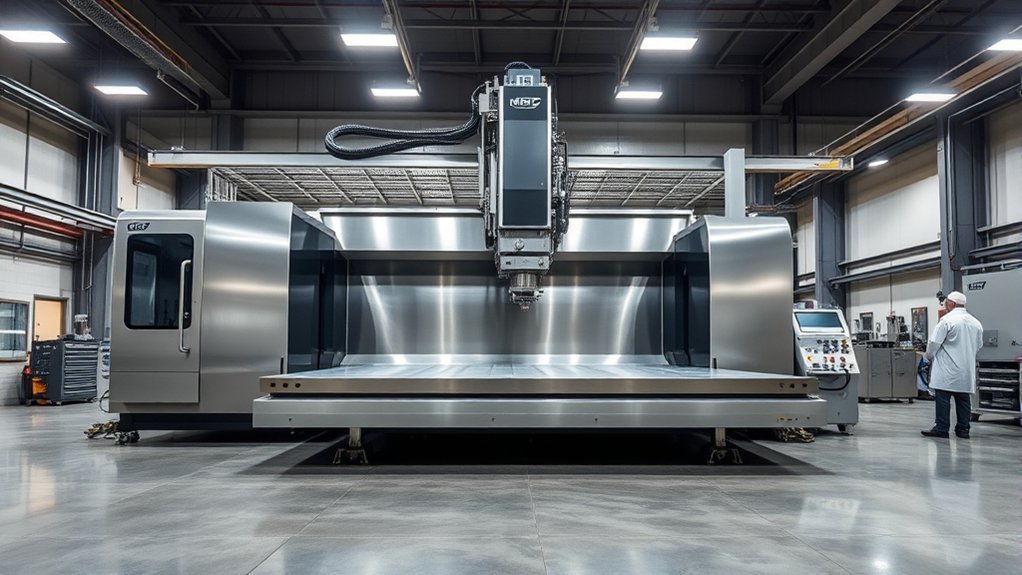
Footprint and work envelope can change the installed cost as much as the equipment price.
Dedicated FSW machines often need long beds, gantries, heavy fixtures, access around the machine, and material-handling space. They suit long panels and extrusions but may require floor reinforcement, a planned installation route, and permanent production space.
Robotic FSW cells can fit flexible layouts and follow parts on positioners or rails. The robot itself may be compact, but the full cell still needs fencing or other safeguarding, fixtures, a spindle package, controls, service access, and loading space.
A CNC-mounted head adds little floor area by itself because it attaches to an existing machining center. The complete application still needs room inside or around the machine for the fixture, backing plate, cooling, controls, tool storage, loading, and safe access. Also count the opportunity cost of using machining-center hours for welding.
For many aluminum applications, FSW does not require filler wire, flux, or shielding gas. That can reduce consumable storage and handling. Other materials or special process variants may have different environmental or shielding needs, so confirm the application with the process supplier.
Measure the full production envelope
- Maximum part size and weight
- Weld length and start/stop locations
- Fixture and backing-plate dimensions
- Tool approach, tilt, and withdrawal clearance
- Robot, rail, rotary-table, or positioner sweep
- Operator loading and inspection access
- Maintenance clearance and component-removal path
3D welding capabilities and welding speed
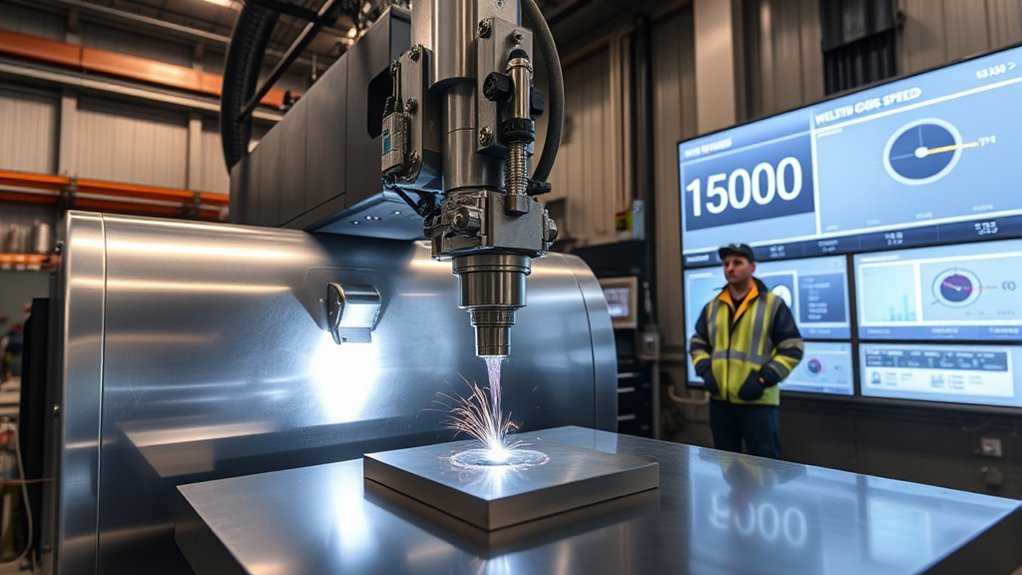
Dedicated gantries are commonly optimized for long, straight, or gently curved seams, but custom machines can have more complex kinematics. Robotic cells are attractive for 3D parts because a multi-axis arm can change tool position and orientation around the workpiece.
3D welding versatility
A robotic system can follow horizontal, vertical, overhead, and changing-orientation paths when the spindle, robot payload, reach, force-control strategy, fixtures, and safety cell are designed for the application. A multi-axis CNC can also follow 3D paths, but its coverage depends on machine travels, rotary axes, collision limits, and the ability to maintain the required tool orientation.
Welding speed and cycle time
The cited supplier comparison publishes a maximum welding speed of up to 3 m/min across its compared solutions. This is a maximum equipment figure, not a guaranteed production speed. Actual travel speed depends on alloy, thickness, joint design, tool, heat input, force, path curvature, start and stop strategy, quality requirements, and machine acceleration.
Cycle time also includes loading, clamping, probing, plunge and dwell, welding, tool withdrawal, unloading, inspection, tool changes, and planned maintenance. Ask vendors to demonstrate the complete cycle on a representative part, not only the straight-line travel speed.
Axis count and typical use
| Configuration | Typical capability | Main limitation to check |
|---|---|---|
| 3-axis CNC | Planar or contoured paths where tool orientation can remain fixed | Limited ability to change tool angle around complex surfaces |
| 4-axis CNC | Adds a rotary axis for cylindrical parts or indexed orientations | Rotary-axis load, access, and collision envelope |
| 5-axis CNC | Changes tool orientation along more complex 3D paths | Available force, stiffness, travel, and head clearance at each orientation |
| Industrial robot | Broad 3D reach with flexible tool orientation; rails and positioners can extend coverage | Deflection under process load, payload, singularities, reach, and compensation |
| Dedicated gantry | High stiffness and long repeatable seams; custom axes may be available | Less flexible than a robot unless extra axes are engineered into the system |
Selecting the right FSW solution
Choosing the right friction stir welding solution means looking past the sticker price. Start with the part and acceptance requirements, then select the machine architecture.
- Define the application: List alloys, thicknesses, joint types, weld lengths, part sizes, annual volume, target cycle time, and future part families.
- Set quality requirements: State strength, leak-tightness, distortion, surface finish, dimensional tolerance, inspection, traceability, and applicable standards.
- Check process capacity: Confirm axial and lateral force, torque, rotational speed, travel speed, stiffness, force control, data recording, work envelope, and tool orientation.
- Confirm the complete scope: Identify who supplies the fixture, backing, tools, guarding, cooling, controls, programming, installation, training, qualification, and acceptance tests.
- Compare lifecycle cost: Include maintenance, spares, tool use, labor, inspection, downtime, scrap, utilities, and the value of occupied floor or CNC capacity.
- Validate before purchase: Run representative weld trials and require measurable acceptance criteria for the factory and site acceptance tests.
When each equipment type usually makes sense
- CNC head: A strong option when a suitable machining center is available and the parts fit its travel, force, stiffness, and access limits.
- Robotic cell: Useful for complex 3D paths, multiple part families, and flexible layouts when robot deflection and process-force control are properly managed.
- Dedicated machine: Often best for long seams, high force, heavy fixtures, stable high-volume production, or an application that justifies a purpose-built system.
Quote-comparison checklist
| Ask the supplier to state | Why it matters |
|---|---|
| Included equipment and exclusions | Prevents a low base price from hiding major integration costs |
| Guaranteed part, alloy, thickness, and weld path | Connects the promise to your real application |
| Cycle-time calculation and assumptions | Separates travel speed from total production time |
| Factory and site acceptance tests | Defines how performance will be proven before final acceptance |
| Tooling, expected tool life, and replacement cost | Improves operating-cost estimates |
| Warranty, service response, spares, and software support | Reduces downtime risk after launch |
| Delivery, installation, commissioning, and training schedule | Creates a realistic production-start date |
Warning: FSW equipment has rotating tools, high forces, hot workpieces, pinch points, and possible flying chips. Use engineered guarding, interlocks, emergency stops, lockout/tagout procedures, safe clamping, and task-specific PPE. In the United States, review applicable OSHA machine-guarding requirements, including 29 CFR 1910.212.
Contacting Stirweld for FSW solutions

Specialist suppliers such as Stirweld offer CNC heads, robotic spindles, dedicated equipment, feasibility studies, fixture design, prototyping, training, and support. Other machine builders and integrators may offer different architectures and commercial terms, so compare more than one qualified source when possible.
Send a clear request for quotation with part drawings, material specifications, thickness range, annual volume, weld paths, required standards, acceptance tests, available equipment, utilities, floor-space limits, and target production date. Ask for a line-item proposal that separates equipment, engineering, fixtures, tools, integration, freight, installation, commissioning, training, qualification, and optional services.
Early weld trials can reduce risk. They help confirm joint design, clamping, tool selection, process parameters, inspection methods, and cycle time before a major capital commitment.
Glossary
- Friction stir welding (FSW)
- A solid-state joining process that uses frictional heat and a rotating, non-consumable tool to soften and mix material along a joint without melting the base metal. The TWI guide to friction stir welding explains the process, applications, advantages, and limitations.
- Dedicated FSW machine
- A purpose-built machine, often a gantry or portal system, designed around the force, travel, fixtures, controls, and production needs of friction stir welding.
- FSW head for CNC
- An add-on head that mounts to a compatible machining center and provides FSW functions such as force control, force recording, cooling, and spindle protection.
- Robotic FSW cell
- An industrial robot combined with an FSW spindle or head, fixtures, safety equipment, controls, software, and often a positioner or rail.
- Factory acceptance test (FAT)
- A test performed before shipment to show that the supplied system meets agreed technical and performance requirements.
- Site acceptance test (SAT)
- A test after installation at the buyer’s site to confirm operation, safety functions, utilities, and agreed production results.
Frequently Asked Questions
What is the maintenance cost for friction stir welding equipment?
There is no reliable universal percentage. Maintenance depends on machine type, duty cycle, tool and spindle wear, cooling equipment, sensors, calibration, service coverage, and spare-parts strategy. Ask each supplier for a multi-year maintenance schedule, labor rates, recommended spares, software fees, calibration needs, and expected downtime.
How long does it take to set up friction stir welding equipment?
A routine changeover may be quick after the process is proven, but first-time setup can include fixture installation, tool selection, program development, force and speed trials, inspection, and qualification. Ask the vendor to separate equipment delivery, installation, commissioning, process development, training, and production approval in the schedule.
What materials can friction stir welding join?
FSW is widely used for aluminum alloys. It has also been applied to magnesium, copper, titanium, nickel, steel, polymers, composites, and some dissimilar-material combinations. Tool material, machine force, heat control, shielding needs, and process difficulty vary greatly, so verify feasibility for the exact material pair.
Are there safety concerns with FSW equipment?
Yes. Main hazards include rotating tools, pinch and crush points, hot parts, chips, heavy fixtures, stored energy, automated motion, and unexpected startup. Use a documented risk assessment, engineered guarding, interlocks, emergency stops, lockout/tagout, safe lifting methods, secure clamping, training, and suitable PPE.
What training is required to operate FSW machinery?
Training should cover machine controls, hazards, clamping, tooling, parameter limits, process monitoring, inspection, abnormal conditions, and maintenance boundaries. The required qualification depends on the product, customer, jurisdiction, and applicable standard. For aluminum FSW, ISO 25239-3:2020 addresses qualification of welding operators.
Can any CNC machine use an FSW head?
No assumption should be made without an engineering check. The host machine needs enough continuous force, stiffness, spindle power and torque, attachment compatibility, clearance, travel, cooling, control integration, and fixture capacity. Confirm the exact CNC model and application with both the head supplier and the machine owner or manufacturer.
What hidden costs should be included in an FSW budget?
Common items include fixtures, backing plates, tools, spares, guarding, cooling, utilities, freight, taxes, foundations, material handling, integration, programming, trials, destructive testing, non-destructive testing, training, qualification, software support, maintenance, and lost capacity on a shared CNC machine.
How should buyers compare FSW equipment quotes?
Use one technical specification for every bidder. Compare included scope, proven part capability, acceptance tests, cycle-time assumptions, tooling, fixture design, standards compliance, delivery, warranty, service response, spare parts, software support, and total installed cost. A lower base price may not be the lower-risk or lower-cost project.
Related articles
Sources
- Stirweld: Friction Stir Welding Machine, Find the Ideal Solution — supplier-published cost, thickness, lead-time, positioning, work-envelope, and speed comparisons.
- Stirweld: Standard FSW Head for CNC — product specifications and host-machining-center integration checks.
- TWI: What Is Friction Stir Welding? — process description, materials, applications, advantages, and limitations.
- ISO 25239-4:2020 — specification and qualification of FSW procedures for aluminum.
- ISO 25239-5:2020 — quality and inspection requirements for aluminum FSW.
- OSHA 29 CFR 1910.212 — general machine-guarding requirements for hazards such as rotating parts and flying chips.
Conclusion
Friction stir welding equipment can range from a comparatively affordable CNC-mounted head to a custom, seven-figure production system. The best choice depends on your parts, force and thickness requirements, work envelope, production rate, quality plan, and existing equipment.
Use published prices only for early budgeting. Before buying, validate the process on representative parts, compare equal quote scopes, define acceptance tests, and calculate the cost per accepted part. A technically proven system with clear service and qualification support is usually a safer investment than the lowest base price.