
Welding certification costs in Ohio depend on what you mean by “certification.” A school certificate may include months of hands-on training, while an American Welding Society (AWS) Certified Welder credential is earned by passing a specific performance test. Current published Ohio program prices are much higher than the outdated $1,610 figure often quoted online.
Quick Answer
In Ohio, current published welding certificate prices range from about $6,990 for Apollo Career Center’s 336-hour short-term program to $13,190 for its 696-hour fabrication program, including registration. Standalone AWS Certified Welder testing varies by facility, and 2026 AWS fees include a $70 application plus a $105 annual maintenance subscription.
Key Takeaways
- Published Ohio training programs currently range from several thousand dollars to more than $13,000, depending on hours, curriculum, equipment, and testing included.
- A school completion certificate and an AWS Certified Welder credential are not the same thing.
- The AWS Certified Welder exam price is set by the Accredited Test Facility, so you must request a local quote.
- Financial aid depends on program length and eligibility; short programs may not qualify for federal aid.
- Budget for PPE, transportation, retests, and ongoing credential maintenance in addition to tuition.
At a Glance
| Published Ohio Examples | About $6,990 to $13,190 including registration for the Apollo programs discussed below; other schools use different pricing models |
| Typical Program Length | About 5 months to 1 year in the cited Ohio career-center programs |
| Standalone AWS CW Fees | $70 AWS application; test price set by the test facility; $105 annual maintenance subscription in 2026 |
| Financial Aid | Program-specific; possible options include federal aid for eligible longer programs, WIOA funding, veterans benefits, scholarships, and payment plans |
Overview of Welding Certification Costs in Ohio
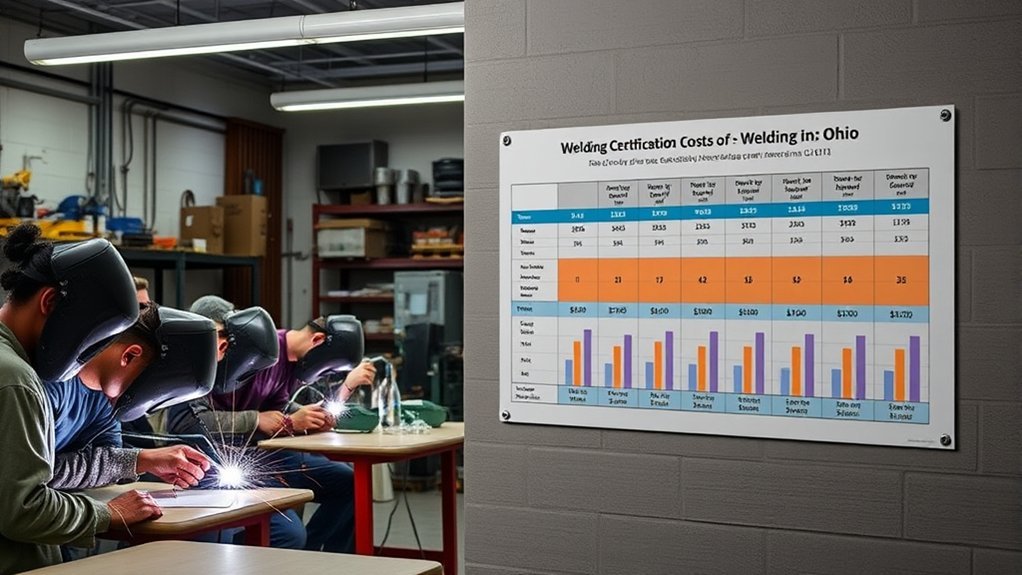
There is no single statewide price for welding certification in Ohio. Your total depends on whether you need a complete training program, a short skills class, an AWS performance qualification, or an advanced professional credential such as Certified Welding Inspector (CWI).
For a current example, Apollo Career Center’s Short-Term Welding program lists tuition and fees of $6,980 plus a $10 registration fee. The 336-hour program runs for about five months, and the published price includes classroom materials, supplies, exam preparation, and a certification test.
Apollo’s longer Fabrication Concepts and Plate Welding program lists $13,180 plus a $10 registration fee. It includes 696 hours of training and a toolbox. These figures show why you should use the school’s current program page rather than an old flat estimate.
A realistic budget starts with the exact credential your target employer requires—not with a generic “welding certification” price.

These Stanley MaxSteel straight aviation snips are built for clean, controlled cutting through sheet metal and other tough materials. Serrated cutting edges help prevent slippage for more accurate results, while the double pivot action delivers increased cutting power with less effort. Designed for dependable performance, they are a practical choice for metalworking, HVAC tasks, and general workshop use.

These colorful answer buzzers turn lessons, review games, and family activities into lively game-show style challenges that boost participation and make learning more interactive. Each buzzer has a distinct sound to clearly identify who buzzed in first, while the durable, palm-sized design makes them easy for kids and adults to use in classrooms, homeschools, and group settings.

Experience J.R.R. Tolkien's legendary Middle-earth saga in a compact hardcover boxed set that brings together The Hobbit and The Lord of the Rings. This deluxe collection is ideal for readers who want a portable, collectible edition of the classic fantasy adventures, making it perfect for gifting, re-reading, and building a treasured library. The boxed presentation adds display appeal while the hardcovers offer lasting durability for years of enjoyment.
Types of Welding Certifications Available
Welding schools, testing facilities, and employers use similar terms for different credentials. Understanding the difference prevents you from paying for training that does not match your job goal.
Training Certificate vs. Professional Certification
- School certificate: Shows that you completed a welding curriculum. It may cover blueprint reading, safety, fabrication, SMAW, GMAW, GTAW, or oxy-fuel cutting.
- AWS Certified Welder credential: Shows that you passed a hands-on performance test using a specific process, position, material, and Welding Procedure Specification.
- Employer or project qualification: May be limited to one company, code, procedure, or job. A new employer can require another test even when you hold an AWS credential.
- Professional certification: Credentials such as CWI test broader inspection knowledge and require qualifying education, experience, and a vision examination.
AWS Certified Welder Qualifications
The AWS Certified Welder program is performance-based. AWS does not require a course, degree, or minimum work history before the test, although most beginners need hands-on training to pass.
Terms such as 3G, 4G, and 6G describe test positions, not a simple beginner-to-advanced certification ladder. The best qualification depends on the work you want to do. Structural steel, pipe, sheet metal, aluminum, and refinery work may use different codes, positions, base metals, and processes.
Advanced and Specialty Credentials
AWS also offers credentials for inspectors, educators, supervisors, engineers, robotic welding personnel, and other specialties. The CWI credential, for example, requires a qualifying mix of education and welding-related experience plus a vision test.
Note: WPQ1, WPQ2, WCQA, and NDEC are advanced AWS endorsements associated with inspector pathways. They are not entry-level Certified Welder qualifications.
Factors Affecting Certification Pricing
The price changes with the amount of training, the process being tested, the welding position, the code or procedure, and what the school includes in tuition.
Course Enrollment Fees
Longer programs usually cost more because they include additional lab time, consumables, instructor hours, and subjects such as math, blueprint reading, metallurgy, fabrication, and career preparation. Some schools include tools and certification testing; others bill those items separately.
| Cost Driver | Why It Changes the Price |
|---|---|
| Program hours | More booth time, instruction, and consumables |
| Processes taught | SMAW, GMAW, FCAW, and GTAW require different equipment and supplies |
| Plate vs. pipe | Pipe preparation and position testing can require more practice |
| Included equipment | Toolboxes, PPE, books, and consumables may be bundled or separate |
| Credential included | Some programs include one test; additional qualifications and retests cost more |
Exam and Certification Costs
The AWS 2026 price list sets the Certified Welder application at $70. The hands-on exam itself is priced by the individual AWS Accredited Test Facility, so the facility must quote the test, materials, bend testing or inspection, and any retest.
Advanced AWS exams cost much more. For example, the 2026 price list shows initial CAWI/CWI exams at $1,255 for members and $1,520 for nonmembers. This is a different career path from an entry-level Certified Welder test.
Pro Tip: Ask for a written quote that separates tuition, registration, books, PPE, tools, consumables, the first certification test, retests, and credential maintenance.
Breakdown of Program Costs
A complete budget should separate school costs from testing and living expenses. The following example uses currently published Apollo figures rather than the obsolete $1,610 estimate.
| Item | Current Published Amount or Rule |
|---|---|
| Apollo Short-Term Welding | $6,980 tuition and fees + $10 registration |
| Apollo Fabrication Concepts and Plate Welding | $13,180 + $10 registration; published price includes a toolbox |
| AWS Certified Welder application | $70 in the 2026 AWS price list |
| AWS Certified Welder exam | Set by the Accredited Test Facility |
| AWS Certified Welder maintenance | $105 annual subscription for unlimited renewals in 2026 |
Do not assume that every program includes the same items. A lower tuition price can become more expensive after adding a helmet, jacket, gloves, boots, hand tools, textbooks, gas, filler metal, testing, and transportation.
Financial Aid and Payment Options

Financial aid is tied to the school, program length, enrollment status, and your eligibility. Apollo states that federal financial assistance is available for eligible students in full-time programs of 600 hours or more. Its 336-hour Short-Term Welding checklist says that program is not eligible for federal aid through FAFSA.
Possible funding sources include:
- Federal aid: Pell Grants and federal loans for eligible students in eligible programs.
- WIOA funding: Local OhioMeansJobs centers may approve training for eligible participants.
- Veterans education benefits: Availability depends on the program and the student’s eligibility.
- School and community scholarships: Deadlines and award rules vary.
- Employer reimbursement or apprenticeship: Some employers pay for job-required training or testing.
- Payment plans: Useful when available, but review fees and due dates.
Note: A school’s general financial-aid page does not prove that every welding course qualifies. Confirm the exact program code with the financial-aid office before enrolling.
Comparison of Institutions Offering Certification
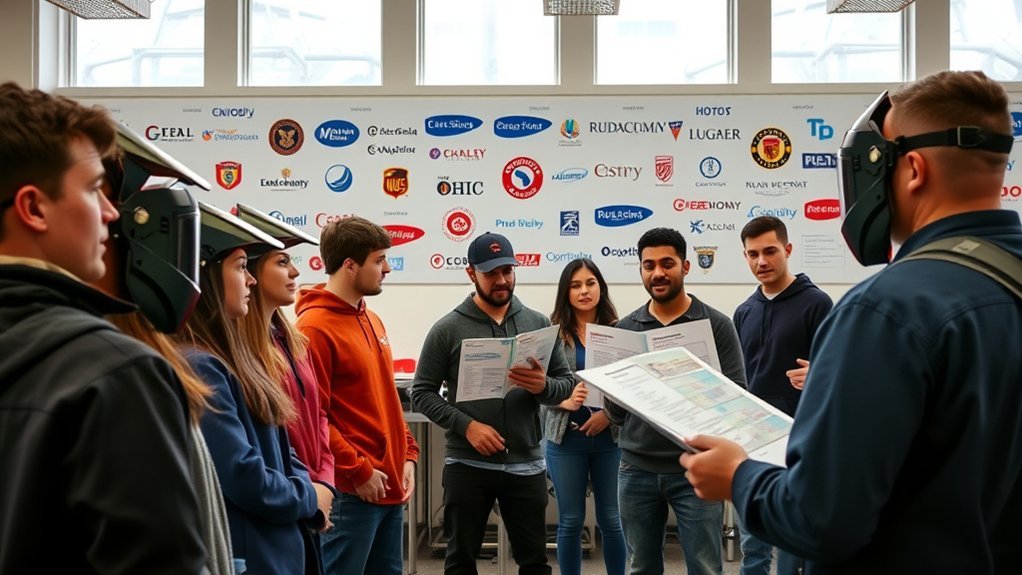
Ohio programs use different formats, so compare total hours and included items instead of tuition alone.
| Ohio Option | Length | Published Cost | Important Detail |
|---|---|---|---|
| Apollo Short-Term Welding | 336 hours / about 5 months | $6,980 + $10 registration | Materials, supplies, exam prep, and certification test listed as included |
| Apollo Fabrication Concepts and Plate Welding | 696 hours / 49 weeks | $13,180 + $10 registration | Broader SMAW, GMAW, GTAW, and fabrication curriculum; toolbox included |
| Eastland-Fairfield Welding | 600 clock hours | $8,860 tuition/fees | Ask the school which books, tools, PPE, and certification tests are included |
| Stark State Welding Technology Certificate | About 1 year | Credit-based; calculate from current tuition and course fees | The school lists separate welding course and test fees, so total cost depends on the schedule |
Prices and start dates can change. Save a copy of the program page or written quote that applies to your enrollment term.

This hardcover cookbook offers fast, approachable recipes designed for busy days and low-energy nights. Caroline Chambers focuses on simple, flavorful meals that help you get dinner on the table without overthinking it. It's a practical pick for home cooks who want quick weeknight inspiration and minimal-fuss cooking.

This interactive sentence building set helps children practice early reading, writing, and grammar through hands-on play. Color-coded word cards, photo cards, and punctuation pieces make it easy to build simple sentences while reinforcing capitalization, parts of speech, and sentence structure. It is a versatile learning tool for homeschool and classroom use, with included game ideas and teaching suggestions to support multiple skill levels.

This daily devotional helps parents pray purposefully for their children through a full year of Scripture readings, reflections, and guided prayer prompts. Written to encourage faithful family discipleship, it offers practical, biblically grounded support for parents who want to shape their prayers around God's Word. A foreword by Sinclair B. Ferguson adds trusted theological insight and encouragement.
Additional Fees to Consider
Extra costs can materially change the final amount you pay. Ask about each of these before signing an enrollment agreement:
- Registration, application, placement, or technology fees
- Helmet, safety glasses, jacket, gloves, work boots, and hearing protection
- Hand tools, toolbox, textbooks, and online access codes
- Lab consumables, coupons, filler metal, shielding gas, and grinding discs
- Medical or vision examinations required for a specific credential
- Certification applications, test-facility charges, inspection, and retests
- AWS Certified Welder maintenance fees and continuity documentation
- Transportation, parking, meals, and lost work time
Warning: Welding exposes students to arc radiation, hot metal, fumes, gases, electrical hazards, and fire risks. Choose a program that enforces appropriate PPE, ventilation, equipment inspection, and supervised lab procedures consistent with OSHA welding safety guidance.
Potential Return on Investment

Certification can improve your ability to document job-specific skills, but it does not guarantee a wage, job offer, or promotion. Earnings vary by experience, process, industry, shift, travel, union status, overtime, and location.
The U.S. Bureau of Labor Statistics reports a national median wage of $51,000 per year, or $24.52 per hour, for welders, cutters, solderers, and brazers in May 2024. BLS projects 2% employment growth from 2024 to 2034, which is slower than average, while still projecting about 45,600 openings per year from growth and worker replacement.
To judge value, compare the program’s total out-of-pocket cost with:
- Local job postings that name the process, position, and code required
- The program’s completion, placement, and credential pass rates
- Whether the school offers enough booth time to pass the target test
- Employer partnerships, apprenticeships, and interview support
- The cost of retesting or adding another process later
A lower-cost test-only route may suit an experienced welder. A beginner may receive better value from a longer program that teaches safety, blueprint reading, fit-up, and multiple processes before testing.
Resources for Further Information
Use this process to choose a welding program or certification test in Ohio:
- Start with the job. Find several local postings and write down the required process, position, material, code, and experience.
- Choose the credential. Decide whether you need training, a school certificate, an AWS Certified Welder test, or an advanced credential such as CWI.
- Verify the test site. Use the AWS directory to locate an Accredited Test Facility and confirm the exact qualification offered.
- Request an itemized price. Get tuition, tools, PPE, books, testing, retest, and maintenance charges in writing.
- Check funding before paying. Ask the school and your local OhioMeansJobs center which funding programs apply to the exact course.
- Review outcomes. Ask for completion rates, placement data, employer partners, and the first-attempt certification pass rate.
- Plan for continuity. After earning an AWS Certified Welder credential, keep records and submit the required maintenance documentation on schedule.
Pro Tip: Ask the testing facility to write the full qualification on the quote—process, code, position, material, thickness or diameter range, and whether destructive or nondestructive testing is included.
Frequently Asked Questions
How long does it take to complete a welding certification program in Ohio?
Current Ohio examples range from about five months for a 336-hour short-term program to roughly one year for a broader certificate. An experienced welder who needs only a performance test may finish much faster.
Can I earn an AWS welding certification fully online?
No. You can complete theory, fundamentals, or exam-preparation courses online, but an AWS Certified Welder credential requires an in-person hands-on performance test at an approved facility.
What prerequisites are needed for welding certification programs?
School admission rules vary and may require a diploma or GED, identification, placement testing, or an interview. AWS does not set education or experience prerequisites for the performance-based Certified Welder test, but advanced credentials such as CWI do have eligibility requirements.
Can I use an AWS Certified Welder credential in another state?
AWS describes its Certified Welder credential as transferable and not tied to one employer or state. However, an employer, project, union, or code authority may still require a different procedure qualification or a new employer test.
Do welding certifications expire?
Rules depend on the credential. AWS Certified Welder status can remain active indefinitely when the welder maintains continuity in the qualified process and submits maintenance documentation every six months. Other AWS credentials follow their own renewal and recertification schedules.
Is the certification test included in welding-school tuition?
Sometimes. Apollo’s short-term program says a certification test is included, but other schools may charge separately. Confirm the exact test, number of attempts, application fee, inspection method, and retest price in writing.
Can an employer pay for my welding certification?
Yes. Some employers pay for training or testing when a qualification is required for the job. Apprenticeships and workforce programs may also reduce your cost, so ask before paying for a test on your own.
Conclusion
Welding certification in Ohio is not a one-price purchase. Current published training examples range from about $6,990 to $13,190 including registration, while a stand-alone AWS Certified Welder test has a separate application, facility-set exam price, and ongoing maintenance cost. Match the credential to real job requirements, compare itemized quotes, and verify aid before enrolling.
Sources
- Apollo Career Center — Short-Term Welding — current program length, price, curriculum, and included test
- Eastland-Fairfield Career and Technical Schools — Welding — Ohio program hours and published tuition/fees
- American Welding Society — 2026 Program Price List — application, maintenance, inspector, and endorsement fees
- American Welding Society — Certified Welder Program — testing, prerequisites, portability, and continuity requirements
- U.S. Bureau of Labor Statistics — Welders, Cutters, Solderers, and Brazers — pay and employment outlook
- Occupational Safety and Health Administration — Welding Hazards and Solutions — welding health and safety risks

Stay organized with a durable 1-subject notebook set designed for school, note-taking, and digital study support. The college ruled pages resist ink bleed, tear out cleanly, and work with the Five Star Study App to create flashcards and sync notes to Google Drive. Tough pockets, a water-resistant cover, and Spiral Lock wire help protect your work throughout the year.

This silky, lightweight K-beauty face primer visibly smooths skin and minimizes the appearance of pores for a refined, velvety look. Its soft-matte finish helps reduce shine and creates a smooth base that supports longer-lasting makeup wear without feeling heavy. Suitable for all skin types, it works well under powder, liquid, or cream foundation and is designed to glide on evenly for a flawless finish.

Ticonderoga wood-cased pencils deliver smooth, reliable writing with an exclusive #2 graphite formula that produces consistent, bold lines. Made with premium wood for easy sharpening and minimal breakage, these pre-sharpened pencils also feature a latex-free eraser that removes marks cleanly. Trusted by teachers and suitable for kids, they offer dependable performance for school, office, and everyday writing tasks.