
Daytona State welding program cost depends on which of two welding certificates you choose, and their prices and admission rules are easy to mix up. The entry-level Welding Technology certificate is an in-person, 725-clock-hour program, while Advanced Welding is a separate limited-access certificate for experienced or previously credentialed welders. Tuition is only part of the real cost because students may also face lab, tool, book, protective-equipment, application, assessment, and graduation charges. For comparison, see our guides to Florida welding program cost, college welding program cost and trade school for welding cost.
Quick Answer
Daytona State College’s Welding Technology certificate is an in-person, 24.17-vocational-credit, 725-clock-hour program designed for about nine months. At 2026–27 rates, Florida-resident tuition and standard per-credit fees are about $1,987.74. Using the latest detailed welding-specific expenses plus current administrative fees, a practical resident planning budget is about $6,239.46.
Key Takeaways
- Florida residents pay a 2026–27 vocational-program rate of $82.24 per credit, including standard per-credit fees.
- The 24.17-credit program produces an estimated resident tuition and standard-fee total of $1,987.74 before access, lab, equipment, and other charges.
- Using Daytona State’s latest detailed welding-specific expense figures, a domestic Florida resident should plan for about $6,239.46 in direct program-related costs, but this is not an official term-specific quote.
- The Welding Technology certificate is in person, contains 725 clock hours, and is designed for about nine months of study.
- The 2026–27 Open Door Grant currently lists Welding Technology as an eligible program for qualifying Florida residents, subject to funding and program rules.
- The college certificate and AWS Certified Welder status are separate credentials.
Daytona State Welding Program Cost Overview
Daytona State College’s Welding Technology program is a 24.17-vocational-credit career certificate with 725 clock hours of classroom and laboratory training.
Training starts with welding safety and oxy-acetylene welding and cutting, then progresses through several manual and semi-automatic processes. Daytona State’s current program page lists SMAW stick welding with 6010 and 7018 electrodes, plasma arc cutting, carbon arc gouging, fabrication, FCAW-S, FCAW-G, GMAW-S, GMAW-P, spool-gun and push-pull aluminum welding, and GTAW on carbon steel, aluminum, and stainless steel. Students also develop blueprint-reading skills.
Program Snapshot
| Credential | Applied vocational / career certificate |
| Program Code | 103300 |
| Program Length | 24.17 vocational credits and 725 clock hours |
| Typical Duration | About nine months; the latest detailed curriculum sequence uses two semesters |
| Delivery | In-person classroom and welding-lab instruction |
| Campus Availability | Daytona State lists Welding Technology among the programs that can be completed 100% at its Deltona Campus; confirm the location and section for your term |
| 2026–27 Resident Tuition and Standard Fees | Approximately $1,987.74 before separate program expenses |
Note: Daytona State’s current public tuition and welding pages do not provide one complete 2026–27 all-in price for the basic certificate. The planning total in this guide therefore combines current 2026–27 general college charges with the latest detailed welding-specific lab, book, PPE, and tool estimates that can be verified in the 2025–26 catalog. Always check your current Falcon Self-Service balance before paying.
Welding Technology vs. Advanced Welding
The basic Welding Technology certificate and the Advanced Welding certificate are different programs. Their tuition, laboratory, textbook, admission, credential, and equipment figures should not be combined.
Basic Welding Technology
The basic program is the 725-clock-hour certificate discussed throughout this guide. It introduces major welding and cutting processes and is designed to prepare students for entry-level welding-related employment or further skill development.
Advanced Welding
Advanced Welding is a separate limited-access certificate. The current 2026–27 program contains 25 vocational hours and 750 contact hours and focuses on intermediate and advanced SMAW, GTAW, pipe welding, pipe fitting, fabrication, and emerging welding technologies.
Current admission requirements are more specific than simply having prior welding experience. Applicants must submit an Advanced Welding application and meet the program’s entrance requirements. Daytona State currently requires an AWS D1.1 Structural Steel 3G Certification, placement evaluation, required CASAS Reading and Mathematics results or an approved exemption, and an accepted prior welding credential. The catalog also provides pathways based on a standard high school diploma/GED or qualifying welding-industry employment experience.
The $2,056 tuition-and-fee estimate and $350 textbook estimate sometimes associated with Daytona State welding came from the Advanced Welding program’s 2025–26 cost table. They should not be used as the price of the basic Welding Technology certificate.
Note: Daytona State also advertises a separate online Welder Technician course. It is not the same program as the 725-clock-hour Welding Technology certificate. The online course is self-paced, uses virtual learning and simulation labs, and its current FAQ states that it does not prepare students for a certification.
Tuition and Fees for In-State and Out-of-State Students
Daytona State’s 2026–27 tuition schedule separates base tuition from mandatory financial-aid, technology, and capital-improvement fees. Welding Technology is a vocational certificate, so associate-degree tuition rates do not apply.
| 2026–27 Vocational Charge | Florida Resident | Nonresident |
|---|---|---|
| Tuition component | $68.53 per credit | $276.09 per credit |
| Financial-aid fee | $6.85 per credit | $27.41 per credit |
| Technology fee | $3.43 per credit | $13.71 per credit |
| Capital-improvement fee | $3.43 per credit | $11.75 per credit |
| Total per vocational credit | $82.24 | $328.96 |
In-State Tuition Rates
A Florida resident taking all 24.17 vocational credits would pay approximately $1,987.74 in tuition and standard per-credit fees at the 2026–27 rate:
24.17 credits × $82.24 = $1,987.74
This amount does not include the separate access fee, assessment fee, application fee, course-specific lab charges, books, tools, protective equipment, optional testing costs, graduation fee, transportation, housing, or other living expenses.
Out-of-State Tuition Costs
A nonresident taking the same 24.17 vocational credits would pay approximately $7,950.96 in tuition and standard per-credit fees:
24.17 credits × $328.96 = $7,950.96
If a domestic nonresident incurred the same program-specific lab, book, PPE, tool, access, assessment, application, and graduation amounts used in the resident planning example below, the resulting direct-cost planning figure would be about $12,202.68. That is a budgeting calculation, not an official Daytona State quote, and actual course charges can change.
Additional Fees Overview
- Domestic application fee: $18 per application
- International application fee: $60
- Assessment fee: $38 during the first semester
- Access fee: $1.50 per credit, or about $36.26 for 24.17 credits
- Laboratory fees: College-wide charges range from $2 to $1,506 per course
- Testing fees: Generally $10 to $80, with possible additional publisher charges
- Certificate graduation fee: $25
Warning: Do not use the college-wide $2-to-$1,506 laboratory range as the total welding lab budget. It is a per-course range. Daytona State’s latest detailed Welding Technology cost table lists more than $3,100 in combined lab fees for the complete basic program.
Estimated Total Cost of the Welding Program

The latest detailed program-specific Welding Technology budget that can be verified in Daytona State’s catalog is the 2025–26 table. It lists $3,144.46 in lab fees, $300 for textbooks, $190 for approved PPE, and $500 for tools.
The following estimate combines those 2025–26 welding-specific figures with Daytona State’s current 2026–27 tuition and administrative charges. It is intended for planning only and is not an official bill.
| Expense | Planning Amount | Basis |
|---|---|---|
| Resident tuition and standard per-credit fees | $1,987.74 | Current 2026–27 rate |
| Access fee | $36.26 | Current $1.50 × 24.17 credits |
| First-semester assessment fee | $38.00 | Current 2026–27 charge |
| Laboratory fees | $3,144.46 | Latest detailed program estimate, 2025–26 |
| Textbooks | $300.00 | Latest detailed program estimate, 2025–26 |
| Approved PPE | $190.00 | Latest detailed program estimate, 2025–26 |
| Tools | $500.00 | Latest detailed program estimate, 2025–26 |
| Domestic application fee | $18.00 | Current charge for a domestic application |
| Certificate graduation fee | $25.00 | Current certificate-tier charge |
| Estimated Florida-resident total | $6,239.46 | Planning estimate, not an official quote |
This estimate does not include housing, meals, transportation, child care, replacement equipment, optional certification tests, personal expenses, payment-plan enrollment or service charges, or future increases in course-specific fees.
Pro Tip: Wait for the current program equipment list before buying a helmet, gloves, clothing, boots, hand tools, or books. Instructor specifications and course requirements can change, and equipment that does not meet the lab requirements may have to be replaced.
Warning: Welding can expose students to ultraviolet and infrared radiation, metal fumes and gases, hot metal, sparks, noise, fire, and electrical hazards. Follow all instructor procedures and use the protection required for the process and environment. The OSHA welding, cutting, and brazing guidance explains recognized hazards and appropriate engineering controls, work practices, and personal protective equipment.
Admission Requirements, Schedule, and Training
For the basic Welding Technology certificate, Daytona State’s latest detailed catalog lists a standard high school diploma or GED as the normal academic entrance route. Alternative eligibility may be possible for applicants who meet required CASAS Career & Technical Education English and Mathematics scores and complete advising requirements. Students must also be able to understand directions and operate welding equipment safely.
The latest detailed program-of-study table lists eight welding and laboratory courses. The sample sequence places four courses in the first semester and four in the second, although the college notes that course sequence can vary.
- Introduction to Welding I and II
- Shielded metal arc welding
- Plasma cutting and introductory MIG welding
- Gas metal arc welding
- Introductory pipe welding
- Gas tungsten arc welding
- Advanced gas tungsten arc and pipe welding
Current Daytona State program information also highlights carbon arc gouging, FCAW-S and FCAW-G, short-circuit and pulsed GMAW, aluminum spool-gun and push-pull methods, and GTAW work on carbon steel, aluminum, and stainless steel.
Daytona State currently identifies Welding Technology as an in-person, nine-month program. Its Deltona Campus page lists Welding Technology among the programs that can be completed 100% at that campus. The published Welding Technology curriculum does not list a required internship. Current public program pages also do not publish a standard welding class size or promise evening or weekend sections.
Note: Course times, campus assignments, and sequences can change by term. Before arranging work, child care, or transportation, confirm the available schedule with Daytona State. The current Welding Technology page lists Stephen Grau at 386-506-3991 and Diane Mathers at 386-506-4165 as program contacts.
Financial Aid and Payment Options
Daytona State currently identifies Welding Technology as financial-aid eligible. Actual eligibility and the amount a student receives depend on the rules of each aid program, enrollment status, residency, financial need, funding availability, and other requirements.
- FAFSA and federal aid: Submit the Free Application for Federal Student Aid to be considered for eligible federal grants, loans, and work-study assistance.
- Daytona State financial aid: Review the college’s Financial Aid Services page for current document requirements, deadlines, and eligibility information. Daytona State says its 2026–27 Foundation Scholarship application is open.
- Foundation scholarships: The Daytona State College Foundation offers scholarships to eligible current and incoming students.
- Open Door Grant: Daytona State’s 2026–27 Open Door Grant currently lists Welding Technology as an eligible major. Eligible Florida residents may receive an award covering up to 100% of eligible tuition, fees, exams or assessment costs, books, and related materials after other federal, state, scholarship, or third-party payments are applied. Funding is limited and the award applies to the approved term.
- Other funding: Depending on eligibility, students may also use Bright Futures, outside scholarships, employer assistance, tuition waivers, third-party authorizations, or other approved resources.
- Nelnet e-Cashier: Daytona State offers an installment plan through Nelnet. The college currently states that the plan charges no interest but has an enrollment fee of up to $40 per semester.
- Falcon Payment Plan: After the e-Cashier contract period closes, Daytona State says a Falcon Payment Plan may be available with a $45 service charge and a 50% down payment.
Applicants admitted without a standard high school diploma or GED through an alternative eligibility route should pay particular attention to aid rules. Daytona State’s Welding Technology catalog states that students without a standard high school diploma or GED cannot receive federal student financial aid.
Pro Tip: Compare every financial-aid award with your full welding budget rather than tuition alone. For example, Daytona State says Florida Prepaid does not cover access, assessment, online, or lab fees, while an eligible Open Door award can potentially cover a broader set of approved costs.
How Daytona State Compares With Other Florida Welding Programs
Welding-program prices can be difficult to compare because schools publish different types of numbers. One institution may publish tuition only, while another estimate includes lab fees, tools, certification tests, or other program costs. Program length also differs substantially, so compare both hours and what each quoted amount includes.
| Institution | Published Length | Published Cost Indicator |
|---|---|---|
| Daytona State College | 725 clock hours; about nine months | About $1,987.74 in 2026–27 resident tuition and standard per-credit fees; about $6,239.46 using current administrative charges plus the latest detailed welding-specific expense estimates |
| Hillsborough College | 1,050 clock hours; three semesters | The current program page does not publish a directly comparable all-in program total; its Welding Technology curriculum includes an internship |
| Palm Beach State College | 1,050 clock hours; 35 instructional weeks | $2,919 published in-state tuition on its currently posted program-contact table, which is dated February 2025; supplies, equipment, and other charges should be verified separately |
| Northwest Florida State College | 1,050 clock hours for Welding Technology; three terms in the July 2026 program sheet | Approximately $2,700 fall + $3,200 spring + $1,400 summer, or about $7,300 total; the sheet says students receive a tool kit and that AWS certification tests available through the program are included in program cost |
| Florida Gateway College | Confirm the current welding-program length separately | $84.89 resident vocational-certificate rate per hour; the tuition-rate page does not provide a complete welding-program total |
Note: These figures are not apples-to-apples prices. Before choosing a program, ask each school whether its quoted amount includes consumable metal, shielding gases, lab fees, books, tools, protective clothing, certification testing, application charges, and graduation fees.
Career Opportunities and Potential Earnings
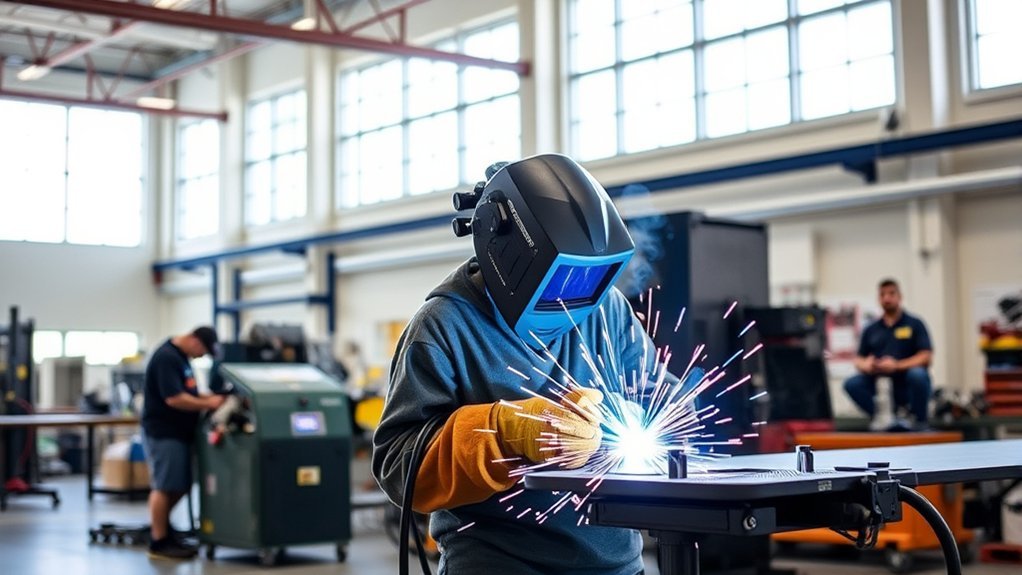
Graduates may pursue work as welders, fabricators, structural welders, pipe welders, welding helpers, welding technicians, or production workers in construction, manufacturing, repair, industrial fabrication, and related fields.
Daytona State’s current 2026–27 welding catalog data reports approximately 1,760 regional jobs and 143 annual openings for welders, cutters, solderers, and brazers. Its published regional wage figures are:
- 10th percentile: $33,510 per year
- Median: $44,800 per year, or $21.54 per hour
- 90th percentile: $60,230 per year
A separate O*NET wage table using 2025 Bureau of Labor Statistics data reports a $48,170 median for welders, cutters, solderers, and brazers in the Deltona–Daytona Beach–Ormond Beach area and a $50,640 statewide Florida median. The figures differ because the sources use different datasets, geographic definitions, and reporting methods.
Current public sources place the Daytona-area median welding wage in roughly the mid-to-upper $40,000s, but completing a welding program does not guarantee a job, starting salary, overtime level, certification, or promotion timeline.
Actual earnings depend on experience, welding process, position, employer, industry, shift, travel, overtime, testing qualifications, and local demand. Specialized pipe, structural, robotic, inspection, or supervisory work can have different pay levels and usually requires additional experience, testing, or credentials.
College Certificate vs. AWS Certification
Completing Daytona State’s Welding Technology certificate demonstrates that you completed the college curriculum. It does not automatically make you an AWS Certified Welder.
The AWS Certified Welder program is performance based. Candidates complete a welder performance qualification test at an AWS Accredited Testing Facility and weld according to the applicable Welding Procedure Specification. Available processes, qualifications, testing fees, and retesting costs vary by facility and test.
AWS states that its Certified Welder program does not require a particular formal education pathway. Welding school, technical-college training, apprenticeships, military experience, and on-the-job practice are different ways a candidate may develop the skill needed to pass the performance test.
How to Confirm Your Exact Cost Before Enrolling
- Confirm the program: Make sure you are reviewing Welding Technology – Applied, program code 103300, rather than the separate Advanced Welding certificate or online Welder Technician course.
- Verify residency: Confirm whether Daytona State has classified you as a Florida resident or nonresident for tuition purposes.
- Request the current equipment list: Ask the welding program for the term’s required tools, PPE, clothing, books, and consumable charges before buying equipment.
- Review each registered course: Laboratory fees are assigned by course, so your final amount depends on your actual registration.
- Check Falcon Self-Service: Review the posted balance and payment deadline after registration. Daytona State states that tuition and fees may change and Falcon Self-Service should be checked for the current balance.
- Verify your aid award: Do not treat a FAFSA, scholarship application, or Open Door application as payment until the award has been approved and applied to your account.
- Compare payment-plan costs: Include any Nelnet enrollment fee or Falcon Payment Plan service charge in your budget if you use an installment plan.
- Budget for indirect expenses: Include commuting, meals, child care, replacement gear, and lost work time when comparing programs.
Pro Tip: Ask for a written, term-specific estimate that separates tuition, standard fees, lab fees, books, tools, PPE, payment-plan charges, and optional certification testing. That figure is more useful for enrollment decisions than either tuition alone or a general college cost-of-attendance estimate.
Sources
- Daytona State College Welding Technology — current program format, training processes, skills, and program contacts
- Daytona State College 2026–27 Tuition and Fees — resident and nonresident vocational rates and current administrative charges
- Daytona State College 2025–26 Welding Technology Catalog — latest detailed program-specific lab, book, PPE, tool, admission, and curriculum estimates used in this guide
- Daytona State College Scholarships — 2026–27 Foundation Scholarship and Open Door Grant information
- O*NET Florida Welding Wages — 2025 BLS state and Deltona–Daytona Beach–Ormond Beach wage data
- Occupational Safety and Health Administration — welding, cutting, and brazing hazards and safety controls
Frequently Asked Questions
Are online welding courses available at Daytona State?
The 725-clock-hour Welding Technology career certificate is listed as an in-person program. Daytona State also advertises a separate online Welder Technician course, but it is not the same certificate. The online course is self-paced and its current FAQ states that it does not prepare students for a certification.
What is the average class size for the welding program?
Daytona State’s current public Welding Technology pages do not publish a standard welding-specific average class size. Capacity can depend on the course, available lab stations, instructor staffing, and term, so ask the program office about the section you plan to take.
Does the Welding Technology program include an internship?
No required internship appears in the published Daytona State Welding Technology curriculum. Students instead complete substantial supervised welding-lab training. This differs from some Florida programs, such as Hillsborough College’s current Welding Technology curriculum, which does include an internship.
How long does the Daytona State welding program take?
The basic Welding Technology certificate contains 725 clock hours and Daytona State currently lists a typical duration of about nine months. The latest detailed curriculum organizes the program across two semesters, although sequence and availability can vary.
Are evening or weekend welding classes available?
Daytona State’s current public Welding Technology pages do not guarantee evening or weekend sections. Course times can change by term, so check the live schedule and confirm your section with the welding program before arranging work, transportation, or child care.
How much should a Florida resident budget for the program?
At 2026–27 rates, resident tuition and standard per-credit fees total about $1,987.74 for 24.17 vocational credits. A broader planning estimate is approximately $6,239.46 when current access, assessment, application, and graduation charges are combined with the latest detailed welding-specific lab, book, PPE, and tool estimates. It is not an official term-specific bill.
Can I complete Daytona State Welding Technology at the Deltona Campus?
Daytona State currently lists Welding Technology among the programs that can be completed 100% at the Deltona Campus. Confirm your term’s actual course locations and section availability before registering.
Is Welding Technology eligible for the Open Door Grant?
Yes. Daytona State’s 2026–27 Open Door Grant information currently lists Welding Technology as an eligible major. Qualifying Florida residents may receive support for eligible tuition, fees, exams or assessments, books, and related materials after other aid is applied. Awards depend on eligibility and available funding.
Does graduating automatically make me an AWS Certified Welder?
No. Daytona State’s college certificate and AWS Certified Welder status are separate credentials. AWS certification requires successfully completing an applicable welder performance qualification test at an AWS Accredited Testing Facility and meeting AWS certification requirements.
Conclusion
Daytona State’s basic Welding Technology certificate has relatively low Florida-resident tuition, but tuition alone does not represent the full welding-school bill. At 2026–27 rates, 24.17 vocational credits produce approximately $1,987.74 in resident tuition and standard per-credit fees. A broader direct-cost planning figure is about $6,239.46 when current administrative charges are combined with Daytona State’s latest detailed welding-specific estimates for lab fees, books, PPE, and tools.
The certificate provides 725 hours of in-person welding education and is currently described as a roughly nine-month program. Financial aid, Foundation scholarships, the 2026–27 Open Door Grant, and payment plans may help eligible students manage costs. Before enrolling, verify your residency classification, current lab charges, equipment list, campus and class schedule, aid award, and final Falcon Self-Service balance. Those term-specific figures are more reliable than any single advertised tuition number.