Welding course costs in the UK vary widely because a one-day hobby class, a regulated college qualification and a coded welder test are different products. As of July 2026, the price can range from under £50 for online theory to £2,500 or more for an intensive qualification route. Before booking, check the practical hours, welding process, certificate type, VAT and testing fees.
Quick Answer
As of July 2026, UK welding training can cost about £27–£39 for online theory, £99–£540 for a hobby or one-day practical class, £380–£1,000 for two- to five-day intensive training, and £1,300–£2,500 or more for qualification routes. Coded testing usually adds separate assessment, training, test-piece and inspector fees.
Key Takeaways
- A cheap introductory class normally provides experience or an attendance certificate, not a professional coded qualification.
- Current short-course examples range from about £200 for one day to £900–£1,000 for five days, depending on the process and material.
- Regulated qualifications and specialist industrial courses can cost £1,300–£2,500 or more.
- Coded welding fees depend on the standard, process, material, joint, position, thickness and number of test pieces.
- Always ask whether VAT, PPE, consumables, registration, inspection, retesting and certification are included.
At a Glance
| Online theory course | About £27–£39; useful for theory, but not a substitute for supervised practical assessment |
| One-day practical course | About £135–£540, depending on class size, one-to-one tuition and what is included |
| Two- to five-day intensive course | About £380–£1,000 for common MIG, TIG or MMA training; specialist industrial courses may cost more |
| Regulated or specialist qualification | Commonly £1,300–£2,500 or more, depending on duration, awarding body and assessment |
| Coded welder assessment | Often quoted separately; one current provider lists a £600 assessment plus £240–£300 per training day |
Factors That Affect Welding Course Costs
The course length is only one part of the price. A provider may charge more for small classes, one-to-one tuition, aluminium or stainless steel, pipe welding, difficult positions, regulated assessments or independent inspection.
- Course purpose: A hobby workshop is cheaper than career training or a job-specific qualification test.
- Welding process: MIG/MAG, TIG, MMA and flux-cored training use different equipment, gases and consumables.
- Material: Mild steel is often the simplest training material. Aluminium and stainless steel may require different machines, shielding gases and preparation.
- Teaching format: One-to-one tuition usually costs more per day than a group class.
- Certificate: An attendance certificate, a regulated vocational qualification and a coded welder qualification are not equivalent.
- Testing scope: Coded testing becomes more expensive when you add processes, materials, positions, pipe sizes or test pieces.
- Location and schedule: London, specialist industrial centres, weekends and on-site employer training may have different rates.
Note: There is no national tariff for private welding courses. Treat published prices as provider examples, check the booking date and ask for a written total that shows VAT and every assessment fee.
Introductory Welding Course Prices
Beginner courses range from short creative workshops to intensive practical training. A low-cost class may let you try one or two processes and complete a small project. A more structured course may focus on one process for several days so you can practise setup, joint preparation, torch or electrode control, weld positions and basic defect recognition.
For example, Central Building & Welding Academy lists one day of basic MIG, TIG or MMA training at £200, two days at £380 and five days at £900. Its TIG aluminium option is listed at £220 for one day, £420 for two days and £1,000 for five days. Other providers advertise creative group workshops from about £99–£135 and private one-to-one tuition at higher daily rates.
| Course Type | Typical Content | What You Usually Receive |
|---|---|---|
| Hobby or taster day | Basic safety, machine setup and simple joints or a small project | Experience; sometimes an attendance certificate |
| Multi-day beginner course | Longer practice in one or more processes, joint types and positions | Provider certificate unless a regulated qualification is clearly stated |
| College or awarding-body course | Practical units, knowledge work, portfolio and formal assessment | A named regulated qualification when all requirements are passed |
Pro Tip: Ask how many hours you will spend welding. A five-day course with a small class and your own bay may offer more useful practice than a cheaper course with long demonstrations and limited torch time.
Short and Intermediate Welding Training Costs
Intermediate training is normally aimed at people who can already set up equipment and make basic welds. Instead of paying for a course labelled “intermediate,” choose training that names the exact process, material, joint and outcome you need.
Course Pricing Overview
- Two-day practical training: Current provider examples are around £380 for general basic training, while specialist industrial delivery can be £800 plus VAT.
- Five-day intensive training: Current examples range from about £900 for basic MIG, TIG or MMA training to £1,800 plus VAT for mechanised or orbital TIG.
- Private tuition: One-to-one lessons may be sold by the hour or day and can cost more than a group course.
- Extra assessment: A skills analysis, qualification registration, code test or retest may be charged separately.
Duration and Content Variations
A short course may run for one to five days. A regulated certificate can run for several days, several weekends or many weeks. Coded-welder preparation can take one day for an experienced welder or much longer for someone who is not yet ready to pass the required test.
Useful intermediate content includes fillet and butt joints, positional welding, parameter selection, distortion control, visual inspection, defect correction and repeated practice on the material and joint used in the target job.
Advanced and Qualification Course Costs
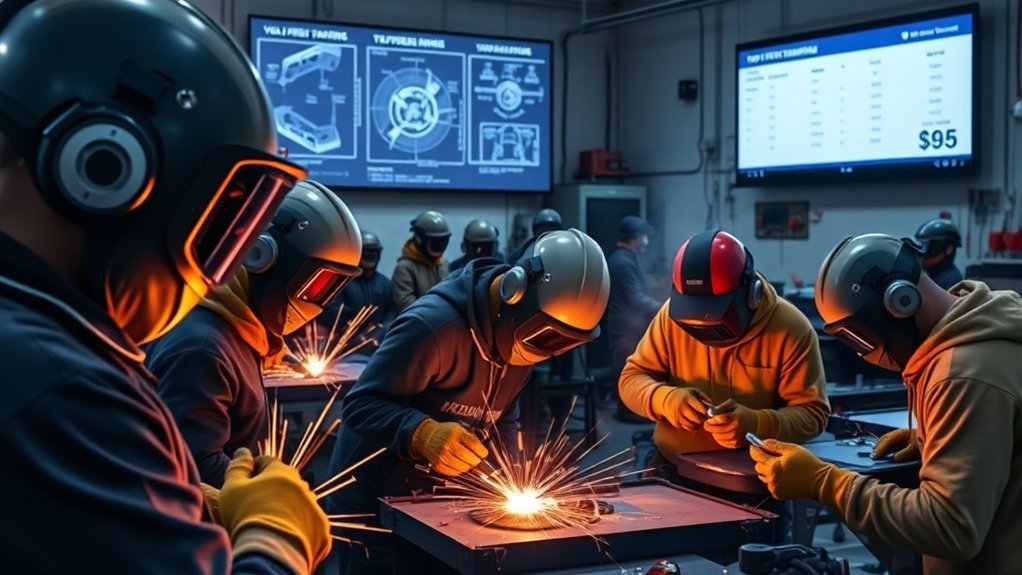
Advanced training can cost well above £1,200. A current two-week Level 2 Certificate in Welding Skills is advertised at £2,500, while specialist industrial providers list courses such as five-day mechanised and orbital TIG training at £1,800 plus VAT. Longer college programmes may use different fee and funding systems.
Before paying for advanced training, confirm these points:
- Entry level: Find out whether you need prior workshop experience or a skills assessment.
- Exact outcome: Ask for the qualification title, awarding body, standard or certificate wording.
- Practical hours: Check how much supervised welding time is included.
- Materials and processes: Make sure the training matches the work you want, such as stainless pipe TIG, aluminium MIG or structural steel MMA.
- Assessment and retests: Ask whether the first test, destructive or non-destructive testing, inspector attendance and any retest are included.
Specialist and Coded Welding Training Fees

A “coded welder” is not someone who has passed one universal welding licence. The qualification is limited by the test variables, such as the welding process, filler material, parent material group, joint type, welding position, product form and dimensions.
For steel fusion welding, BS EN ISO 9606-1:2017 is a current UK standard. BS 4872-1 covers approval testing for certain steel work where welding procedure approval is not required. Aluminium qualifications may use BS EN ISO 9606-2. Some contracts use ASME Section IX or an AWS code, but those requirements are job-specific rather than a general UK certificate.
Pricing is usually bespoke. One current provider lists a £600 assessment fee for BS EN ISO 9606-1 test pieces, £240 per training day, £300 per day for a 6G pipe-to-plate route and £420 for an additional test piece. The final total rises if you need several days of preparation, multiple processes or more than one test configuration.
A coded test proves competence only within its stated qualification range. It does not automatically cover every process, material, thickness, joint or welding position.
Warning: Do not book a coded test based only on the words “industry recognised.” Ask the employer, client or inspector which standard, process, material, joint, position and thickness range the job requires.
Financial Help and Welding Course Discounts

Funding is not automatic, and there is no single scheme covering every private welding course in the UK. Eligibility depends on your age, residency, location, qualification level, provider and employment status.
Grants, Bursaries and Loans
In England, adults may be able to apply for grants or bursaries through a college, training organisation or other funding body. An Advanced Learner Loan may help with an eligible Level 3 to Level 6 course at an approved provider in England if the learner meets the rules. These options do not apply to every short private course.
Scotland, Wales and Northern Ireland operate separate course-search and funding systems. Check My World of Work, Careers Wales or nidirect for local guidance.
Group Booking and Employer Discounts
Some providers quote lower per-person rates for employer groups, repeat bookings or on-site delivery. Others offer discounts when several short courses are booked together. Ask for a written quote that states the minimum group size, cancellation terms, travel charges and whether certification is included.
Apprenticeships and Skills Bootcamps
An apprenticeship can be a better route than paying privately because the apprentice earns while training and the employer receives government support for eligible training costs. In England, Skills Bootcamps are free, flexible courses for adults aged 19 or over, but availability and qualification outcomes vary by area and provider.
How to Compare Welding Training Providers
Do not compare providers on the headline fee alone. Ask for the same information from each centre so you can compare the real cost and outcome.
| Factor | What to Ask | Why It Matters |
|---|---|---|
| Total price | Is VAT included? Are registration, materials, testing and certificates extra? | Prevents a low headline fee from becoming an expensive final bill |
| Course outcome | Is it attendance, in-house, regulated or coded certification? | Shows whether the certificate matches your employment goal |
| Practical access | How many learners share each bay, machine and tutor? | Determines how much hands-on practice you receive |
| Tutor experience | What recent industry, inspection and teaching experience does the tutor have? | Relevant experience matters more than an arbitrary number of years |
| Safety controls | Are local exhaust ventilation, suitable RPE, screens and PPE provided? | Welding fume, radiation, burns, fire and electric shock require proper controls |
| Policies | What happens if you miss a day, fail a test or need to reschedule? | Retests and replacement days can add significant cost |
What Welding Certificates and Qualifications Mean
The word “certified” is often used loosely, so read the exact certificate title before you pay.
- Attendance or in-house certificate: Shows that you completed a provider’s course. It can support a CV, but it is not automatically a regulated qualification or coded approval.
- Regulated vocational qualification: A named qualification from an awarding organisation, normally based on set learning outcomes and assessment requirements.
- Welder qualification or coding: A practical test against a named standard and defined range. For example, BS EN ISO 9606-1 covers qualification testing for manual and partly mechanised fusion welding of steels.
A relevant qualification can help you meet an employer or contract requirement, but it does not guarantee a job or a specific pay rate. Employers may still require a trade test, site induction, safety training, experience or a qualification to their own welding procedure.
Welder qualifications also need continuity and revalidation. TWI explains that BS EN ISO 9606 certificates require confirmation at six-month intervals and use one of the standard’s revalidation routes.
Additional Welding Training Costs

The advertised course fee may not be the final price. Build a budget that includes:
- VAT: Some commercial providers show prices excluding VAT, while others include it.
- PPE: Safety boots, flame-resistant overalls, gloves, eye protection and suitable respiratory protection may be required.
- Materials and consumables: Metal, gas, wire, electrodes, tungsten, filler rod, grinding discs and test coupons may be included or billed separately.
- Registration and assessment: Awarding-body fees, inspector attendance, laboratory testing, certificates and retests can increase the total.
- Travel and accommodation: Specialist centres may require several days away from home.
- Lost earnings: A weekday course may cost more overall than an evening or weekend option if you must take unpaid leave.
- Renewal or revalidation: Some job-specific qualifications require continuity records, further testing or renewal activity.
Which Welding Course Should You Choose?
Match the course to the result you need rather than buying the longest or most expensive option.
- For a hobby or home project: Choose a supervised taster or one-day practical class that covers safe setup and the process you plan to use.
- For a career change: Look for a Level 1 or Level 2 route, a substantial amount of workshop practice, employer links and a clear progression path.
- For an experienced welder seeking coded work: Get the required standard and test range from the employer first, then book a skills assessment and targeted preparation.
- For an employer: Compare on-site or group training with external courses, and specify the welding procedure, materials and qualification outcome in the quote.
- For specialist work: Use a provider with current experience in the relevant sector, such as pressure equipment, structural steel, nuclear, rail or aerospace.
Online Welding Courses vs Hands-On Training
Online welding courses can teach terminology, equipment setup, parameter selection, joint design and troubleshooting. Current UK examples are available from about £27–£39. They can be useful before a workshop course or as refresher theory.
However, video lessons cannot prove that you can produce an acceptable weld. A practical qualification requires supervised welding and assessment under the rules of the relevant course or standard. Treat an online completion certificate as theory training unless the provider clearly explains a separate hands-on assessment.
Welding Course Safety and PPE
A reputable course should teach fume control, fire prevention, electrical safety, cylinder handling, hot-metal hazards, eye and skin protection, housekeeping and emergency procedures. The UK Health and Safety Executive states that all welding fume can cause lung cancer and advises controlling exposure with measures such as local exhaust ventilation and suitable respiratory protective equipment.
Warning: Do not choose a course that relies on an open door or general room ventilation as its only fume control for routine indoor welding. Ask to see the extraction system, screens, PPE rules and risk controls before you book.
Frequently Asked Questions
Are there online welding courses available in the UK?
Yes. Online courses can cover welding theory, machine settings and troubleshooting, with current examples starting below £40. They do not replace supervised practical training or a hands-on welder qualification test.
What is the duration of a typical welding course?
A hobby class may last one day, an intensive practical course may run for two to five days, and a regulated college qualification may take several weeks or longer. Coded preparation depends on your starting skill and the test requirements.
Do welding courses include hands-on training?
Most in-person welding skills courses include practical work, but the amount varies. Ask how many learners share each machine and how many hours you will spend welding rather than watching demonstrations.
Can I work while attending welding classes?
Often, yes. Many providers offer evening, weekend or block courses. Check the attendance rules before booking because missing practical sessions or assessments may delay completion or create extra fees.
Is there an age limit for enrolling in welding courses?
There is no single age rule for every UK welding course. Colleges, apprenticeships, Skills Bootcamps and private providers use different entry and safeguarding rules. Ask the provider about minimum age, consent, PPE sizes and any medical restrictions.
Does completing a welding course make me a coded welder?
Not unless the course includes a successful practical qualification test to the required standard and test range. An attendance certificate or general welding qualification is not the same as a job-specific coded welder certificate.
Are VAT, PPE and test fees included in the course price?
Sometimes, but not always. Request a written breakdown covering VAT, PPE, materials, registration, assessment, inspector attendance, test pieces, certification and retests before paying a deposit.
Conclusion
UK welding course costs range from low-cost online theory and hobby workshops to multi-day practical training, regulated qualifications and bespoke coded testing. The best value is the course that matches your exact goal and gives you enough supervised practice. Compare the full price, certificate type, welding process, class size, safety controls and testing scope before you book.
Sources
- Central Building & Welding Academy — Basic Intensive Welding and Coded Welding Training and Testing — current example prices for short courses, TIG aluminium and coded assessment.
- MTC Training — Welding Courses — current examples of specialist and industrial course fees.
- BSI — BS EN ISO 9606-1:2017 — current standard and scope for qualification testing of welders working with steels.
- TWI — Welding Procedure and Welder Qualification — certificate continuity and revalidation information.
- GOV.UK — Grants and Bursaries for Adult Learners, Advanced Learner Loan Eligibility and Skills Bootcamps — funding routes and eligibility limits in England.
- Health and Safety Executive — Welding Fume: Protect Your Workers — welding-fume risks and control measures.