
NWTI welding cost depends on the program you choose. According to NWTI’s 2026–27 catalog, the full in-person Welding Technology diploma has an estimated in-state cost of $7,850, including tuition, institutional fees, books, and supplies. Short and online options have separate prices and are not equivalent programs.
Quick Answer
NWTI’s full Welding Technology diploma is estimated at $7,850 for an in-state student in the 2026–27 catalog. It runs for two semesters plus a five-week summer term. NWTI has also offered a $600 Basic Welding evening course (2026 session) and an online Welder Technician course listed at about $2,799. Check both with the school, because short-course prices change.
Key Takeaways
- The full Welding Technology diploma is estimated at $7,850 in state for 2026–27.
- The diploma includes 972 clock hours and 37 credit hours over two semesters and a five-week summer term.
- Welding hoods and gloves are the student’s responsibility, even though the published program estimate includes books and supplies.
- NWTI accepts eligible grants and scholarships but does not participate in the federal student loan program.
- Completing the program does not automatically grant an AWS credential; students must pass the applicable performance test.
NWTI Welding Cost by Training Option
Northwest Technical Institute, commonly abbreviated as NWTI, is a public technical institute in Springdale, Arkansas. Its welding offerings range from an introductory evening class to a full hands-on diploma and a separate online career-training course.
| Program | Published Price | Length and Format | Best For |
|---|---|---|---|
| Welding Technology diploma | $7,850 estimated in-state total | Two semesters plus a five-week summer term; 972 clock hours and 37 credits | Students seeking intensive shop training, a diploma, and preparation for welding performance tests |
| Basic Welding | $600 for the 2026 session (confirm current price) | Part-time evening instruction; future schedules may differ | Beginners exploring welding or developing introductory MIG and stick-welding skills |
| Online Welder Technician | About $2,799 when last checked (confirm current price) | Online, self-paced career training | Students seeking flexible theory instruction who understand that online study cannot replace supervised booth practice |
The official NWTI 2026–27 catalog is the controlling source for the diploma estimate. The Basic Welding page (which no longer shows a price) and online Welder Technician page list separate offerings whose dates and prices may change.
Note: The posted $600 Basic Welding session ran from January through May 2026. Treat that amount as the most recently published benchmark, not a guarantee that the next session will have the same dates or price.
Welding Technology Tuition and Fee Breakdown
NWTI lists in-state tuition at $85 per credit hour and out-of-state tuition at $90 per credit hour for 2026–27. Because the Welding Technology diploma contains 37 credits, base tuition is approximately $3,145 in state before institutional, welding, textbook, testing, and supply charges.
The catalog’s published $7,850 in-state estimate is more useful than tuition alone because it includes tuition, fees, books, and supplies. The catalog also identifies the following welding-related charges:
| Catalog Item | Published Amount | Timing or Purpose |
|---|---|---|
| Application fee | $10 | New application |
| Welding textbook fee | $200 | Listed for fall |
| Welding lab fee | $400 | Listed for fall and spring |
| Consumable fee | $325 | Listed for fall and spring; supports materials used during practice |
| Tools and equipment replacement fee | $400 | Listed for fall and spring |
| Certification exam fee | $125 | Listed for the second semester |
| Graduation fee | $40 | Charged for graduation processing |
Full-time students (12 or more credits) also pay general fees each semester: administrative $75, facilities $75, student support $170 and technology $140, which is $460 per semester. A first ID badge costs $5. The welding lab, consumable and tools fees are listed as charges for each of the fall and spring semesters.
Added together, the catalog line items (tuition, welding fees, general fees for two semesters and one-time fees) come to roughly $6,650. NWTI’s own $7,850 estimate is higher because it also allows for summer-term charges and supplies, so ask the business office for a written term-by-term bill before you enroll.
For an out-of-state student, the $5-per-credit difference adds approximately $185 across 37 credits before considering any other differences. NWTI publishes the $7,850 total specifically as an in-state estimate, so an out-of-state applicant should obtain a personalized total rather than simply adding $185 and assuming nothing else changes.
At $7,850 for 972 scheduled clock hours, NWTI’s published in-state estimate equals about $8.08 per training hour before grants, transportation, food, or housing.
Tools, Safety Gear, and Supplies
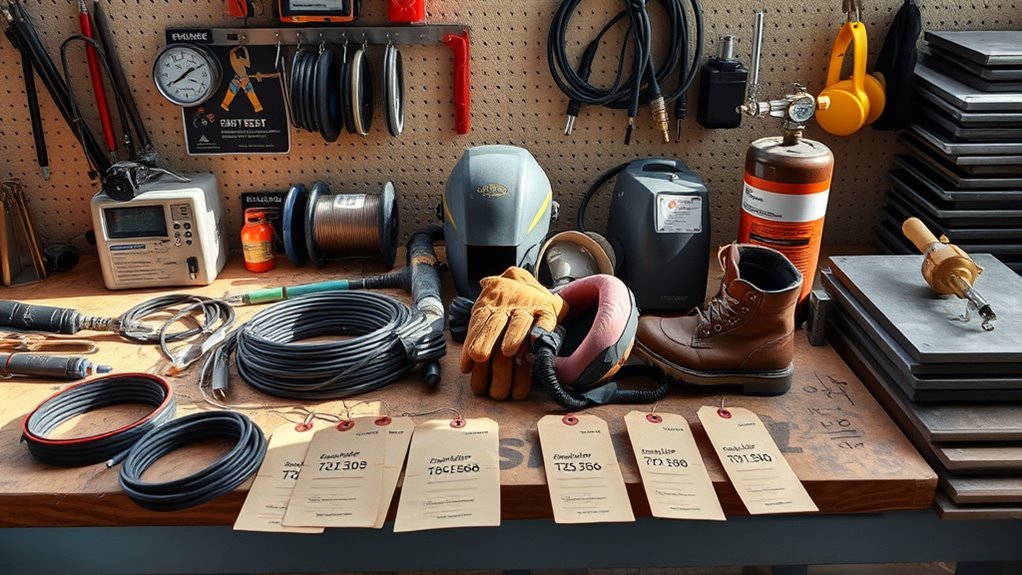
NWTI’s catalog says welding hoods and gloves are the student’s responsibility. It also states that a student cannot participate in welding training without the required safety equipment. The catalog does not publish a price list for personal protective equipment, so ask the department for current requirements before you shop.
A current welding-equipment list may include some combination of:
- An approved welding helmet or hood with the required lens protection
- Welding gloves suitable for the processes being taught
- Safety glasses with side protection
- Flame-resistant clothing or approved welding sleeves and jacket
- Leather work boots meeting the school’s shop requirements
- Hearing protection where required
- Basic measuring, marking, and hand tools specified by the instructor
Warning: Welding can expose students to ultraviolet radiation, hot metal, sparks, fumes, electric shock, fire, eye injury, and burns. Follow NWTI’s lab rules and the applicable OSHA welding-safety guidance. Do not substitute casual clothing, sunglasses, or unapproved equipment for proper welding PPE.
Pro Tip: Ask the welding department for the current equipment list before buying anything. Confirm the required helmet type, footwear, clothing, glove style, and tool brands so you do not spend money on gear that is prohibited or unnecessary.
You do not need to buy a welding machine to start. NWTI’s catalog names hoods and gloves as student-supplied items and does not say every Welding Technology student must buy a personal welder.
Lab Access, Equipment Use, and Material Costs
The Welding Technology curriculum is built around supervised shop instruction. Students train in oxy-fuel and plasma cutting, brazing, shielded metal arc welding, gas metal arc welding, gas tungsten arc welding, and related fabrication work. The curriculum also lists experience with a CNC plasma-cutting table and CNC press brake.
NWTI charges program-specific fees that help support lab operations and practice materials. These include the published welding lab fee, consumable fee, and tools-and-equipment-replacement fee. A separate certification-exam charge is listed for the second semester.
Note: “Consumables” may include electrodes, wire, shielding gas, metal coupons, tips, abrasives, and other items used up during training. Ask whether the published consumable fee covers all routine practice materials or whether any course requires additional purchases.
Students should follow check-in, setup, shutdown, housekeeping, and fault-reporting procedures for every assigned station. Safe use of shared equipment protects students and keeps the lab running. The tools-and-equipment replacement fee is a flat charge, but ask NWTI whether any policy makes students pay for damaged equipment.
Financial Aid, Scholarships, and Payment Plans

Grants, scholarships, employer assistance, and an approved installment plan may reduce the amount a student must pay at once. Eligibility is not automatic, and an advertised award maximum is not a promise that one student will receive that amount.
Federal and State Aid
Start with the Free Application for Federal Student Aid. Eligible students may receive a Federal Pell Grant. The maximum scheduled Pell Grant for the 2026–27 award year is $7,395, although the actual award depends on financial need, enrollment intensity, eligibility, and remaining lifetime limits.
NWTI’s catalog states that the school does not participate in the federal student loan program. A student should therefore avoid building a budget that assumes federal Direct Loans will cover the remaining balance.
Arkansas residents may also investigate:
- Arkansas Future Grant: A last-dollar program that may cover tuition and general mandatory fees for eligible high-demand programs at qualifying Arkansas institutions.
- Arkansas Workforce Challenge: An award of up to $3,000 per eligible program for qualifying Arkansas residents pursuing approved high-demand training.
- NWTI scholarships and waivers: The catalog lists several institutional and program-related opportunities with separate eligibility rules.
State funding, eligible program lists, deadlines, and award rules can change. Submit the FAFSA and state-aid applications early, then confirm in writing which awards appear on your NWTI account.
NWTI Payment Plan Rules
NWTI’s installment arrangement is more limited than a standard open-enrollment monthly plan. According to the 2026–27 catalog:
- Installment plans may be considered for extenuating circumstances.
- The option applies during fall and spring, not the summer term.
- The request must be made by the applicable census-date deadline.
- The student must pay 25% of the balance initially.
- The remaining balance is divided across the next three months.
- A $25 late fee may be charged for a late installment.
- Approval is not guaranteed.
Students who expect to need an installment arrangement should contact the business office before the payment deadline rather than waiting until an account becomes past due.
Employer Sponsorship and Third-Party Billing
An employer, workforce agency, rehabilitation program, or other approved third party may agree to pay some or all of a student’s charges. NWTI requires appropriate authorization before the payment due date, and a new authorization may be needed for each semester.
Ask the sponsor to state exactly whether it covers tuition, general fees, welding-specific fees, certification testing, books, PPE, transportation, and any amount owed after a student withdraws. Employer reimbursement programs may require the student to pay first and submit grades afterward.
Short Courses and Online Welding Training

NWTI’s shorter options can cost less than the full diploma because they provide a different amount and type of training.
Basic Welding Course
NWTI’s 2026 Basic Welding session was listed at $600 and met on Monday evenings from January 27 through May 11. The course focused on introductory MIG and stick-welding knowledge and practice. It is useful for exploration or basic skill development but should not be represented as equivalent to the 972-hour Welding Technology diploma.
Because that session has ended, prospective students should verify the next start date, schedule, included materials, PPE requirements, refund rules, and current price directly with NWTI.
Online Welder Technician Course
The online Welder Technician course was listed at about $2,799 when we last checked (July 2026). Online study can introduce welding theory, terminology, safety principles, print reading, and process concepts, but it cannot provide the same supervised arc time, booth correction, equipment setup, or physical performance testing as the in-person diploma.
Before selecting the online course, confirm whether it includes tools, physical textbooks, exam vouchers, instructor support, an extension policy, or any in-person skills assessment. Students seeking an employer-recognized performance qualification should also identify where they will complete supervised practice and testing.
How NWTI Compares With Community College and Trade-School Programs
Welding program prices vary widely by state subsidies, residency, credits, lab hours, equipment, credential level and aid. Compare each program’s official net price rather than relying on generic ranges. For other schools, see our guides to welding school costs and welding school costs in Arkansas.
Compare Total Cost, Not Sticker Price
Use the same categories for every school:
- Tuition and mandatory institutional fees
- Welding lab, consumable, and testing charges
- Books, PPE, tools, and replacement items
- Application, identification, and graduation charges
- Transportation, food, and housing
- Grants and scholarships that do not need to be repaid
- Amount due before classes begin
- Refund obligations if the student withdraws
A lower tuition figure can become more expensive if it excludes consumables, testing, or long-distance commuting. Conversely, a higher published total may be easier to evaluate when most required school costs are already included.
Program Length and Value
NWTI’s diploma concentrates 972 clock hours into two semesters and a five-week summer term. That schedule may help a student enter the workforce sooner than a two-year associate degree, while an associate program may include more general education and transferable academic credit.
NWTI’s catalog also describes an articulation agreement under which eligible graduates of applicable diploma programs may receive up to 30 elective credits at NorthWest Arkansas Community College. Students considering a future degree should confirm whether the current Welding Technology diploma qualifies, how the credits will be recorded, and which degree requirements they satisfy.
Career value depends on more than the diploma name. The U.S. Bureau of Labor Statistics reported a $53,750 median annual wage in May 2025 for welders, cutters, solderers, and brazers, with pay varying substantially by location, industry, experience, process skill, travel, overtime, and certification. See the current BLS occupational profile before using a wage estimate in a return-on-investment calculation.
Budgeting Tips and Cost-Saving Strategies
A realistic welding-school budget should begin with NWTI’s official program estimate and then add personal expenses that are not included in the school figure.
- Use $7,850 as the published in-state diploma baseline. Do not replace it with a broad national trade-school range.
- Request a term-by-term account estimate. Ask when each lab, consumable, textbook, technology, certification, and equipment fee is assessed.
- Get the approved PPE list before shopping. Buying the wrong hood, boots, clothing, or gloves wastes money and may delay lab participation.
- Do not buy a personal welder without written instructions. The current catalog does not publish a general requirement that every student purchase one.
- Apply for aid early. Submit the FAFSA, Arkansas aid applications, institutional scholarship forms, and employer paperwork before their deadlines.
- Budget for attendance. Add fuel, vehicle maintenance, meals, childcare, and lost work hours based on the actual class schedule.
- Keep an emergency reserve. PPE replacement, transportation repairs, or missed work can create expenses beyond the school’s published estimate.
- Track net cost. Your expected out-of-pocket amount equals school charges plus personal attendance costs minus confirmed grants, scholarships, and sponsor payments.
Do not subtract aid until it appears in an official award notice and you understand its enrollment, attendance, grade, and completion requirements.
Curriculum, Certification, and Career Support
The Welding Technology curriculum covers more than one welding process. Published coursework includes cutting, brazing, SMAW, GMAW, GTAW, fabrication-related skills, blueprint or technical interpretation, and use of computer-controlled fabrication equipment.
AWS Test Preparation Versus Automatic Certification
NWTI’s Welding Techniques Lab is designed to prepare students for certification testing, with optional test paths involving processes such as SMAW, GMAW, FCAW, or GTAW. However, graduating from the program does not automatically make every student an AWS Certified Welder or grant a blanket “AWS D1.1 certificate.”
The AWS Certified Welder Program is performance-based. A qualification is tied to the procedure, code, process, material, thickness, and welding position tested. Ask NWTI:
- Which code or procedure specification the $125 test uses
- Which processes and positions students may test in
- Whether testing occurs at an AWS Accredited Test Facility
- Whether retesting requires an additional fee
- What documentation a successful student receives
- How continuity records must be maintained after testing
What Employment Assistance NWTI Publishes
NWTI’s catalog describes employment assistance through school personnel, advisory committees, agencies, employer relationships, job information, and vacancy notices. That support may help students identify opportunities, but it is not a guarantee of employment, a paid apprenticeship, a particular wage, or placement with a specific employer.
The catalog does not promise individual resume rewriting, interview coaching or direct apprenticeship placement. Ask Career Services which welding-specific employers, hiring events, application workshops, and apprenticeship contacts are currently active.
Questions to Ask Before Enrolling
- What is the exact total for my residency status and intended start term?
- Which “fall and spring” fees are charged once per term?
- Which books, tools, PPE, and consumables are included in the $7,850 estimate?
- What equipment must I bring on the first lab day?
- How many students, welding booths, and instructors are assigned to the current cohort?
- Which AWS test procedure, process, and position are included in the certification-exam fee?
- What additional fee applies if I need to retest?
- Which grants and scholarships has the financial-aid office confirmed for my account?
- What payment is due before classes begin?
- What happens to my charges and aid if I withdraw or fail to maintain attendance?
- Does the school provide any current housing-resource list for students relocating to Springdale?
- Which employers hired recent welding graduates, and which services does Career Services currently provide?
Frequently Asked Questions
What certifications can NWTI welding students pursue?
NWTI prepares students for optional welding performance tests in processes such as SMAW, GMAW, FCAW, and GTAW. The credential or qualification depends on the specific procedure, process, position, material, and code tested. Graduation by itself does not automatically award every student an AWS D1.1 or NCCER credential.
Does NWTI offer job-placement or apprenticeship assistance?
NWTI publishes general employment assistance through staff, employer contacts, advisory groups, agencies, job information, and vacancy notices. It does not guarantee a job or paid apprenticeship. Ask Career Services which welding-specific placement and apprenticeship resources are currently available.
What are NWTI welding class sizes and instructor ratios?
The 2026–27 catalog does not publish a standard welding-lab class size or instructor-to-student ratio. Ask the department for the expected cohort size, number of working booths, number of instructors or lab assistants, and amount of individual arc time for your intended term.
Does NWTI provide housing for out-of-town students?
The 2026–27 catalog does not list on-campus housing, dormitories, homestay placement, or a formal housing-assistance program. Students relocating to Springdale should plan for off-campus housing and ask Student Services whether any current community resource list is available.
Can an employer sponsor or reimburse NWTI welding tuition?
Yes, an employer or another approved third party may pay eligible charges, but coverage depends on the sponsor’s policy. NWTI requires proper authorization by the payment deadline, and authorization may be required each semester. Confirm whether the sponsor covers fees, books, PPE, testing, and withdrawal-related balances.
How much is the full NWTI Welding Technology program?
NWTI’s 2026–27 catalog estimates the in-state total at $7,850, including tuition, fees, books, and supplies. Out-of-state students and students with unusual personal expenses should request a customized term-by-term estimate.
Can a Pell Grant cover the entire welding-program cost?
The maximum scheduled Pell Grant for 2026–27 is $7,395, but not every student receives the maximum. The award depends on eligibility, financial need, enrollment intensity, and federal limits. It may cover much of the published program estimate, but it may not cover the full balance or personal living expenses.
Does NWTI offer a monthly payment plan?
NWTI may approve a fall or spring installment plan for extenuating circumstances. The catalog requires an initial payment of 25%, with the remainder divided over three months. The plan is not offered for summer, approval is not automatic, and late installments may incur a $25 fee.
Conclusion
For most students comparing NWTI welding costs, the key figure is the $7,850 estimated in-state total for the 2026–27 Welding Technology diploma. That estimate covers a 972-hour, 37-credit program delivered over two semesters and a five-week summer term. A $600 Basic Welding session and an approximately $2,799 online course provide lower-cost alternatives, but they offer different levels of hands-on practice and credential preparation.
Before enrolling, request a written term-by-term bill, verify the current PPE list, confirm which AWS performance test is available, and apply early for every grant or sponsor payment for which you may qualify. Base the final decision on verified net cost, supervised lab time, certification opportunities, schedule, and career support rather than a generic trade-school price range.
Related Welding Cost Guides
- How much does welding school cost?
- Welding school cost in Arkansas
- AWS welding certification cost
- Tulsa Welding School tuition costs
Sources
- Northwest Technical Institute 2026–27 Catalog — program cost, length, curriculum, tuition, fees, PPE responsibilities, aid policies, payment terms, and employment assistance.
- NWTI Basic Welding — introductory course format.
- Federal Student Aid: Pell Grants — 2026–27 maximum Pell Grant and general eligibility information.
- Arkansas Student Application Management System — official Arkansas grant and scholarship programs, eligibility rules, and deadlines.
- Occupational Safety and Health Administration: Welding Hazards and Solutions — welding hazards, protective equipment, ventilation, and safe work practices.
- American Welding Society Certified Welder Program — performance-testing requirements and the scope of welding qualifications.