
In the U.S., a welding machine can cost less than a few hundred dollars for basic hobby work, roughly $700–$3,000 for many capable shop machines, and $5,000–$20,000+ for high-output industrial or engine-driven systems. The machine price is only part of the budget. Leads, torches or guns, shielding gas, filler metal, PPE, ventilation and fire controls, maintenance, and any required electrical work can add substantially to the ready-to-weld total.
Last updated: August 10, 2026. U.S. price bands, cited manufacturer MSRPs, and technical references were reviewed for this update.
Quick Answer
Plan on about $150–$600 for a small entry-level welder, $700–$3,000 for a capable shop machine, and $5,000–$20,000+ for high-output industrial or engine-driven equipment. A complete ready-to-weld setup often costs several hundred dollars more because gas equipment, PPE, consumables, and power upgrades may not be included.
Key Takeaways
- Stick welders usually have the lowest entry cost, while AC/DC TIG, advanced multiprocess, and engine-driven machines cost more.
- Duty cycle, amperage, input voltage, aluminum capability, included accessories, and warranty support matter more than the process name alone.
- Do not compare machine-only prices with complete packages. Check whether the torch, regulator, foot pedal, leads, cart, spool gun, and gas cylinder are included.
- Consumables and maintenance should be budgeted from your expected workload instead of using a single annual estimate.
- Safe welding also requires suitable PPE, fire prevention, and fume control.
How Much Does a Welding Machine Cost?
Most buyers can use the following ranges as a planning guide. They are not minimum or maximum retail prices: current listings can fall outside them based on brand, output, package contents, seller, and location.
| Welder category | Typical planning range | Common use |
|---|---|---|
| Small entry-level inverter | $150–$600 | Learning, thin material, occasional repairs |
| Capable hobby or light-fabrication machine | $700–$2,000 | Garage fabrication, farm repair, maintenance |
| Professional shop machine | $2,000–$6,000 | Daily fabrication, higher duty cycle, advanced controls |
| Industrial or engine-driven system | $5,000–$20,000+ | Production, field service, pipeline, heavy construction |
Ready-to-weld budget formula: machine + process accessories + shielding gas or electrodes/wire + PPE + ventilation/fire controls + electrical work + tax/shipping. Compare complete packages using the same list so a low machine-only price does not hide required add-ons.
These bands overlap because a compact premium TIG machine may cost more than a basic industrial stick power source. Current manufacturer examples also show why package comparisons matter. As checked on August 10, 2026, Lincoln Electric listed the Sprinter 180Si stick/DC TIG machine at an $849 MSRP and the POWER MIG 215 MPi multiprocess machine at a $1,999 MSRP; Lincoln also listed higher-priced accessory packages for both models. Current retailer listings show that some basic stick machines sell below the planning bands above and some AC/DC TIG machines sell below $1,000, so treat every range on this page as a budgeting band rather than a market floor. Prices and promotions can change.
The cheapest machine is not always the lowest-cost choice. A welder that matches your material, power supply, and duty cycle can prevent early upgrades and repeated accessory purchases.

The DeLonghi Water Filter helps reduce scale buildup and unwanted impurities that can affect your coffee machine's performance and taste. Its active carbon and ion-exchange technology helps improve brew consistency, maintain flavor, and reduce the need for frequent descaling. Designed as an OEM authorized replacement part, it fits select DeLonghi models for reliable everyday maintenance.

This daily devotional helps parents pray purposefully for their children through a full year of Scripture readings, reflections, and guided prayer prompts. Written to encourage faithful family discipleship, it offers practical, biblically grounded support for parents who want to shape their prayers around God's Word. A foreword by Sinclair B. Ferguson adds trusted theological insight and encouragement.

This hardcover cookbook offers fast, approachable recipes designed for busy days and low-energy nights. Caroline Chambers focuses on simple, flavorful meals that help you get dinner on the table without overthinking it. It's a practical pick for home cooks who want quick weeknight inspiration and minimal-fuss cooking.
Overview of Welding Machine Types and Uses
The best welding process depends on the metal, thickness, joint, location, finish requirement, and operator skill. The machine price is only one part of that decision.
MIG vs. TIG
MIG welding, also called gas metal arc welding or GMAW, feeds a consumable wire continuously through the gun. It is generally faster to learn and productive for mild steel, stainless steel, and, with the correct equipment, aluminum. A gas-shielded MIG setup needs a cylinder, regulator, hose, wire, contact tips, and usually a cart or secure cylinder restraint.
TIG welding, also called gas tungsten arc welding or GTAW, uses a non-consumable tungsten electrode. The operator may add filler metal separately and control heat with a foot pedal or fingertip control. TIG is slower but gives excellent control on thin material and visible welds. DC TIG handles steel and stainless steel; AC capability is normally required for conventional TIG welding on aluminum, and AC/DC machines cost more than basic DC-only units.
Stick Welding Uses
Stick welding, or shielded metal arc welding (SMAW), uses a flux-coated consumable electrode. It is popular for construction, farm equipment, repair, and outdoor work because it does not require an external shielding-gas cylinder. It also tolerates less-than-perfect surfaces better than TIG, although cleaning rust, paint, oil, and moisture still improves weld quality and safety.
Entry costs are low because the basic setup is simple: a suitable power source, electrode holder, work lead, electrodes, chipping hammer, wire brush, and PPE. Stick is less convenient for thin sheet because it can be harder to control heat and prevent burn-through.
Flux-Cored Welding
Flux-cored arc welding uses a tubular wire filled with flux. Self-shielded wire can be useful outdoors because it does not need bottled gas, while gas-shielded flux-cored wire is common in heavier fabrication. A machine advertised as “MIG” may support flux-cored wire, but you should confirm polarity, drive-roll compatibility, wire-size range, and output capacity before buying.
Multiprocess Advantages
A multiprocess welder combines two or more processes, commonly MIG, flux-cored, DC TIG, and stick. It can reduce shop space and avoid buying separate power sources, but the package may not include every accessory needed for each process.
Check the limits carefully. Many compact multiprocess machines provide DC TIG only, so they do not offer conventional AC TIG for aluminum. Some use lift-arc TIG instead of high-frequency start, and some require a separate TIG torch, foot control, or spool gun. One machine can add flexibility, but it does not remove the need to learn each process. For the right workload, the practical benefits are broader capability, better space efficiency, possible savings, and operator confidence from using one familiar interface.
Pro Tip: Compare the “what’s included” list, not just the front-panel features. A lower-priced machine can become more expensive after you add a torch, regulator, pedal, spool gun, cart, and leads.
Factors That Drive Welding Machine Costs
Power output, duty cycle, input voltage, process capability, controls, build quality, portability, package contents, and support all affect price. A higher price is justified only when those features match your work.
| Factor | Why it affects cost | What to check |
|---|---|---|
| Amperage and material capacity | More output usually requires larger power components and cooling. | Rated output and tested material range, not only the maximum amp number. |
| Duty cycle | Longer continuous welding at a stated amperage requires greater thermal capacity. | Percentage, amperage, voltage, and ambient-temperature conditions. |
| Input power | Dual-voltage and three-phase designs add flexibility or industrial capacity. | 120V, 208V, 230/240V, or three-phase requirements and recommended circuit size. |
| AC/DC and pulse controls | Advanced electronics add process control, especially for TIG and aluminum. | Whether the feature is included or requires a paid option. |
| Portability and ruggedness | Light inverter designs and jobsite protection can increase engineering cost. | Weight, handle design, enclosure rating, generator compatibility, and lead length. |
| Brand, warranty, and service network | Parts support, repair access, documentation, and warranty service add value. | Exact warranty term by component, exclusions, registration, and local service availability. |
Why Duty Cycle Matters
Duty cycle is normally stated as a percentage of a 10-minute period at a specific output. A 30% duty cycle at 200 amps means three minutes of welding followed by seven minutes of cooling under the stated test conditions. The duty cycle usually increases when you weld at a lower amperage.
For occasional tacks and short repairs, a modest duty cycle may be enough. For long beads, production work, or high-amperage welding, paying for a stronger duty cycle can reduce thermal shutdowns and lost time.
Input Power and Electrical Installation
A 120V machine is convenient for light work, but maximum output may be limited. A 230/240V circuit usually provides more welding capacity and a better duty cycle. Before buying, compare the machine’s input-amperage requirements with the receptacle, breaker, conductor size, extension-cord limits, and generator output available at your location.
Electrical installation costs vary too much to use one national estimate. If a new circuit, panel upgrade, or three-phase service is required, get a quote from a qualified electrician before choosing the machine.
Warning: Welding exposes you to electric shock, intense light, hot metal, fire, and hazardous fumes. Use suitable eye, face, hand, body, and foot protection; remove combustibles; secure cylinders; and provide ventilation or local exhaust appropriate to the metal and coating. Confined-space welding needs a formal hazard assessment and additional controls.
Price Ranges by Welding Process
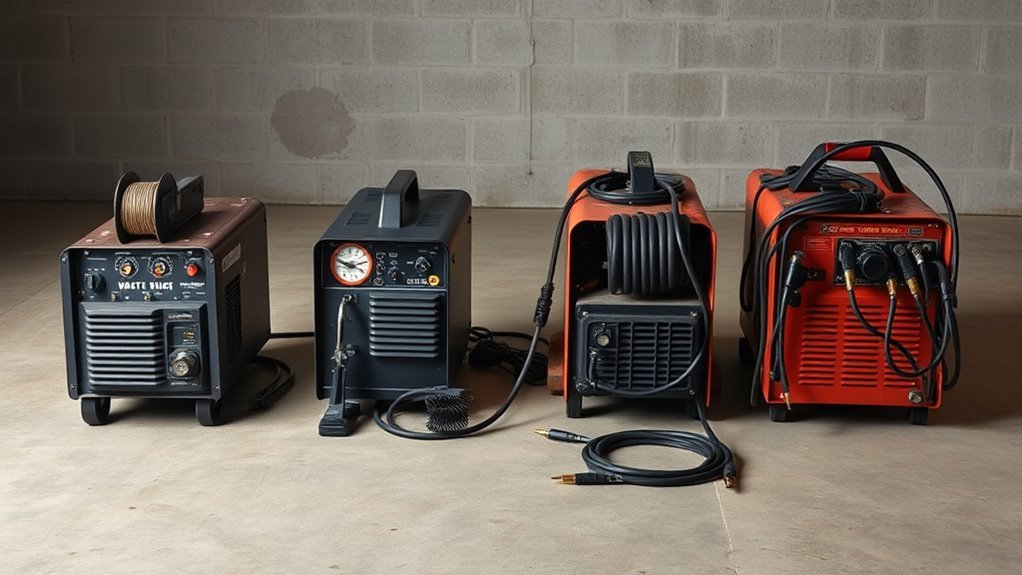
The following ranges are practical budgeting bands for the U.S. market, not fixed retail quotes. Premium brands, complete packages, automation, water cooling, feeders, and engine-driven power can move a machine well beyond the listed range.
| Process | Entry or light-duty | Professional or industrial | Common extra costs |
|---|---|---|---|
| Stick | $150–$600 | $700–$3,000+ for higher-output shop power sources | Leads, holder, electrodes, chipping tools |
| MIG or flux-cored | $250–$1,000 | $1,500–$8,000+ | Gas cylinder, regulator, wire, tips, liner, spool gun |
| DC TIG | $500–$1,500 | $2,000–$5,000+ | Torch, pedal, regulator, argon, tungsten, filler rod |
| AC/DC TIG | $800–$2,500 | $3,000–$8,000+ | Same TIG accessories; water cooler on higher-output systems |
| Multiprocess | $700–$1,500 | $2,000–$10,000+ | Process-specific torches, pedals, guns, gas equipment |
| Engine-driven welder/generator | About $4,000–$8,000 | $10,000–$20,000+ | Fuel, engine service, trailer or truck mounting, leads |
Note: Very low online prices may describe the power source only, omit essential accessories, use optimistic output claims, or provide limited parts support. Compare the data plate, manual, included equipment, independent safety certification, warranty, and seller support.
Comparing Entry-Level, Professional, and Industrial Models
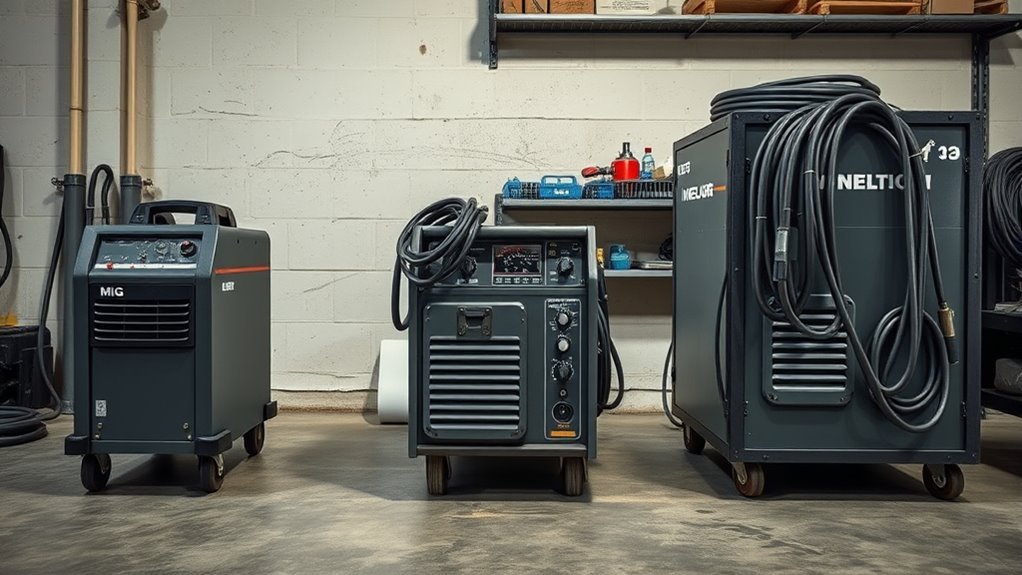
Entry-Level Price Range
Entry-level welders focus on affordability, portability, and simple controls. They are suitable for learning, occasional repairs, and short welds within their rated material range. Common limits include shorter duty cycles, lower output on 120V power, shorter leads, fewer settings, and limited aluminum capability.
A beginner does not automatically need the cheapest machine. A stable arc, clear manual, local consumables, and usable controls can make learning easier and reduce the chance of replacing the machine after the first few projects.
Professional and Industrial Costs
Professional machines add stronger wire-feed systems, better low-end control, longer duty cycles, memory settings, pulse modes, remote controls, and more durable components. Industrial systems may include separate feeders, water-cooled torches, automated interfaces, data logging, three-phase input, engine drives, or near-continuous output.
Production buyers should compare cost per usable hour, service response, parts availability, and downtime risk. A cheaper power source can cost more over its life if it cannot sustain the required amperage or if replacement parts are difficult to obtain.
| Tier | Best for | Features worth paying for |
|---|---|---|
| Entry-level | Learning and occasional home use | Stable arc, clear settings, common consumables, adequate leads |
| Professional | Regular repair and fabrication | Higher duty cycle, dual voltage, better controls, service network |
| Industrial | High-throughput or critical work | Continuous output, modular feeders, automation, remote support, rugged construction |
Accessories, Maintenance, and Long-Term Ownership Costs
The welder itself is only one part of the ready-to-weld budget. The additional share varies widely by process and by what the package includes, so build a line-item estimate before ordering. If you are budgeting the entire learning or shop setup rather than the machine and its operating equipment, use the separate welding startup cost guide to avoid mixing two different cost questions.
| Cost item | What it may include | Budget guidance |
|---|---|---|
| PPE | Helmet, safety glasses, gloves, jacket or sleeves, suitable footwear, hearing protection | Often $100–$500+ depending on helmet and clothing |
| Gas equipment | Cylinder purchase or lease, regulator/flowmeter, hose, first fill | Get a local supplier quote because cylinder policies and gas prices vary |
| Process accessories | TIG torch, foot pedal, spool gun, wire feeder, longer leads, cart | Can add several hundred to several thousand dollars |
| Consumables | Wire, rods, electrodes, tungsten, tips, nozzles, liners, cups, gas | Estimate from pounds of filler and hours of welding, not a flat annual number |
| Fume and fire controls | Local exhaust, screens, extinguisher, fire-resistant blankets, cylinder restraint | Site-specific; commercial shops may require engineered controls |
| Maintenance | Cleaning, drive rolls, liners, fans, cables, connectors, calibration, engine service | Follow the manual and budget by operating hours and environment |

This grill brush and scraper makes it easier to remove stubborn residue from grill grates with three rows of tightly woven stainless-steel bristles and a sharp built-in scraper. The long reinforced handle helps keep hands away from heat while providing strong leverage for thorough cleaning across the entire grill surface. Designed for safer, longer-lasting use, it suits many grill types including charcoal, smoker, porcelain, infrared, and more.

Post-it Super Sticky Easel Pads are designed to keep ideas visible and organized during meetings, training sessions, brainstorming, and project planning. The large premium paper resists marker bleed-through and sticks securely to many surfaces, then repositions without surface damage. A sturdy backcard and portable handle make them easy to move between rooms and use with most easel stands.

LIQUI MOLY Cera Tec is a ceramic-based engine oil additive designed to reduce friction and wear in petrol and diesel engines. It mixes easily with compatible motor oils, helps protect against metal-to-metal contact, and can improve smoother engine performance while supporting lower fuel consumption. Suitable for engines, transmissions, pumps, and compressors, it is built to handle extreme temperatures and long service intervals.
How to Estimate Electricity Cost
Use this simple estimate:
Electricity cost = input kilowatts × hours used × local electricity rate.
Use input power from the machine’s specification sheet or data plate rather than multiplying maximum welding amps by arc voltage. Welders do not draw full rated input continuously, so actual cost depends on output, duty cycle, idle time, and power-source efficiency.
Maintenance That Protects Your Investment
- Keep cooling passages and fans free of dust according to the manual.
- Inspect work leads, electrode holders, guns, torches, connectors, and power cords for heat damage or loose connections.
- Replace worn contact tips, liners, drive rolls, O-rings, and torch parts before they cause feeding or gas problems.
- Keep gas cylinders upright, restrained, capped when moved, and away from damage.
- For engine-driven units, include oil, filters, batteries, fuel-system service, and storage care.
- Invest in training and written procedures to reduce rework, wasted consumables, and avoidable incidents.
A planned maintenance budget replaces surprise failures with more predictable costs, less downtime, and better control over total ownership expense.
How to Choose the Right Welding Machine
Start with the work rather than the brand. Write down the metals, normal thickness range, maximum thickness, welding location, available power, expected weld duration, and finish requirement.
What Size Welding Machine Do I Need?
Size a welder for the process, material, normal thickness, and weld duration you use most often. Compare the manufacturer’s rated output and material-capacity chart with your typical work, then check the duty cycle at the amperage you expect to use. Do not choose by maximum amperage alone. Also confirm that your available 120V or 230/240V circuit can supply the required input. Miller’s first-welder selection guide likewise centers the decision on amperage needs, duty cycle, process, and available input power. If one unusually thick job is far outside your normal range, renting a larger machine can be more economical than oversizing every purchase around that single project.
| Your main need | Good process to consider | Important buying check |
|---|---|---|
| Fast garage fabrication on mild steel | MIG | Wire range, gas setup, 120/240V output, duty cycle |
| Outdoor repair and dirty farm steel | Stick or self-shielded flux-cored | Electrode compatibility, generator use, lead length |
| Thin stainless or high-finish work | DC TIG | Low-amperage control, high-frequency start, pedal support |
| Precision aluminum TIG | AC/DC TIG | AC balance/frequency, output, cooling, torch package |
| Mixed repair work | Multiprocess | Exactly which processes and accessories are included |
| Remote field welding plus generator power | Engine-driven welder/generator | Weld output, auxiliary watts, fuel, noise, service access |
Buying Checklist
- Confirm the process and polarity needed for your material and filler.
- Match the rated material range and output to your normal work, not a one-time maximum.
- Compare duty cycle at the amperage you expect to use.
- Verify the input voltage, breaker, plug, extension-cord limits, and generator requirements.
- List every included and missing accessory.
- Check local availability and cost of gas, filler metal, tips, liners, electrodes, and replacement parts. For a separate consumables benchmark, see the guide to welding electrode costs.
- Read the warranty by component and identify the nearest authorized service option.
- Add PPE, ventilation, fire prevention, taxes, shipping, and electrical work to the final price.
Finding the Best Value, Used Equipment, Rentals, and Financing
Compare at least three complete packages using the same assumptions. A useful comparison sheet includes machine price, shipping, tax, accessories, gas equipment, electrical work, consumables, warranty, and expected maintenance.
New vs. Used Welding Machines
A used industrial machine can offer strong value, but test it under load before buying. Check the serial number, input voltage, output stability, cooling fan, displays, wire feeder, gas solenoid, connectors, cables, torch, and evidence of moisture or heavy grinding dust. Confirm that manuals and replacement parts are still available.
For inverter machines, a low purchase price may not be a bargain if the main circuit board is obsolete or costs nearly as much as the machine. Ask whether the warranty transfers; many warranties apply only to the original purchaser.
When Renting Makes Sense
Rental can be economical for a short project, a temporary production increase, an engine-driven field job, or a process you want to test before buying. Compare the daily or weekly rate with delivery, pickup, consumables, damage waiver, fuel, cleaning charges, and the cost of downtime if the correct accessories are not included.
Rebates and Financing
Manufacturer rebates and distributor packages can lower the purchase price, but promotions have dates, eligible stock numbers, and submission rules. Verify the offer on the manufacturer’s current page before buying.
When financing, compare the total amount paid, annual percentage rate, fees, term, prepayment rules, and whether the payment fits your consumables and maintenance budget. Business buyers should also ask their tax professional how equipment depreciation or expensing applies to their situation.
Frequently Asked Questions
Are welding machine prices negotiable at local shops?
Sometimes. Local distributors may have flexibility on package pricing, freight, accessories, training, or service rather than the machine’s advertised price. Bring a comparable written quote and ask for the complete out-the-door cost. National promotions and minimum-advertised-price rules may limit direct discounts.
What do welding machine warranties typically cover?
Most manufacturer warranties cover defects in materials or workmanship for a stated period, but coverage differs by component. Main power sources, circuit boards, guns, torches, batteries, engines, accessories, and labor may have different terms. Consumables, abuse, incorrect input power, poor maintenance, and normal wear are commonly excluded.
Can I rent a welding machine instead of buying?
Yes. Renting is often sensible for short projects, specialized high-output work, or testing a process before purchase. Confirm the included leads, feeder, torch, gas equipment, trailer, fuel policy, delivery charges, and damage responsibility before comparing rental cost with ownership.
How do import taxes affect welding machine cost?
For U.S. buyers, the landed cost can include customs duty and merchandise-processing fees, brokerage, freight, and state or local sales or use tax. The rate depends on the machine’s Harmonized Tariff Schedule classification, value, and country of origin. The United States does not use a federal VAT, so do not add “VAT” as a generic U.S. import charge.
Can a MIG welder weld aluminum?
Yes, if the MIG machine and wire-feed system are designed for the aluminum wire and thickness you plan to weld. Soft aluminum wire can be difficult to push through a long standard gun cable, so a compatible spool gun or push-pull system is often used. Miller explains that a spool gun improves aluminum-wire feedability by placing a small spool at the gun. Confirm gun compatibility, filler wire, drive rolls or liner, shielding gas, polarity, and recommended settings in the exact machine manual before buying accessories.
How much should a beginner spend on a welder?
A practical beginner budget is often $300–$1,000 for the machine, plus PPE and process-specific accessories. Spend enough to get stable output, clear controls, common consumables, and reliable support. Choose the process based on your projects rather than buying a multiprocess machine only because it has more modes.
Is a 120V welder enough for home use?
It can be enough for thin material, small repairs, and short welds. For thicker steel, higher-amperage processes, or longer duty cycles, a 230/240V machine usually provides more capacity. Always follow the manufacturer’s circuit and extension-cord requirements.
Do all MIG and TIG welders require shielding gas?
Gas-shielded MIG and TIG normally require the correct shielding gas. A MIG-capable machine may also run self-shielded flux-cored wire without an external cylinder if the machine supports the required polarity and wire. Stick welding uses flux-coated electrodes and does not need a shielding-gas cylinder.
Conclusion
A realistic welding-machine budget starts with the process, metal, thickness, duty cycle, and available power. Small welders may cost a few hundred dollars, capable shop machines often fall in the high hundreds to low thousands, and industrial or engine-driven systems can exceed $20,000. Add the missing torch, leads, gas equipment, PPE, ventilation, consumables, electrical work, and maintenance before comparing offers. Before buying, compare at least three complete packages with the same ready-to-weld budget formula and buying checklist above. The best value is the lowest complete cost for a machine that can safely sustain your real workload.
Sources
- OSHA 29 CFR 1910.252: Welding, Cutting, and Brazing — PPE, fire prevention, ventilation, and confined-space requirements.
- Miller: Duty Cycle, What It Is and Why It’s Important — 10-minute duty-cycle definition and cooling-time example.
- ESAB Welding FAQ — official overview of MIG, TIG, stick, and flux-cored processes.
- Lincoln Electric Sprinter 180Si — current manufacturer specifications and MSRP benchmark for a portable stick/DC TIG unit.
- Lincoln Electric POWER MIG 215 MPi — current manufacturer specifications and MSRP benchmark for a multiprocess package.
- U.S. Customs and Border Protection: Duty, Taxes, and Other Import Fees — U.S. duty and processing-fee guidance.

This cordless mini dehumidifier helps keep small spaces dry, fresh, and odor-free without spills, cords, or batteries. Its rechargeable silica gel design is ideal for closets, cabinets, cars, bathrooms, boats, and gun safes, with a moisture indicator that shows when it is ready to recharge. Compact and easy to place or hang, it offers a simple low-maintenance solution for controlling humidity in tight areas.

This hardcover edition by Eric Metaxas offers a compelling look at the origins of the United States during the Colonial Period. It blends historical narrative with engaging storytelling, making it appealing for readers interested in American history, early nation-building, and the ideas that shaped the country. A strong choice for history enthusiasts, students, and anyone exploring the foundations of the nation.

Drop Stop provides complete coverage for the gap around your seat belt catch, helping keep keys, phones, and other small items from slipping into hard-to-reach spaces. Designed to move with your seat, it installs easily and stays in place without constant readjustment. This original, patented seat gap filler comes with bonus accessories for added convenience and a cleaner, safer driving experience.
