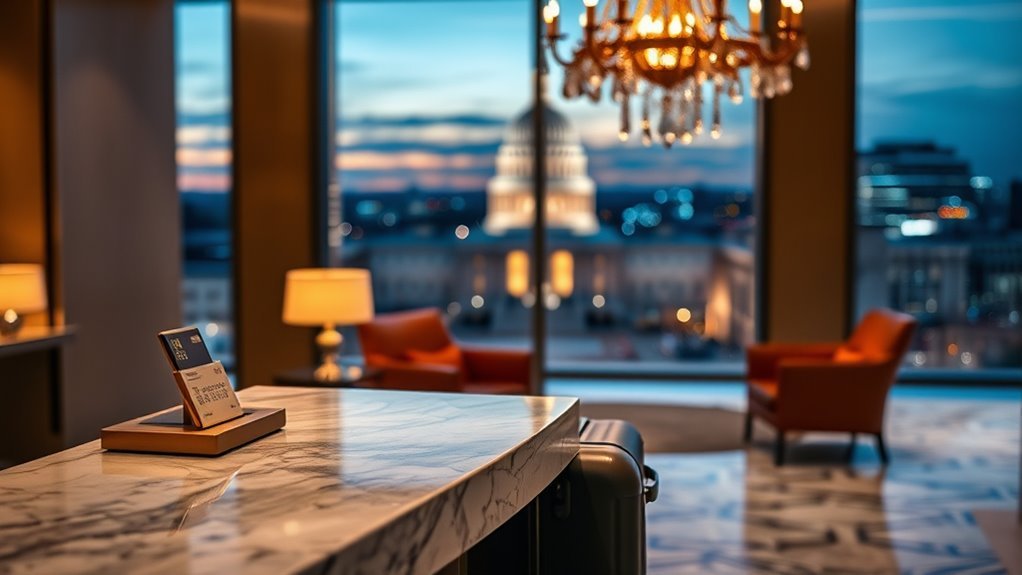
5-star hotel prices in Washington, DC, vary by hotel, room category, and travel date. A luxury room may cost several hundred dollars per night, while a premium suite or landmark-facing room can cost much more. To plan your stay, compare the full room price, Washington’s lodging tax, included amenities, and cancellation terms.
Quick Answer
For planning, allow about $400 to $800 per night before tax for a Washington, D.C. luxury hotel, although individual rates can fall outside that range. Premium properties and suites may exceed $1,000. The District’s 15.95% lodging tax makes a taxable $600 room cost $695.70 per night before optional expenses.
Key Takeaways
- Four Seasons Hotel Washington, D.C., is the city’s only hotel with a Forbes Travel Guide Five-Star award for 2026.
- The 15.95% transient-accommodation tax applies through September 30, 2027.
- Washington’s 2026 convention calendar included 18 citywide conventions representing approximately 376,000 hotel room nights.
- Hotel location, room views, lounge access, and cancellation flexibility can change the value of a stay.
- Under federal fee-disclosure rules, unavoidable mandatory hotel fees must be included in the displayed total price.
Top Picks for Luxury Hotels in Washington, D.C.

Washington, D.C., offers luxury hotels for sightseeing, business trips, romantic stays, and waterfront breaks. The best choice depends on where you want to stay and which services matter most.
There is an important difference between a hotel marketed as five-star and one officially awarded that rating by an independent inspector. In the 2026 Forbes Travel Guide awards, Four Seasons Hotel Washington, D.C., is the capital’s only Forbes Five-Star hotel. The Hay-Adams holds a Forbes Four-Star rating, while several other well-known luxury properties have different classifications.
The following eight hotels offer distinct locations and amenities. They are listed as luxury options, not as eight independently certified Forbes Five-Star hotels.
| Hotel | Best For | Verified Highlight |
|---|---|---|
| Four Seasons Hotel Washington, D.C. | Forbes Five-Star service and Georgetown access | A confirmed 2026 Forbes Five-Star hotel with a spa, fitness club, and Bourbon Steak restaurant. |
| The Hay-Adams | White House views and historic character | A Forbes Four-Star hotel overlooking the White House, Lafayette Square, and St. John’s Church, with 124 guest rooms and 21 suites. |
| Conrad Washington, DC | Conventions, shopping, and downtown dining | Located in CityCenter, within blocks of the convention center and public transportation. Selected rooms provide access to the Sakura Club. |
| Fairmont Washington, D.C., Georgetown | Spacious rooms and club-lounge benefits | Rooms start at 400 square feet. Fairmont Gold accommodations include lounge access, breakfast, appetizers, and dedicated concierge service. |
| Pendry Washington DC – The Wharf | Modern waterfront luxury | Features Spa Pendry, a fitness center, a swimming pool, a pool terrace, and waterfront dining and lounge spaces. |
| InterContinental Washington D.C. – The Wharf | Rooftop swimming and Potomac views | Offers a heated rooftop pool, onsite spa, fitness center, and waterfront accommodations. |
| Hotel Washington | White House access and rooftop views | Historic property near the White House, with the VUE rooftop terrace offering views across the city. |
| The Ritz-Carlton, Washington, D.C. | Traditional luxury in the West End | A West End location convenient for Georgetown, Dupont Circle, and nearby business districts. |
Note: There is no single U.S. government five-star hotel classification. Rating standards vary among booking platforms and independent organizations. Forbes Travel Guide explains its Five-Star criteria, which emphasize anonymous inspections, personalized service, and consistent quality. A luxurious hotel may still hold a different official rating.
5-Star Hotel Prices in Washington, D.C. in 2026
For a 2026 luxury stay in Washington, D.C., a practical starting search budget is several hundred dollars per room per night. Rooms around $400 to $600 can offer good luxury value on some dates. Premium properties, suites, and high-demand nights can cost $700 to more than $1,000 before tax.
These are illustrative planning amounts, not a verified citywide average. Individual hotel prices change with demand, room availability, amenities, and booking conditions.
For example, a standard room with a courtyard view may cost less than a suite at the same hotel. A flexible reservation can also cost more than a prepaid, nonrefundable room.
Use the full after-tax cost as your main comparison. A property with a higher nightly rate may provide breakfast, club access, or other benefits that reduce your overall spending.
Estimated Cost After D.C. Hotel Tax
Washington, D.C., applies a 15.95% tax to transient accommodations through September 30, 2027, according to the District’s Office of Tax and Revenue.
The following table shows how that rate affects different taxable nightly charges. Each total includes the 15.95% tax but excludes optional expenses.
| Taxable Nightly Charge | 15.95% D.C. Tax | Estimated Total |
|---|---|---|
| $400.00 | $63.80 | $463.80 |
| $500.00 | $79.75 | $579.75 |
| $600.00 | $95.70 | $695.70 |
| $700.00 | $111.65 | $811.65 |
| $800.00 | $127.60 | $927.60 |
| $1,000.00 | $159.50 | $1,159.50 |
For a longer stay, multiply the after-tax nightly total by the number of nights, assuming the taxable rate stays the same.
For example, three nights at a taxable rate of $600 per night would cost approximately $2,087.10 after lodging tax. A two-night stay at that rate would cost $1,391.40.
The examples do not include parking, restaurant meals, room service, spa treatments, pet fees, optional upgrades, or other purchases. If the booking price already includes tax, do not add the tax again.
A $600 taxable nightly charge becomes approximately $695.70 after Washington, D.C.’s 15.95% lodging tax, before optional expenses.
Why Some 2026 Dates May Cost More
Washington’s hotel demand changes around major conventions, national celebrations, festivals, and government events. A busy citywide event can reduce room availability and push rates higher.
Destination DC reported 18 citywide conventions in 2026, representing approximately 376,000 room nights and 246,000 attendees. Those figures show why convention dates deserve attention when comparing hotel costs.
The city’s 2026 calendar also included several major travel periods:
- March 20 to April 12, 2026: The National Cherry Blossom Festival brought visitors to Washington for spring celebrations and sightseeing.
- July 4, 2026: Independence Day marked the United States’ 250th anniversary, with celebrations and events around the capital.
- Convention and graduation periods: Large meetings, university ceremonies, and group bookings affected demand on individual dates.
- Autumn and winter events: Cultural performances, festivals, sporting events, and holiday travel can influence weekend and weekday prices.
For travelers planning a spring 2027 visit, the National Cherry Blossom Festival has announced March 20 to April 11, 2027, as its festival dates. Actual peak bloom depends on weather and does not necessarily match the full festival period.
The Destination DC events calendar provides the city’s scheduled exhibitions, festivals, performances, and other events. Comparing nearby dates can help you identify a better-priced stay.
Key Factors That Affect Luxury Hotel Pricing in Washington, D.C.
The same Washington hotel may offer very different rates from one day to another. Your travel dates, room type, and booking conditions usually explain more of the difference than the hotel’s star label.
- Travel dates: Conventions, celebrations, holidays, graduations, and special events can raise demand.
- Neighborhood: A White House-area hotel, Georgetown property, and waterfront hotel at The Wharf may follow different demand patterns.
- Room type: Suites, club rooms, connecting accommodations, balconies, and premium views generally cost more than standard rooms.
- Number of guests: Extra adults, additional beds, and larger room requirements may increase the price.
- Cancellation terms: Flexible reservations often cost more than prepaid, nonrefundable bookings.
- Included benefits: Breakfast, lounge access, hotel credits, parking packages, and late checkout may improve the overall value.
- Taxes and fees: Government taxes, mandatory charges, and optional services affect the amount you ultimately pay.
- Length of stay: Some packages require a minimum stay, while selected offers reward longer bookings.
Room location within the hotel also matters. A quieter courtyard-facing room and a landmark-view suite may have different prices even when they share the same facilities and services.
Warning: A lower prepaid rate is not automatically the better deal. A nonrefundable booking may leave you paying for unused nights if your plans change. Check cancellation deadlines, deposits, early-departure rules, and change penalties before paying.
How Mandatory Hotel Fees Should Appear
The Federal Trade Commission’s Rule on Unfair or Deceptive Fees took effect on May 12, 2025. It requires short-term lodging businesses to include unavoidable mandatory fees in the total price displayed upfront.
For example, a required daily resort or destination fee generally cannot be hidden until the final checkout stage. Businesses may display an itemized breakdown, but the full mandatory total must be more prominent than individual components.
Government taxes can appear separately from the first displayed total. They must still be disclosed before payment. Optional purchases, including parking, spa treatments, meals, and selected upgrades, may also be added when you choose them.
The FTC rule does not limit how much a hotel can charge. Instead, it requires clearer pricing so you can compare offers more fairly.
Comparing Luxury Hotels: What to Expect for Your Money

A more expensive hotel is worth considering when its location, services, or included benefits match your plans. However, a higher room rate does not guarantee that every feature will be useful to you.
Compare how much time you will spend at the hotel, which attractions you plan to visit, and whether the amenities are included in your specific room rate.
Location and Neighborhood
Washington’s luxury hotels are spread across several neighborhoods. Each area offers different advantages for sightseeing, business travel, dining, and relaxation.
- Georgetown: A good choice for historic streets, upscale shopping, restaurants, and a quieter luxury setting. Four Seasons is a notable option.
- Downtown and Lafayette Square: Convenient for White House-area sightseeing, government offices, and central attractions. The Hay-Adams and Hotel Washington are useful choices.
- West End: Offers access to Georgetown, Dupont Circle, George Washington University, and nearby offices. The Ritz-Carlton and Fairmont suit this area.
- CityCenter and Mount Vernon Square: Useful for conventions, downtown dining, shopping, and public transportation. Conrad is especially convenient for convention visitors.
- The Wharf: Suits travelers who want waterfront restaurants, entertainment, swimming pools, and a resort-like atmosphere. Pendry and InterContinental are established options.
If your trip focuses on the National Mall and central museums, a downtown location may reduce local travel time. If you prefer waterfront restaurants and hotel relaxation, The Wharf may provide more value.
Amenities That May Justify a Higher Price
Luxury hotels differ in what the standard room rate includes. Some premium rooms provide additional services that can replace expenses you would otherwise pay separately.
For example, Fairmont Gold accommodations provide lounge access, breakfast, refreshments, and concierge assistance. These benefits can be useful during longer stays or business trips.
At Conrad Washington, DC, the Sakura Club offers a different premium experience. Eligible Sakura rooms and suites include dedicated service, breakfast, dinner, and snacks and drinks throughout the day.
Other amenities worth comparing include:
- A spa, indoor pool, outdoor pool, or full fitness center
- Personalized concierge assistance
- Landmark, city, or waterfront views
- Onsite restaurants and room service
- Breakfast, dining credits, or lounge refreshments
- Parking packages or other useful hotel credits
- Larger rooms, suites, or connecting-room options
- Flexible cancellation and late-checkout privileges
Do not assume every amenity is complimentary. A hotel may offer a spa without including treatments, or provide a club lounge only to guests in selected room categories.
Pro Tip: Compare the price of a standard room and a club-level room after accounting for meals and included benefits. If breakfast, refreshments, and dining credits replace purchases you already planned to make, the higher room category may offer better total value.
How to Choose the Right 5-Star Hotel for Your Stay
Choose a luxury hotel by matching its location, room benefits, and final cost to your trip. A hotel with the highest advertised star rating is not necessarily the best choice for every traveler.
Use these steps to narrow your options without paying for features you will not use.
- Choose your preferred neighborhood. Decide whether Georgetown, the White House area, CityCenter, the West End, or The Wharf best suits your plans.
- Set an after-tax room budget. Include the 15.95% lodging tax and leave enough money for meals, transportation, parking, and other expenses.
- Identify essential amenities. Decide whether you need breakfast, a pool, spa, club lounge, accessible accommodation, connecting room, or pet-friendly policy.
- Compare matching rooms. Use the same dates, number of guests, room type, currency, and cancellation conditions across properties.
- Read the booking rules. Check deposit amounts, payment timing, minimum-stay requirements, cancellation deadlines, and early-departure penalties.
- Review local events. Compare nearby arrival dates if your stay overlaps a convention, national celebration, or festival.
- Confirm the final checkout amount. Make sure the total includes mandatory charges and discloses applicable taxes and optional additions before payment.
There is no reliable rule that booking exactly 85 days in advance always produces the lowest Washington luxury-hotel price.
For an ordinary stay, begin comparing rates several weeks or months before your trip. For major conventions, cherry-blossom season, Independence Day, or other large events, start earlier because desirable rooms may become unavailable.
A refundable booking can provide flexibility while you compare prices. If you find a better offer, secure the replacement reservation before canceling the original, and confirm that cancellation will not trigger a penalty.
Frequently Asked Questions
How much does a 5-star hotel in Washington, D.C. cost?
Budget roughly $400 to $800 per night before tax as an illustrative luxury-hotel search range, not a verified market average. Premium rooms, famous properties, and busy travel dates may cost over $1,000. Your actual rate depends on the hotel, dates, occupancy, room type, and booking conditions.
How much hotel tax will I pay in Washington, D.C.?
Washington, D.C., applies a 15.95% transient-accommodation tax through September 30, 2027. A taxable $600 nightly charge becomes $695.70 after tax. Three nights at that same rate cost approximately $2,087.10 before optional expenses. If your booking total already includes tax, do not add it again.
What is the best luxury hotel in Washington, D.C.?
The best hotel depends on your priorities. Four Seasons is the capital’s only 2026 Forbes Five-Star hotel. The Hay-Adams suits White House-area sightseeing, Conrad offers convention-center convenience, and Pendry and InterContinental provide waterfront amenities at The Wharf. Compare their room categories and included benefits before choosing.
How far in advance should I book a luxury hotel?
There is no guaranteed 85-day booking rule. Start comparing rates several weeks or months ahead, especially if you want a particular room or hotel. Book earlier for major conventions, cherry-blossom season, Independence Day, and other high-demand events. A refundable rate may provide more flexibility.
Are weekends always cheaper than weekdays in Washington, D.C.?
No, weekends are not always cheaper. Business travel and conventions can increase weekday demand, while festivals, weddings, and leisure visitors may increase weekend prices. Compare the same hotel and room type across nearby dates to find the better rate for your particular stay.
Are mandatory hotel fees included in the advertised price?
Yes, unavoidable mandatory lodging fees must be included in the displayed total price under the FTC fee rule. Government taxes may initially appear separately but must be disclosed before payment. Optional purchases such as parking, spa treatments, pet services, meals, and room upgrades may increase your final cost.
Does every hotel described as 5-star have the same standard?
No, five-star classifications vary among booking platforms and independent rating organizations. Forbes Travel Guide uses anonymous inspections and emphasizes service quality. A luxury hotel advertised as five-star on a booking platform may hold a Four-Star or Recommended designation from Forbes, or have no Forbes rating.
Related cost guides: Compare average 4-star hotel cost in Washington, DC, average 3-star hotel cost in Washington, DC, Washington, DC Cherry Blossom hotel prices to plan your full U.S. lodging budget.
Conclusion
A luxury stay in Washington, D.C., can cost several hundred dollars per night or more than $1,000 at premium properties. The right budget depends on your dates, room category, and hotel choice.
Compare matching offers, account for the 15.95% lodging tax, and review the final fees and included benefits. Choose the hotel that gives you the most useful amenities and location for your total budget.
Sources
- District of Columbia Office of Tax and Revenue — confirms the 15.95% transient-accommodation tax through September 30, 2027.
- Federal Trade Commission: Rule on Unfair or Deceptive Fees FAQ — explains mandatory-fee inclusion, total-price displays, and government-tax disclosure.
- Destination DC: 2026 Meetings and Convention Outlook — confirms 18 citywide conventions, approximately 376,000 room nights, and 246,000 attendees.
- Destination DC Events Calendar — provides the city’s events, exhibitions, festivals, and performances.
- Forbes Travel Guide 2026 Star Award Winners — confirms the independent Five-Star, Four-Star, and Recommended classifications.
- Forbes Travel Guide: Washington, D.C. Luxury Hotels — identifies reviewed luxury properties in the Washington area.
- National Cherry Blossom Festival — confirms the announced March 20 to April 11, 2027, festival dates.
- Conrad Washington, DC: Sakura Club — confirms the club’s dining and service benefits for eligible accommodations.
- Official hotel websites linked in the comparison table above — support hotel locations, room types, facilities, and property-specific amenities.