The cost of living in Lesotho in 2026 is about M10,700–M14,100 (~$645–$850) a month for a single person living comfortably in Maseru, and about M6,300–M7,600 (~$380–$460) on a lean budget. A couple should plan on roughly M15,700–M18,900 (~$945–$1,140), and a family of four about M24,700–M29,600 (~$1,490–$1,785) before international school fees. These figures use an exchange rate of about M16.6 per US dollar (October 5, 2026). Rent is low, but fuel, electricity in winter, and imported goods take a bigger bite than the rent figures suggest. Below you’ll find rents, utility and fuel prices, food costs, taxes, visa rules, and sample budgets.
Quick Answer
- Single person: M6,300–M7,600 (~$380–$460) on a lean budget; M10,700–M14,100 (~$645–$850) for a comfortable one in Maseru.
- Couple: M15,700–M18,900 (~$945–$1,140) a month in a one-bedroom.
- Family of four: about M24,700–M29,600 (~$1,490–$1,785) before international school fees.
- Rent, one-bedroom: about M850–M1,400 (~$51–$84) outside the center; M1,400–M2,700 (~$84–$163) in the center, based on thin crowd-sourced data.
- Utilities: up to about M3,500 (~$211) a month for an 85 m² apartment with electric heating; internet adds about M625 (~$38).
- Local transport: M10–M17 (~$0.60–$1.02) per ride under the May 2026 fare list.
- Petrol: about M24.80 per liter (~$1.49) in early October 2026.
Exchange Rate, Inflation, and the Economy in 2026
Three numbers shape what Lesotho costs you this year.
The exchange rate. Lesotho’s currency is the loti (plural maloti, code LSL, shown as M). It is pegged one-to-one to the South African rand, and the Central Bank of Lesotho holds reserves specifically to sustain that peg. Rand notes are accepted everywhere in Lesotho, but maloti are not accepted in South Africa. The loti traded at about M16.62 per dollar on October 5, 2026, close to its level for most of the year. This guide uses M16.6. Because the loti follows the rand, any rand swing changes your dollar budget overnight.
Inflation. The Lesotho Bureau of Statistics reported annual inflation of 2.6% in August 2026. The World Bank put July 2026 inflation at 2.9%, down from an average of 4.3% in 2025 and 6.1% in 2024. Overall prices are calm, but fuel moved sharply this year (see the transport section).
Incomes. The World Bank classifies Lesotho as a lower-middle-income economy, with gross national income of about $1,280 per person in 2025 and growth projected at 1.2% in 2026. Poverty and inequality are widespread, especially in rural areas.
Prices that look tiny in dollars can still be heavy for local households. A foreign income stretches far in Lesotho; a local salary often does not.
Salaries and Minimum Wage
Lesotho has no single national minimum wage. The government sets separate minimums by sector, from textiles and construction to retail, security, and domestic work. The current rates come from the Labour Act Wages (Minimum Wages) Notice of 2025 (Legal Notice No. 62 of 2025), with the latest increase effective April 1, 2026. Published summaries put the general minimum at about M2,242 (~$135) a month. Textile workers, the country’s largest group of factory workers, earned a minimum of M2,000 a month after the 2023 increase.
Crowd-sourced data put the average net salary at about M12,557 (~$756) a month, but this figure is skewed toward office jobs in Maseru. Many households live on far less. If you plan to work locally, compare any offer against the budgets below.
Housing and Rent
Housing is the cheapest major cost in Lesotho, but the data are thin. Crowd-sourced averages updated in June 2026 rest on only 76 price reports from eight contributors, and a second crowd-sourced model gives higher central rents. Use the table as a rough guide and compare live listings in the exact area.
| Home Type | Average Rent (M/month) | Approx. USD | Reported Range (M) |
|---|---|---|---|
| 1-bed, city center | 1,367–2,025 | $82–$122 | 600–2,500 |
| 1-bed, outside center | 850 | $51 | 350–1,500 |
| 3-bed, city center | 7,168 | $432 | 4,500–12,005 |
| 3-bed, outside center | 2,833 | $171 | 2,000–3,500 |
The budgets in this guide use M850–M1,400 for a one-bedroom outside the center and M1,400–M2,700 for a central or better-quality one-bedroom. Secure, furnished units in the best parts of Maseru can cost more than the top of these ranges.
Where to Live
There is not enough data for a reliable rent table by town, so the comparison below is about what each area offers rather than exact prices.
| Area | Relative Rent | What to Expect |
|---|---|---|
| Maseru | Highest | Most jobs, apartments, supermarkets, private clinics, and internet choices; next to the South African border at Maseru Bridge |
| Teyateyaneng, Leribe (Hlotse), Mafeteng | Lower | Fewer listings and services; commuting to Maseru adds transport costs |
| Butha-Buthe, Mohale’s Hoek | Lower | Small towns with basic shops; specialized care means travel |
| Mountain districts (Mokhotlong, Thaba-Tseka, Qacha’s Nek) | Lowest cash rent | Cold winters, long travel times, weaker connectivity, higher heating needs |
Renting Tips
- Ask exactly which furniture and appliances are included, and whether water, security, and refuse collection are in the rent.
- Ask for two or three recent electricity receipts. Most homes use prepaid meters, so past top-ups show real winter costs.
- Photograph the unit and agree on an inventory before you pay the deposit.
- Get the deposit amount, notice period, and refund terms in writing.
- Check security: burglar bars, a gate, and a guard or secure parking matter in Maseru.
Utilities, Internet, and Phone
Electricity is the utility that varies most. Lesotho’s winters (June to August) are cold, especially in the highlands, and electric heaters push bills up fast. The crowd-sourced estimate for electricity, heating, water, and refuse in an 85 m² apartment is about M3,501 (~$211) a month. That figure comes from very few reports and likely reflects heavy winter heating. A smaller flat with careful use and a gas heater or gas cooking will pay much less.
Electricity tariffs are set by the national regulator, LEWA, which held workshops on a new tariff structure in August 2026. No 2026/27 domestic rate had been published at the time of writing, so budget with recent bills rather than a per-kWh figure.
| Service | Typical Monthly Cost (M) | Approx. USD |
|---|---|---|
| Utilities, 85 m² apartment (crowd-sourced) | 3,501 | $211 |
| Utilities, small flat (budget estimate) | 1,200–1,750 | $72–$105 |
| Home internet, 60 Mbps+ | 625 | $38 |
| Mobile plan, calls + 10 GB data | 340 (range 100–500) | $20 |
The small-flat estimate scales the 85 m² figure down to a one-bedroom. Vodacom Lesotho and Econet Telecom Lesotho are the two mobile networks, and many people rely on mobile data instead of a fixed line.
Food: Groceries and Eating Out
Most groceries come from South Africa, so supermarket prices sit close to South African levels, plus transport costs. Local staples such as maize meal (papa), beans, and seasonal vegetables are cheap. Imported cheese, wine, and branded snacks are not.
Crowd-sourced prices, updated June 2026:
| Item | Typical Cost (M) | Approx. USD |
|---|---|---|
| Milk (1 liter) | 18.75 | $1.13 |
| White bread (1 lb loaf) | 12.25 | $0.74 |
| Rice (1 lb) | 14.52 | $0.87 |
| Eggs (12) | 25.60 | $1.54 |
| Chicken fillets (1 lb) | 46.50 | $2.80 |
| Meal at an inexpensive restaurant | 125 | $7.53 |
| Fast-food combo meal | 100 | $6.02 |
| Domestic beer (pint, at a bar) | 30 | $1.81 |
| Cappuccino | 32.50 | $1.96 |
A single person who cooks most meals should budget about M2,500–M3,300 (~$151–$199) a month for groceries, based on crowd-sourced basket estimates. The low end assumes a local diet built on maize meal, beans, vegetables, and chicken; the high end includes more imported food. Couples should plan on about double.
- Compare supermarkets with neighborhood shops and street markets for produce.
- Some residents near the border shop in Ladybrand or Ficksburg in South Africa, where choice is wider.
- Keep imported treats and restaurant meals in a separate budget line.
Transportation and Fuel
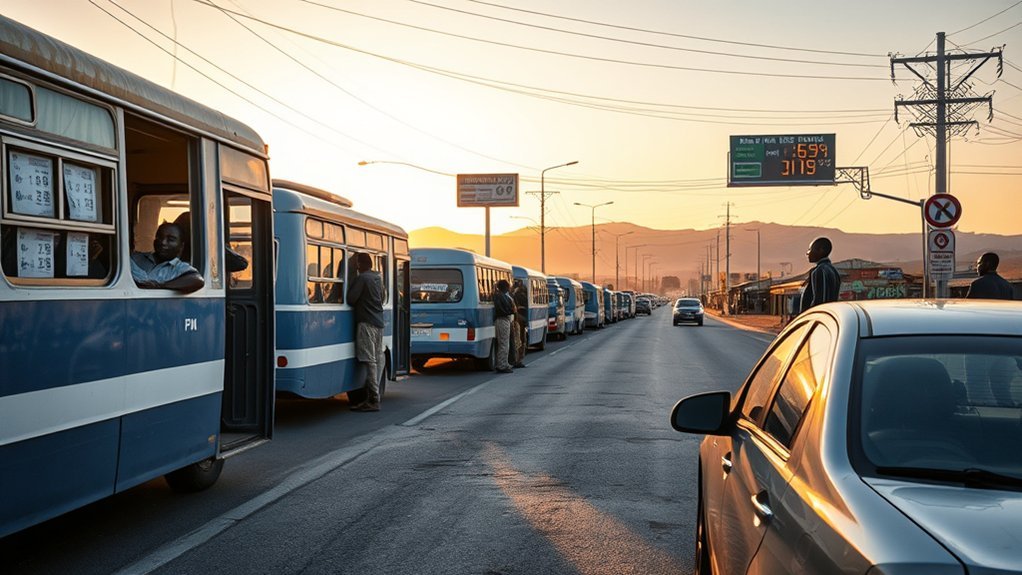
Most people get around by shared 4+1 taxis (small sedans on fixed routes), minibus taxis, and buses. The government’s public transport price list, effective May 11, 2026, set these local fares:
| Mode | Local Fare (M) | Approx. USD |
|---|---|---|
| 4+1 taxi | 17 | $1.02 |
| Minibus taxi | 15 | $0.90 |
| Bus or sprinter | 10 | $0.60 |
A commuter who rides twice each workday spends about M400–M680 (~$24–$41) a month, depending on the mode. Long-distance fares depend on the route.
Fuel. Pump prices are set by the government and changed often in 2026. After large hikes on April 1, the May 6, 2026 adjustment raised petrol 95 to M25.90 a liter and diesel to M34.75. Fuel-price trackers showed petrol 95 at about M24.80 (~$1.49) and diesel at about M30.95 (~$1.86) per liter in early October 2026. Filling a 45-liter tank with petrol costs about M1,115 (~$67).
A car is useful for the mountain districts and trips to South Africa, but it adds fuel, insurance, licensing, and repairs. Most newcomers in Maseru manage with taxis.
Healthcare and Insurance
Lesotho has public hospitals and clinics, church-run (CHAL) facilities, and a small number of private doctors and clinics, mostly in Maseru. Public care costs little, but facilities are stretched. For serious or specialist treatment, many residents travel to Bloemfontein in South Africa, about two hours from Maseru.
Reliable 2026 prices for private consultations and insurance in Lesotho are not published. Plan for:
- International health insurance that covers treatment in South Africa and medical evacuation. This is the single most important health cost for foreigners.
- Out-of-pocket spending on private consultations, tests, and medicines, which are paid in cash or by card at the time of care.
- An emergency fund for travel to South Africa if you need a specialist.
The sample budgets include M500–M3,000 a month for health and miscellaneous costs, depending on household size. Get insurance quotes for your age before you commit.
Childcare and Schools
- Private full-day preschool: about M1,150 (~$69) per child a month, with reported fees from M500 to about M2,000.
- International primary school: crowd-sourced reports average about M24,000 (~$1,446) a year per child, with a range of M20,000–M32,000. Few reports exist, so ask each school for its full fee schedule, including enrollment, transport, and uniforms.
- Public primary school: primary education is free and compulsory under the Education Act of 2010. Families still pay for uniforms, supplies, and some meals and activities. Classes are taught in Sesotho and English.
For a family with two children in international school, tuition adds about M4,000 (~$241) a month on average.
Taxes: VAT and Income Tax
- VAT: the standard rate is 15% and is included in shelf prices. Some basic items are zero-rated or exempt.
- Income tax rates for 2026/27: under the 2026 income tax amendment regulations, effective April 1, 2026, resident individuals pay 20% on taxable income up to M77,760 a year (M6,480 a month) and 30% above that.
- Tax credit: every resident taxpayer gets a personal credit of M12,240 a year (M1,020 a month), up from M11,640. In practice, this means income up to about M61,200 a year (~$3,690), or M5,100 a month, pays no income tax.
| Monthly Gross Salary (M) | Income Tax (M) | Take-Home Before Other Deductions (M) | Approx. USD Take-Home |
|---|---|---|---|
| 5,000 | 0 | 5,000 | $301 |
| 10,000 | 1,332 | 8,668 | $522 |
| 20,000 | 4,332 | 15,668 | $944 |
The examples apply the 2026/27 bands and credit to salary alone. If you earn from abroad, check your home country’s rules and get local advice before you stay long term.
Visas and Residence Permits
According to the US State Department, US citizens do not need a visa for stays of up to 180 days. The border usually grants 30 days, and you can extend up to 180 days through the Office of Immigration at the Ministry of Home Affairs. Stays longer than 180 days need a residence permit. Many Commonwealth and EU nationals also enter visa-free, but check the rules for your passport.
The Ministry of Home Affairs immigration page lists these permit types:
- Temporary permit for 90 days
- Two-year residence permit (categories include business, employment such as doctors, nurses, and teachers, missionaries, and joining a spouse or relative)
- Study permit for up to four years
- Indefinite permit
Fees are set by the Aliens Control (Amendment of Schedule) Regulations, 2018, but the ministry does not publish the amounts online, and its online visa system appears to be suspended. Contact the ministry in Maseru for current fees before you apply.
Most travelers reach Lesotho through South Africa, usually via O.R. Tambo airport in Johannesburg. You need two blank passport pages for South Africa, and children under 18 need unabridged birth certificates.
Safety and Practical Notes
The US government rates Lesotho at Level 2, “Exercise Increased Caution,” as of June 17, 2026, because of crime and health risks. Armed robbery and carjacking occur, including in downtown Maseru, and foreigners are often targeted. Street lighting is limited, so avoid walking alone at night. These risks raise costs in ways the averages don’t show: secure housing, taxis after dark, and a car with good locks.
One-Time Setup Costs
Budget for these before your first month:
- Rental deposit: landlords usually ask for a deposit plus the first month’s rent. On an M1,400 flat with a one-month deposit, that is M2,800 (~$169) up front.
- Furniture and kitchen basics: needed for unfurnished units. Many people buy in Maseru or across the border.
- Winter heating: a gas or electric heater before June, plus a larger electricity top-up.
- Phone and internet: a local SIM is cheap; fixed internet may need an installation fee.
- Residence permit fees: confirm with the Ministry of Home Affairs.
- Health insurance: the first premium for international cover, ideally before you arrive.
Sample Monthly Budgets
These budgets combine the figures above for Maseru. All amounts are in maloti. Leisure includes restaurant meals and, for the comfortable budgets, a gym membership at about M600 (~$36) a month.
| Expense | Single, Lean | Single, Comfortable | Couple | Family of Four |
|---|---|---|---|---|
| Rent | 850–1,400 (1-bed) | 1,400–2,700 (1-bed) | 1,400–2,700 (1-bed) | 2,833–7,168 (3-bed) |
| Utilities | 1,200–1,750 | 1,750–3,500 | 2,000–3,500 | 3,500 |
| Internet + mobile | 340 | 965 | 1,305 | 1,305 |
| Groceries | 2,500 | 3,300 | 5,500 | 9,000 |
| Eating out + leisure | 500 | 1,600 | 2,500 | 2,000 |
| Transport | 400–600 | 680–1,000 | 1,000–1,400 | 1,400–2,000 |
| Childcare / school extras | — | — | — | 1,650 |
| Health + miscellaneous | 500 | 1,000 | 2,000 | 3,000 |
| Total (M) | 6,300–7,600 | 10,700–14,100 | 15,700–18,900 | 24,700–29,600 |
| Total (USD) | $380–$460 | $645–$850 | $945–$1,140 | $1,490–$1,785 |
Family of four: the childcare line covers one child in private preschool (about M1,150) and school extras for one child in a public primary school. International school for two children adds about M4,000 (~$241) a month, for a total of roughly M28,700–M33,600 (~$1,730–$2,025).
Salary check: the comfortable single budget is close to the crowd-sourced average net salary of about M12,557, and more than four times the general minimum wage. That gap shows why most local households spend far less than these budgets assume.
Money-Saving Tips
- Live just outside the center. A one-bedroom outside central Maseru can cost roughly 40% to 60% less, but add taxi fares before you decide.
- Plan for winter. Seal drafts, use a gas heater, and buy electricity in advance so a cold snap doesn’t wreck your budget.
- Eat local. Papa, beans, seasonal vegetables, and chicken cost far less than imported foods.
- Use buses and sprinters. At M10, they are the cheapest local option.
- Watch fuel announcements. Prices changed several times in 2026; fill up before announced increases.
- Hold some savings in dollars or another currency. The loti follows the rand, which can swing sharply.
- Bundle South Africa trips. If you cross the border for shopping or medical care, combine errands to save on travel.
How Lesotho Compares With Nearby Countries
Lesotho is entirely surrounded by South Africa, so most comparisons start there. Rents in Maseru are well below those in Johannesburg, Cape Town, or Pretoria, while supermarket prices are similar because most goods are imported from South Africa. See our guide to the cost of living in South Africa for city-by-city detail.
Eswatini is the closest match: another small kingdom with a currency pegged to the rand. Compare our cost of living in Eswatini guide. For the wider region, the cost of living in Botswana starts at about P7,500–P8,000 (~$545–$575) a month for a single person living simply, higher than Lesotho’s lean budget, and our Namibia cost of living guide covers another rand-linked option.
Compared with the United States, Lesotho is far cheaper for rent and local transport. Groceries, fuel, and electronics are closer to US levels, and private healthcare often means paying South African prices.
Frequently Asked Questions
How much money do you need to live in Lesotho per month?
A single person needs about M10,700–M14,100 (~$645–$850) a month for a comfortable life in Maseru, or M6,300–M7,600 (~$380–$460) on a lean budget. A couple should budget about M15,700–M18,900 (~$945–$1,140), and a family of four about M24,700–M29,600 (~$1,490–$1,785) before international school fees.
Can one person live in Lesotho on $500 a month?
Yes, on a lean budget. At about M16.6 per dollar, $500 is roughly M8,300. That covers a one-bedroom outside the center, local food, buses and minibuses, and careful electricity use. It is tight for a central apartment, frequent taxis, imported groceries, or private healthcare.
How much is rent in Maseru?
Crowd-sourced 2026 data put a one-bedroom at about M850 (~$51) outside the center and M1,367–M2,025 (~$82–$122) in the center. A three-bedroom averages about M2,833 (~$171) outside the center and M7,168 (~$432) in the center. Secure, furnished units cost more.
What currency is used in Lesotho?
Lesotho uses the loti (plural maloti, code LSL), pegged one-to-one to the South African rand. Rand notes are accepted everywhere in Lesotho. The loti traded at about M16.6 per US dollar in early October 2026.
What is the income tax rate in Lesotho?
For 2026/27, residents pay 20% on taxable income up to M77,760 a year and 30% above that. A personal tax credit of M12,240 a year means income up to about M61,200 a year pays no income tax. VAT is 15%.
Do Americans need a visa for Lesotho?
No. US citizens can stay up to 180 days without a visa. The border usually grants 30 days, which can be extended through the Ministry of Home Affairs. Stays longer than 180 days require a residence permit.
How much is petrol in Lesotho?
Petrol 95 cost about M24.80 per liter (~$1.49) in early October 2026, after a peak of M25.90 in May. Diesel cost about M30.95 per liter (~$1.86).
Conclusion
Lesotho is one of the cheaper places in southern Africa to rent a home, and local transport costs about a dollar a ride. The costs to watch are winter electricity, fuel, imported food, and private healthcare, which often means travel to South Africa. A single person can live comfortably in Maseru for about $645–$850 a month, or for closer to $400 by living outside the center and eating locally. Because the loti follows the rand, check the exchange rate before you lock in a budget, and get recent utility bills and insurance quotes before you sign anything.
Sources
- Exchange-Rates.org – USD to LSL history, 2026
- Central Bank of Lesotho – Monetary Policy Committee statement (loti–rand peg)
- Lesotho Bureau of Statistics – inflation, August 2026
- World Bank – Lesotho overview
- Lesotho Tribune – fuel price increase, May 2026
- PaySpace – Lesotho income tax updates for 2026/2027
- US State Department – Lesotho country information
- Ministry of Home Affairs – immigration services
- Lesotho public transport price list, effective May 11, 2026
- Labour Act Wages (Minimum Wages) Notice, 2025 (Legal Notice No. 62 of 2025)
- Numbeo – Lesotho (crowd-sourced prices, June 2026)