
Snow College welding cost for the Welding Technology certificate, a 30-credit, one-semester program at the Richfield campus, starts with $2,550 in tuition, about $204 in general student fees, and approximately $225 for books, according to the college’s published figures for 2026–2027. The academic catalog also lists course-specific fees for the required TEWT classes and welding electives. Based on the published fee schedule and a 15-credit elective mix, those welding course fees add about $650–$750, putting the estimated direct academic cost at approximately $3,629–$3,729 before tools, PPE, housing, food, transportation, and personal expenses. For comparison, see our guides to Dixie Technical College welding cost and trade school for welding cost.
Quick Answer
Snow College currently lists its one-semester Welding Technology certificate at $2,550 in tuition, about $204 in general student fees, and $225 for books. The 2026–2027 catalog separately lists welding course fees; based on the required classes plus 15 elective credits, those fees add about $650–$750. That puts the estimated direct academic cost at approximately $3,629–$3,729 before tools, PPE, housing, food, transportation, and personal expenses.
Key Takeaways
- The current Welding Technology certificate requires 30 credits and is designed for completion in one semester.
- Tuition, general student fees, books, and the catalog-listed welding course fees put the estimated direct academic cost at approximately $3,629–$3,729 before tools, PPE, housing, food, and transportation.
- The current dedicated welding page identifies the Richfield campus and lists fall, spring, and summer starts.
- Richfield housing ranges from $1,400 to $2,170 in a fall or spring semester and from $1,120 to $1,735 in summer.
- FAFSA aid, Snow College departmental scholarships, AWS Foundation scholarships, work-study, and veterans benefits may reduce eligible students’ out-of-pocket costs.
At a Glance
| Program Length | One semester |
| Credits | 30 semester credits |
| Campus | Richfield, Utah |
| Estimated Direct Academic Cost | Approximately $3,629–$3,729 for tuition, general student fees, books, and listed welding course fees |
How Much Does Snow College Welding Cost in 2026–2027?
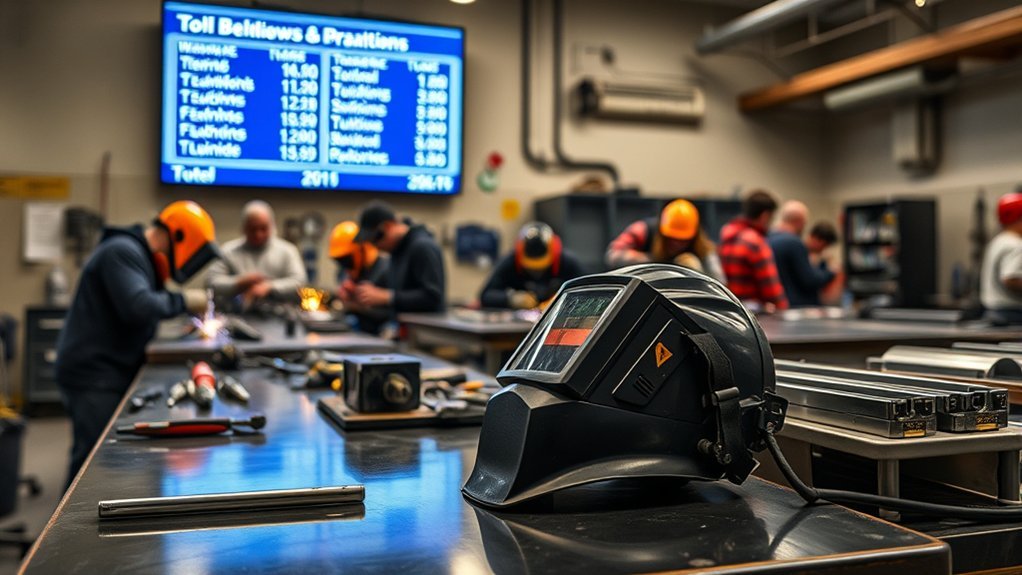
The current Snow College Welding Technology page lists the certificate as a one-semester program with $2,550 in tuition, approximately $204 in general student fees, and about $225 for books. The 2026–2027 academic catalog identifies it as a 30-credit certificate, while the 2026–2027 student-fee schedule lists separate fees for individual TEWT welding courses.
| Direct Cost | Published Amount |
|---|---|
| Tuition | $2,550 |
| General student fees | Approximately $204 on the welding program page |
| Books | Approximately $225 |
| Required-course fees | $375 for the 15 credits of required TEWT courses |
| Elective-course fees | Approximately $275–$375 for a valid 15-credit elective mix, depending on courses selected |
| Estimated direct academic total | Approximately $3,629–$3,729 |
How Much Do Welding Course Fees Add?
Snow College’s 2026–2027 fee schedule lists a separate fee for every TEWT course in the certificate. The eight required courses total $375 in course fees. The certificate then requires 15 elective credits; using the published credit values and fee schedule, a valid 15-credit elective mix adds approximately $275–$375. That makes the listed welding course-fee total about $650–$750, depending on the electives selected.
The resulting $3,629–$3,729 estimate includes tuition, the program-page estimate for general student fees, books, and catalog-listed welding course fees. It does not include tools, personal protective equipment, housing, groceries, transportation, personal spending, or possible housing application costs. Tuition and fees are subject to change, so the student account remains the final billing source.
A stronger 2026–2027 baseline is approximately $3,629–$3,729 for tuition, general student fees, books, and listed welding course fees before tools, safety gear, and living expenses.
Does Snow College Charge Different Welding Tuition by Residency?

Snow College publishes separate resident, nonresident, and Western Undergraduate Exchange rates for its general academic programs. However, its current welding page lists the technical certificate separately at $2,550 in tuition and does not divide that figure into resident and nonresident prices.
Program-Specific Tuition
The welding certificate consists of 30 technical-education credits. At the listed technical-education rate, those credits total $2,550. This program-specific figure is more useful than multiplying Snow College’s general academic tuition by two semesters because the welding certificate is designed to be completed in one semester.
Snow College’s welding page lists general student fees at about $204. The 2026–2027 catalog lists Richfield general student fees at $201.25, creating a small published discrepancy. This guide uses the welding page’s program-specific $204 estimate in its totals, while the amount posted to the student account is the final charge. Course-specific TEWT fees are a separate budget line in the catalog.
Does Out-of-State Tuition Apply?
The current welding page does not display a higher nonresident price for the technical certificate. Therefore, the general nonresident academic-semester rate of $7,400 should not automatically be used to estimate the welding program.
Students taking additional academic courses, upper-division courses, or a different degree pathway may be billed under other tuition schedules. The same applies to WUE pricing, which Snow College lists for general academic enrollment rather than as the published price for this certificate.
International students should not use the $2,550 figure as a complete cost-of-attendance estimate. Snow College publishes separate international-student cost guidance, so international applicants should use the college’s current international figures for visa and funding planning.
Note: The $2,550 figure is the price currently displayed on Snow College’s Welding Technology program page. Registration choices or future rate changes can alter the final bill.
What Do Books, Tools, and Welding Supplies Cost?

Snow College currently estimates books for the Welding Technology certificate at approximately $225. The school lists the cost of tools as “TBD,” meaning there is no reliable published total for the complete equipment package.
Estimated Book Costs
The book estimate may cover printed or electronic course materials, but the exact amount can change with the student’s selected courses and required editions. Because the certificate includes both required courses and 15 elective credits, materials may differ between students.
The curriculum includes welding safety, measurement systems, print reading, inspection and testing, fabrication, and several welding processes. Course materials may therefore include more than a conventional textbook.
Required Safety Equipment
Welding students should expect to need suitable eye and face protection, protective gloves, flame-resistant clothing, appropriate footwear, and other equipment specified by the program. Snow College does not currently publish a complete PPE package price, so a fixed $500–$1,000 estimate would be speculative.
The Occupational Safety and Health Administration explains that welding can expose workers to radiant energy, sparks, hot metal, fumes, gases, noise, and other hazards. The correct PPE depends on the process, material, and work environment.
Warning: Do not buy a complete welding tool or PPE package solely from a generic online list. Equipment must match the program’s current requirements, including the correct helmet, protective lenses, clothing, gloves, and footwear.
Additional Supply Expenses
Students may also need tools, coveralls, consumable items, replacement gloves, or project-specific materials. Some equipment may remain the student’s personal property after the course, but that does not mean every item is included in tuition.
Keep tools and PPE as a separate budget category until Snow College publishes or provides the current required-equipment list. This avoids buying duplicate items or equipment that does not meet course specifications.
How Much Is Richfield Campus Housing?
The welding certificate’s current dedicated program page identifies Snow College’s Richfield campus. Current Richfield student housing consists of cooking apartments, so housing and food should be budgeted separately.
| Richfield Housing Type | Fall or Spring | Summer |
|---|---|---|
| Shared room | $1,400 per semester | $1,120 per semester |
| Deluxe shared room | $1,820 per semester | $1,455 per semester |
| Private room | $2,170 per semester | $1,735 per semester |
Because these are cooking apartments, students need a separate grocery and household-supplies budget. The rates also do not include transportation, entertainment, phone service, medical costs, or other personal spending.
Snow College’s housing contract currently requires $250 when applying, consisting of a $50 nonrefundable application fee and a $200 deposit. A deposit is not necessarily a permanent expense if it is later credited or returned under the contract terms, but it affects the amount needed upfront.
What Is the Total Snow College Welding Cost With Housing?

Combining the estimated direct academic cost of $3,629–$3,729 with current 2026–2027 Richfield housing produces the following starting totals. The range reflects different welding elective-course fees.
| Enrollment and Housing | Estimated Starting Total |
|---|---|
| Fall or spring with shared housing | Approximately $5,029–$5,129 |
| Fall or spring with deluxe shared housing | Approximately $5,449–$5,549 |
| Fall or spring with private housing | Approximately $5,799–$5,899 |
| Summer with shared housing | Approximately $4,749–$4,849 |
| Summer with deluxe shared housing | Approximately $5,084–$5,184 |
| Summer with private housing | Approximately $5,364–$5,464 |
These totals include tuition, the program-page general student-fee estimate, books, catalog-listed welding course fees, and housing. They exclude tools, PPE, groceries, transportation, housing application costs, medical expenses, and personal spending. A commuter who already lives near Richfield may therefore spend much less than a student who relocates.
Pro Tip: Build two budgets: a school-charge budget for tuition, general fees, course fees, and books, and a personal budget for tools, PPE, housing, food, and travel. This makes it easier to see exactly what financial aid must cover.
What the Welding Program Covers
The 30-credit certificate combines required introductory courses with 15 credits of approved welding electives. According to the current catalog, students learn to:
- Follow daily welding-safety practices.
- Use measurement systems, written instructions, blueprints, and welding symbols.
- Perform Shielded Metal Arc Welding, or SMAW.
- Perform Gas Tungsten Arc Welding, or GTAW.
- Perform Gas Metal Arc Welding, or GMAW.
- Perform Flux Cored Arc Welding, or FCAW.
- Use thermal cutting equipment on ferrous and nonferrous metals.
- Select suitable welding or cutting processes for different applications.
Required courses include Introduction to Welding and Cutting, Measurement Systems, and first- and second-level courses in several welding processes. Elective options include print reading, weld inspection and testing, metal fabrication, and specialized process courses.
Competency-Based Education Format
Snow College describes the welding certificate as a Competency-Based Education program. Students progress by showing mastery rather than simply completing a set number of classroom hours.
Course materials can include assignments, instructional videos, quizzes, laboratory work, and assessments. Snow College states that students must score at least 80% on an assessment before advancing to the next section. Students are also expected to keep up with their work and attend required labs and externships.
This format may provide flexibility in how quickly a student studies individual lessons, but it is not a fully self-paced online program. Snow College’s welding page says students are expected to keep up with required work and attend labs and externships.
What Financial Aid Can Snow College Welding Students Use?
Eligible students may use several forms of aid to reduce their out-of-pocket cost. Aid is not automatic, and it may not cover every tool, housing, transportation, or personal expense.
| Financial Aid Type | How It May Help |
|---|---|
| Federal grants | FAFSA results may qualify an eligible undergraduate for a Pell Grant or other need-based grant funds that normally do not require repayment. |
| Federal Work-Study | Eligible students can earn money through approved part-time employment. An award and available job are not guaranteed. |
| Federal student loans | Loans can help cover remaining eligible costs but must be repaid with applicable interest and fees. |
| Snow College scholarships | Snow College lists Welding Technology at the Richfield campus among the majors eligible for departmental scholarship consideration. |
| AWS Foundation scholarships | The AWS Foundation offers several welding-education scholarships, including opportunities for students in short certificate programs. |
| Veterans education benefits | Eligible veterans, service members, and dependents may be able to use VA education benefits for approved coursework. |
The first step for federal aid is the free FAFSA application. FAFSA information is used to determine possible eligibility for grants, work-study, and federal student loans.
What Scholarships Are Available for Welding Students?
Snow College includes Welding Technology at the Richfield campus in its list of departmental scholarship areas. The college’s priority scholarship deadline is generally March 1, and applicants normally need to be admitted by that date.
The AWS Foundation also supports students pursuing welding and related education. Its offerings can include national, district, section, and welder-training scholarships. Award sizes, eligibility rules, and deadlines differ by scholarship and application cycle.
For the 2026–2027 cycle, AWS lists a Welder Training Scholarship for students pursuing certificate programs shorter than two years. This type of scholarship is more directly relevant to Snow College’s one-semester certificate than a scholarship limited to bachelor’s or associate-degree students.
Scholarships are competitive and may have enrollment, academic-progress, residency, essay, or financial-need requirements. Receiving one should not be assumed until the student has an official award notice.
Can You Use a Payment Plan for Snow College Welding?
Snow College requires tuition, fees, housing, and meal-plan charges to be paid in full or placed on an approved payment plan by the fifth day of the semester. Missing that deadline can place registered classes at risk.
The college’s current payment-plan information lists a $40 enrollment fee and an initial down payment. Payment amounts can adjust if charges or financial aid on the student account change.
Important planning dates and costs include:
- Fall start: August
- Spring start: January
- Summer start: May
- Snow College priority scholarship deadline: March 1
- Tuition or payment-plan deadline: Fifth day of the semester
- Payment-plan enrollment fee: $40 under the current published plan
Note: Scholarship and aid applications should be completed well before classes begin. Some awards and work-study positions have limited funding even when the applicant meets the basic eligibility rules.
Frequently Asked Questions
How much does the Snow College welding program cost?
Snow College currently lists $2,550 in tuition, approximately $204 in general student fees, and about $225 for books. The 2026–2027 catalog separately lists TEWT course fees. Based on the required courses plus 15 elective credits, those fees add about $650–$750, putting estimated direct academic costs at approximately $3,629–$3,729 before tools, PPE, housing, groceries, transportation, and personal expenses.
Are there specific prerequisites for enrolling in the welding certificate?
The 2026–2027 certificate page does not list a separate welding skills test as a program-admission requirement. However, individual courses have prerequisites and must be taken in the correct sequence. For example, advanced process courses require completion of their introductory course.
How long is the Welding Technology program at Snow College?
Snow College currently describes the 30-credit certificate as a one-semester program. Students can begin in fall, spring, or summer. Actual completion depends on registration, competency progress, lab attendance, course availability, and successful completion of all requirements.
Can students work while attending the welding program?
Working may be possible, but the 30-credit, one-semester schedule is intensive. The CBE format gives students some control over lesson review and assessment timing, yet required laboratory work still demands consistent attendance. The welding program page also says students are expected to attend labs and externships.
Are internships or job placements guaranteed?
Snow College’s welding program page says students are expected to attend labs and externships, but the published program information does not guarantee a specific internship, externship placement, employer placement, or job offer. Employer hiring depends on skills, qualifications, location, and available positions.
What welding credential does the program provide?
Students complete Snow College’s Welding Technology certificate. The curriculum includes SMAW, GTAW, GMAW, and FCAW, commonly called Stick, TIG, MIG, and flux-cored welding. These are welding processes, not four separate certifications. The catalog does not state that a separate AWS Certified Welder credential is included.
Do out-of-state students pay more for the welding certificate?
The current welding program page lists one tuition amount of $2,550 and does not publish separate resident and nonresident prices for the certificate. General academic tuition tables should not automatically be substituted for the technical-program price.
What is a realistic total budget with housing?
Using the published direct academic estimate of $3,629–$3,729 and current Richfield housing, a starting total is about $5,029–$5,129 with shared fall or spring housing or $5,799–$5,899 with a private room. Food, tools, PPE, transportation, application costs, and personal expenses are still additional.
Conclusion
Snow College’s Welding Technology certificate is a 30-credit, one-semester program at the Richfield campus. The program page lists $2,550 in tuition, about $204 in general student fees, and approximately $225 for books, while the 2026–2027 catalog lists additional TEWT course fees. Including those published course fees produces an estimated direct academic cost of approximately $3,629–$3,729 before tools and living expenses.
A student using shared Richfield housing should budget about $5,029–$5,129 for published academic charges plus fall or spring housing. A private room raises that starting range to about $5,799–$5,899. Tools, PPE, groceries, transportation, application costs, and personal expenses must still be added.
The most effective ways to lower the out-of-pocket cost are to submit the FAFSA, apply for Snow College’s welding departmental scholarship, review current AWS Foundation opportunities, and arrange payment before the fifth day of the semester. Compare aid as grants and scholarships first, earned work-study income second, and repayable loans last. For broader context, compare this program with our 2026 welding school cost guide.
Sources
- Snow College Welding Technology — current program length, tuition, fees, books, campus, start terms, and CBE information.
- Snow College 2026–2027 Welding Technology Certificate Catalog — credit requirements, courses, and program outcomes.
- Snow College 2026–2027 Student Fees — Richfield general student fees and course-specific TEWT welding fees.
- Snow College Richfield Housing and Residence Life — current fall, spring, and summer housing prices.
- Snow College FAFSA and Financial Aid — grants, work-study, loans, and FAFSA guidance.
- Snow College Departmental Scholarships — welding scholarship availability at the Richfield campus.
- AWS Foundation Scholarships — current welding-education scholarship programs and application information.
- Snow College Cashier and Payment Options — current payment-plan information and payment deadlines.
- Snow College Veterans Affairs — education-benefit guidance for eligible veterans and dependents.
- Snow College International Student Costs — separate international-student cost guidance.