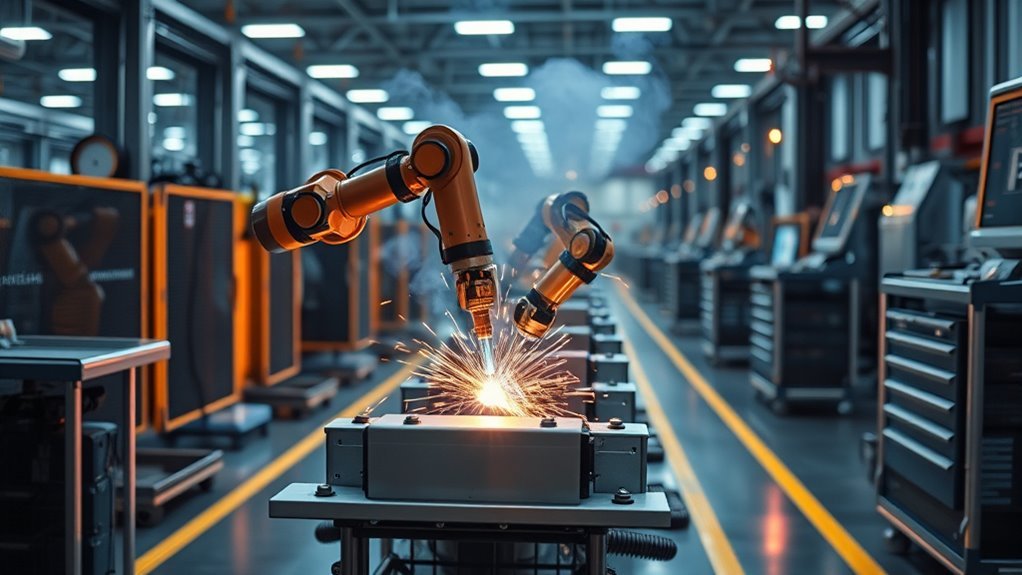
A robotic welding system can cost less than a custom production cell, but the robot arm is only one part of the bill. Your real budget depends on the welding process, reach, payload, positioners, fixturing, guarding, fume control, software, training, and how much integration work the application needs.
Public 2026 pricing shows pre-engineered cobot welding packages in roughly the $75,000–$140,000 range, while custom industrial cells commonly begin in the low six figures and can climb well beyond $250,000. The most reliable approach is to compare complete, line-item quotes and calculate total cost of ownership instead of shopping by robot price alone.
Quick Answer
A complete robotic welding cell typically costs about $75,000–$140,000 for many pre-engineered cobot packages and $150,000–$250,000 or more for custom industrial systems. Complex fixtures, positioners, seam tracking, laser equipment, guarding, ventilation, and integration can push the final price above $500,000.
Key Takeaways
- The price of a robot arm is not the price of a working welding cell.
- Current turnkey cobot welding packages often fall near $75,000–$140,000, while custom cells usually cost more.
- Fixtures, positioners, safety controls, fume extraction, programming, and installation can equal or exceed the robot hardware cost.
- A cobot does not automatically eliminate guarding; the complete welding application needs a documented risk assessment.
- Use your own cycle times, labor costs, scrap, uptime, and part mix to calculate payback.
Robotic Welding Cell Cost at a Glance
The ranges below are useful for early budgeting, not for final purchasing. Publicly advertised packages differ in what they include, and most industrial integrators price systems after reviewing parts, weld procedures, takt time, utilities, and safety requirements.
| System | Planning Range | What the Price Usually Means |
|---|---|---|
| Robot arm and controller only | Quote-based | Usually excludes the welder, torch, table, fixtures, safety system, programming, and commissioning. |
| Pre-engineered cobot welding package | About $75,000–$140,000 | Often includes a cobot, power source, torch, worktable or cart, controls, and basic software. For example, Hirebotics lists a package starting at $105,000, while Vectis reports that most of its systems cost $95,000–$140,000 and some configurations may start lower. |
| Custom industrial arc-welding cell | Often $150,000–$250,000+ | May include a six-axis robot, guarding, PLC/HMI, fixtures, one or more positioners, sensors, installation, and validation. |
| Complex multi-station, vision, laser, or high-payload cell | $250,000–$500,000+ | Custom engineering, multiple robots, coordinated motion, large positioners, laser safety controls, inspection, and automated material handling can raise the price sharply. |
Note: Ask every supplier to separate equipment, integration, freight, installation, training, acceptance testing, software, warranty, and optional accessories. Two quotes with the same total can include very different scopes.
Types of Welding Robots and Price Ranges
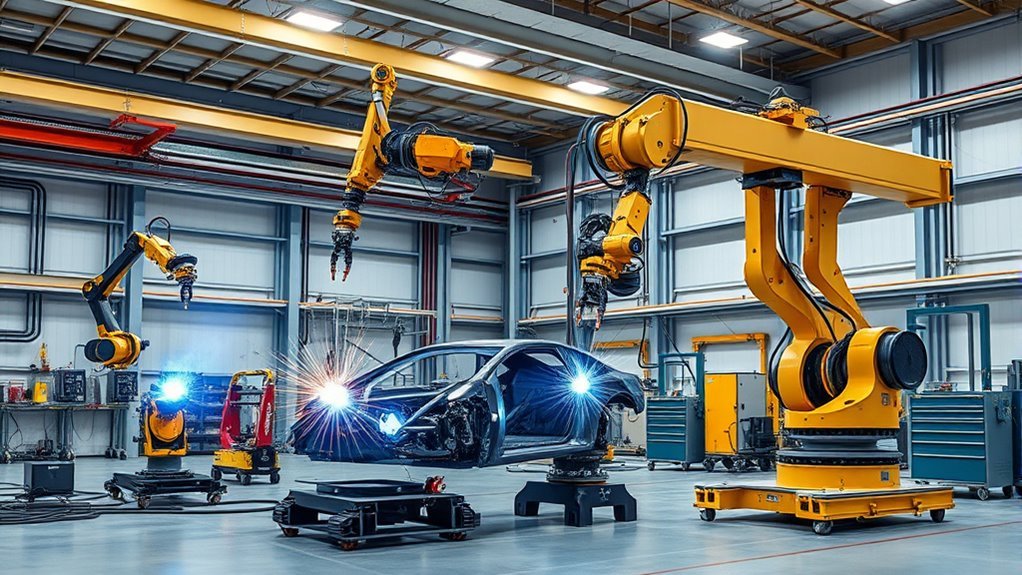
Robot type affects reach, speed, payload, floor space, programming, and safeguarding. For welding, the most common choices are six-axis articulated robots and collaborative robot arms. Cartesian and SCARA robots can support special applications, but they are not direct substitutes for a typical six-axis welding arm.
Articulated Industrial Welding Robots
A six-axis articulated robot is the standard choice for arc welding, resistance spot welding, and many laser applications. Its wrist can hold the torch at different travel and work angles while reaching around fixtures and into corners. Models designed for arc welding also route cables and hoses to reduce interference. FANUC, for example, describes its ARC Mate 120iD as an articulated robot built for narrow fixtures and difficult-to-reach welds.
These robots are often paired with fixed tables, headstock-tailstock positioners, turntables, or multi-axis positioners. The robot may be only a minority of the completed cell price once tooling, controls, guarding, and integration are included.
Collaborative Welding Robots
A cobot welding package uses a force- and power-limited robot with simplified teaching tools. It can be attractive for job shops, short runs, and parts that change often. Pre-engineered packages may reduce custom engineering time and provide a smaller footprint than a traditional cell.
However, “collaborative” describes the robot and operating mode, not the safety of the entire welding process. Hot metal, arc radiation, sparks, sharp fixtures, fumes, and the welding torch can still require curtains, area scanners, barriers, restricted access, or a fenced cell. Guarding decisions must come from a risk assessment of the complete application.
Cartesian, Gantry, and Track-Based Systems
Cartesian or gantry systems move on linear axes. They work well for long, straight seams, large panels, tanks, beams, and applications where the torch follows a controlled path over a wide work area. A simple mechanized track can cost less than a six-axis cell, while a large custom gantry with multiple axes, seam tracking, and automated loading can cost much more.
SCARA Robots for Welding
SCARA robots are mainly designed for high-speed assembly, dispensing, inspection, and material handling. Their limited wrist orientation makes them uncommon for general arc welding. They may suit a tightly constrained brazing, soldering, dispensing, or special joining task, but they should not be presented as a standard low-cost replacement for a six-axis welding robot.
Process-Specific Welding Automation
Resistance spot welding, laser welding, orbital welding, and hard automation have different cost structures. Spot-welding robots need high-payload arms and heavy guns. Laser systems add a laser source, chiller, beam delivery, enclosure, extraction, and strict optical safety controls. Electron-beam welding is usually performed inside specialized vacuum equipment rather than treated as a routine robot-arm end effector.
Key Components That Drive System Cost

A complete cell is a system of interdependent components. Saving money on one item can create cost elsewhere if it slows cycle time, causes poor access, or increases downtime.
- Robot and controller: Reach, payload, repeatability, mounting position, environmental rating, and cable routing affect the model and price.
- Welding package: The power source, wire feeder, torch, dress package, process software, water cooler, and communication interface must work together.
- Fixtures and tooling: Robotic welding needs repeatable part location and joint fit-up. Loose or inconsistent parts create missed joints and defects.
- Positioners: Rotary tables and coordinated positioners keep welds in a favorable orientation and can let loading occur while the robot welds another station.
- Sensors: Touch sensing, through-arc seam tracking, laser vision, part-present sensors, and weld monitoring add cost but may be necessary for variation.
- Safety system: Fencing, interlocked doors, scanners, light curtains, safety PLCs, emergency stops, arc screens, and signage depend on the risk assessment.
- Fume and fire controls: Source capture, ducting, make-up air, spark control, and fire protection must match the process and material.
- Controls and integration: PLC/HMI programming, I/O, plant-network communication, conveyors, traceability, and upstream or downstream equipment add engineering hours.
- Installation and validation: Freight, rigging, electrical work, compressed air, gas piping, floor anchoring, commissioning, and acceptance testing may be separate quote items.
The lowest robot quote is not always the lowest-cost cell. Reliable fixturing, safe access, fast changeover, and maintainable torch routing often determine whether the system reaches its target output.
End-Effector Options and Their Price Impact
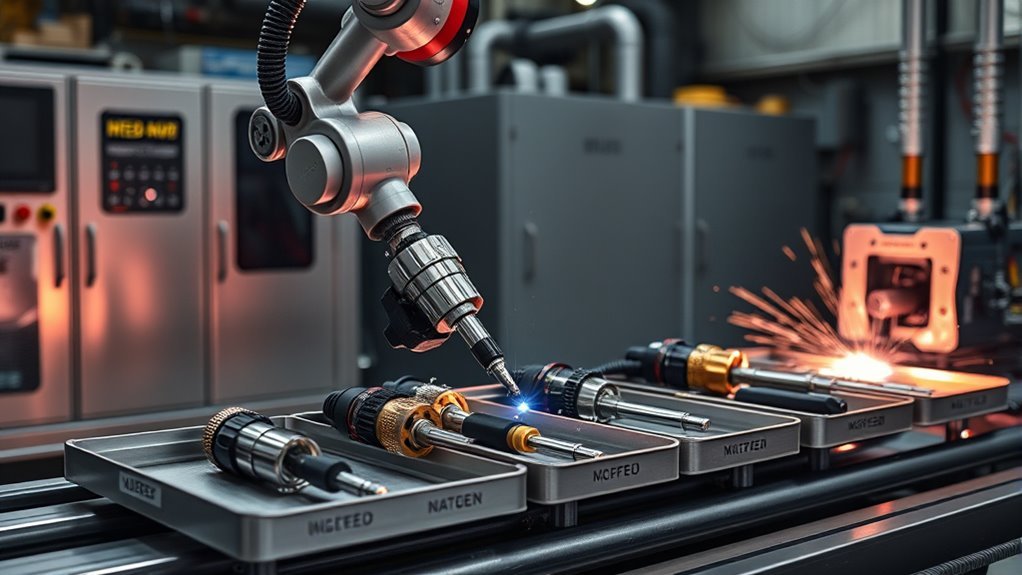
The welding torch or gun is only the starting point. End-of-arm tooling, cable management, sensing, cleaning equipment, and collision protection can change both purchase price and operating cost.
| Option | Typical Cost Effect | Why It Changes the Budget |
|---|---|---|
| Air-cooled MIG torch | Lower | Simple and common, but duty cycle and heat may limit demanding applications. |
| Water-cooled torch and cooler | Moderate | Supports higher amperage and duty cycle but adds hoses, a cooler, maintenance, and leak risk. |
| Robotic spot-welding gun | High | The gun can be heavy and may require a larger robot, transformer, dress package, cooling, and tip-dressing equipment. |
| Touch sensing or through-arc tracking | Moderate | Adds software and setup time but can compensate for limited joint variation. |
| Laser seam tracking or vision | High | Requires sensors, calibration, software, mounting, protective windows, and integration. |
| Torch reamer, wire cutter, and anti-spatter station | Moderate | Raises initial cost but can reduce manual cleaning and unplanned stoppages. |
| Laser welding head | Very high | The head is part of a larger laser system that also needs a source, chiller, enclosure, extraction, controls, and optical safety measures. |
Pro Tip: Price the torch package around the required amperage, duty cycle, joint access, cable bend radius, and maintenance access. An undersized or poorly routed package can erase savings through frequent tip changes, cable failures, and crashes.
Safety, Facility, and Integration Expenses
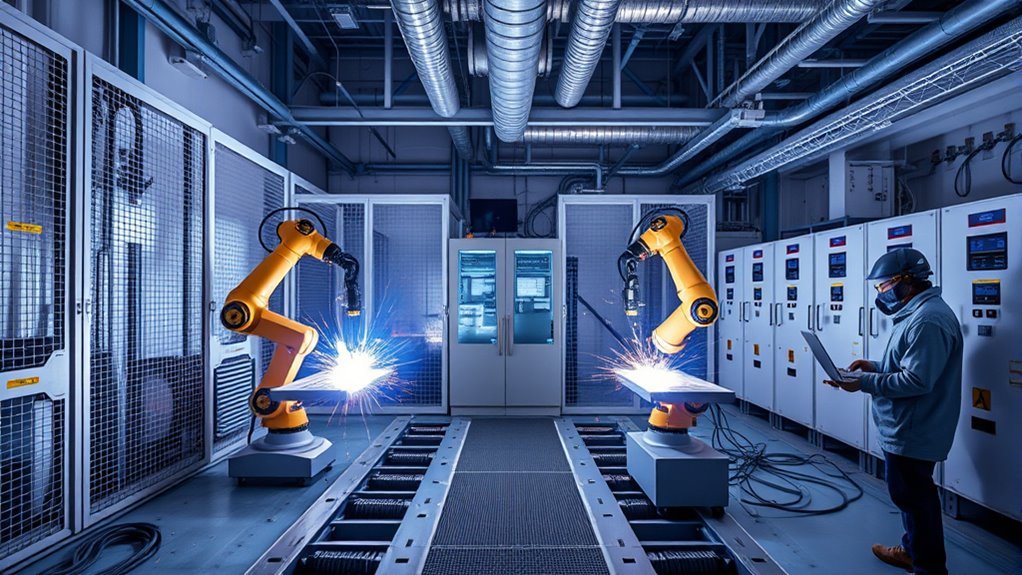
Safety and facility work should be part of the first budget, not added after the cell is purchased. In the United States, the current consensus standard is ANSI/A3 R15.06-2025, which covers industrial robots, robot applications, cells, and use. OSHA also requires employers to address machine guarding, welding hazards, hazardous energy, and worker exposure.
Warning: Do not assume a cobot welding cell can run without barriers. The application must be risk-assessed, and arc flash, hot work, fumes, sharp tooling, pinch points, flying spatter, and nearby equipment may require guarding even when the robot has collaborative safety functions.
Common safety and facility costs include:
- Risk assessment and safeguarding design: Defines hazards, operating modes, access points, stopping performance, and required protective measures.
- Fencing and interlocked access: Prevents entry into hazardous space during automatic operation.
- Safety scanners and light curtains: May stop or slow the system when a person approaches, depending on the validated design.
- Arc screens and curtains: Control exposure to ultraviolet and infrared radiation and protect nearby workers from sparks.
- Fume extraction: Source capture, hood design, ducting, filtration, and make-up air must match the process, base metal, coating, and production rate. NIOSH reports that local exhaust ventilation can substantially reduce welding-fume concentrations.
- Fire prevention: Hot-work controls, housekeeping, combustible removal, extinguishers, alarms, and any required fire watch must be planned with the facility’s safety team and insurer.
- Lockout/tagout provisions: Disconnects and written energy-control procedures are needed for servicing when unexpected startup or stored energy could injure workers.
- Utilities: Electrical service, gas, compressed air, cooling water, network drops, and ventilation capacity may require facility upgrades.
- Floor space and material flow: The quote should account for safe loading, finished-part unloading, forklift routes, maintenance access, and future changeovers.
OSHA notes that many robot incidents occur during programming, setup, testing, maintenance, and adjustment rather than routine automatic production. That makes safe manual modes, access control, training, and recovery procedures just as important as guarding during normal cycles.
Programming, Maintenance, and Consumables Costs
Ongoing cost varies too much for one monthly or annual figure to fit every shop. A cell running one stable carbon-steel part on two shifts has a different cost profile from a high-mix job shop welding stainless steel, aluminum, or coated parts. Build the budget from expected usage and supplier quotes.
Programming Setup Costs
Programming cost depends on the number of parts, weld length, joint access, sensing, positioner motion, inspection requirements, and how often jobs change. Include both initial launch and future reprogramming.
- Part and process review: Confirm weld procedure, joint design, fit-up tolerance, reach, torch angles, and sequence.
- Fixture and tool-center-point setup: Establish repeatable part location and calibrate the torch.
- Path teaching: Create approach points, weld paths, weave patterns, starts, stops, and recovery positions.
- Process tuning: Set voltage, wire feed speed, travel speed, gas flow, crater fill, and other procedure variables.
- Simulation or offline programming: May reduce on-cell downtime for complex or high-mix work, but software, CAD preparation, post-processing, and training add cost.
- Validation: Run production-equivalent parts, inspect welds, document settings, and complete acceptance testing.
Integrator and contractor rates vary by region and scope, so use quoted hours and rates rather than a generic hourly allowance. Also identify which changes your trained staff can make without paid service support.
Ongoing Maintenance Expenses
Maintenance should cover the robot, welding power source, torch, wire feeder, positioners, safety devices, extraction system, and fixtures. The annual budget may include:
- Manufacturer-recommended robot inspections and lubrication
- Preventive replacement of torch liners, cables, hoses, seals, and wear parts
- Contact-tip, nozzle, diffuser, neck, and anti-spatter-system service
- Wire-feed and drive-roll inspection
- Calibration of the tool center point, positioners, sensors, and safety devices
- Fume-extractor filter replacement and duct inspection
- Software support, backups, licenses, and cybersecurity updates
- Service-contract premiums, travel charges, and emergency callout labor
Ask suppliers for a preventive-maintenance schedule, recommended spare-parts list, response-time options, and the expected cost of wear components at your planned duty cycle.
Consumables and Replacement Parts
Model consumables from production rather than using a flat monthly estimate. Track:
- Filler metal: Pounds of wire deposited per part, transfer efficiency, spool or drum size, and supplier price.
- Shielding gas: Flow rate multiplied by arc time, plus purge or pre-flow time and leakage allowance.
- Front-end torch parts: Tips, nozzles, diffusers, liners, necks, insulators, and cleaning fluid.
- Fixture wear: Clamps, locating pins, bushings, sensors, cables, and protective covers.
- Spare assemblies: A ready torch, dress pack, wire feeder, safety switch, and critical sensor may prevent long outages.
A useful KPI is consumable cost per accepted part. Pair it with arc starts, wire used, rework, downtime, tip changes, and repair frequency to find waste that a monthly total can hide.
Training and Support Costs
Operators need instruction on loading, job selection, alarms, safe restart, quality checks, and basic consumable changes. Programmers and maintenance staff need deeper training in motion, frames, welding parameters, I/O, safety functions, troubleshooting, and backups. Required credentials and refresher intervals depend on the employer, manufacturer, welding code, customer requirements, and local rules; there is no single universal “robot welding certification” that covers every role.
Hidden Costs That Quotes Often Miss
Before approving a system, check whether the quote includes the following items:
- Freight, rigging, unloading, and floor anchoring
- Electrical panels, transformers, disconnects, gas piping, air drops, and network work
- Fume-extraction ducting, filters, make-up air, and fire-protection changes
- Sample fixtures, production fixtures, spare fixtures, and fixture prove-out
- Positioner tooling, guarding around rotating equipment, and coordinated-motion software
- Travel and living expenses for installation or service technicians
- Factory acceptance testing and site acceptance testing
- Weld procedure qualification, destructive testing, inspection equipment, and customer approval
- Operator, programmer, maintenance, and safety training
- Lost production during installation, ramp-up, debugging, and employee training
- Software subscriptions, remote-support fees, backups, and license renewals
- Recommended spare parts and backup tooling
Pro Tip: Define acceptance criteria before issuing a purchase order. Include the part number, material, weld procedure, takt time, changeover time, quality standard, uptime test, training deliverables, documentation, and who pays for corrections if the cell misses the target.
Calculating Total Cost of Ownership and ROI
Total cost of ownership includes the purchase price plus every cost required to install, run, maintain, and support the cell over the evaluation period.
TCO = capital equipment + integration + facility work + training + financing + operating cost + maintenance + downtime − residual value
For a simple payback estimate, first calculate the net annual benefit:
Net annual benefit = annual labor capacity gained + scrap/rework savings + throughput contribution + avoided outsourcing − annual operating and support costs
Simple payback period = initial project cost ÷ net annual benefit
Simple ROI = (total benefit − total cost) ÷ total cost × 100
Illustrative ROI Example
The example below shows the method only. It is not an industry benchmark and should be replaced with your plant’s actual quote and production data.
| Illustrative Item | Amount |
|---|---|
| Initial cell, integration, and commissioning | $120,000 |
| Annual labor capacity gained or redeployed | $80,000 |
| Annual scrap and rework savings | $12,000 |
| Annual contribution from added throughput | $8,000 |
| Annual service, software, training, utilities, and incremental consumables | $17,000 |
| Net annual benefit | $83,000 |
| Simple payback | About 1.45 years |
For capital approval, also test a conservative case. Lower the expected utilization, add ramp-up time, include downtime, and reduce projected labor or throughput benefits. For longer projects, use discounted cash flow, net present value, financing cost, taxes, and residual value with help from your finance team.
Data Needed for a Reliable ROI Model
- Annual production volume and expected product mix
- Manual cycle time and measured arc-on time
- Robot cycle time, loading time, and changeover time
- Fully burdened labor cost, including overtime and shift premiums
- Current scrap, repair, inspection, and customer-return cost
- Expected utilization, planned downtime, and unplanned downtime
- Consumable use per accepted part
- Maintenance, service, software, utilities, and training costs
- Value of added capacity only when the shop can sell or use that capacity
When Robotic Welding Makes Financial Sense
A welding robot is most likely to work financially when parts are repeatable, weld volume is high enough to keep the cell busy, fixtures can control variation, and the shop has people who can own the process.
| Stronger Fit | Weaker Fit or Higher Risk |
|---|---|
| Repeatable parts and joint locations | Large fit-up variation with no plan to control or sense it |
| Enough volume or recurring batches to reuse programs | One-off work that takes longer to fixture and program than to weld manually |
| Stable weld procedures and accessible joints | Frequent engineering changes and inaccessible joints |
| A trained process owner and maintenance support | No assigned owner, programmer, or maintenance plan |
| A real need for capacity, consistency, ergonomics, or labor redeployment | Savings depend on capacity that the business cannot use or sell |
Robots repeat programmed motion; they do not automatically correct poor fit-up, dirty material, unstable wire feeding, weak fixtures, or an unsuitable weld procedure. Miller notes that robotic systems need repeatable parts and fixtures unless sensing is added to handle variation.
Choosing the Right Robot for Your Production Needs
Start with the part and process, not a robot brand. A good request for quotation gives integrators enough information to design the cell and compare alternatives fairly.
- Define the parts: Provide drawings, CAD files, material, thickness, weight, joint types, tolerances, and annual volume.
- Define the weld process: List the procedure, filler metal, gas, position, quality code, inspection method, and required deposition.
- Measure the work: Record manual cycle time, arc time, loading, turning, cleaning, inspection, and changeover.
- Map access: Confirm reach, payload, torch angles, collision risks, and whether a positioner is needed.
- Control variation: Decide whether better fixtures, part redesign, touch sensing, seam tracking, or vision is required.
- Plan safety and facilities: Include the risk assessment, guarding, fume extraction, utilities, fire controls, floor space, and material flow.
- Plan staffing: Assign operators, a process owner, programming support, maintenance, and quality responsibility.
- Request lifecycle pricing: Ask for preventive maintenance, spare parts, software, training, warranty, service response, and expected wear-item costs.
- Require a prove-out: Run representative parts and confirm takt time, changeover, weld quality, alarms, recovery, and acceptance criteria before final sign-off.
Note: A modular cobot package may be the better choice for frequent product changes, while a guarded industrial cell with positioners may deliver a lower cost per part at high volume. The best system is the one that meets the production target safely and repeatedly.
Frequently Asked Questions
Is the robot arm price the same as the welding cell price?
No. A robot arm and controller normally exclude the welding power source, torch, wire feeder, table, fixtures, positioners, safety equipment, fume extraction, PLC/HMI work, programming, installation, training, and validation. Compare complete installed scopes rather than robot-only prices.
Can robotic welders operate unattended overnight or on weekends?
Only when the employer has designed and validated the system for that operating mode. The cell needs reliable part handling, fault detection, safeguarding, fume control, fire prevention, remote alarms, quality controls, and a response plan. Local rules, insurer requirements, hot-work policies, and facility procedures may restrict unattended welding.
What training is required for operators and programmers?
Operators need role-specific training on safe loading, job selection, alarms, restart, quality checks, and basic service tasks. Programmers and maintenance staff need deeper instruction in motion, coordinate frames, welding parameters, I/O, safety functions, troubleshooting, backups, and lockout/tagout. Exact credentials and refresher intervals vary by employer, equipment, welding code, and jurisdiction.
How do warranty coverage and service-contract pricing work?
Coverage varies by the robot, welder, integrator, and third-party components. Compare the warranty start date, duration, parts and labor coverage, travel charges, exclusions, preventive-maintenance requirements, remote support, response time, loaner equipment, and software support. Ask who coordinates a failure involving more than one supplier.
Are financing or leasing options available?
Yes. Manufacturers, integrators, equipment-finance companies, and banks may offer loans, leases, or subscription-style programs. Compare the total payments, interest or money factor, fees, maintenance obligations, purchase option, residual value, insurance requirements, and early-termination terms. Review tax treatment with a qualified tax professional.
Can existing jigs and fixtures be reused with a robot?
Sometimes. Existing fixtures must locate parts repeatably, resist welding distortion, provide robot and torch access, avoid collisions, and support safe loading. They may need new clamps, hardened locators, sensors, grounding, positioner interfaces, or clearance changes. Prove the fixture with representative parts before relying on it in the ROI estimate.
How long does a robotic welding system take to pay for itself?
There is no universal payback period. Vendor examples often report roughly two years or less, but actual results depend on utilization, part repeatability, labor and overtime, throughput demand, scrap, changeover time, maintenance, and ramp-up. Use a conservative model based on measured production data and include downtime.
Conclusion
A realistic robotic welding budget starts with the complete cell, not the arm. Public package prices can help you plan, but the final number depends on fixtures, positioners, sensing, safety, ventilation, facilities, integration, training, and support.
Build a line-item TCO model, prove the process on representative parts, and test a conservative ROI case. A properly scoped system can add capacity, consistency, and safer work. A poorly matched cell can become an expensive fixture. Let the part mix, takt time, weld quality, risk assessment, and usable business demand decide whether the investment makes sense.
Sources
- Hirebotics Cobot Automation Pricing — current public package starting price and included equipment.
- Vectis Automation Pricing — current all-in pricing range for many cobot welding and cutting systems.
- OSHA Technical Manual: Industrial Robot and Robot System Safety — robot hazards, lifecycle risk, and non-routine work concerns.
- Association for Advancing Automation: ANSI/A3 R15.06-2025 — current U.S. industrial robot safety standard overview.
- NIOSH: Local Exhaust Ventilation for Welding Operations — evidence supporting source-capture ventilation.
- Miller: Reducing Risk When Investing in Welding Automation — repeatable parts, fixture quality, sensing, and crash-related downtime.