
Laser welding cost starts with the machine’s advertised price, but that is only the starting point. Your final cost depends on the type of system, material and joint, production volume, safety controls, facility work, operator time, consumables, inspection, and downtime. Comparing those items together gives you a far more reliable answer than comparing laser wattage alone.
Quick Answer
Laser welding equipment has been advertised at about $7,300 for one 1.2 kW air-cooled handheld model and about $19,500 for one 1.5–2 kW three-in-one system (prices checked in July 2026 and subject to change); premium and enclosed packages are often quote-based. Your real budget must also include enclosure, extraction, electrical work, gas, PPE, training, maintenance, and downtime.
Key Takeaways
- Current advertised handheld-laser prices range widely, and premium systems may require a dealer quote.
- Wattage does not tell you whether the price includes a gun, wire feeder, chiller, PPE, enclosure, training, or installation.
- There is no reliable universal laser-welding price per meter or hourly shop rate.
- Open-beam handheld systems can require costly Class 4 laser controls, ventilation, restricted access, and specialized PPE.
- Calculate cost per productive hour and cost per accepted part before deciding whether to buy, finance, lease, or outsource.
What Determines Laser Welding Cost?
The price of laser welding depends on more than material thickness and machine power. The largest cost drivers are the system type, required weld quality, joint design, fit-up, production volume, safety package, and level of automation.
System Type
Handheld continuous-wave fiber welders are commonly used for sheet-metal fabrication. Pulsed fiber or Nd:YAG systems may be used for jewelry, molds, batteries, medical components, and other precision work. Automated laser cells add robots, motion systems, guarding, vision, fixtures, and process monitoring.
CO2 lasers still have industrial uses, but they are not directly comparable to the near-infrared fiber systems commonly sold as modern handheld metal welders. A 6 kW industrial laser source or automated cell should not be compared with a portable 1–2 kW handheld package based only on wattage.
Material and Thickness
Thicker material generally needs more laser power, slower travel, additional passes, or a different joint design. Reflective metals such as aluminum and copper can also require a laser source designed to tolerate back reflection.
The exact alloy matters. Stainless steel, mild steel, galvanized steel, aluminum, nickel alloys, titanium, and copper do not respond in the same way. Coatings, oxide, oil, moisture, and surface contamination can affect weld quality and fume generation.
Joint Design and Fit-Up
Laser welding performs best when parts fit closely and the beam can reach the entire joint. Large gaps, inconsistent edges, poor fixtures, and variable part position can slow production or require filler wire, seam tracking, rework, or a different process.
A simple lap seam on clean, repeatable sheet metal may be inexpensive to produce. A short, complex, cosmetic, code-controlled, or difficult-to-reach joint can cost much more even when the total weld length is small.
Quality and Inspection Requirements
A visual cosmetic weld is not priced the same as a weld that requires documented penetration, leak testing, destructive testing, metallography, dimensional inspection, or compliance with a customer or industry welding specification.
The quote should state the acceptance criteria, inspection method, sample size, documentation, and responsibility for rejected parts.
Typical Laser Welding Machine Prices
Laser-welder prices change with promotions, configuration, service coverage, and region. The figures below are advertised examples checked on July 28, 2026 and may have changed since. They are not universal market averages and may exclude tax, freight, installation, extraction, enclosure work, or other facility costs.
| Current Example | Advertised Price | What to Check |
|---|---|---|
| ARCCAPTAIN LW1200, 1.2 kW air-cooled handheld system | $7,299 sale price when checked | Package contents, compliance documentation, warranty, service access, PPE, and enclosure needs |
| Boss FC-Fusion, 1.5–2 kW fiber welder, cutter, and cleaner | $19,497 when checked | Selected power, included accessories, training, freight, installation, and safety infrastructure |
| IPG LightWELD, up to 2 kW | Request a quote | Model, cleaning modes, feeder, service, PPE, accessories, enclosure, and commissioning |
| Miller OptX, 1 kW and 2 kW packages | Dealer or project quote | Complete-package versus enclosure-package pricing, wire feeder, training, and service coverage |
Note: A low advertised machine price does not prove that the complete installation will be inexpensive. Ask for a line-item quote showing the laser source, gun, fiber length, feeder, nozzles, optics, cooling, PPE, enclosure, extraction, training, shipping, warranty, and commissioning.
Handheld Versus Enclosed and Automated Systems
A handheld welder may appear inexpensive because the price does not include the room or enclosure needed to control laser radiation. A turnkey package may cost more upfront but include guarding, interlocks, warning systems, process gas hardware, wire feeding, training, and service.
Automated cells can cost far more because they may include a robot, controller, vision system, seam tracking, fixtures, extraction, safety fencing, interlocks, validation, and integration. Request a complete installed quote instead of estimating an automated system from the laser-source price.
Precision and Jewelry Laser Welders
Lower-power pulsed systems are a separate category. Their cost depends on pulse control, microscope or camera system, work chamber, motion stages, spot size, service support, and application. They should not be ranked against production handheld systems by wattage alone.
Laser Welding Service Cost per Meter and per Hour
There is no dependable universal laser-welding cost per meter or national hourly rate. A supplier may quote a repeat production job by weld length, part, batch, or machine hour, but the final price normally includes more than beam-on time.
For short runs, setup and inspection can cost more than the actual laser-on time. For repeat production, fixture quality, cycle time, yield, and batch size usually control the cost per part.
How an Outsourced Quote Is Built
| Quote Component | What It Covers |
|---|---|
| Engineering and setup | Drawing review, parameter development, trial welds, programming, documentation, and first-article work |
| Fixtures and tooling | Part location, clamping, shielding-gas delivery, heat control, and repeatable joint fit-up |
| Machine and operator time | Loading, alignment, welding, unloading, cleaning, and handling—not only laser-on time |
| Consumables | Shielding gas, filler wire, protective windows, nozzles, cleaning materials, and wear parts |
| Inspection and documentation | Visual inspection, leak testing, dimensional checks, destructive tests, reports, and traceability |
| Finishing and logistics | Cleaning, passivation, grinding, packing, freight, rush handling, and minimum-order charges |
A practical estimate uses this formula:
Quoted job cost = setup and tooling + machine and operator time + consumables + inspection + finishing + freight.
Then calculate:
Cost per accepted part = total job cost ÷ number of parts that pass inspection.
For a long, repeatable seam, a supplier may convert the qualified cycle into a per-meter price. That figure should not be transferred to another material, thickness, joint, tolerance, quantity, or inspection requirement.
Pro Tip: Send the same drawing package, quantity, acceptance criteria, and delivery requirements to each supplier. A low quote may simply exclude fixtures, first-article testing, finishing, or freight that another supplier included.
Hidden and Ongoing Laser Welding Expenses
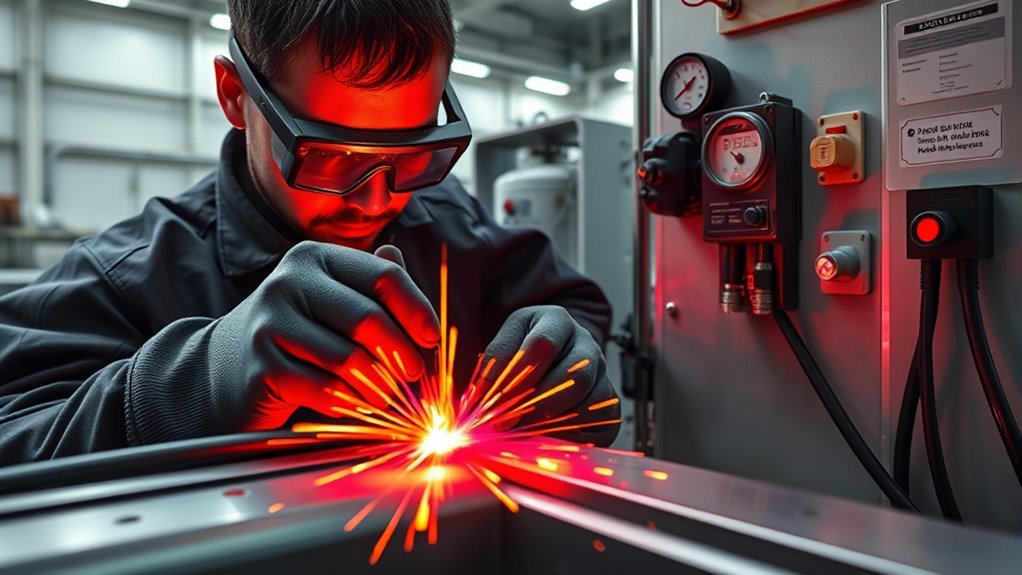
The largest budgeting mistake is treating the welder as a stand-alone power tool. A complete laser-welding operation may require facility changes, safety engineering, extraction, process gas, operator training, inspection equipment, spare optics, and a downtime plan.
Warning: Open-beam handheld laser welders commonly operate as Class 4 systems. Direct or reflected radiation can cause immediate eye or skin injury and may create a fire hazard. Do not assume that an ordinary welding curtain, helmet, or pair of glasses is laser-rated. A qualified laser-safety assessment must determine the enclosure, controlled area, interlocks, barriers, beam stops, warning systems, ventilation, procedures, and wavelength-specific PPE required for the installation.
Safety and Compliance Costs
The OSHA Technical Manual on laser hazards describes controls for Class 4 installations, including trained and authorized personnel, controlled access, suitable beam termination, warning systems, standard operating procedures, and laser protective eyewear selected for the wavelength and optical density required.
A facility may need some or all of the following:
- A rated laser enclosure, room, curtain, barrier, window, or beam stop
- Door interlocks and an emergency laser-disconnect system
- Warning signs, activation lights, restricted access, and key control
- A laser safety officer or qualified laser-safety consultant
- A documented hazard analysis and nominal hazard zone evaluation
- Written operating, maintenance, alignment, and emergency procedures
- Laser-rated eyewear and helmets matched to the system wavelength
- Fire-resistant materials and fire-response planning
- Operator, maintenance, visitor, and supervisor training
- State or local registration, permits, or inspections where applicable
Laser products sold in the United States are also subject to federal product-performance and labeling requirements described by the U.S. Food and Drug Administration. Ask the supplier for the product classification, certification label, compliance documentation, manuals, and U.S. service contact.
Fume Extraction and Air Monitoring
Laser welding can generate metal fumes and gases from the base metal, filler, plating, paint, oil, cleaners, and other surface materials. OSHA states that suitable ventilation should reduce hazardous fumes and vapors from laser welding and other laser-material interactions.
Budget for local exhaust ventilation, filters, replacement filters, ducting, make-up air, industrial-hygiene evaluation, and respiratory protection when engineering and work-practice controls cannot keep exposure within applicable limits.
Electrical, Gas, Cooling, and Installation
Installation costs may include a dedicated circuit, disconnect, grounding, voltage conversion, gas cylinders or bulk supply, regulators, hoses, chiller clearance, climate control, network connection, floor space, delivery, rigging, and commissioning.
Ask the supplier for maximum input current and total system power. Do not estimate electricity from the optical output rating alone.
Use this formula:
Electricity cost per hour = total measured input kW × local electricity rate per kWh.
Include the laser source, chiller or cooling system, wire feeder, computer, extraction equipment, and other equipment that operates during production.
Consumables and Replacement Parts
Consumables can include shielding gas, filler wire, nozzle tips, protective windows, lens components, seals, filters, cleaning materials, and damaged torch parts.
Current examples on the IPG LightWELD store include $49 nozzle tips, a $65 five-pack of protective windows, a $125 replacement focus lens, $200 laser-safety glasses, a $799 helmet, and a $2,200 wire feeder when checked on July 28, 2026. These are examples from one product family, not universal prices.
Maintenance, Service, and Downtime
Maintenance costs depend on contamination, hours, environment, cooling, handling, optics care, and service coverage. Instead of using a generic yearly allowance, request:
- The preventive-maintenance schedule and labor requirements
- Current prices for common service parts
- Expected replacement intervals for protective optics and filters
- Remote-support and on-site service rates
- Travel charges and response-time targets
- Loaner or replacement-machine availability
- Coverage for the source, fiber, gun, scanner, feeder, chiller, and labor
- Warranty exclusions for contamination, impact, misuse, and consumables
Lost production can exceed the repair bill. Include the expected cost of downtime, missed deliveries, overtime, and outsourced emergency work in the risk calculation.
Training and Qualification
Operator training should cover laser hazards, access control, PPE, system startup and shutdown, parameter selection, joint preparation, gas, filler wire, inspection, abnormal conditions, and emergency response.
Separate laser-safety training from welding qualification. A customer, contract, or welding code may require documented procedure and personnel qualification, but that is different from the facility’s laser-safety program.
Calculating Total Cost of Ownership and ROI

Total cost of ownership combines the purchase, installation, safety setup, operating expenses, maintenance, training, financing, downtime, and expected resale value over a defined period. Use productive machine hours rather than scheduled shop hours so idle time does not make the equipment appear cheaper than it is.
Step 1: Calculate the Installed Investment
Installed investment = machine + options + freight + tax + enclosure or controlled-area work + electrical work + extraction + gas equipment + commissioning + initial training.
Step 2: Annualize the Ownership Cost
Annualized capital cost = (installed investment − expected resale value) ÷ ownership years.
Add yearly fixed expenses such as service contracts, software, insurance, recurring safety reviews, calibration, scheduled training, and facility costs.
Step 3: Calculate Fixed Cost per Productive Hour
Fixed cost per productive hour = annual fixed ownership costs ÷ productive operating hours.
Productive hours should exclude training, setup that cannot be billed, breakdowns, waiting for parts, idle shifts, and time when the machine has no suitable work.
Step 4: Add Operating Cost per Hour
Total cost per productive hour = fixed ownership cost + operator labor + electricity + gas + filler wire + optics and consumables + maintenance reserve.
Step 5: Calculate Cost per Accepted Part
Cost per accepted part = setup cost ÷ accepted batch quantity + cycle time × hourly cost + part-specific consumables + inspection + rework allowance.
Worked TCO Example
The following example shows the method only. It is not a market quote.
- Machine and options: $20,000
- Safety enclosure, electrical work, extraction, delivery, and commissioning: $12,000
- Initial training and launch supplies: $3,000
- Total installed investment: $35,000
- Planning period: five years
- Conservative resale estimate: $5,000
- Annualized capital cost: ($35,000 − $5,000) ÷ 5 = $6,000 per year
- Other fixed annual costs in this example: $4,000
- Productive use: 1,000 hours per year
- Fixed ownership cost: ($6,000 + $4,000) ÷ 1,000 = $10 per productive hour
- Operator labor: $32 per hour
- Electricity: $1.50 per hour
- Gas and consumables: $3 per hour
- Maintenance reserve: $2 per hour
- Example total: $48.50 per productive hour
If a part takes three minutes of productive machine time, its time-based cost is about $2.43 before setup allocation, material, fixtures, inspection, rejected parts, finishing, packaging, and overhead.
Note: The worked example uses assumed inputs to demonstrate the calculation. Replace every input with written supplier quotes, your utility rate, loaded labor cost, expected production hours, and actual inspection requirements. Tax treatment and financing should be reviewed with a qualified financial or tax professional.
Payback and ROI
Calculate monthly savings from work that will actually move to the laser:
Monthly net savings = avoided outsourcing + saved labor + reduced rework and finishing − added laser operating costs.
Then calculate:
Payback period in months = net installed investment ÷ monthly net savings.
Do not base ROI on a vendor’s maximum welding-speed demonstration alone. Include loading, alignment, part handling, cleaning, filler-wire changes, inspection, maintenance, and the percentage of your work that is truly suitable for laser welding.
Buying, Leasing, Financing, or Outsourcing
| Option | Best Fit | Main Risk |
|---|---|---|
| Outsource | Low or uncertain volume, occasional specialty work, high product variety, or no laser-safety infrastructure | Supplier lead time, minimum charges, freight, and less process control |
| Lease or finance | Stable demand with a need to preserve cash or align payments with production | Interest, fees, insurance, return conditions, and a total financed cost above the cash price |
| Buy | Repeatable work, sufficient utilization, internal process expertise, and approved safety infrastructure | Low utilization, technical obsolescence, downtime, repair exposure, and unsuitable future work |
Outsourcing is often the safer first step when demand is uncertain. A supplier can produce sample parts, establish realistic cycle times, and reveal fixture or fit-up problems before you commit to a machine and facility project.
Tips to Reduce Purchase and Operating Costs
Match the Machine to Real Parts
Choose power, fiber length, feeder capacity, cooling, modes, and automation from your actual material list and production targets. Buying unused power or features increases capital cost without improving payback.
Send representative parts to the supplier and request documented sample welds. Test the hardest material, thickest joint, poorest access, largest expected gap, and strictest cosmetic or inspection requirement.
Improve Fit-Up Before Increasing Power
Better cutting, forming, edge preparation, and fixtures can reduce gaps, rework, filler-wire use, and parameter variation. A lower-power system with stable fit-up may outperform a larger system used on inconsistent parts.
Compare Complete Packages
Require each quote to identify:
- Laser source brand, model, wavelength, and rated power
- Gun, scanner, fiber length, nozzles, and cleaning capability
- Wire feeder, drive rolls, wire sizes, and accessories
- Cooling system and environmental limits
- Enclosure, barriers, interlocks, warning systems, and PPE
- Extraction and filter requirements
- Electrical, gas, network, and floor-space requirements
- Delivery, rigging, installation, and commissioning
- Operator and maintenance training
- Warranty terms and service-response commitments
- Consumable and common repair-part prices
- Software, updates, licenses, and remote-support charges
Track Productive Utilization
Measure setup time, beam-on time, total cycle time, accepted parts, rejected parts, consumable use, downtime, and maintenance. This shows whether the machine is producing the savings used in the original ROI estimate.
Use Preventive Maintenance
Follow the manufacturer’s cleaning and inspection schedule. Protect the fiber and gun, keep optics clean, control dust and humidity, replace contaminated protective windows promptly, and train operators to recognize abnormal reflections, overheating, gas problems, and poor weld behavior.
Compare Warranty Coverage, Not Just Duration
There is no universal laser-welder warranty. Miller currently advertises a three-year warranty for its OptX handheld category, but every buyer should read the written terms. Confirm whether coverage includes the laser source, delivery fiber, torch, scanner, controller, feeder, chiller, labor, travel, shipping, and downtime.
Pro Tip: Ask the supplier to quote a complete ready-to-produce package and a bare-machine package. The difference reveals how much of the apparent bargain depends on safety, installation, training, and service costs being purchased separately.
Questions to Answer Before Requesting Quotes
- What materials, grades, coatings, and thicknesses will be welded?
- What joint types, weld lengths, gaps, and access limits are expected?
- Is filler wire required, and which wire sizes and alloys will be used?
- What shielding gas, flow, purity, and delivery system are required?
- How many parts are needed per batch, shift, month, and year?
- What is the required cycle time?
- What cosmetic, strength, penetration, leak, and dimensional criteria apply?
- What inspection, qualification, and documentation are required?
- Who supplies fixtures, programs, parameter development, and first-article testing?
- Does the quote include a rated enclosure or controlled-area design?
- What electrical, extraction, gas, cooling, and floor-space changes are required?
- What training, warranty, service response, consumables, freight, and installation are included?
Frequently Asked Questions
What safety certifications are required for operating laser welding equipment?
There is no single federal laser-welder operator certificate. Class 4 installations require properly trained and authorized personnel, a facility-specific safety program, suitable controls, and supervision by a person qualified to manage laser hazards. ANSI Z136.1 and Z136.9 are safety standards, not operator licenses. Manufacturer training, employer authorization, welding-code qualification, and state requirements are separate issues.
Can laser welding be used on aluminum or other nonferrous metals?
Yes. Suitable systems can weld aluminum, copper, titanium, nickel alloys, and other nonferrous metals. Results depend on the alloy, thickness, reflectivity, oxide layer, joint fit-up, shielding, filler wire, and laser source. Test representative coupons and qualify the procedure before production, especially for structural, pressure, leak-tight, or safety-critical parts.
How long is the typical warranty for a laser welding system?
There is no universal warranty period. Miller currently advertises a three-year warranty for its OptX handheld-laser category, while other manufacturers use different terms. Check coverage for the source, fiber, gun, scanner, controller, feeder, chiller, labor, travel, shipping, optics, contamination, misuse, and consumables.
Do portable or handheld laser welders require special licensing?
The United States does not have one universal federal industrial-laser operator license. However, federal product rules apply to the equipment, employers must control workplace hazards, and some states or local authorities may require laser registration, permits, inspections, or operator or institution licensing. Check the applicable state radiation-control program before buying or installing the machine.
What training do operators need to run laser welders?
Operators need training appropriate to the laser class and their duties. It should cover beam hazards, reflections, access control, PPE, ventilation, startup and shutdown, parameter selection, gas, wire feeding, joint preparation, inspection, maintenance limits, abnormal conditions, and emergency response. Additional welding-procedure or personnel qualification may be required by the contract, customer, or applicable welding code.
Is laser welding cheaper than TIG or MIG welding?
It can be cheaper for repeatable parts where faster travel, lower distortion, less grinding, and reduced rework offset the higher equipment and safety cost. TIG or MIG may remain cheaper for low volume, large gaps, dirty or variable parts, field repair, complex access, or work that does not keep the laser productive. Compare cost per accepted part rather than welding speed alone.
Is laser welding normally priced per meter?
A supplier may use a per-meter price after a repeat job has stable material, fit-up, fixtures, cycle time, and inspection. Short runs and new parts are more often driven by minimum charges, engineering, setup, tooling, machine and operator time, inspection, finishing, and freight. A per-meter figure from one job should not be applied to a different part without review.
Conclusion
Laser welding can reduce cycle time, distortion, finishing, and rework on the right parts, but the advertised machine price does not reveal the full investment. Compare complete installed packages, obtain real service and consumable quotes, include Class 4 safety and ventilation costs, and calculate cost per accepted part at realistic utilization. Outsourcing sample production before buying can confirm whether the process, fixtures, quality, and savings match your shop’s needs.
Related guides: how to calculate laser welding cost, Miller laser welding cell cost, and robotic welding cost.
Sources
- OSHA Technical Manual: Laser Hazards — laser classification, controlled areas, LSO duties, training, engineering controls, PPE, fumes, and Class 4 requirements
- U.S. Food and Drug Administration: Laser Products and Instruments — federal laser-product classifications, labeling, and performance standards
- ARCCAPTAIN LW1200 Product Page — current advertised example for a 1.2 kW air-cooled handheld laser welder
- Boss FC-Fusion Product Page — current advertised example for a supported 1.5–2 kW three-in-one system
- IPG LightWELD Systems and Accessories — package features and current accessory, PPE, optics, nozzle, and feeder prices
- Miller OptX Handheld Laser Systems — current models, system capabilities, safety resources, packages, and warranty information

1 thought on “Laser Welding Cost: Machines, Services and Hidden Expenses”
Pingback: How To Calculate Laser Welding Cost: Step-by-Step Guide