
Exhaust welding cost is often about $75 to $250 for a small, accessible repair, while a welded flex-pipe job may run about $200 to $600. Treat those figures as planning ranges rather than fixed national prices: rust, access, pipe material, required parts, local labor rates, and the exact failure can move a quote well outside them.
Quick Answer
A small, accessible exhaust weld or patch is often quoted around $75 to $250, while a welded flex-pipe replacement may run about $200 to $600. These are planning ranges, not fixed national averages. Custom stainless work, severe rust, catalytic-converter problems, or full pipe replacement can cost much more. Ask whether the quote includes parts, preparation, welding, installation, and leak testing.
Last updated: August 10, 2026 — refreshed with current exhaust-pipe replacement pricing and current CDC, EPA, OSHA, and NIOSH guidance.
Key Takeaways
- A localized crack in solid metal may be weldable, but thin, flaking, or widespread rust usually requires a replacement section.
- A muffler or exhaust specialist may be able to install a universal pipe or flex section instead of replacing an expensive complete assembly.
- The cheapest quote is not necessarily the best value. Preparation, alignment, leak testing, material compatibility, and warranty terms matter.
- Exhaust leaks can expose occupants to carbon monoxide, so cabin fumes, headaches, dizziness, or unusual exhaust noise should not be ignored.
- Never remove or bypass a catalytic converter or another required emissions-control component.
At a Glance
| Time Required | About 30 minutes to 2 hours for an accessible repair; several hours for removal, fabrication, severe rust, or custom fitting |
| Difficulty | Moderate to advanced; thin exhaust tubing is easy to burn through or distort |
| Tools Needed | Suitable welder, grinder, clamps, PPE, fume extraction, fire extinguisher, vehicle lift or rated jack stands, and leak-testing equipment |
| Cost | Planning range: about $75–$250 for many small repairs and $200–$600 for many welded flex-pipe jobs; complete pipe or component replacement can exceed $1,000 |
Warning: Exhaust welding involves fire, electricity, hot metal, toxic fumes, vehicle-lifting hazards, and possible carbon-monoxide exposure. Never work beneath a vehicle supported only by a jack, never run an engine in an enclosed garage, and do not weld near fuel, brake, electrical, battery, or high-voltage components without the correct vehicle-specific procedure.
Factors Influencing Exhaust Welding Prices
The cost of welding an exhaust depends on the exact failure and the work needed before and after the weld. A technician may spend only a few minutes running the final bead but considerably longer locating the leak, removing rust, cutting damaged material, shaping a replacement section, aligning the system, and checking the completed repair.

These Stanley MaxSteel straight aviation snips are built for clean, controlled cutting through sheet metal and other tough materials. Serrated cutting edges help prevent slippage for more accurate results, while the double pivot action delivers increased cutting power with less effort. Designed for dependable performance, they are a practical choice for metalworking, HVAC tasks, and general workshop use.

This daily devotional helps parents pray purposefully for their children through a full year of Scripture readings, reflections, and guided prayer prompts. Written to encourage faithful family discipleship, it offers practical, biblically grounded support for parents who want to shape their prayers around God's Word. A foreword by Sinclair B. Ferguson adds trusted theological insight and encouragement.

Drop Stop provides complete coverage for the gap around your seat belt catch, helping keep keys, phones, and other small items from slipping into hard-to-reach spaces. Designed to move with your seat, it installs easily and stays in place without constant readjustment. This original, patented seat gap filler comes with bonus accessories for added convenience and a cleaner, safer driving experience.
Typical Exhaust Welding Costs
The following ranges are useful for planning, but they are not fixed national prices. Vehicle design, local labor rates, taxes, material, rust, and part availability can move a quote outside these ranges.
Price context: There is no single authoritative U.S. estimator for stand-alone exhaust welding. The welding figures below are planning ranges synthesized from current public repair pricing, while full component replacement has stronger national estimator data. [VERIFY: validate the stand-alone welding ranges against a documented multi-shop or first-party quote dataset before treating them as national benchmarks.] Get a vehicle-specific local quote before approving work.
| Repair Type | Planning Range | What Changes the Price |
|---|---|---|
| Small crack, seam, or hanger weld | $75–$250 | Access, shop minimum, cleaning, and surrounding metal condition |
| Weld-in flex-pipe replacement | $200–$600 | Flex section size, pipe removal, engine movement, and nearby components |
| Short replacement pipe or sleeve | $150–$500 | Bending, cutting, flanges, clamps, hangers, and material |
| Muffler or resonator work | $200–$700 | Whether the shell is repairable or the component must be replaced |
| Custom or stainless fabrication | $300–$1,500+ | Number of joints, bends, tips, finish quality, and fabrication time |
| Manifold, catalytic converter, or complete assembly | Often $500–$2,500+ | Vehicle-specific parts, sensors, emissions requirements, and labor access |
Note: A small weld and a complete exhaust-pipe replacement are different jobs. RepairPal’s estimator, updated June 18, 2026, lists an average exhaust-pipe replacement at $1,237–$1,295 before taxes, fees, location differences, and related repairs. That is why a specialist’s cut-and-weld option can save money when the remaining metal is sound and the failed section can be repaired safely.
What Is Included in the Quote?
A complete exhaust-welding quote may include:
- Inspecting the pipe, muffler, flex section, flanges, gaskets, heat shields, and hangers
- Locating the actual leak rather than relying only on the noise
- Removing rust, coatings, dirt, and weakened metal
- Cutting out the damaged section
- Supplying pipe, flex tubing, flanges, clamps, gaskets, or hangers
- Aligning and supporting the system before welding
- Welding one or more joints
- Reinstalling removed components
- Checking clearances around the body, suspension, wiring, fuel system, and heat shields
- Performing a final visual, sound, smoke, or pressure-based leak check
Ask whether the estimate includes all parts, labor, taxes, disposal fees, and post-repair testing. A quote that covers only “one weld” may rise if the technician discovers that the surrounding pipe is too thin to hold it.
Job Complexity and Access
An exposed joint near the rear of the vehicle is normally easier to repair than a leak close to the engine, firewall, catalytic converter, oxygen sensor, fuel tank, heat shield, or suspension. Rusted fasteners and narrow working space may require the exhaust section to be removed before it can be repaired safely.
Custom bends, multiple joints, dual exhausts, large truck tubing, stainless steel, and mismatched aftermarket components also increase fabrication and setup time.
Regional Variations in Labor Costs
Labor rates vary by city, state, property costs, technician availability, insurance expenses, and the type of facility performing the work. A densely populated market may have higher posted labor rates than a small town, but location alone does not determine the final price.
A specialist muffler shop may complete an exhaust repair faster than a general repair facility because it already has pipe expanders, benders, tubing, hangers, flanges, and welding equipment ready for the job. A higher hourly rate can therefore produce a lower total bill if the technician needs less time.
How to Compare Local Prices
- Describe the same job to every shop. Provide the year, make, model, engine, photos, and the location of the suspected leak.
- Ask whether an inspection fee applies. Some shops include inspection in the repair, while others charge separately.
- Request the repair method. Confirm whether the shop plans to patch, sleeve, weld in a section, replace a flex joint, or install a complete assembly.
- Compare the complete total. Include parts, labor, taxes, shop supplies, and warranty coverage.
- Ask what happens if the pipe is too rusty. The shop should obtain approval before expanding the scope of work.
Pro Tip: Ask the shop to mark the failed area in a photo and explain why it recommends welding or replacement. This makes competing quotes much easier to compare.
Quality and Workmanship Considerations
Good exhaust welding starts with sound base metal. A clean-looking bead will not last if it is attached to metal that is paper-thin, deeply pitted, contaminated, or flaking away around the joint.
| Factor | Effect on Cost and Durability |
|---|---|
| Surrounding metal | Solid metal can support a durable repair; widespread thinning usually requires a larger replacement section. |
| Preparation | Removing corrosion, coating, oil, and weak material takes time but improves weld quality. |
| Accessibility | Tight access may require component removal, additional shielding, or fabrication on a bench. |
| Material | Mild steel, aluminized steel, and stainless steel require compatible technique and filler material. |
| Alignment | Poor alignment can place stress on the weld, flex joint, hangers, manifold, or engine mounts. |
| Leak testing | A post-repair check helps identify pinholes, incomplete seams, and leaks at nearby joints. |
MIG Versus TIG Exhaust Welding
MIG welding is commonly used for steel exhaust repairs because it is relatively fast and practical for fitting replacement sections. TIG welding provides precise heat control and is often chosen for stainless steel or appearance-focused custom fabrication.
One process is not automatically better for every repair. Material thickness, contamination, access, welder setup, filler compatibility, and technician experience have a major effect on the result. Thin tubing requires careful heat control because excessive heat can burn through the pipe or distort the joint.
When an Exhaust Can Be Welded
Welding may be a good option when:
- The crack or hole is confined to a small area
- The metal around the damage is still thick and structurally sound
- A hanger or bracket has separated from otherwise usable pipe
- A universal flex section can be fitted without affecting emissions equipment
- A short damaged section can be cut out and replaced
- The repair can be completed without overheating nearby wiring, fuel lines, brake lines, sensors, or interior materials
When Replacement Is Better
Replacement is usually the better value when:
- Rust covers a large area or the pipe crumbles during cleaning
- Several leaks are present along the same section
- The muffler or resonator shell is separating at multiple seams
- The failed pipe is integrated with a catalytic converter, manifold, or complex flange assembly
- A previous patch has failed because the surrounding metal continues to deteriorate
- The pipe is crushed, badly misaligned, or internally restricted
- The repair would alter a required emissions-control component
A complete exhaust-pipe replacement can be expensive because some vehicles use large one-piece assemblies. RepairPal’s estimator illustrates how full replacement costs can be far above a localized weld, although the exact price depends heavily on the vehicle and location.
Weld or Replace? Quick Decision Guide
| Condition | Usually Better Choice | Why |
|---|---|---|
| Small crack or failed hanger on solid metal | Weld | The repair can restore the local failure without replacing sound pipe. |
| Short rusted section with sound metal on both sides | Cut out and weld in a section | Removing the weak metal gives the new section a stronger base than a surface patch. |
| Multiple holes, flaking pipe, or thin metal over a wide area | Replace the section or component | A weld cannot make badly deteriorated surrounding metal structurally sound. |
| Failure involves required emissions equipment | Use a compliant repair or replacement | The repair must preserve the certified emissions configuration and required components. |
How an Exhaust Leak Is Diagnosed
A technician normally inspects the system from the exhaust manifold to the tailpipe. The loudest point is not always the failed point because sound can travel through hollow tubing and heat shields.
The inspection may include:
- Looking for soot around cracks, flanges, gaskets, flex joints, and welds
- Checking for broken hangers or contact between the exhaust and body
- Inspecting heat shields for looseness or vibration
- Checking flex-pipe braiding and the inner liner
- Listening during a cold start, when some leaks are easier to hear
- Using a professional smoke or low-pressure leak test
- Checking engine movement or damaged mounts when flex joints fail repeatedly
Choosing Between Professional and DIY Repairs
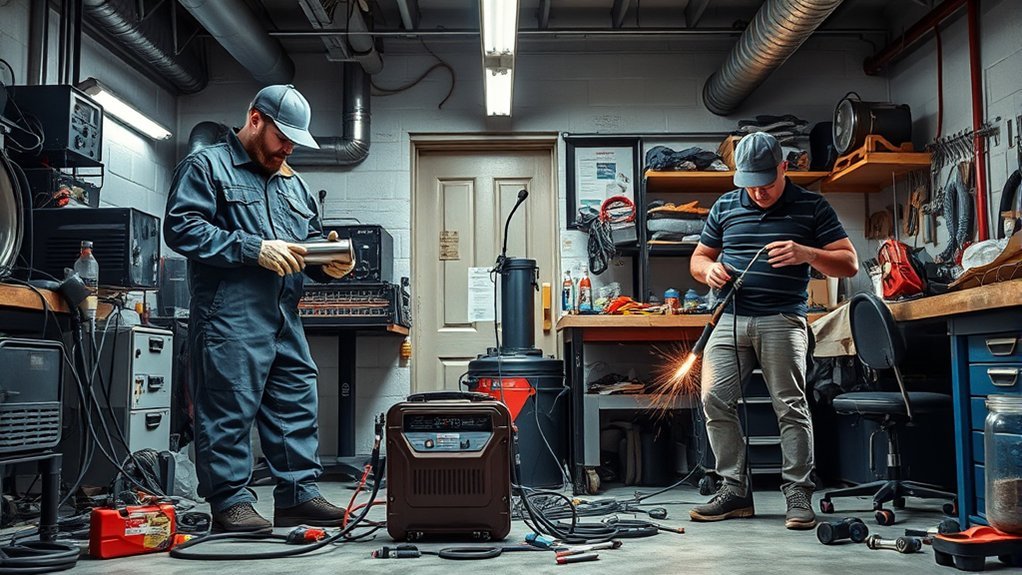
The decision between professional and DIY exhaust welding should be based on safety, equipment, access, material condition, and experience rather than labor cost alone.
Weighing Cost vs. Time
A simple professional repair may be completed in less than two hours when the leak is easy to reach and the surrounding pipe is solid. Rust removal, cutting, component removal, custom bending, alignment, and multiple welds can extend the work to several hours.
DIY work may appear cheaper, but setup and preparation often take longer than the weld itself. Savings are most realistic when you already own the correct welder, protective equipment, grinder, clamps, lifting equipment, fire protection, and ventilation system.
Buying all of that equipment for one repair can cost more than paying an exhaust specialist.
Tool Access and Skills
A properly equipped DIY workspace may require:
- A MIG or TIG welder suitable for the exhaust material and thickness
- Compatible wire, shielding gas, electrodes, or filler rod
- An auto-darkening welding helmet with the correct shade
- Welding gloves, protective clothing, and eye and hearing protection
- An angle grinder with suitable cleaning and cutting discs
- Exhaust clamps, locking pliers, magnets, or alignment fixtures
- A vehicle lift or correctly rated jack stands on solid, level ground
- Local fume extraction or effective mechanical ventilation
- A suitable fire extinguisher and shielding for nearby components
- Vehicle-specific service information for batteries, modules, sensors, airbags, and high-voltage systems
Thin exhaust tubing is less forgiving than thicker structural steel. Poor fit-up, excessive wire speed, incorrect heat, contamination, or long continuous beads can create burn-through, distortion, incomplete fusion, pinholes, or leaks.
Quality and Safety Considerations
The Occupational Safety and Health Administration’s welding standard requires workplace controls for welding fire and ventilation hazards. NIOSH guidance on welding ventilation also explains that welding fumes vary with the base metal, coatings, filler material, and process, with some stainless and coated metals presenting additional hazards.
Warning: Never weld on an exhaust while fuel is leaking, while the vehicle is supported only by a hydraulic jack, or while combustible material is exposed to sparks. Remove or shield nearby combustibles, keep extinguishing equipment ready, and inspect the area for smoldering material after the hot work ends.
Do not assume that removing one battery cable protects every vehicle module. Some vehicles have multiple 12-volt batteries, retained power, sensitive electronics, or high-voltage hybrid systems. Follow the manufacturer’s service procedure and place the welding return clamp as close to the work as practical so current does not travel through bearings, modules, or unrelated circuits.
Because the CDC warns that a small exhaust leak can allow carbon monoxide to build up inside a vehicle, the engine should not be run in an enclosed garage. Stop using the vehicle and seek urgent inspection if exhaust odor enters the cabin or occupants develop headache, dizziness, nausea, weakness, confusion, or unusual tiredness.
Emissions and Legal Considerations
Exhaust repair must preserve required catalytic converters, oxygen sensors, and other emissions-control equipment. The U.S. Environmental Protection Agency explains that removing or rendering a catalytic converter inoperative is illegal under federal law.
Do not authorize a shop or DIY modification that replaces a catalytic converter with straight pipe, relocates required sensors improperly, or defeats the certified emissions configuration. State inspection and emissions rules may add further requirements.
Impact of Shop Type on Pricing

Shop type can affect price, but it does not guarantee workmanship. The best choice is a facility that regularly performs exhaust fabrication, can explain the repair method, uses compatible materials, and provides clear warranty terms.

This hardcover cookbook offers fast, approachable recipes designed for busy days and low-energy nights. Caroline Chambers focuses on simple, flavorful meals that help you get dinner on the table without overthinking it. It's a practical pick for home cooks who want quick weeknight inspiration and minimal-fuss cooking.

This heartfelt memoir blends laugh-out-loud honesty with tender reflections on love, loneliness, and the unexpected healing power of rescue dogs. Isabel Klee shares her journey fostering pups in the city while navigating dating and self-discovery, offering an intimate, relatable story for readers who enjoy emotional, character-driven narratives. It is a warm, engaging read about opening your heart and finding connection in surprising places.

The Bosch Professional GBA 18V 5.0Ah CoolPack Lithium-Ion Battery delivers extended runtime for demanding trade and DIY applications. Its CoolPack technology helps protect the battery against overheating and supports longer service life, while the rugged design is built to handle tough jobsite use. Fully compatible with Bosch Professional 18V tools, it offers flexible power across the same voltage class.
Independent Shop Savings
An independent exhaust or muffler specialist may offer a cost-effective repair because it can fabricate a short section instead of replacing a complete manufacturer assembly. Lower overhead may also help, but the shop’s equipment and experience are more important than its ownership structure.
Ask whether the technician regularly repairs your exhaust material, whether the system must be removed, and whether the shop will leak-test the completed work.
Chain Store Overheads
A national chain may use standardized labor procedures, approved parts, and written warranty policies. It may also recommend complete component replacement when local fabrication is not part of its normal service.
That approach can cost more than a weld-in repair, but it may be appropriate when the original assembly is severely rusted, emissions-certified, integrated with a catalytic converter, or unsuitable for a durable patch.
| Provider | Possible Advantage | Question to Ask |
|---|---|---|
| Exhaust or muffler specialist | Fabrication equipment and frequent welding experience | Can you install a replacement section instead of the complete assembly? |
| Independent general shop | Personalized diagnosis and flexible parts sourcing | Do you weld exhausts in-house or send the work elsewhere? |
| National chain | Standardized processes and written policies | Is fabrication available, or is full replacement the only option? |
| Dealership | Vehicle-specific procedures and original-equipment parts | Is the component covered by an emissions or vehicle warranty? |
| Mobile or home-based welder | Convenient service and potentially lower overhead | Do you have safe lifting, fire control, ventilation, insurance, and a written warranty? |
Home-Based Services Benefits
A qualified mobile or home-based provider may offer flexible scheduling and competitive pricing. However, vehicle exhaust work requires more than a portable welder. The provider needs stable vehicle support, adequate working clearance, fume control, fire protection, compatible materials, and a safe way to inspect and test the repair.
Before booking, confirm business insurance, experience with automotive exhausts, the repair location, payment terms, and warranty coverage. Avoid anyone who plans to weld under a vehicle supported only by a jack or who offers to remove required emissions equipment.
Customer Experiences and Expectations
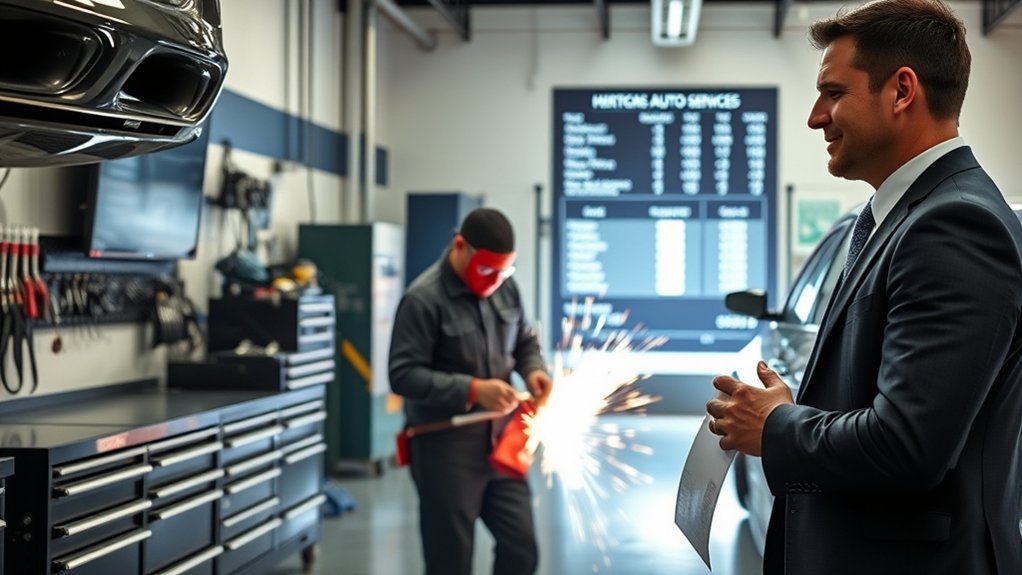
Two drivers can receive very different exhaust-welding quotes without either quote being automatically unfair. One vehicle may need a single clean weld, while another requires rust removal, a new flex joint, custom pipe, oxygen-sensor handling, or removal of an entire assembly.
The estimate should describe the actual failed part and the proposed repair. Useful wording includes “cut out and replace 8-inch rusted pipe section,” “install universal stainless flex joint,” or “reweld broken rear hanger.” A vague line such as “repair exhaust” makes it difficult to judge the value.
Questions to Ask Before Approving the Repair
- Where is the leak, and can you show it to me?
- Is the surrounding metal thick enough to support a durable weld?
- Are you patching the hole or replacing the weakened section?
- What pipe material and diameter will you use?
- Does the quote include parts, removal, welding, installation, and leak testing?
- Could hidden rust change the price?
- Will you contact me before doing additional work?
- Does the repair preserve all required emissions equipment?
- What written warranty applies to the weld, part, and labor?
Establishing a relationship with a trustworthy mechanic can make future repairs easier, but clear communication and written scope are more dependable than expecting an informal discount.
Tips for Finding Affordable Welding Services

The lowest-cost durable repair usually comes from matching the repair method to the condition of the exhaust. Paying for a small weld makes sense when the surrounding metal is sound. Repeatedly patching a badly rusted pipe does not.
- Start with an exhaust specialist. A muffler shop may have more fabrication options than a shop that replaces only complete assemblies.
- Get two or three itemized quotes. Make sure each provider is pricing the same repair method.
- Ask about a weld-in section. A universal flex pipe or short pipe section may cost less than a complete vehicle-specific assembly.
- Check warranty coverage first. Catalytic converters and some emissions components may have separate manufacturer or federal warranty coverage.
- Do not approve an emissions delete. A cheap straight-pipe option can be illegal and may trigger warning lights, inspection failure, excess emissions, or drivability problems.
- Evaluate the surrounding rust. A larger replacement section may cost more initially but last longer than a patch on weak metal.
- Use reviews carefully. Look for repeated comments about exhaust fabrication, accurate quotes, leak-free work, and warranty support rather than relying only on an overall star rating.
- Request approval limits. Tell the shop to contact you if the repair will exceed the written estimate by an agreed amount.
Pro Tip: A quote that includes cutting away all weak metal, fitting a compatible section, supporting the exhaust correctly, and checking for leaks may provide better value than a cheaper surface patch.
Frequently Asked Questions
What tools are needed for DIY exhaust welding?
You need a welder suited to the pipe material, compatible filler or wire, a welding helmet, gloves, protective clothing, grinder, clamps, replacement tubing, fire extinguisher, fume extraction, and a lift or correctly rated jack stands. You also need vehicle-specific electrical and high-voltage safety information. Never work under a vehicle supported only by a jack.
How long does an exhaust welding repair take?
A small, accessible weld may take about 30 minutes to two hours after inspection. A rusted flex pipe, custom section, seized hardware, component removal, or multiple leaks can require several hours. Ask whether the quoted time includes diagnosis, cooling, installation, and leak testing.
Are there warranties for exhaust welding repairs?
Many shops offer some form of workmanship or part warranty, but coverage varies. Ask for the duration and exclusions in writing. A shop may not cover a new crack that develops in a different area of an old, rusted exhaust system.
Can welding affect exhaust-system performance?
Yes. A correctly fitted and sealed repair should restore exhaust flow and prevent leaks. A misaligned, restricted, incomplete, or leaking weld can create noise, vibration, reduced clearance, exhaust odor, warning lights, or abnormal sensor readings.
Is repairing an exhaust better for the environment?
Repairing a sound component can reduce material waste compared with replacing a complete assembly. However, the repair must remain leak-free and preserve every required emissions-control device. Removing or bypassing a catalytic converter increases pollution and can violate federal and state law.
Can a badly rusted exhaust be welded?
Only if enough solid metal remains around the damaged area. If cleaning exposes several holes, thin edges, deep scaling, or crumbling pipe, a new pipe section or component is usually more durable than welding over the rust.
Can I drive with an exhaust leak?
An exhaust leak should be inspected promptly because fumes may enter the cabin and damaged parts can separate or contact nearby components. Stop driving and arrange safe transport if fumes enter the cabin, the exhaust becomes extremely loud, a pipe hangs low, or anyone develops headache, dizziness, nausea, weakness, or confusion.
Is it cheaper to weld or replace an exhaust?
Welding is usually cheaper when the damage is localized and the surrounding metal is solid. Replacement is usually better value when rust is widespread, several leaks are present, or the repair would require extensive fabrication on weak metal. Compare the complete quoted repair with the price and expected life of a replacement section.
How long can a welded exhaust repair last?
There is no reliable universal lifespan. A weld on clean, solid, correctly aligned metal can last much longer than a patch attached to thin or heavily corroded pipe. Durability depends on metal condition, preparation, fit-up, heat cycling, vibration, road salt, moisture, and whether the original cause of the failure was corrected.
Sources
- Occupational Safety and Health Administration: Welding, Cutting, and Brazing Requirements — welding ventilation, fire prevention, hot-work precautions, and fire-watch guidance
- Centers for Disease Control and Prevention: Carbon Monoxide Poisoning Basics — vehicle exhaust leaks and carbon-monoxide safety
- NIOSH Engineering Controls Database: Welding Ventilation — welding-fume hazards and local exhaust ventilation
- U.S. Environmental Protection Agency: Transportation Air-Pollution Questions — federal catalytic-converter tampering rules
- RepairPal Exhaust Pipe Replacement Cost Estimator — national replacement-cost estimate updated June 18, 2026, plus diagnostic and repair context
Conclusion
A small exhaust weld is often quoted around $75 to $250, but that figure should be treated as a planning range rather than a fixed national average. Flex-pipe replacement, custom fabrication, severe rust, and component replacement can raise the bill substantially. The best repair is not always the smallest patch or the cheapest quote. It is the option that removes weak metal, uses compatible material, restores alignment, seals the leak, preserves emissions equipment, and includes a proper safety and leak inspection.
Ask for an itemized quote, compare the same repair method at more than one qualified shop, and choose replacement instead of welding when the surrounding exhaust is too thin or corroded to support a lasting repair.

This practical guide brings together traditional skills and self-sufficiency knowledge in one accessible reference. It helps readers learn time-tested home, craft, and survival techniques with clear guidance suited for beginners and hobbyists alike. Ideal for anyone interested in homesteading, DIY living, or preserving old-fashioned know-how.

The ANCEL AD310 is a compact OBD II scanner designed to quickly diagnose check engine light issues by reading and clearing emission-related trouble codes. It also provides live data, freeze frame, I/M readiness, and vehicle information, making it a practical tool for drivers and home mechanics. With broad compatibility across many 1996 and newer OBD2 vehicles, it is a simple, fast, and portable way to check engine problems.

The Veepeak OBDCheck BLE is a Bluetooth OBD-II scanner designed for iOS and Android users who want an easy way to read and clear check engine light codes. It supports generic diagnostics such as freeze frame data, I/M readiness, and live sensor readings through compatible third-party apps. Built for most 1996+ vehicles in the US, it connects over Bluetooth LE and works with popular apps for everyday vehicle troubleshooting and monitoring.
