Editorial Review: Hospitality & Travel Analysis Team
The baseline average cost of a two-bedroom hotel suite in major U.S. cities ranges from $348 to over $700 per night before taxes, depending on location, hotel star tier, and seasonal demand. Because hoteliers do not track two-bedroom suites as a separate nationwide market category in industry reports, the most reliable benchmark is doubling the local standard Average Daily Rate (ADR) or GSA lodging per diem and factoring in a living room/kitchen premium.
Quick Answer
There is no single official national average rate for two-bedroom hotel suites. A practical baseline starting benchmark is $347.52 per night before tax for two standard rooms, based on June 2026’s national hotel average daily rate (ADR) of $173.76. In high-demand markets like New York City, Los Angeles, and San Francisco, true two-bedroom suites frequently cost between $500 and $1,200+ per night during peak dates.
Key Takeaways
- No single authoritative industry source publishes a dedicated nationwide daily average specifically for two-bedroom suites.
- Use two standard rooms at the destination’s market ADR as your starting price benchmark, then evaluate the suite’s all-in price.
- Location, major event dates, property tier, kitchen features, maximum occupancy, and cancellation flexibility cause dramatic rate swings.
- Under FTC rules enforced since May 2025, initial displayed hotel rates must include all mandatory resort and destination fees.
- For stays exceeding seven nights, contact property sales offices directly to secure extended-stay discounts not listed online.
How Much Does a 2-Bedroom Hotel Suite Cost in Major US Cities?
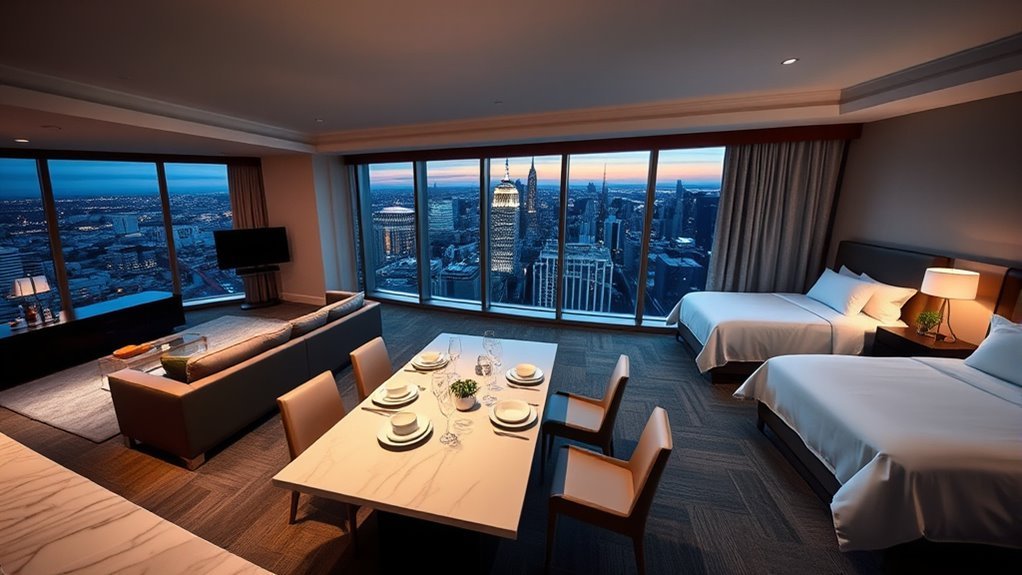
Flat national figures like “$5,300 per month” or “$7,000 in NYC” are too broad to serve as reliable planning metrics. Hotel analytics organizations track the average daily rate (ADR) across all sold rooms, but they do not publish an isolated national ADR metric dedicated solely to two-bedroom suite inventory.
For market context, CoStar reported a U.S. national hotel ADR of $173.76 in June 2026. Reserving two standard rooms at that nationwide average equals $347.52 per night before taxes. A true two-bedroom suite may cost roughly the same as two rooms, slightly less, or significantly more when it includes dining quarters, a full kitchen, a premium view, or executive lounge access.
New York City highlights why a single national average is inaccurate. In full-year reports, NYC led major U.S. markets with an overall average room rate of $333.71 for a single standard room. Doubling that benchmark establishes a baseline of $667.42 per night before tax, though scarce Manhattan luxury two-bedroom suites frequently command far higher totals.
Decision Framework: The 2-Bedroom Suite Pricing Formula
To estimate a realistic rate for any city, use this benchmark calculation:
Estimated Suite Rate = (2 × Local Standard Room ADR) + Suite Premium (10% to 50%) + Local Mandatory Fees
If the suite quote is lower than two standard rooms at the same hotel, it represents a cost-effective choice for group accommodation.
The most accurate price benchmark is not an arbitrary national suite average—it is the all-in quote for your exact dates compared directly with two standard rooms in the same neighborhood.
City Price Benchmarks for Travel Planning
The table below references FY 2026 GSA lodging rates as a standardized single-room baseline. These represent federal government reimbursement limits before taxes, not consumer averages or suite quotes. Doubling the figure establishes a realistic baseline for two standard rooms.
| City | One-Room GSA Benchmark | Two-Room Baseline | Key Factors Elevating Suite Rates |
| New York City | $179–$342 | $358–$684 | Manhattan location, tight inventory, skyline views, holidays, and high-demand conventions |
| Los Angeles | $191 | $382 | Coastal zones, Beverly Hills, valet parking fees, resort amenities, and major entertainment events |
| San Francisco | $259–$272 | $518–$544 | Tech convention schedules, downtown proximity, parking charges, and bay views |
| Chicago | $142–$234 | $284–$468 | Peak summer tourism, McCormick Place conventions, Loop location, and lake views |
| Atlanta | $182–$197 | $364–$394 | Downtown sport events, regional trade shows, Midtown location, and residential layouts |
Floor Plan Alert: A true “two-bedroom suite” features two completely enclosed bedrooms with privacy doors. Some booking platforms label one-bedroom suites with pull-out sofas or adjoining rooms under confusing terms. Always confirm the unit’s schematic layout before confirming payment.
What Key Factors Drive Two-Bedroom Hotel Suite Rates?
Suite pricing is governed by more than physical square footage. Two properties in the same zip code can quote wildly different rates depending on layout features, included services, and booking conditions.
How Does Location and Neighborhood Affect Suite Pricing?
Central business districts, beachfront strips, convention centers, and properties near major sports arenas command premium nightly rates. Parking charges can also significantly alter the real cost. A suburban suite charging $300 per night with free parking can end up cheaper than a $270 downtown suite charging $65 for overnight valet parking.
How Do Seasons and Major Events Drive Rates?
Room rates flex dynamically alongside academic holidays, convention calendars, concert series, athletic tournaments, and weather shifts. Major regional events cause surge pricing across surrounding municipalities. During June 2026, U.S. national hotel ADR increased 6.7% year-over-year, supported by host-city travel surges. Rate spikes remain concentrated in high-demand markets rather than evenly distributed nationwide.
How Do Suite Layouts and Living Features Change the Price?
A true two-bedroom suite frequently includes two full bathrooms, a dining area, a full kitchen, en-suite laundry, and a separate living room. These features raise base rates above standard connecting rooms. Review the maximum guest capacity and bed configurations carefully—a suite advertised for six guests might feature two king beds and a sleeper sofa rather than three fixed beds.
How Do Cancellation Policies and Booking Rules Impact Rates?
Flexible, fully refundable rates carry a 10% to 20% premium over nonrefundable, prepaid rates. Review security deposit requirements, early-departure penalties, and date-change flexibility. A cheaper nonrefundable rate offers poor value if travel plans remain subject to change.
How Does Pricing Vary Across Hotel Star Tiers?
Star ratings indicate amenity levels and service quality, but they do not establish fixed pricing floors. Broad generalizations—such as $400–$650 for 3-star suites or $1,200+ for 5-star suites—do not hold true across all U.S. markets.
Understanding Hotel Rating Systems
Online travel agencies frequently apply independent rating algorithms. Professional inspection programs use stricter criteria—AAA relies on its Diamond designation program, while Forbes Travel Guide employs a luxury Star rating framework.
- Midscale and extended-stay properties: Prioritize functional space, fully equipped kitchens, complimentary breakfast, and predictable value (e.g., Residence Inn, Homewood Suites, Element).
- Upscale hotel properties: Feature expanded dining options, full service desks, state-of-the-art fitness centers, and enhanced finishes (e.g., Marriott, Hilton, Hyatt Regency).
- Luxury properties: Provide prime addresses, dedicated concierge service, multiple marble bathrooms, gourmet kitchens, club lounge access, and personalized staff services (e.g., Ritz-Carlton, Four Seasons, St. Regis).
Comparing Physical Room Features Over Star Tiers
Focus on the specific room inventory rather than star counts alone. A spacious two-bedroom residence suite at an extended-stay hotel may offer superior utility for a travelling family compared to a smaller luxury suite at double the rate. Always verify square footage, bath counts, kitchen equipment, housekeeping frequency, and included amenities before booking.
What Seasonal Pricing Patterns Should You Expect?
Dynamic hotel pricing engines react to live booking velocity. Peak rates do not follow a fixed percentage jump, and off-season discounts vary depending on local market demand.
- Audit city event calendars: Search for major conventions, sporting events, festivals, and university graduations that create compression nights.
- Explore neighboring districts: Booking a property a few metro stops away can substantially reduce nightly room and parking expenses.
- Test flexible date windows: Adjusting your arrival or departure by a single day can unlock lower rate tiers.
- Compare weekday vs. weekend patterns: Financial districts feature lower weekend rates, whereas resort destinations drop in price midweek.
- Monitor refundable reservations: If public rates decrease prior to arrival, rebook at the lower rate under flexible cancellation policies.
What Are the Best Strategies for Securing Suite Discounts?
Rather than relying on fixed booking rules (such as “always book 30 days early”), use a structured comparison protocol:
- Search for precise room classifications: Input “two-bedroom suite,” “two-bedroom residence,” and “two-bedroom apartment,” and verify that both bedrooms feature full privacy doors.
- Compare three layout choices: Benchmark one two-bedroom suite against two standard rooms and an equivalent vacation rental for your exact travel dates.
- Calculate the all-in total: Account for mandatory resort charges, taxes, parking fees, pet surcharges, and breakfast costs.
- Check direct brand channels: Hotel direct sites often offer member-only discounts, complimentary Wi-Fi, and superior cancellation terms.
- Engage property sales teams: For stays exceeding seven nights or multi-suite bookings, direct sales contact can unlock unlisted extended-stay discounts.
- Evaluate loyalty point value: Premium multi-bedroom suites require higher point redemptions or may be excluded from standard reward inventory.
- Evaluate bundled packages: Flight-plus-hotel bundles can reduce total travel costs, provided cancellation rules remain manageable.
Pro Tip: Request an email confirmation from the hotel detailing the exact room name, bedding configuration, bathroom count, kitchen appliances, and guaranteed connecting layout prior to submitting nonrefundable payments.
What Hidden Fees and Taxes Affect Hotel Suite Totals?
U.S. lodging taxes vary widely across states, counties, and cities, ranging from 10% to over 18% when combining state sales taxes, city occupancy charges, and special tourism assessment districts.
Under the FTC’s Rule on Unfair or Deceptive Fees enforced since May 12, 2025, lodging sellers must prominently display the upfront total price inclusive of all mandatory fees. Government-imposed taxes may be calculated later in the checkout flow but must be clearly itemized before final payment.
- Mandatory resort or facility fees: Must be integrated into upfront rate displays under federal FTC guidelines.
- Government taxes and municipal fees: Itemized before final payment authorization.
- Overnight parking charges: Often optional, but can add $30–$80+ per night in metropolitan centers.
- Pet, extra-guest, and rollaway charges: Depend on guest counts and hotel pet policies.
- Security deposits and incidental holds: Temporary credit card authorizations that restrict available funds during stay duration.
- Early departure and cancellation penalties: Stipulated in specific rate terms and enforced during schedule changes.
New York City presents a complex tax structure, combining a 5.875% city occupancy tax, state and local sales taxes, a daily tiered city hotel fee, and a $1.50 state unit charge. Tax exemptions may apply for continuous extended stays exceeding 180 days under New York State Tax Department regulations.
Warning: Never base booking decisions on the preliminary base rate shown in search engines. Compare the grand total for the full stay, inclusive of resort fees, taxes, parking, and refundability terms.
How Does Length of Stay Affect Suite Pricing?
Extended stays frequently unlock discounted weekly, monthly, corporate, or relocation rates. Discount levels depend on seasonal occupancy, housekeeping frequency, and whether the hotel specializes in extended-stay accommodations.
Dedicated extended-stay hotel brands—such as Residence Inn by Marriott, Homewood Suites by Hilton, Staybridge Suites by IHG, and Element by Westin—are specifically designed around multi-bedroom configurations featuring full kitchens and dedicated workspace layouts.
When negotiating long-term suite stays, request details on:
- Discounted weekly or monthly flat rates rather than standard nightly rates multiplied by total nights
- Minimum length-of-stay commitments and early departure fee structures
- Housekeeping service schedules (e.g., daily vs. weekly full clean)
- In-suite kitchen equipment, laundry access, parking allowances, and mail reception
- Local tax exemption thresholds (often taking effect after 30 or 90 consecutive days)
- A written, itemized agreement detailing the full stay cost and deposit refund policies
Hotel Suites vs. Vacation Rentals: Which Is Best?
Choosing between a two-bedroom hotel suite, two standard rooms, or a vacation rental depends on service expectations, space requirements, local municipal regulations, and total costs.
| Accommodation Type | Best Suited For | Key Checks Before Booking |
| Two-bedroom hotel suite | Families and groups desiring communal living space plus on-site hotel services | Enclosed bedroom count, bathroom numbers, kitchen appliances, occupancy limits, and housekeeping rules |
| Two standard hotel rooms | Individual privacy, separate bathrooms, and broader availability across property tiers | Whether connecting or adjacent room guarantees are confirmed in writing |
| Vacation rental | Residential neighborhoods, larger kitchen spaces, in-unit laundry, and multi-week stays | Municipal legal compliance, cleaning fees, host rating history, cancellation terms, and total pricing |
Hotel suites provide 24/7 staff presence, standardized cleanliness protocols, daily or scheduled housekeeping, luggage storage, and predictable security. Vacation rentals offer home-like amenities, but service responsiveness and facility quality vary by individual owner. Reserving two standard rooms often represents the most cost-effective solution when suite premiums are elevated.
What Essential Amenities Should Families Look For?
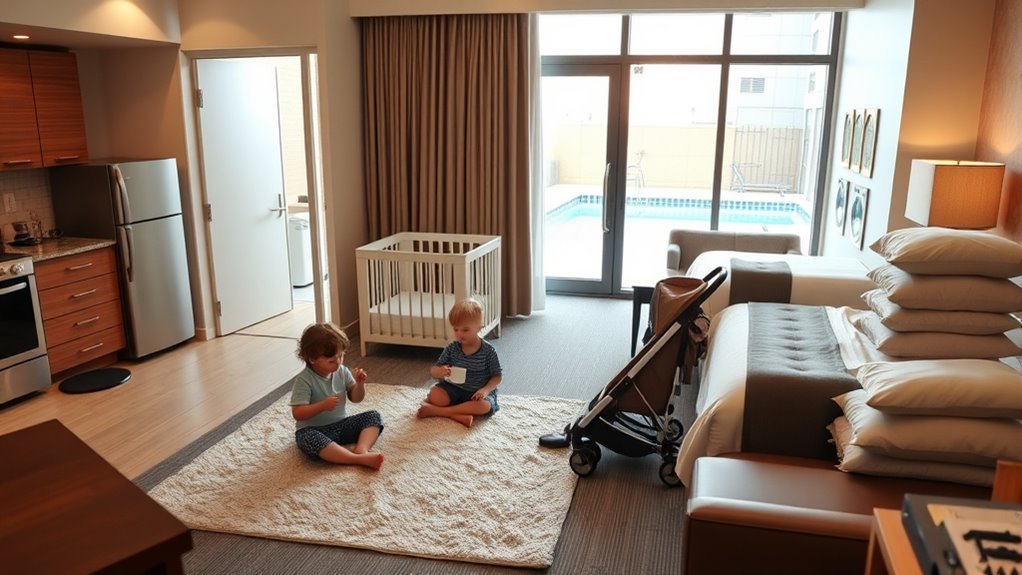
A suite rate is only advantageous if the physical layout supports your group’s operational needs. Evaluate key physical amenities before booking:
- Enclosed sleeping rooms: Confirm both bedrooms feature solid interior doors and distinct bed types.
- Bathroom counts: Two full bathrooms prevent morning bottlenecks for larger groups.
- Kitchen functionality: Distinguish between full kitchens (stove, oven, full refrigerator) and kitchenettes (mini-fridge, microwave only).
- In-suite laundry: In-room washers and dryers add significant value during extended family stays.
- Seating capacity: Ensure living and dining furniture comfortably seats all registered guests.
- Included meals and housekeeping: Free daily breakfast offsets higher room rates; review housekeeping schedules for extended stays.
- Child and infant equipment: Confirm crib availability, rollaway fees, pool safety rules, and childproofing options.
- Accessibility compliance: Under U.S. Department of Justice ADA Title III rules, hotel reservation systems must detail accessible features (doorway widths, roll-in showers, grab bars) and hold reserved accessible inventory.
What Trends Are Shaping Future Suite Prices?
Industry-wide hotel forecasts reflect overall market trends rather than isolated suite pricing. In 2026, CoStar and Tourism Economics adjusted full-year U.S. hotel performance forecasts following solid demand growth, with host markets benefiting from major international event travel.
Demand for spacious accommodations with full kitchen features remains high among families and remote workers. While hoteliers continue converting properties into residence-style inventory, hyper-local supply, construction costs, and event schedules will remain the primary drivers of suite rates.
Frequently Asked Questions
What is the average cost of a two-bedroom hotel suite in the USA?
No official national average is published for this exact room category. As a practical benchmark, reserving two standard hotel rooms averages approximately $347.52 per night before taxes based on June 2026 U.S. hotel ADR ($173.76). True two-bedroom suites range from $350 to over $1,200 nightly depending on location and tier.
Is a two-bedroom suite cheaper than two hotel rooms?
Sometimes. Compare the suite’s all-in quote against two standard rooms at the same property. Factor in kitchen savings, complimentary breakfast, parking charges, bathroom counts, and cancellation flexibility before deciding.
What is a reasonable cost for a hotel room?
A reasonable cost depends on city market conditions, travel dates, and hotel tier. Use local market ADRs or federal GSA lodging per diem rates as your baseline benchmark, then evaluate the all-in total for your travel window.
What is a typical hotel suite layout?
A standard suite features a designated sleeping area plus a separate living space. A true two-bedroom suite contains two separate, fully enclosed bedrooms with doors, though bathroom numbers, kitchen facilities, and living room bedding vary across properties.
Do hotels offer monthly discounts on two-bedroom suites?
Yes. Many extended-stay properties offer weekly, monthly, corporate, or relocation rates. Contact property sales departments directly for written extended-stay quotes, and review housekeeping terms, minimum stay rules, and local tax exemptions.
How much does an average hotel cost to buy?
Commercial hotel purchase costs vary dramatically based on location, room count, property condition, brand affiliation, and cash flow. Valuation requires commercial real estate appraisals, operating statement reviews, and professional feasibility studies.
Conclusion
A two-bedroom hotel suite offers an exceptional balance of communal space and privacy for group travel, but generic nationwide monthly averages are misleading. Establish your baseline cost using double the local standard room ADR, verify that the floor plan contains two private bedrooms, and calculate the grand total inclusive of fees and taxes. The best choice is the option that meets your space requirements while delivering superior all-in value.
Sources
- CoStar: U.S. Hotel Performance Data for June 2026 — national ADR metrics, occupancy figures, RevPAR, and event impact.
- CoStar: Full-Year U.S. Hotel Performance Reports — national and New York City ADR performance benchmarks.
- U.S. General Services Administration (GSA) Per Diem Rates — FY 2026 federal lodging reimbursement baselines.
- Federal Trade Commission (FTC) Unfair Fees Rule FAQs — mandatory display guidelines for short-term lodging fees.
- New York State Department of Taxation and Finance — hotel room occupancy tax rules and long-stay exemption criteria.
- U.S. Department of Justice ADA Title III Regulations — accessible lodging reservation and room description requirements.