

Dubai can offer strong take-home pay because the UAE does not levy personal income tax on individual employment earnings, but housing, school fees, cooling, transport, and move-in charges can make the city expensive. A realistic budget therefore depends less on one citywide “average” and more on where you live, whether you have children, how you commute, and which benefits your employer provides.
Quick Answer
Living alone in Dubai in 2026 commonly requires about AED 8,000–12,000 per month for a modest lifestyle outside prime districts, or AED 13,000–18,000 with a one-bedroom in Downtown. Families often need AED 20,000–35,000 before private-school fees. Rent, schooling, transport, and employer benefits create the largest differences.
Key Takeaways
- Dubai has no UAE personal income tax on individual employment earnings, but 5% VAT, housing fees, and service charges still affect your budget.
- Recent market data puts a new one-bedroom lease near AED 80,029 per year across Dubai and about AED 126,109 in Downtown Dubai.
- A tenant may need several thousand dirhams for Ejari, DEWA activation and deposit, the landlord deposit, agent charges, and the first rent payment.
- A 30-day RTA public-transport pass costs AED 140, AED 230, or AED 350, depending on the number of zones.
- Health insurance is mandatory. Employers generally insure employees, while sponsors are normally responsible for uninsured dependents.
Note: The figures below are planning estimates, not personal financial, legal, tax, or insurance advice. Rental listings, provider prices, school fees, fuel prices, and exchange rates change. Verify the latest amounts before signing a lease or accepting an employment package.
Overview of Dubai’s Cost of Living

The cost of living in Dubai can range from manageable to extremely high. The main variables are housing location, household size, private education, car ownership, dining habits, and whether an employer pays for health insurance, flights, housing, or school tuition.
Dubai ranked 15th globally in Mercer’s 2024 Cost of Living survey and was the highest-ranked Middle Eastern city in that edition. That result is useful historical context, but it is not a live 2026 ranking. Mercer’s survey also focuses on international employees and assignment costs, so it should not be treated as a minimum household budget.
The following ranges combine recent rent data with current utility, food, connectivity, and transport benchmarks. They are editorial planning models rather than government-set minimums.
| Household and Lifestyle | Planning Range Per Month | Typical Assumptions |
|---|---|---|
| Single, budget-conscious | AED 6,000–9,000 | Shared housing or a lower-cost studio, home cooking, and public transport |
| Single, private one-bedroom | AED 9,000–14,000 | One-bedroom outside prime districts, moderate dining, and mixed transport |
| Single in Downtown or another prime district | AED 13,000–18,000+ | Prime-area one-bedroom, utilities, connectivity, dining, and leisure |
| Family of four before school fees | AED 20,000–35,000+ | Two- or three-bedroom home, food, utilities, insurance gaps, and family transport |
For most households, the housing decision—not the grocery bill—determines whether Dubai feels manageable or expensive.
Housing and Rent Prices in Dubai

Rent is usually the largest monthly expense. Prices vary by neighborhood, building age, furnished status, view, amenities, proximity to a Metro station, and whether the agreement is a new lease or a renewal.
Property Finder’s recent Dubai market data reports an average of approximately AED 80,029 per year for a new one-bedroom lease across Dubai. That equals about AED 6,669 per month. The reported renewal average is lower at approximately AED 63,545 per year, or AED 5,295 per month.
In Downtown Dubai, recent data puts a new one-bedroom lease near AED 126,109 per year, or approximately AED 10,509 per month. Renewals average about AED 117,779 per year, or AED 9,815 per month.
| One-Bedroom Market | New Lease Per Year | Approx. Monthly Equivalent | Renewal Per Year |
|---|---|---|---|
| Dubai-wide average | AED 80,029 | AED 6,669 | AED 63,545 |
| Downtown Dubai | AED 126,109 | AED 10,509 | AED 117,779 |
These are market benchmarks rather than guaranteed quotes. Use the Dubai Land Department Rental Index to check the rental range for a specific location and property type. Compare complete written quotes because an apartment with lower rent may have higher cooling, parking, commuting, or building-related costs.
Downtown and Prime-District Rent
Downtown, Dubai Marina, Jumeirah Beach Residence, Jumeirah Lakes Towers, Old Town, and newer premium developments such as Uptown Dubai generally command higher rents because of their location, views, facilities, and access to business or leisure areas.
A less central apartment may reduce rent substantially, but the saving can disappear if the household needs two cars, pays frequent taxi fares, or faces a long daily school run. Compare the combined cost of rent and transport rather than judging the apartment price alone.
Upfront Rental and Move-In Costs
The monthly rent equivalent does not show how much cash may be required before move-in. The exact total depends on the contract, payment schedule, agent, and property.
| Move-In Item | Amount or Treatment |
|---|---|
| Initial rent payment | Depends on the annual rent and number of agreed payments; fewer payments can require much more cash upfront. |
| Landlord security deposit | Contract-specific and generally refundable, subject to deductions permitted by the agreement. |
| Agent commission | Negotiated or stated by the brokerage; confirm the amount and VAT before committing. |
| Ejari registration | AED 177.75 through the website or app, or AED 220 through a trustee center. |
| DEWA refundable deposit | AED 2,000 for an apartment or AED 4,000 for a villa. |
| DEWA activation | AED 155, including registration, connection, knowledge, and innovation fees. |
| Municipality housing fee | Generally 5% of annual rent, divided across monthly DEWA bills. |
Warning: Do not sign a lease based only on the advertised monthly equivalent. Ask for the rent-payment schedule, deposit, commission, Ejari cost, DEWA charges, cooling arrangement, parking allocation, maintenance responsibility, and full move-in total in writing.
What Rent Usually Does Not Cover
Rent usually does not include electricity, water, internet, mobile service, the municipality housing fee, or separately billed district cooling. Some furnished or serviced units use a different billing structure, so review the tenancy agreement carefully.
For an apartment around 85m², a reasonable planning range for electricity, water, and cooling is approximately AED 500–1,200 per month. Hot weather, poor insulation, a large unit, frequent air-conditioning use, and separate district-cooling charges can push the total higher.
Family Housing Options
Families commonly compare two- and three-bedroom apartments or villas based on school access, commute time, playgrounds, parking, and community facilities. Central and waterfront communities tend to cost more, while properties farther from major business districts can provide more space for the rent.
Housing should be evaluated together with education and transport. A lower-rent home may require a longer school-bus route, a second car, more toll-road use, or additional childcare time. Families should also check whether the employer provides a housing allowance, dependent medical insurance, or a school-fee allowance.
Utilities and Connectivity Costs

DEWA uses consumption-based slabs for electricity and water. The bill can also include fuel surcharges, VAT, and the municipality housing fee. Current tariffs are available on the DEWA slab-tariff page.
A current crowdsourced benchmark for basic utilities in an 85m² apartment is close to AED 790 per month, but actual bills can be lower or substantially higher. A useful planning range is:
- Electricity, water, and cooling: AED 500–1,200 per month for a typical apartment
- Home internet: approximately AED 250–400 per month for a standard fixed plan
- Mobile service: approximately AED 100–250 or more per line, depending on data and contract terms
- Municipality housing fee: generally 5% of annual rent, collected monthly through the DEWA bill
Pro Tip: Ask whether the building is chiller-free or uses separately metered district cooling. Two apartments with the same rent can have noticeably different summer occupancy costs.
Food and Grocery Expenses

Food costs depend on whether you buy local staples, imported products, premium meat, organic foods, or ready-made meals. Residents who cook most meals can keep expenses moderate, while frequent delivery and restaurant dining can double the food budget.
Grocery Price Benchmarks
Recent crowdsourced Dubai prices provide the following broad benchmarks. Store promotions, brand choices, neighborhood, and imported-food preferences will change the final bill.
| Item | Approximate Price |
|---|---|
| Milk, 1 liter | AED 6.66 |
| Fresh white bread, 500g | AED 5.08 |
| Chicken fillets, 1kg | AED 31.71 |
| Fast-food combination meal | About AED 35 |
| Cappuccino | About AED 22.47 |
Monthly Food Budget
The following amounts are practical budgeting ranges rather than official averages:
- One adult, mainly home cooking: AED 900–1,500 per month
- Couple: AED 1,800–2,800 per month
- Family of four: AED 3,000–5,000 per month
Imported foods, specialty diets, meal delivery, alcohol, premium supermarkets, and frequent dining out can raise these totals considerably.
Dining Out in Dubai: What to Expect

Dubai offers inexpensive cafeteria meals, global fast-food chains, family restaurants, hotel dining, and luxury venues. An inexpensive restaurant meal commonly costs around AED 45–50. A three-course meal for two at a mid-range restaurant can reasonably be budgeted at approximately AED 250–350, while premium venues can cost far more.
A fast-food meal is around AED 35, and coffee commonly costs about AED 20–25. A 0.5-liter draught beer at a licensed venue may cost approximately AED 45–60, depending on the location and promotion.
Someone who buys lunch at work, orders dinner several times a week, and socializes at hotels can easily spend more on dining than on groceries. Set a separate restaurant and delivery allowance instead of including everything under one general food category.
Transportation and Commuting Costs

Dubai’s transport budget depends on whether your home and workplace are near the Metro, how many fare zones you cross, and whether the household owns a car.
Metro and Bus Costs
With a standard Silver Nol card, current RTA fares are:
- One zone: AED 3 per journey
- Two zones: AED 5 per journey
- More than two zones: AED 7.50 per journey
- 30-day pass: AED 140 for one zone, AED 230 for two zones, or AED 350 for all zones
A commuter who lives and works near public transport may spend only a few hundred dirhams per month. Someone relying on taxis for both ends of the journey may spend much more.
Taxi Costs
According to the RTA taxi-fare information, street-hail meters generally start around AED 5–5.50. App-booked taxis commonly have a higher starting fare, and airport taxis start higher again. The final fare depends on distance, time, booking method, waiting time, and applicable surcharges.
Fuel and Car Ownership
UAE fuel prices are revised monthly. For July 2026, Special 95 gasoline was AED 3.29 per liter. Fuel alone does not show the full cost of driving. A car budget should also include:
- Vehicle finance or depreciation
- Insurance and registration
- Maintenance, tires, and repairs
- Salik toll charges
- Paid parking
- Residential or workplace parking fees
- Fines and unexpected recovery costs
Pro Tip: Before choosing a cheaper home farther from work, calculate the extra monthly fuel, Salik, parking, taxi, and commuting time. A higher-rent home near the Metro may be cheaper overall.
Health Insurance and Medical Expenses
Health insurance is mandatory for Dubai residents under Dubai Law No. 11 of 2013. An employer is generally responsible for insuring its employees. A sponsor is generally responsible for dependents who do not receive coverage through an employer.
Mandatory Health Coverage
The policy must meet Dubai’s applicable minimum requirements. Network size, hospitals, outpatient benefits, maternity care, dental treatment, medicines, deductibles, co-payments, age, and pre-existing conditions can all affect the premium and out-of-pocket cost.
The ISAHD health-insurance FAQ explains employer and sponsor obligations. Do not rely on a single old Essential Benefits Plan price because eligibility and insurer pricing can change. Obtain a current compliant quotation for each uninsured dependent.
Private Insurance and Out-of-Pocket Costs
Even when an employer supplies insurance, review the policy rather than assuming every expense is covered. Check:
- Which hospitals, clinics, pharmacies, and laboratories are in-network
- Whether dependents are included
- Co-payments and deductibles
- Annual limits and sub-limits
- Maternity and newborn coverage
- Dental, optical, and mental-health benefits
- Pre-authorization requirements
- Emergency treatment outside the UAE
Budget separately for co-payments, uncovered medicines, dental treatment, eyewear, and services outside the approved network.
Involuntary Loss of Employment Insurance
The UAE’s Involuntary Loss of Employment scheme is separate from health insurance. For covered employees, the subscription costs AED 5 plus VAT per month when basic salary is AED 16,000 or less, or AED 10 plus VAT per month when basic salary exceeds AED 16,000. Benefit limits and eligibility rules apply.
Note: Employer-paid health insurance is part of the value of a compensation package. A salary that appears higher may be less attractive if you must purchase dependent coverage or pay substantial co-payments yourself.
Salary Expectations and Income Levels

Recent crowdsourced data puts Dubai’s average monthly net salary near AED 15,227, equivalent to roughly USD 4,146 at the UAE dirham’s dollar peg. This citywide mean includes many occupations and experience levels, so it should not be treated as a guaranteed offer or the amount every resident needs.
The UAE does not levy personal income tax on individual employment earnings. Official information is available through the UAE Government taxation portal. However, residents still pay 5% VAT on many goods and services, and some people may have filing or payment obligations in another country.
Illustrative Salary Ranges
| Monthly Salary | What It May Support |
|---|---|
| Below AED 10,000 | Often requires shared housing, a lower-cost studio, employer accommodation, or strict control of transport and discretionary spending. |
| AED 12,000–18,000 | Can support an independent single lifestyle outside prime districts, depending on debt, savings goals, and benefits. |
| AED 20,000–30,000 | Generally strong for a single person or couple; a family’s comfort depends heavily on rent and school fees. |
| AED 35,000–50,000+ | Can support many family lifestyles, but premium housing, multiple school fees, domestic help, debt, and luxury spending can still absorb the income. |
These are planning bands, not official salary standards. A person sending money abroad, repaying debt, supporting relatives, or targeting a high savings rate may need much more than someone with the same housing and household size.
Evaluate the Total Compensation Package
Compare more than basic salary. A strong package may include:
- Housing or accommodation allowance
- Health insurance for a spouse and children
- School-fee support
- Annual flight allowance
- Transport or car allowance
- Performance bonuses or commission
- Remote-work or flexible-hours arrangements
- End-of-service gratuity and other contractual benefits
Benchmark the offer against your profession, experience, qualifications, working hours, household obligations, and the exact cost of living near the workplace.
Budgeting for Expats in Dubai
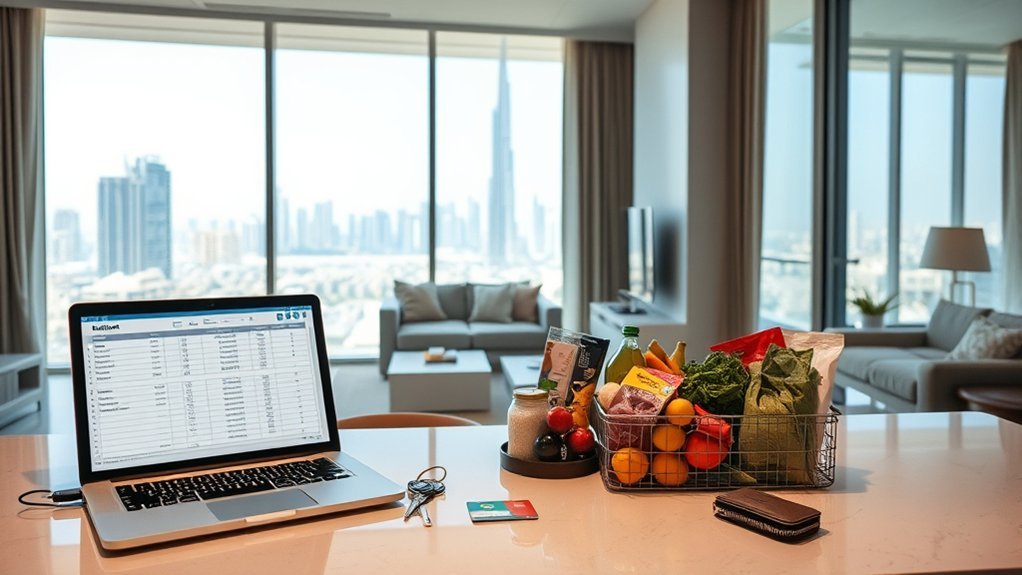
A useful Dubai budget separates fixed contractual costs from flexible lifestyle spending. Rent, the housing fee, school tuition, debt, and insurance commitments are difficult to reduce after signing. Dining, delivery, subscriptions, shopping, and entertainment are easier to adjust.
Sample Single-Person Monthly Budget
| Category | Planning Range |
|---|---|
| One-bedroom rent outside prime districts | AED 5,300–7,000 |
| Municipality housing fee | AED 265–350 |
| Electricity, water, and cooling | AED 500–1,200 |
| Internet and mobile | AED 350–650 |
| Groceries and moderate dining | AED 1,200–2,200 |
| Transport | AED 350–1,200 |
| Leisure, clothing, and miscellaneous costs | AED 700–1,500 |
| Illustrative monthly total | AED 8,665–14,100 |
This example excludes debt repayments, remittances, major travel, vehicle finance, employer-uncovered medical costs, and one-time move-in expenses.
Family Budget Considerations
A family of four can reasonably plan on AED 20,000–35,000 per month before private-school fees, depending on rent, transport, insurance coverage, food, and lifestyle. Private education can add several thousand dirhams per child each month when annual tuition is spread across the year.
Every Dubai private school publishes a KHDA School Fees Fact Sheet. Use it to check tuition, books, transport, uniforms, extracurricular charges, and any mandatory fees. Dubai private-school tuition was frozen for the 2026–27 academic year, but the amount still varies widely by school and grade.
Ways to Reduce Living Costs
- Choose a home near work, school, or a Metro station rather than comparing rent alone.
- Check renewal data and the DLD Rental Index before negotiating a lease.
- Ask whether cooling is included or billed separately.
- Compare the cash required for one, two, four, or more rent payments.
- Cook regularly and limit delivery fees and premium imported groceries.
- Use an RTA pass when daily journeys follow the same zones.
- Negotiate dependent insurance, school support, flights, and transport benefits before accepting a job.
- Keep an emergency fund for deposits, job changes, medical co-payments, and travel.
Comparing Dubai’s Costs With Other Global Cities

Dubai can be less expensive than some global financial centers in selected categories while costing more in others. Comparisons with Seattle, London, Singapore, Hong Kong, or other cities change according to exchange rates, neighborhood selection, household size, tax treatment, healthcare, schooling, and the source’s methodology.
Dubai’s main financial advantage for many employees is the absence of UAE personal income tax on individual employment earnings. Its main pressure points are prime-area rent, private education, car-dependent commuting, summer cooling, and premium lifestyle spending.
For a useful comparison, calculate disposable income rather than comparing one rent or restaurant figure. Subtract taxes, housing, healthcare, school fees, transport, debt, and mandatory charges from the salary in each city. Then compare the amount available for savings and discretionary spending.
Frequently Asked Questions
How much salary do you need to live comfortably in Dubai?
A single person living independently outside prime districts may find AED 12,000–18,000 per month workable. A couple may prefer AED 20,000 or more, while a family commonly needs AED 25,000–40,000 or more once housing, transport, dependent insurance, and school fees are considered. Comfort depends on debt, savings goals, benefits, and lifestyle.
Is AED 50,000 a good monthly salary in Dubai?
AED 50,000 per month is a strong salary for many singles, couples, and families. It can provide substantial savings when housing and school costs are moderate. Premium housing, several private-school places, domestic help, luxury vehicles, debt, and frequent travel can still use a large share of the income.
What is the average cost of living in Dubai with rent?
A single person with a one-bedroom outside prime districts can reasonably budget about AED 9,000–14,000 per month, including rent, the housing fee, utilities, food, connectivity, transport, and moderate leisure. A Downtown one-bedroom can push the total toward AED 13,000–18,000 or more.
Can I live in Dubai on a USD 4,000 monthly salary?
USD 4,000 is approximately AED 14,690 at the dirham’s dollar peg. It can support many single-person lifestyles, including an independent apartment outside the most expensive districts. It may be tight for a family paying private-school fees or for someone with debt, large remittances, or premium housing.
How much cash do I need before renting an apartment?
The total can include the first rent payment, landlord deposit, brokerage commission, Ejari registration, AED 2,000 DEWA apartment deposit, AED 155 DEWA activation cost, moving expenses, and furniture. Because rent-payment schedules vary, the required upfront cash can range from several thousand dirhams to several months of rent.
Is Dubai completely tax-free?
The UAE does not levy personal income tax on individual employment earnings, but Dubai is not free of all taxes and charges. Residents pay 5% VAT on many purchases, and tenants generally pay a municipality housing fee equal to 5% of annual rent. Foreign tax obligations may also apply according to citizenship, residence, and income source.
Conclusion
Dubai can be financially attractive when the salary and benefits match the household’s real costs. A single resident near public transport may live comfortably on a moderate professional salary, while a family paying prime-area rent, private-school fees, dependent insurance, and car expenses may need considerably more.
Start with the full annual housing cost, including the municipality fee and move-in charges. Add cooling, connectivity, food, transport, medical gaps, school fees, debt, and savings. Finally, compare that total with the complete employment package rather than the basic salary alone. This approach gives a far more reliable answer than any single citywide average.
Sources
- UAE Government Taxation Portal — individual income-tax and UAE taxation information.
- Dubai Land Department Rental Index — official rental-range and increase guidance.
- DEWA Move-In Service Guide — utility deposits, activation fees, and connection requirements.
- Dubai Roads and Transport Authority Nol Fares — current Metro and bus journey and pass prices.
- ISAHD Health Insurance FAQ — employer, sponsor, employee, and dependent coverage responsibilities.
- KHDA School Fees Fact Sheet Guide — official private-school fee and parent-cost information.

2 thoughts on “Average Living Cost in Dubai: Prices, Rent & Salary Guide”
Pingback: Is Dubai Currency Higher Than Australia? | UAETrav
Pingback: UAE Cost Of Living 2026: Monthly Budget Breakdown