
A traffic lawyer commonly charges about $200–$500 as a flat fee for a routine speeding, red-light, or similar ticket. If the case is billed by the hour, a planning range of roughly $150–$400 or more is common, but the actual quote depends on the charge, court, driving record, location, and work included.
Those numbers are estimates, not a national fee schedule. Some lawyers charge less for a simple first ticket, while a criminal traffic charge, trial, appeal, or separate driver’s-license hearing can cost far more. The best comparison is a written quote that clearly lists the services and expenses included.
Quick Answer
For a routine traffic ticket, a lawyer often charges a $200–$500 flat fee. Hourly work may run about $150–$400 or more. Serious charges, trials, appeals, and separate license hearings cost more. Compare written quotes for the same scope, because court fines and other expenses may be separate.
Key Takeaways
- Routine ticket cases are usually quoted as a flat fee, while contested or complex cases may be billed hourly.
- The quoted legal fee may not include fines, court assessments, traffic school, records, experts, travel, trial, appeal, or a separate license hearing.
- A lawyer may improve your options, but no ethical lawyer can guarantee dismissal, a specific reduction, or an insurance result.
- Hiring counsel is more likely to be worth considering when jail, license suspension, a commercial driver’s license, a serious misdemeanor, an accident, or multiple prior violations are involved.
Legal information only: Traffic laws, court procedures, point systems, and the right to appointed counsel vary by state and court. This article provides general U.S. cost information, not legal advice for a specific case.
Traffic Lawyer Cost at a Glance
At a Glance
| Routine Ticket | About $200–$500 as a common flat-fee planning range |
| Hourly Work | About $150–$400+ per hour; the national average across all legal practice areas was $349 in 2025 |
| Reckless Driving or Similar Misdemeanor | Often $500–$1,500+ for a straightforward matter; trial or aggravating facts can raise the fee |
| DUI/DWI | Usually several thousand dollars; a trial, felony allegation, injury, or separate license case can push the total much higher |
| Commonly Separate Costs | Ticket fine, court assessments, traffic school, records, experts, travel, trial, appeal, and administrative hearings |
Use these amounts only to build a budget. There is no official nationwide price list for private traffic lawyers. Local quotes can fall outside these ranges, and a low flat fee may cover less work than a higher quote.
Clio’s 2026 rate comparison reports an average U.S. lawyer billing rate of $349 per hour for 2025, with substantial variation by state and practice area.
Factors Influencing Costs
Traffic lawyer fees vary because the amount of work and the possible consequences vary. Two tickets with the same fine can require very different legal strategies if one driver has a clean record and the other faces suspension, a commercial-license problem, or a criminal charge.
Severity of the Offense
A routine civil infraction usually costs less to defend than a misdemeanor or felony driving charge. Higher-risk cases may require evidence review, witness interviews, motions, expert testimony, negotiations with a prosecutor, multiple court appearances, or a trial.
| Type of Matter | Common Planning Range | Why the Price Changes |
|---|---|---|
| Speeding or red-light ticket | About $200–$500 flat fee | Court, speed alleged, record, appearance requirements, and whether negotiation is possible |
| Reckless driving or similar misdemeanor | About $500–$1,500+ for a straightforward case | Criminal exposure, mandatory appearance, accident, prior record, motions, and trial preparation |
| DUI/DWI | Often several thousand dollars and sometimes much more | Criminal defense, scientific evidence, license proceedings, experts, prior offenses, and possible trial |
DUI/DWI is a criminal matter, not a routine traffic-ticket case, so it should not be priced from a basic ticket estimate.
Lawyer’s Experience
Experience can raise the hourly rate or flat fee, especially when the lawyer regularly handles the specific charge in the same courthouse. A newer lawyer may charge less, but price alone does not show whether the lawyer understands the local judge, prosecutor, procedures, or license consequences.
- Lower-cost or smaller-market hourly work: often starts around $150–$300 per hour.
- Experienced counsel or larger markets: often runs around $300–$500+ per hour.
Ask who will actually handle the case. A senior lawyer may quote the matter but assign parts of the work to another attorney or staff member.
Your Driving Record and License Type
A prior record can make negotiation harder and can increase the stakes. Commercial drivers may face job-related consequences even when a personal-license driver would view the same ticket as minor. The lawyer may need extra time to review your motor-vehicle record, prior cases, or out-of-state consequences.
The Court and Location
Fees tend to be higher in large metropolitan areas, but courthouse practice matters as much as city size. A case that can be handled remotely may cost less than one requiring a long trip or several in-person appearances.
Trial, Appeal, and Separate License Hearings
A flat fee may cover negotiation and one court date but exclude trial, appeal, an administrative license hearing, or post-conviction work. These exclusions can change the total price more than the advertised starting fee.
Types of Fees
Traffic lawyers usually use a flat fee for routine tickets and an hourly rate or staged flat fee for more complex matters. A written agreement should explain the scope of representation, the fee, and the expenses you must pay.
Flat Fees
A flat fee is a set amount for a defined package of work. It can make budgeting easier, but “flat” does not always mean “everything through trial.” Read the agreement to see how many appearances are included and what happens if the charge changes.
| Type of Violation | Common Flat-Fee Range |
|---|---|
| Speeding ticket | About $200–$500 |
| Running a red light | About $200–$500 |
| Reckless driving or similar misdemeanor | About $500–$1,500+, with higher fees for trial or aggravating facts |
These figures are broad planning estimates. The written scope matters more than the label. One $300 quote may include one appearance only, while another may include record review, negotiation, and several court dates.
Hourly Rates
With an hourly rate, you pay for the lawyer’s time. The agreement should state the billing rate, minimum billing increment, retainer amount, and how often you will receive an invoice.
- Junior to mid-level attorneys: often about $150–$300 per hour.
- Experienced attorneys or large-metro practices: often about $300–$500+ per hour.
Hourly billing can be reasonable for a case with uncertain work, but the total is harder to predict. Ask for a realistic budget range and which events would cause the estimate to rise.
Retainers and Staged Fees
A lawyer may require money in advance as a retainer and bill against it as work is completed. Another lawyer may charge one flat fee for pretrial work and a separate fee if the case goes to trial. Ask how unused funds are handled and whether any part of the payment is earned immediately under your state’s rules.
Pro Tip: Compare quotes line by line. Ask each lawyer to price the same scope: record review, negotiations, court appearances, motions, trial, appeal, license hearing, travel, and case expenses.
Additional Costs

The lawyer’s fee may be only one part of the total cost. Ask which charges are paid to the lawyer, which are paid to the court, and which are possible only if the case becomes contested.
Court Fees, Fines, and Assessments
Routine traffic cases may involve a ticket fine, court assessments, traffic-school fees, payment-plan charges, or other amounts set by state or local law. These amounts are normally separate from the attorney’s fee unless the agreement clearly says otherwise.
- Ticket fine and court assessments: amounts imposed by the court if the case is resolved with a conviction or negotiated disposition.
- Traffic school or defensive-driving costs: program and administrative fees where the option is available.
- Record or certification fees: charges for driving records, certified documents, transcripts, or copies needed for the defense.
Basic filing, service, or motion fees are not standard in every routine ticket case. Do not assume they apply unless the lawyer or court identifies a specific charge.
Case Expenses
A more serious case may require expenses beyond ordinary office work. These can include expert witnesses, investigators, subpoenas, transcripts, accident reconstruction, travel, or evidence testing.
Administrative Charges
Some firms separately bill for copying, postage, electronic research, travel, or staff time. Other firms include those items in the flat fee. Small charges can add up, so request a detailed explanation before signing.
- Photocopying and records: confirm whether routine copies are included.
- Postage and delivery: ask whether the firm bills actual cost or a fixed charge.
- Travel and additional appearances: confirm mileage, travel time, continuances, and out-of-county court dates.
Warning: Do not ignore the response or court date printed on the citation while shopping for a lawyer. Missing a deadline can trigger added penalties or other consequences under local law.
Geographical Variations
Urban markets with higher overhead and demand often charge more, while rural and smaller markets may charge less. However, two courts in the same state can handle the same ticket differently. Compare several lawyers who regularly appear in the specific court listed on your citation.
Clio reports that the average U.S. lawyer billing rate was $349 per hour in 2025, while state averages varied widely. That figure covers all practice areas, so it is useful as broad market context rather than a traffic-law price list. See the Clio lawyer-rate comparison.
Cost-Saving Tips
You can reduce the risk of surprise bills by comparing the total scope, not only the advertised fee. A slightly higher quote may cost less overall if it includes work that another lawyer bills separately.
Consult Multiple Lawyers
Do not hire the first lawyer you contact without understanding the quote. Many traffic lawyers offer a free or low-cost initial consultation, although this is not guaranteed. Give each lawyer the same facts: the exact charge, court, deadline, alleged speed, prior record, license type, accident details, and any related charges.
| Quote Item | What to Confirm |
|---|---|
| Consultation | Whether it is free, how long it lasts, and whether the fee is credited if you hire the lawyer |
| Legal fee | Flat or hourly, payment schedule, retainer, and billing increments |
| Included work | Document review, negotiations, appearances, motions, trial, appeal, and license hearing |
| Additional costs | Court amounts, records, experts, travel, copying, and extra court dates |
| Refund and withdrawal terms | What happens to unearned funds if the matter ends early or representation stops |
Consider Legal Aid and Lawyer-Referral Services
Free or low-cost legal help may be available, but many legal-aid programs have income limits and may not handle routine traffic tickets. Start with USA.gov’s legal-aid directory and the American Bar Association’s FindLegalHelp resources. Local bar associations and law-school clinics may also offer referrals or limited services.
- Local or state bar lawyer-referral services
- Legal-aid and pro bono organizations
- Law-school clinics
- Limited-scope or unbundled legal services, where permitted
Review Court Options Before Paying for Full Representation
Depending on the court and charge, you may be able to request traffic school, a mitigation hearing, a payment plan, a trial, or another procedure without full-service representation. Use only the official court website listed for your jurisdiction. The California Courts traffic guide is one state example showing how options and consequences are explained.
Benefits of Hiring a Traffic Lawyer
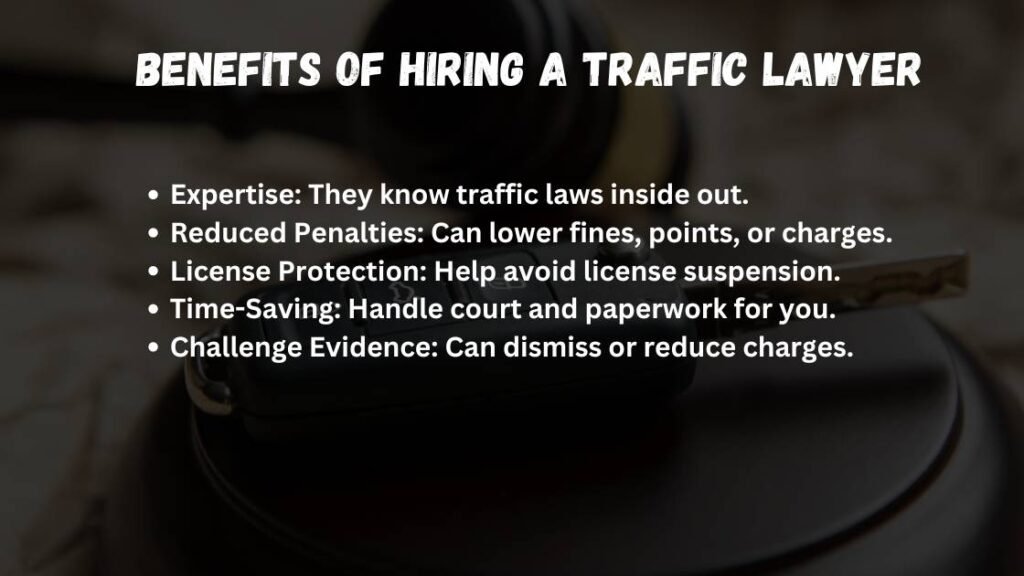
A traffic lawyer can explain the charge, identify defenses, handle negotiations, prepare evidence, and appear in court when local rules allow. The value depends on the stakes and the quality of the available legal options.
Reduced Penalties
A lawyer may be able to seek a lower charge, fewer points, a nonmoving disposition, traffic school, a reduced fine, or another lawful outcome. What is available depends on the facts, prosecutor, judge, and local law. No result is guaranteed.
Improved Case Outcomes
An experienced lawyer may spot evidence problems, procedural issues, or consequences that a driver would miss. Counsel can also present mitigation clearly and help avoid an uninformed plea. This may improve the result, but hiring a lawyer does not automatically produce dismissal or lower insurance premiums.
| Possible Benefit | Clear advice about defenses, plea options, deadlines, points, license exposure, and court procedure |
| Possible Time Saving | The lawyer may handle filings, negotiations, and some appearances, depending on court rules |
| Important Limit | No lawyer can promise dismissal, a specific sentence, no points, or a particular insurance result |
Traffic convictions can affect a driving record, and insurers may use traffic violations when setting premiums. The effect varies by state, insurer, violation, and driving history. The National Association of Insurance Commissioners’ auto-insurance shopping tool explains that speeding and other traffic convictions can increase what a driver pays.
When Hiring a Traffic Lawyer May Be Worth It
Paying a lawyer is easier to justify when the legal or financial risk is much larger than the ticket’s face value. Consider speaking with counsel promptly when:
- The charge is a misdemeanor or felony, such as reckless driving, DUI/DWI, hit-and-run, or driving on a suspended license.
- The citation or related paperwork says jail, license suspension, revocation, probation, or a mandatory appearance is possible.
- You hold a commercial driver’s license or drive for work.
- You already have points, prior convictions, or an active license problem.
- The ticket followed an accident, injury, alleged racing, very high speed, or multiple charges.
- You missed a deadline or court date.
- You live far from the court and want to know whether a lawyer can appear without you.
For a low-level first ticket with no unusual consequences, self-representation or an official court option may cost less than hiring counsel. Compare the lawyer’s fee with the possible effect on fines, points, insurance, work, travel, and license status.
Questions to Ask Before Hiring
- Do you regularly handle this charge in this exact court?
- Is the quote flat or hourly, and is a retainer required?
- What work is included, and what triggers an extra fee?
- Does the fee include every court appearance, trial, appeal, or a license hearing?
- Will I need to appear in person?
- Who will handle the case and communicate with me?
- Which expenses are separate from the legal fee?
- How are unused or unearned funds handled?
- What outcomes are realistically available without promising a result?
- Can I review the written fee agreement before paying?
The American Bar Association’s Model Rule 1.5 says the scope of representation and the basis or rate of fees and expenses should be communicated to the client, preferably in writing. State rules control your actual agreement.
Warning: Treat a guaranteed dismissal, guaranteed insurance result, or guaranteed “no points” promise as a red flag. A lawyer can explain likely options but cannot control the judge, prosecutor, evidence, or insurer.
Frequently Asked Questions
How much does a traffic lawyer cost?
A routine ticket often costs about $200–$500 as a flat fee. Hourly work may run about $150–$400 or more. Criminal driving charges, trial, appeal, and separate license proceedings cost more.
Is hiring a traffic lawyer worth it?
It may be worth it when points, suspension, jail, a commercial license, employment, an accident, prior violations, or a criminal record are at risk. For a simple first ticket, an official court option may cost less.
Do traffic lawyers charge a flat fee?
Many do for routine tickets. Confirm whether the flat fee includes record review, negotiations, all appearances, motions, trial, appeal, and a separate driver’s-license hearing.
Can a traffic lawyer reduce my fines?
A lawyer may request a reduced charge, fine, or other disposition when local law allows, but the result depends on the facts and decision-makers. No reduction is guaranteed.
How are traffic lawyer fees calculated?
The charge, driving record, court, location, lawyer’s experience, number of appearances, evidence, negotiations, motions, trial risk, and separate license issues all affect the fee.
Do traffic lawyers offer free consultations?
Many offer a free or low-cost initial consultation, but not all do. Ask how long it lasts, what will be reviewed, and whether the consultation fee is credited if you hire the lawyer.
How long does a traffic case take?
Some routine cases end at the first court date. A contested case, trial, continuance, appeal, or administrative hearing can take several months or longer.
Can a traffic lawyer dismiss my ticket?
A lawyer can look for legal, factual, or procedural grounds to challenge the ticket and may negotiate when allowed. Only the court or prosecuting authority can produce the final disposition, so dismissal cannot be promised.
What affects traffic lawyer costs?
The main factors are case severity, local market, court location, prior record, license type, lawyer experience, number of court dates, trial preparation, and whether related proceedings are included.
Are traffic lawyer fees refundable?
It depends on the agreement and state ethics rules. Earned fees generally are not refundable, but unearned retainer funds may have to be returned. Review the termination and refund terms before paying.
Does the lawyer’s fee include the ticket fine and court costs?
Usually not. The legal fee pays for representation, while fines, assessments, traffic school, records, experts, and other expenses may be separate. The written agreement should say exactly what is included.
Can I handle a traffic ticket without a lawyer?
Many people handle routine infractions themselves. Use the official court instructions, understand the plea and point consequences, meet every deadline, and seek legal advice when the charge carries serious license, criminal, employment, or immigration consequences.
Conclusion
A routine traffic lawyer often costs about $200–$500 as a flat fee, but the total can rise with the seriousness of the charge, the court, the driving record, and the work required. Compare written agreements rather than headline prices. A qualified lawyer may be valuable when license, criminal, insurance, or employment consequences are significant, but no outcome is guaranteed.
Sources
- Clio — Compare Average Lawyer Hourly Rate by State — national and state-level lawyer billing-rate context.
- American Bar Association — Model Rule 1.5: Fees — communication of fee basis, scope, and expenses.
- American Bar Association — FindLegalHelp.org — lawyer referrals, license checks, and public legal-help resources.
- California Courts — Guide to Traffic Tickets — an official example of ticket options, court process, points, and insurance considerations.
- National Association of Insurance Commissioners — Auto Insurance Shopping Tool — how traffic convictions can affect insurance pricing.
- USA.gov — Find Affordable Legal Aid — official directory for free and low-cost legal help.

1 thought on “How Much Does a Traffic Lawyer Cost?”
Pingback: How Much Does A Clemency Lawyer Cost: A Complete Guide