Hiring a lawyer for a juvenile case can feel urgent and confusing, especially when a family does not know whether private counsel is necessary or what a fair fee looks like. Costs depend on the type of case, the lawyer’s billing method, the local market, and how far the matter proceeds.
Quick Answer
There is no official nationwide price for a juvenile lawyer. Private counsel may bill hourly, charge a flat fee, or require a retainer. Clio’s 2025 billing data lists a $135 average hourly rate for juvenile-law work, but individual defense lawyers may charge much more. Court-appointed counsel may be available in delinquency cases.
Key Takeaways
- Ask the court or public defender’s office about appointed counsel before paying a private lawyer.
- Get the scope, fee, expenses, refund terms, and payment schedule in writing.
- A short matter may require only a few billed hours, while motions, experts, trial, transfer proceedings, or an appeal can increase the total sharply.
- Do not rely on a national “typical case fee” without comparing quotes from lawyers who regularly handle juvenile cases in the local court.
Warning: This article provides general U.S. information, not legal advice. Juvenile-court rules, appointed-counsel eligibility, parental payment duties, and court fees vary by state and county. If a child has been detained, questioned, or given a court date, ask for a lawyer promptly rather than delaying while comparing prices.

A useful fee quote explains not only the price, but also which hearings, motions, negotiations, expenses, and post-case services are included.
What a Juvenile Lawyer Does
A juvenile lawyer represents a young person in a matter handled by juvenile court or in a related proceeding. The exact age limits and court rules differ by state. The Office of Juvenile Justice and Delinquency Prevention notes that states use different age boundaries and may have exceptions that send some cases to adult criminal court.
Role and Responsibilities
In a delinquency case, a juvenile defense lawyer may:
- Explain the allegations, possible outcomes, and court process to the child and family.
- Review police reports, videos, school records, witness statements, and other evidence.
- Challenge unlawful searches, statements, identifications, or unreliable evidence when the facts support it.
- Negotiate with prosecutors and probation staff.
- Prepare for detention, adjudication, disposition, transfer, probation, or review hearings.
- Present information about education, treatment, family support, mental health, and rehabilitation when relevant.
Juvenile defense is different from representing a parent in a child-welfare, custody, school-discipline, or special-education matter. Ask whether the lawyer handles the exact type of case involved.
Why Counsel Matters in Delinquency Cases
In In re Gault, the U.S. Supreme Court recognized core due-process protections for children in delinquency proceedings, including the right to counsel, notice of charges, confrontation of witnesses, and protection against self-incrimination. Local procedures still determine how counsel is appointed and whether a family may face an application or reimbursement charge.
Note: “Court-appointed” does not always mean that every related expense is automatically free. Some jurisdictions assess application, recoupment, supervision, program, evaluation, or other charges, while others prohibit or waive them. Ask for the local rule in writing.
Factors That Influence Juvenile Lawyer Costs
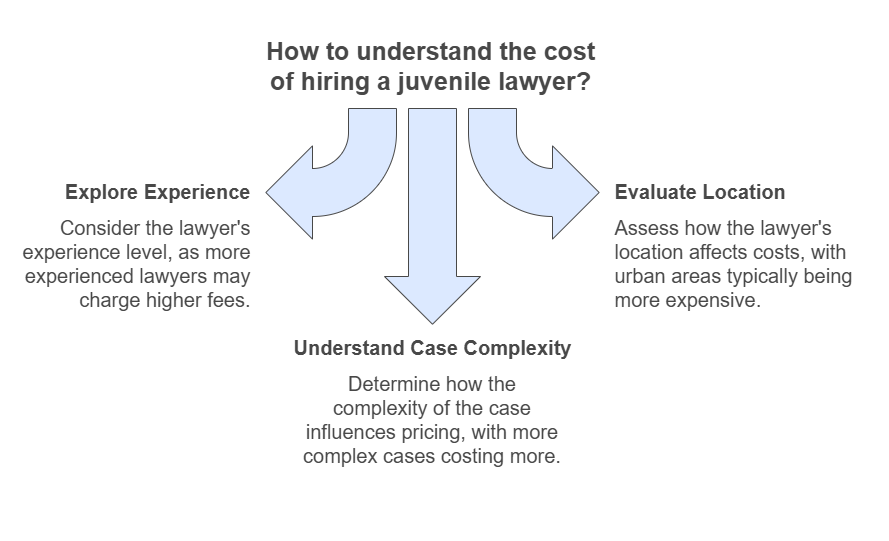
The final bill is shaped by the work required, not only by the charge listed on the petition. Two cases with similar allegations can cost very different amounts if one ends after an early agreement and the other requires experts, motions, or trial.
Experience and Juvenile-Court Focus
A lawyer who regularly practices in juvenile court may charge more than a general practitioner, but relevant experience can also make the work more efficient. Ask how much of the lawyer’s practice involves juvenile delinquency, detention hearings, transfer issues, and disposition planning.
Case Stage and Complexity
Fees usually rise as a case requires more time. Important cost drivers include:
- Whether the child is detained and needs an urgent hearing.
- The number of allegations, witnesses, videos, records, or electronic devices involved.
- Legal research, suppression motions, competency questions, or forensic testing.
- Negotiations, diversion screening, adjudication, disposition, or trial preparation.
- A request to transfer the youth to adult court.
- Post-disposition review, probation violations, appeals, or record-clearing work.
Location and Jurisdiction
Rates vary by state, city, and county. Office overhead, local demand, travel, and the supply of lawyers with juvenile-defense experience all affect pricing. A lawyer may also charge for travel to a distant detention center or courthouse.
Scope of Representation
A low flat fee may cover only the first hearing or negotiations. A broader agreement may include motions and trial. Ask whether the quote includes detention hearings, expert coordination, trial days, sentencing or disposition, probation matters, an appeal, and record sealing.
Types of Fee Structures
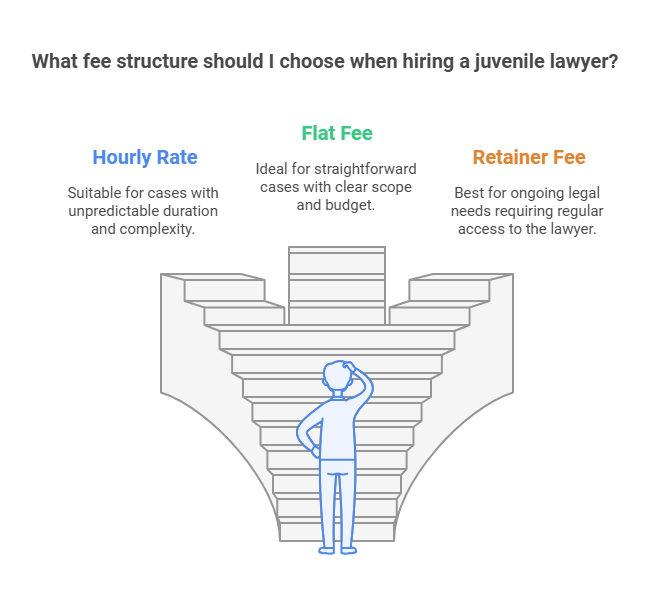
Private juvenile lawyers commonly use hourly billing, flat fees, or an advance retainer. The right choice depends on how predictable the work is and how clearly the agreement defines the scope.
Hourly Rates
With hourly billing, the lawyer records time spent on calls, meetings, research, negotiations, court appearances, and document review. Paralegal or investigator time may be billed at a different rate. Ask about the smallest billing increment, such as one-tenth or one-quarter of an hour, because frequent short calls can add up.
Flat Fees
A flat fee is a set price for defined work. It can make budgeting easier, but “the entire case” must be explained. The agreement should state whether the fee covers only pretrial work or also motions, trial, disposition, probation violations, appeal, and record sealing.
Retainer Fees
A retainer is often an advance deposit against future hourly work. The lawyer sends invoices and deducts earned fees and approved expenses from the balance. The family may have to replenish the account. Ask whether any part is nonrefundable, how unused funds are returned, and where the money is held.
The ABA Model Rule 1.5 says fees and expenses must be reasonable and that the scope and basis of the fee should be communicated to the client, preferably in writing. It also bars contingency fees for representing a defendant in a criminal case. State ethics rules control, so the lawyer should explain the rule that applies locally.
Pro Tip: Compare written scopes, not just headline prices. A $2,000 quote for one hearing is not cheaper than a $4,000 quote that includes investigation, motions, negotiations, and disposition unless both cover the same work.
Contingency billing is not the normal payment model for juvenile delinquency defense. Private lawyers generally use hourly, flat-fee, or retainer arrangements.
Average Juvenile Lawyer Costs Nationwide
No government agency publishes an official national total-case price for juvenile defense. Current billing data can provide context, but it cannot replace a local written quote. Clio’s 2025 aggregated billing data, updated in March 2026, lists an average lawyer rate of $349 per hour across all U.S. practice areas and an average of $135 per hour for juvenile-law work. An individual private juvenile-defense lawyer may quote above or below those figures.
At a Glance
| Published Billing Benchmark | $135 per hour for juvenile-law work in Clio’s 2025 data; not a guaranteed private-defense quote |
| Illustrative 10-Hour Bill | 10 hours × $135 = $1,350, before expenses |
| Illustrative 20-Hour Bill | 20 hours × $250 = $5,000, before expenses |
| Illustrative 40-Hour Bill | 40 hours × $350 = $14,000, before expenses |
These calculations are examples, not predictions. A flat fee may be lower or higher than the hourly result, and a contested case can require far more time than an early-resolution matter.
Regional Variations
State averages differ substantially. Clio’s 2025 data lists overall lawyer averages ranging from $196 per hour in West Virginia to $492 in the District of Columbia. Those are all-practice averages, not juvenile-defense price guarantees, but they show why a single nationwide figure can mislead.
Urban Versus Rural Areas
Large urban markets may have higher overhead and rates, while rural areas may have fewer juvenile specialists and added travel charges. The most useful comparison is among lawyers who handle the same type of case in the same court.
Additional Expenses
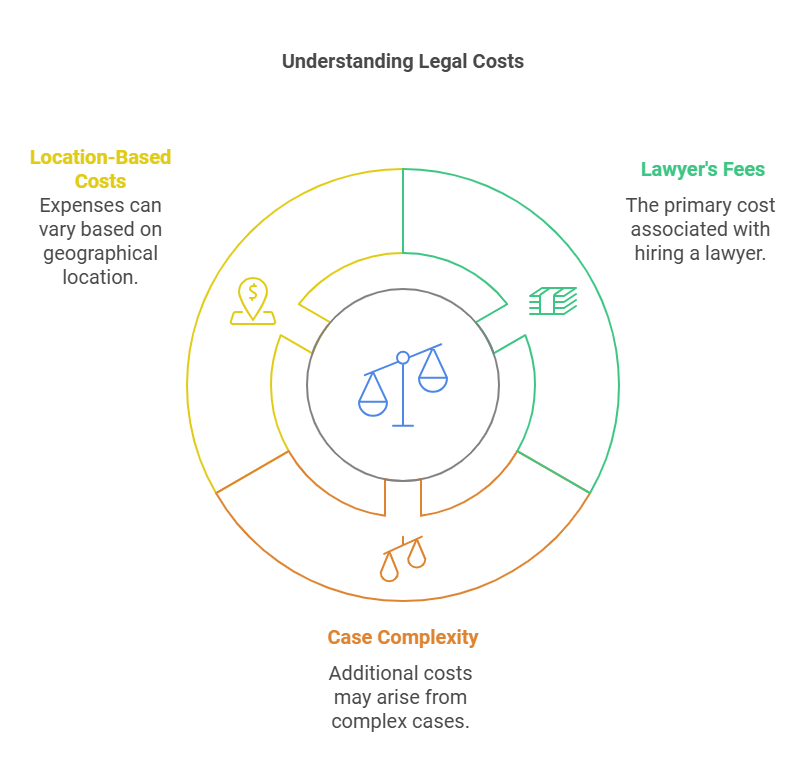
The lawyer’s fee may be only one part of the budget. Ask which expenses require advance approval and whether the firm adds an administrative markup.
Court, Appointed-Counsel, and Program Fees
A family usually does not pay a civil-style filing fee merely to defend a delinquency petition, but local systems may assess other charges. The U.S. Department of Justice has identified possible fees for applying for appointed counsel, processing an appointment, or receiving representation, and has warned that inability to pay must not be used to deny counsel where the right exists. Restitution, supervision, diversion, testing, evaluation, or program costs may also arise under local law.
Expert Witnesses
An expert may be needed for psychology, medicine, digital evidence, identification, accident reconstruction, substance testing, or another technical issue. Ask whether the lawyer expects an expert, who approves the expense, and whether an appointed-counsel system can fund necessary defense services.
Investigation Costs
Private investigators may locate witnesses, obtain records, inspect a scene, preserve video, or verify an account. Some firms include basic investigation in a flat fee; others bill it separately.
Records, Travel, and Evaluations
Other possible expenses include certified records, transcripts, copying, mileage, detention-center visits, interpreters, psychological evaluations, drug testing, and electronic-data review. A written agreement should state who pays each item.
Cost-Saving Strategies
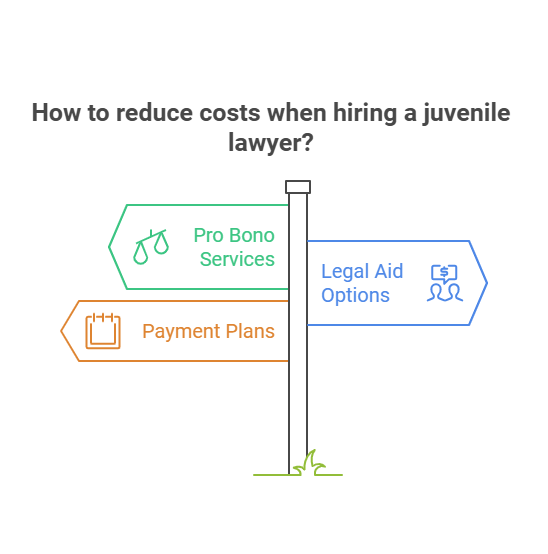
Reducing cost should not mean delaying representation or choosing a lawyer who lacks the needed experience. Start with the options built into the court system, then compare private proposals on the same scope.
Ask About Court-Appointed Counsel First
For a delinquency case, contact the juvenile court, public defender, or appointed-counsel office immediately and ask how eligibility is determined. Some states presume children are indigent, while others consider family finances or use different appointment procedures. Ask whether there is an application, copayment, or reimbursement rule and whether it can be waived.
Seek Pro Bono or Legal-Aid Help for Related Issues
Local bar associations, nonprofit youth organizations, and law-school clinics may provide free or reduced-fee help. However, many legal-aid programs focus on civil matters rather than delinquency defense. They may still help with related education, housing, benefits, record-clearing, or family issues. The American Bar Association’s FindLegalHelp resources can direct families to lawyer-referral and free-help options.
Request a Payment Plan
Some private lawyers allow installments. Confirm the due dates, late-payment terms, whether representation can stop for nonpayment, and what happens to unearned funds if the case ends early.
Use the Initial Consultation Efficiently
Bring the petition, hearing notice, release conditions, police paperwork, school records, and a short timeline. Organized information can help the lawyer give a more accurate scope and reduce time spent reconstructing basic facts.
Evaluating Value for Money
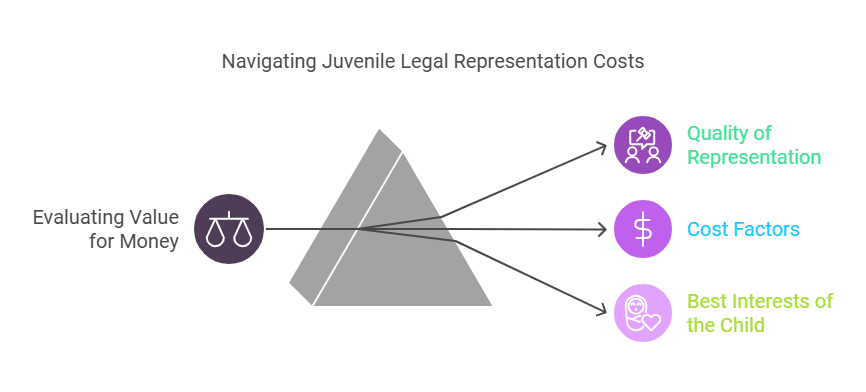
The cheapest quote is not automatically the best value, and the highest fee does not guarantee a particular result. Focus on relevant skill, a clear plan, honest communication, and a complete written agreement.
Assess Lawyer Credentials
Ask how many juvenile cases the lawyer has handled recently, which stages they personally cover, and whether they have experience with the local court, detention hearings, transfer proceedings, experts, and disposition planning. Check the lawyer’s license and public disciplinary record through the state bar.
Evaluate Communication
Ask who will return calls, how often the family will receive updates, and how the lawyer explains choices to the child. The fee agreement should identify the primary lawyer and disclose when associates, paralegals, investigators, or outside counsel may bill time.
Use Reviews Carefully
Reviews can reveal patterns in responsiveness and professionalism, but they cannot prove future results. Juvenile matters are often confidential, and a lawyer may not be able to provide names of past clients. Do not treat a claimed “success rate” as a standardized or guaranteed measure.
Final Considerations
A family should compare cost, scope, experience, and the possible long-term effects of the case. A clear written proposal makes that comparison easier.
Balancing Cost and Quality
Use the following questions when reviewing a quote:
| Question | Why It Matters |
|---|---|
| What stages are included? | Prevents a low quote from excluding motions, trial, disposition, or review hearings. |
| Which expenses are separate? | Shows whether experts, investigators, travel, records, and evaluations require extra funds. |
| Who performs the work? | Clarifies whether the quoted lawyer, an associate, or another professional will handle each task. |
| How are unused funds handled? | Explains refund terms and whether the retainer must be replenished. |
Long-Term Impact of Representation
A juvenile case can affect detention, probation, school, treatment, immigration, driving privileges, and future record access. Depending on the facts and local law, counsel may pursue dismissal, diversion, reduced allegations, a less restrictive disposition, or later record sealing. None of these outcomes is guaranteed, and sealing or expungement may require separate work after the case ends.
Frequently Asked Questions
How much does a juvenile lawyer cost?
There is no official national total. Clio’s 2025 data lists a $135 average hourly rate for juvenile-law work, but private defense rates and flat fees vary widely. Total cost depends on the hours required, the local market, the case stage, and separate expenses.
Do juvenile lawyers charge hourly or a flat fee?
They may use either method. Hourly billing depends on time worked. A flat fee covers a defined scope. Some lawyers require an advance retainer that is billed down as work is completed.
Can a child get a court-appointed juvenile lawyer?
A child has a constitutional right to counsel in qualifying delinquency proceedings, but appointment procedures and financial rules vary. Contact the juvenile court or public defender promptly and ask about eligibility, application steps, and any possible fees or reimbursement rules.
Are juvenile lawyer fees negotiable?
Sometimes. A lawyer may offer a payment plan, limit the scope, or quote separate flat fees for different stages. Any change should be documented in the written fee agreement.
What extra costs should a family ask about?
Ask about investigators, experts, evaluations, records, transcripts, travel, interpreters, electronic evidence, testing, supervision, diversion programs, restitution, and record-sealing work. The lawyer should explain which items are included and which require separate approval.
What should be included in the fee agreement?
The agreement should identify the client, scope, hourly or flat fee, retainer terms, billing increments, expenses, payment dates, staffing, refund terms, and what happens if the case expands or representation ends.
Conclusion
Juvenile lawyer costs vary because cases, courts, and fee agreements vary. Start by asking whether the child qualifies for appointed counsel. When comparing private lawyers, focus on the written scope, relevant juvenile-court experience, communication plan, expenses, and refund terms rather than relying on a single national price.
Prompt legal help can protect the child’s rights and give the family a clearer view of the possible outcomes. A detailed fee agreement also reduces the risk of surprise bills during an already stressful process.
Sources
- Cornell Legal Information Institute — In re Gault — due-process rights in juvenile delinquency proceedings.
- American Bar Association — Model Rule 1.5: Fees — fee communication, reasonableness, and contingency-fee restrictions.
- Clio — U.S. lawyer hourly-rate data — 2025 billing benchmarks by state and practice area.
- U.S. Department of Justice — Fines and Fees Dear Colleague Letter — access to counsel and limits on conditioning rights on ability to pay.
- Office of Juvenile Justice and Delinquency Prevention — Age Boundaries — state variation in juvenile-court jurisdiction.
- American Bar Association — FindLegalHelp — lawyer-referral and free-help resources.