
Divorce can be emotionally difficult, and the cost of legal representation can add another source of stress. A divorce lawyer may charge an hourly rate, a flat fee for a limited service, or bill against an upfront retainer. The final amount depends mainly on where you live, how much help you need, and whether you and your spouse can settle disputed issues.
Quick Answer
Divorce lawyers commonly charge about $200 to $500 or more per hour. A straightforward, uncontested case may cost a few thousand dollars with legal help, while a contested case involving custody, property, support, discovery, or trial can cost tens of thousands. Court charges, mediation, experts, and document service are usually extra.
Legal information: This article provides general information about U.S. divorce costs, not legal advice. Attorney fees, filing charges, waiting periods, fee waivers, and court procedures vary by state and county. Check your local court’s website and consult a licensed family-law attorney about your situation.
Key Takeaways
- Hourly rates commonly fall between $200 and $500 or more, but location, experience, and case complexity can move the rate outside that range.
- The lawyer’s rate is only half of the equation. The number of hours required usually has the greatest effect on the final bill.
- A retainer is normally an advance against future work, not a promise that the entire divorce will cost only that amount.
- Uncontested cases, limited-scope legal help, court self-help services, and appropriate mediation may reduce costs.
- Filing fees, service, discovery, appraisals, custody evaluations, financial experts, and trial preparation may be billed separately.

Knowing how lawyers calculate their fees can help you compare proposals, create a realistic budget, and decide whether you need full representation or help with only part of the case. The figures below are planning benchmarks rather than guaranteed quotes.
| Type of help | Typical cost structure | Best suited to |
|---|---|---|
| DIY or court self-help | Court filing and service charges, unless waived | Simple cases in which both spouses understand their finances and agree on every issue |
| Online document service | Often a fixed document-preparation charge plus court fees | Uncontested cases that meet the service’s eligibility rules |
| Limited-scope lawyer | Hourly or flat fee for defined tasks | People who can handle part of the case but want advice, document review, or hearing preparation |
| Mediation | Free, low-cost, hourly, or session-based, depending on the program and mediator | Spouses who can negotiate safely and disclose information honestly |
| Full-scope lawyer | Usually hourly billing against a retainer | Contested, high-value, high-conflict, custody, abuse, business, or complex financial cases |
The hourly rate matters, but the time needed to gather information, negotiate, prepare documents, attend hearings, and resolve disputes usually determines the final bill.
Factors Influencing Divorce Lawyer Costs
The cost of hiring a divorce lawyer depends on the lawyer, the market, and the work your case requires. Two people in the same city may receive very different estimates if one has a complete agreement and the other has disputed custody, a business, retirement accounts, or concerns about hidden assets.
Lawyer’s Experience
Lawyers with substantial family-law or trial experience often charge more per hour. Specialists may also charge more when a case involves complex property, business valuation, interstate custody, military benefits, international assets, or appeals.
A higher hourly rate does not automatically produce a higher total bill. An experienced lawyer may identify the main issues quickly, avoid unnecessary work, and resolve a familiar problem in fewer hours. Compare the lawyer’s relevant experience, proposed strategy, staffing, and estimated time rather than selecting a lawyer solely by hourly rate.
Geographical Location
Location affects legal rates because operating costs, local market rates, court practices, and the supply of experienced family lawyers differ. According to Clio’s legal billing data published in March 2026, the average U.S. lawyer rate across practice areas was $349 per hour for 2025.
State and practice-area averages also vary. Clio reported a 2025 family-law average of approximately $429 per hour in New York and $410 per hour in California. These are billing-data averages, not mandatory rates or guaranteed quotes. Individual lawyers may charge less or substantially more.
Pro Tip: Compare lawyers who regularly practice in the court where your case will be filed. Familiarity with local rules, judges, filing systems, and scheduling can improve efficiency even when the lawyer’s hourly rate is not the lowest.
Case Complexity
A simple uncontested divorce generally requires less legal work than a case involving disagreements over child custody, parenting time, child support, spousal support, debts, property, retirement benefits, a family business, or the value of professional assets.
An attorney-edited Nolo divorce-cost analysis reports the following results from a 2019 national reader survey:
- Uncontested divorce with a lawyer: Average total costs were about $4,100.
- Disputed cases settled without trial: Average total costs were about $10,600.
- Cases with a trial on at least one issue: Average total costs were about $20,400.
- Cases with trials on two or more issues: Average total costs were about $23,300.
These are historical survey results, not 2026 price guarantees. Current costs may be higher, and a single complex case can fall far outside the averages. The figures are most useful for showing how unresolved disputes and trial preparation increase the bill.
“A divorce is like an amputation; you survive, but there’s less of you.” — Margaret Atwood
Types of Divorce Lawyer Fee Structures
Divorce lawyers use several billing arrangements. Before signing an agreement, ask what services are included, what is excluded, who may work on the file, and when additional payments will be due.
Hourly Rates
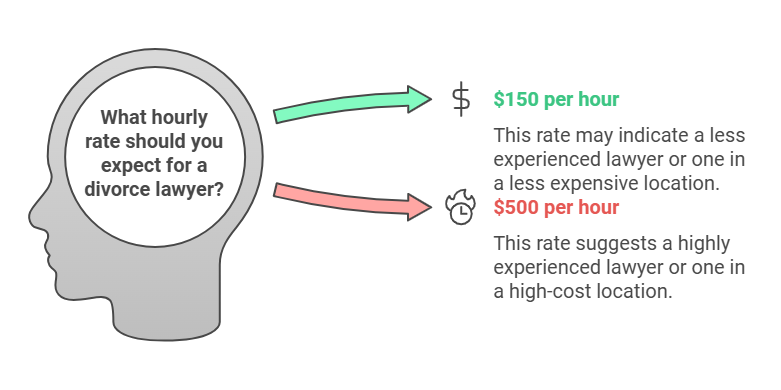
Hourly billing is the most common arrangement for contested divorce work. You pay for the time the lawyer and other billable staff spend on your case. Rates commonly range from about $200 to $500 or more per hour, although location, experience, and the type of work can move the rate outside that range.
The fee agreement should explain the billing increment. For example, a firm may bill in six-minute or fifteen-minute increments. Under a fifteen-minute minimum, even a brief call may be billed as one-quarter of an hour. The American Bar Association’s family-law billing guidance recommends candid discussions about rates, expenses, retainers, and regular statements.
| Lawyer profile | Possible hourly range |
|---|---|
| Newer lawyer or lower-cost market | Approximately $150–$250 |
| Experienced family-law attorney | Approximately $250–$500 |
| Highly specialized or high-cost-market attorney | $500 or more |
These are broad planning ranges. Ask each firm for its actual lawyer, associate, paralegal, and support-staff rates.
Flat Fees
Some lawyers offer a flat fee for a clearly defined service, such as preparing an uncontested-divorce filing, reviewing a settlement agreement, drafting a motion, or attending one hearing. Flat fees can make budgeting easier because the price is agreed upon in advance.
The scope is critical. A flat fee may stop applying if the case becomes contested, additional hearings are scheduled, financial disclosures are incomplete, or the other spouse refuses to sign the agreement. Instead of relying on a general $1,000–$5,000 estimate, request a written quote stating exactly what the flat fee includes and what triggers additional billing.
- Predictable price for the defined work
- No hourly billing for tasks within the agreed scope
- Easier comparison between similar service packages
Retainer Fees
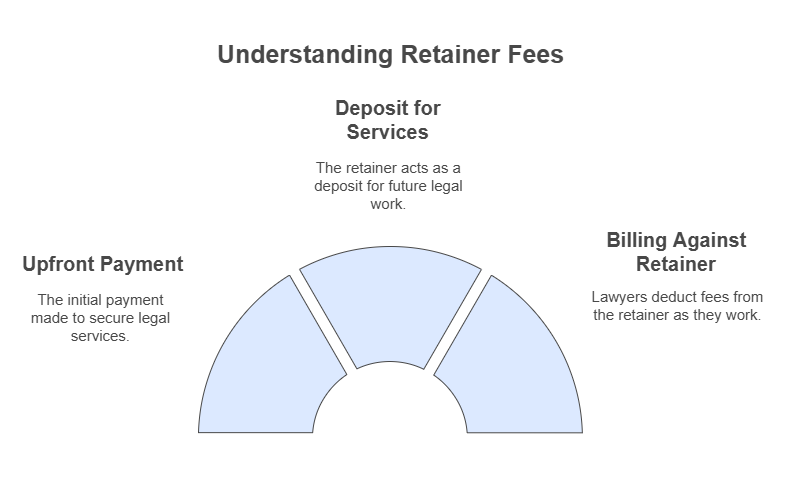
Many divorce lawyers require an upfront retainer before beginning work. The lawyer normally bills earned fees and approved expenses against that money as work is completed.
- You pay an initial retainer, such as $2,500 or another amount stated in the agreement.
- The lawyer and billable staff record their time and deduct earned fees from the available balance.
- You receive statements showing the work, time, rate, charges, and remaining balance.
- You may have to replenish the retainer when the balance falls below an agreed amount.
A retainer is not necessarily the total cost of the divorce. Ask whether unused funds are refundable, where the money will be held, how often you will receive statements, and whether the agreement requires an “evergreen” minimum balance. Rules governing retainers and nonrefundable fees vary by state.
Limited-Scope or Unbundled Legal Services
Limited-scope representation allows you to hire a lawyer for specific tasks rather than the entire case. The lawyer might review forms, explain your rights, prepare a settlement proposal, coach you for mediation, draft an agreement, or appear at a particular hearing.
In Nolo’s 2019 survey, people who hired consulting lawyers reported average fees of approximately $4,600 and a median of $3,000. Those historical figures will not predict every current case, but they show why limited help can cost less than full representation.
Confirm that limited-scope representation is permitted for the task and court involved. The written agreement should clearly identify what the lawyer will do and what you remain responsible for doing.
Contingency Fees
A divorce lawyer generally cannot charge a fee that depends on securing the divorce or receiving a particular amount of alimony, support, or property. ABA Model Rule 1.5 prohibits those arrangements, and most states have adopted similar rules.
Different rules may apply to certain post-judgment collection matters, such as collecting an established support arrearage. Ask a lawyer licensed in your state before assuming any outcome-based arrangement is permitted.
Average Divorce Lawyer Costs
There is no single national price for a divorce lawyer. A useful budget considers the hourly rate, expected hours, court charges, outside professionals, and the possibility that the case will become more contested than expected.
National Averages
Clio’s 2025 billing data places the average hourly rate for U.S. lawyers across all practice areas at $349. An earlier Nolo comparison reported an average family-law rate of approximately $314 per hour for 2024. Individual divorce lawyers may charge less or more than either benchmark.
Nolo’s 2019 reader survey found an average of $11,300 in attorneys’ fees for full-scope divorce representation, with a median of $7,000. More than four in ten respondents paid $5,000 or less. Because the data is historical and high-cost cases can pull the average upward, use these amounts as context rather than as a current quote.
Variations by State
Attorney rates and court costs vary by state, city, county, and practice setting. Lawyers in expensive metropolitan areas and lawyers handling complex financial or custody cases often charge more. A solo lawyer or small firm may have a different rate structure from a large firm with multiple lawyers and support professionals.
Do not compare only the headline hourly rate. Ask who will perform routine work, whether lower-rate associates or paralegals will be used, and how the firm expects to staff your case.
Typical Hourly Rates
A planning range of $200–$500 or more per hour is reasonable for many U.S. divorce matters. A simple case may require relatively few billable hours. A contested case can involve months of document review, negotiations, discovery, motions, expert analysis, settlement conferences, and trial preparation.
For example, a $350 hourly rate produces $3,500 in fees after ten billed hours, $10,500 after thirty hours, and $35,000 after one hundred hours. Outside costs would be additional unless the agreement states otherwise.
What Divorce Lawyers Bill For
Clients are often surprised that billable work includes more than courtroom appearances. Depending on the agreement, you may be charged for:
- Initial case analysis and legal research
- Telephone calls, emails, and video meetings
- Reviewing financial statements, tax returns, messages, and evidence
- Drafting petitions, responses, motions, affidavits, and settlement proposals
- Communicating with the other lawyer, experts, and court staff
- Preparing disclosures and responding to discovery
- Depositions, mediation, settlement conferences, and hearings
- Travel and waiting time when permitted by the fee agreement
- Reviewing and revising the final settlement and divorce judgment
- Post-judgment enforcement or modification work
Ask whether the lawyer charges for short calls, internal conferences, administrative work, travel, electronic research, document storage, copying, postage, and payment processing. Also ask whether multiple professionals may bill for the same meeting.
Pro Tip: Send organized questions in one concise email, provide requested documents in clearly labeled folders, and ask which communications require the lawyer rather than a lower-rate staff member. Organization can reduce avoidable billable time.
Additional Divorce Expenses
Attorney fees are usually the largest expense, but they are not the only cost. Review the engagement agreement to learn whether the firm advances outside expenses and bills you later or requires you to pay providers directly.
Court Fees
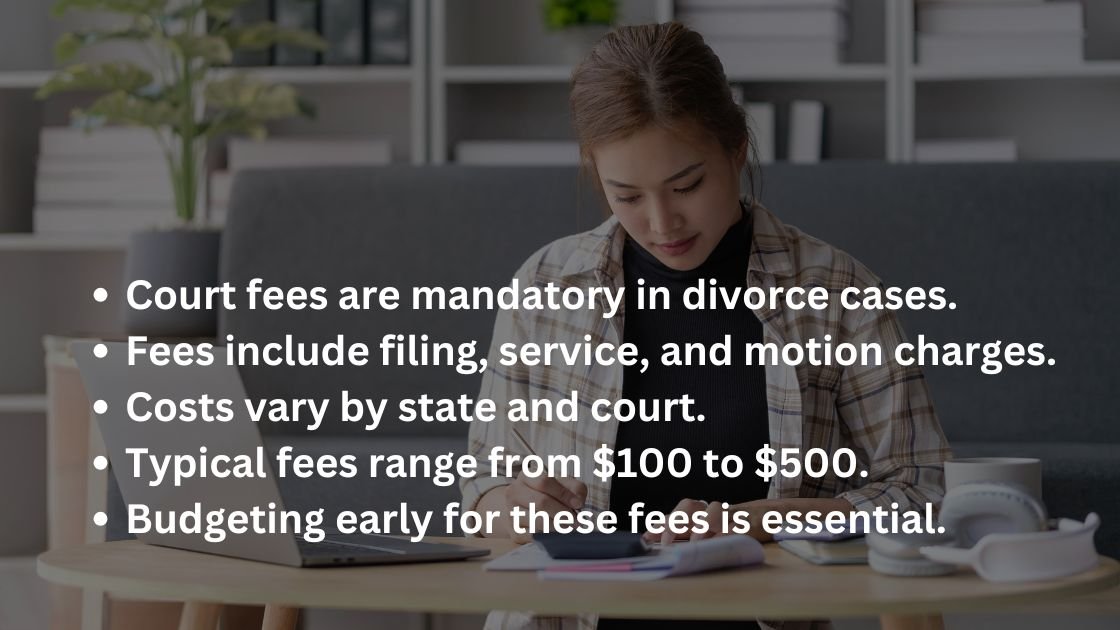
Court charges may include the initial filing fee, a response fee, motion charges, certification fees, copies, electronic filing, and service of process. Divorce filing fees often range from about $100 to more than $450, depending on the jurisdiction.
For current examples, California Courts states that filing a divorce case generally costs $435–$450. New York Courts states that an uncontested divorce costs at least $335 in court filing fees, excluding lawyers, service, copies, notary charges, mailing, and transportation.
If you cannot afford the filing charge, ask the court clerk or self-help center about a fee-waiver application. Approval standards and covered charges vary.
Mediation Costs
Mediation uses a neutral person to help spouses negotiate. The mediator does not represent either spouse and normally does not decide the outcome. Prices vary according to the mediator’s qualifications, location, number of sessions, preparation, and whether lawyers attend.
Some court-connected programs are free or low-cost. For example, New York Courts describes free and low-cost court and community mediation options. Private mediators may charge hourly, by the session, or through a package. Obtain a written fee schedule and ask how cancellation, preparation, document drafting, and follow-up time are billed.
Warning: Mediation may be unsafe or unfair where there is domestic violence, coercive control, threats, stalking, financial abuse, hidden assets, or a serious power imbalance. Speak privately with a lawyer or domestic-violence advocate before agreeing to direct negotiation. Emergency safety and protective-order issues should not be delayed to save legal fees.
Expert Witness and Professional Fees
Some divorces require specialized professionals. Their rates and total charges vary widely, and many require an advance deposit. Possible professionals include:
- Forensic accountants who trace income or assets
- Business, real estate, pension, or personal-property appraisers
- Child-custody evaluators or parenting professionals
- Vocational experts who evaluate earning capacity
- Tax advisers and certified public accountants
- Actuaries or retirement-plan specialists
- Private investigators where their work is lawful and relevant
An expert may charge hundreds of dollars per hour, plus report preparation, travel, deposition, testimony, and cancellation fees. A complex assignment can total thousands of dollars. Request a written scope, rate sheet, deposit requirement, and estimate before authorizing the work.
| Expense type | Planning guidance |
|---|---|
| Court filing and response fees | Often about $100–$450+, depending on the court; fee waivers may be available |
| Process server or sheriff | Varies by location, number of attempts, and service method |
| Mediation | May be free through a court program or billed privately by the hour, session, or package |
| Depositions and transcripts | May include court reporter, transcript, exhibit, video, and lawyer-preparation charges |
| Appraisal or evaluation | Depends on the asset, records, report, and testimony required |
| Expert witness | Often billed hourly with a deposit; total costs may reach thousands |
| Retirement-order preparation | A separate specialist or plan-review charge may apply |
Cost-Saving Tips
Reducing legal costs should not mean giving up important rights or accepting an unsafe agreement. The best savings usually come from choosing the right level of representation, staying organized, and resolving suitable issues without unnecessary litigation.
Choosing the Right Lawyer
Look for a lawyer whose experience matches the issues in your case. A high-asset divorce, contested custody matter, military divorce, or interstate case may require different experience from a simple uncontested filing.
- Confirm the lawyer is licensed and in good standing.
- Read independent reviews for patterns rather than relying on one comment.
- Ask trusted lawyers, accountants, or local bar referral programs for recommendations.
- Ask whether the initial consultation is free, fixed-price, or billed hourly.
- Compare the proposed strategy, staffing, communication policy, and estimated phases of work.
Negotiating and Clarifying Fees

You can ask a lawyer whether a flat fee, limited-scope arrangement, lower initial retainer, phased budget, or payment schedule is available. A lawyer may decline, but the discussion can reveal more affordable ways to structure the work.
- Request a written fee agreement and a clear list of excluded services.
- Ask for lawyer, associate, paralegal, and support-staff rates.
- Confirm the billing increment and whether calls, emails, travel, and internal meetings are charged.
- Ask for an estimate by phase, such as filing, discovery, mediation, and trial.
- Request regular itemized bills and raise questions promptly.
Limiting Court Appearances
Each motion, hearing, deposition, and trial day can add preparation time and outside expenses. When it is safe and both spouses have enough financial information, negotiation, mediation, collaborative divorce, or a focused settlement conference may reduce the number of disputed issues.
| Method | Potential benefit | Important limitation |
|---|---|---|
| Direct negotiation through lawyers | May resolve issues without a hearing | Repeated proposals can still create substantial hourly fees |
| Mediation | Can narrow disputes and provide more control over settlement | Not appropriate without safety, honest disclosure, and meaningful bargaining ability |
| Arbitration | May be more flexible or faster than a court trial | The arbitrator and both lawyers may charge fees, and appeal rights can be limited |
| Limited-scope representation | Concentrates lawyer time on the highest-value tasks | The client remains responsible for work outside the written scope |
Organizing Documents and Communication
Provide complete, readable, and well-labeled records. A chronological summary, list of disputed issues, asset-and-debt spreadsheet, recent tax returns, account statements, and copies of existing court orders can reduce time spent searching for basic information.
Avoid using your lawyer as a messenger for routine parenting disputes or as a substitute for emotional support. Save legal communications for decisions that affect your rights, evidence, deadlines, settlement, or safety.
Payment Plans and Financing
Do not assume that a large retainer is the only available arrangement. Ask about payment timing before hiring the lawyer and before approving expensive discovery, experts, or trial preparation.
Monthly Payment Plans
Some lawyers allow clients to pay an initial amount and then make scheduled payments. Others require the retainer to remain above a minimum balance or require current monthly invoices to be paid in addition to the retained funds.
Get every payment term in writing. Confirm what happens if a payment is late, whether work may pause, whether the lawyer may seek permission to withdraw, and which urgent deadlines remain your responsibility.
Legal Aid Options
Legal Services Corporation funds nonprofit legal-aid organizations throughout the United States. These programs may help eligible people with family-law matters, including divorce, custody, support, and protection from domestic violence.
Eligibility often depends on income, assets, household size, case type, safety concerns, and local program priorities. Qualification does not guarantee full representation because resources are limited. Court self-help centers, law-school clinics, bar-association programs, and pro bono lawyers may provide additional assistance.
Financing Programs
Some firms accept credit cards or work with third-party financing companies. A legal-fee loan can provide money upfront and allow repayment in installments, but it converts legal expenses into debt.
Warning: Before financing legal fees, review the annual percentage rate, origination charge, late fees, repayment term, security interest, credit-reporting policy, and total amount repayable. Do not assume a financing offer from a law firm is interest-free or the least expensive option.
| Payment option | Features | Questions to ask |
|---|---|---|
| Monthly payment plan | Spreads payments over time and may require a down payment | Is interest charged? Must the retainer be replenished? What happens after a missed payment? |
| Legal aid or pro bono help | Free or low-cost help for qualifying cases | Does the program handle divorce, custody, support, or only advice and forms? |
| Credit card or legal-fee loan | Provides immediate funds but may add interest and fees | What is the APR, total repayment, term, late-fee policy, and effect on credit? |
| Fee waiver | May waive or defer eligible court charges | Which fees are covered, what proof is required, and must the waiver be renewed? |
Impact of Uncontested vs. Contested Divorce
The greatest cost difference usually comes from whether the spouses can agree on every material issue and whether they can exchange complete information without extensive discovery or court intervention.
Uncontested Divorce Costs

In an uncontested divorce, both spouses agree on property, debts, parenting arrangements, support, and all other issues that must be decided. The lawyer may prepare or review documents without conducting extensive discovery or preparing for trial.
Nolo’s 2019 survey reported average total costs of about $4,100 for respondents who hired lawyers and had no contested issues. People handling their own divorces reported a median of about $300 and an average of $925, excluding mediation. Online document services commonly added approximately $150–$750 at that time, plus court charges.
Those figures are historical. Current filing fees, service prices, lawyer rates, and document-service charges vary. An uncontested case can also become contested if a spouse changes position or financial information reveals a new issue.
Contested Divorce Costs
A contested divorce involves disagreement over one or more issues. Lawyers may need to request records, question witnesses, take depositions, prepare financial exhibits, retain experts, file motions, attend temporary hearings, negotiate repeatedly, and prepare for trial.
In the 2019 Nolo survey, cases that began with disputes but settled without trial averaged about $10,600 in total costs. Cases with a trial on at least one issue averaged about $20,400, while cases with trials on two or more issues averaged about $23,300. Present-day high-conflict, high-asset, or expert-heavy cases can cost considerably more.
Time Considerations
An uncontested divorce may be completed after the required documents, service, disclosures, settlement, and any mandatory waiting period are satisfied. Some states impose waiting periods of one to six months, and local court processing times also matter.
Contested cases may last many months or longer because of discovery, evaluations, settlement attempts, court availability, and trial scheduling. More time does not automatically mean more lawyer work every day, but a longer case usually creates more communications, updates, deadlines, and opportunities for disputes.
When You Should Strongly Consider Hiring a Lawyer
Even people who hope to settle may benefit from independent advice. Full or substantial legal representation is especially important when:
- There is domestic violence, coercive control, stalking, threats, or concern about child safety.
- You believe assets, income, cryptocurrency, accounts, or debts are being hidden.
- The marriage includes a business, professional practice, stock compensation, trusts, complex real estate, or substantial retirement benefits.
- You disagree about custody, relocation, parenting time, or decision-making authority.
- One spouse has much greater financial knowledge or access to records.
- Your spouse has a lawyer and you do not understand the proposed agreement.
- The case involves more than one state or country, immigration concerns, military benefits, bankruptcy, or pending criminal allegations.
- You are being pressured to sign quickly or waive property, support, or parenting rights.
A DIY or document-service divorce may be reasonable when both spouses agree on every issue, fully understand their finances, can negotiate safely, and have a simple case. Even then, paying a family-law attorney to review the final agreement can help identify unclear language, unenforceable terms, tax problems, or rights that were overlooked.
Who Pays the Divorce Lawyer Fees?
Each spouse commonly pays their own lawyer. However, state law may allow a court to order one spouse to contribute to the other spouse’s reasonable attorney fees. Courts may consider income, access to marital funds, litigation conduct, need, ability to pay, and whether a party caused unnecessary legal work.
A request for attorney fees is not automatically granted, and an award may cover only part of the bill. Ask a local lawyer whether temporary fee contributions, access to joint funds, or an award at the end of the case may be available.
Note: One lawyer normally cannot represent both spouses in the divorce because the spouses may have conflicting interests. A mediator may work neutrally with both spouses, but the mediator does not serve as each spouse’s independent lawyer.
Tax and Retirement Costs to Consider
Divorce can affect filing status, dependents, property transfers, retirement benefits, withholding, and support. Under current federal rules, alimony paid under a divorce or separation instrument executed after 2018 is generally not deductible by the payer and is not included in the recipient’s income. Older instruments and later modifications may receive different treatment. Review the current IRS Publication 504 and obtain tax advice for your agreement.
Dividing a qualified retirement plan may require a qualified domestic relations order or another plan-specific document. Drafting, plan preapproval, revisions, and implementation may produce charges separate from the divorce lawyer’s main bill. Do not assume that language in the divorce judgment alone will complete the transfer.
Questions to Ask a Divorce Lawyer
Choosing the right lawyer requires more than asking for one hourly rate. Use the consultation to understand the likely work, risks, alternatives, and financial terms.
Fee Structure Questions
- Do you charge for the initial consultation?
- Will my case be hourly, flat-fee, limited-scope, or a combination?
- What are the rates for partners, associates, paralegals, and other staff?
- What billing increment do you use?
- Do you charge for calls, emails, travel, waiting, internal conferences, or administrative work?
- What retainer is required, and must I replenish it?
- What happens to unused retainer funds?
- Which outside expenses will I pay?
Experience and Specialization
- How much of your practice involves family law?
- How often do you practice in the court handling my case?
- Have you handled cases involving issues similar to mine?
- Who will perform most of the work?
- What is your approach to settlement, mediation, and trial?
- Do you have experience with the experts my case may require?
Estimated Total Costs
- What is your preliminary estimate for each likely phase?
- Which facts could increase or reduce the estimate?
- How much could discovery, mediation, experts, and trial add?
- Will you warn me before beginning work that materially changes the budget?
- How often will I receive itemized statements?
- Can we identify tasks suitable for a lower-rate professional or limited-scope service?
No lawyer can guarantee the total cost of a contested divorce at the first meeting. A useful lawyer should still explain the likely phases, major cost drivers, and decisions that could change the budget.
Frequently Asked Questions
How much does a divorce lawyer cost?
Divorce lawyers commonly charge about $200 to $500 or more per hour. Total fees may be a few thousand dollars for straightforward work or tens of thousands for contested cases involving discovery, experts, multiple hearings, or trial.
What factors affect divorce lawyer fees?
The main factors are the lawyer’s hourly rate, location, experience, number of disputed issues, volume of financial records, need for discovery or experts, cooperation between spouses, court schedule, and whether the case settles or goes to trial.
How much is a divorce lawyer retainer?
Retainers vary widely. A lawyer may request a few thousand dollars or substantially more for a complex case. The retainer is usually an advance against hourly work, not the total price, and the agreement may require you to replenish it.
Are there hidden costs in a divorce case?
Possible additional expenses include filing fees, process service, motions, transcripts, depositions, mediation, appraisals, custody evaluations, forensic accountants, tax advice, retirement-order preparation, copying, travel, and expert testimony. Request an itemized explanation before hiring the lawyer.
Can one divorce lawyer represent both spouses?
Normally, no. Spouses may have conflicting legal interests, even in an uncontested case. A mediator may work neutrally with both spouses, but each spouse may still obtain independent legal advice before signing an agreement.
Can my spouse be ordered to pay my divorce lawyer?
Possibly. State law may allow a court to order one spouse to contribute to the other spouse’s reasonable fees based on financial need, ability to pay, access to marital money, or litigation conduct. An award is not automatic and may cover only part of the bill.
Can I reduce my divorce lawyer costs?
You may reduce costs by organizing records, combining nonurgent questions, using limited-scope services, assigning suitable work to lower-rate staff, requesting phase-based estimates, resolving safe and informed issues through negotiation or mediation, and avoiding unnecessary court disputes.
What can I do if I cannot afford a divorce lawyer?
Ask about legal aid, pro bono programs, court self-help centers, fee waivers, law-school clinics, limited-scope representation, flat-fee document review, and payment plans. Availability and eligibility vary by location and case type.
Conclusion
Divorce lawyer costs depend on the lawyer’s rate, the amount of work required, the issues in dispute, and whether the case settles or proceeds toward trial. A broad hourly range of $200–$500 or more can help with early planning, but only a written local quote can reflect your facts.
Before hiring a lawyer, compare experience, staffing, scope, billing increments, retainers, outside expenses, and likely phases of work. Ask about limited-scope help, mediation where it is safe, fee waivers, legal aid, and payment arrangements. Do not sacrifice safety, complete financial disclosure, or important legal rights solely to reduce the immediate bill.
Sources
- Clio Legal Trends: Lawyer Hourly Rates — national, state, and practice-area billing benchmarks updated in March 2026.
- Nolo: How Much Will My Divorce Cost? — attorney-edited explanation of lawyer fees, limited-scope help, filing costs, and historical consumer-survey results.
- American Bar Association: Fees and Billing — hourly billing, flat fees, retainers, expenses, written agreements, and cost control.
- ABA Model Rule 1.5: Fees — reasonable-fee standards and restrictions on contingency fees in domestic-relations matters.
- California Courts and New York Courts — current examples of divorce filing fees and fee-waiver information.
- Legal Services Corporation — information about civil legal aid and family-law assistance for qualifying households.