
Tax lawyer costs vary widely because a short legal consultation and a contested IRS case require very different amounts of work. A straightforward matter may cost a few hundred dollars, while an audit, appeal, business-tax dispute, or court case can cost several thousand dollars or more. The lawyer’s rate, location, experience, billing method, and the condition of your records all affect the final bill.
Quick Answer
A tax lawyer commonly costs about $200 to $600 or more per hour, although there is no official national rate. Flat-fee matters may range from several hundred dollars to more than $10,000. Audits, appeals, multiple tax years, business issues, and litigation usually cost more than a consultation or simple notice response.
Key Takeaways
- Treat published prices as budgeting estimates, not guaranteed quotes.
- Hourly rates often fall near $200–$600+, but the number of hours usually matters more than the rate alone.
- Flat fees provide predictability only when the engagement agreement clearly defines what is included.
- Government filing or application fees are normally separate from the attorney’s fee.
- A CPA, enrolled agent, Low Income Taxpayer Clinic, or direct IRS option may cost less for some matters.
- No reputable professional can guarantee that the IRS will reduce a tax debt, remove penalties, or accept an Offer in Compromise.
Note: This guide provides general information about U.S. tax-law fees. It is not legal or tax advice. Prices, professional-conduct rules, privilege, court admission, and filing deadlines vary by jurisdiction and case.

There is no government-set price for a tax attorney. A broad hourly range can help with budgeting, but the scope of work and number of billable hours determine the real cost.
Tax Lawyer Cost Overview
Many tax attorneys bill by the hour, while others quote a flat fee for a defined service. Ongoing or unpredictable cases may require an advance-fee deposit, often called a retainer. Some firms also use a hybrid arrangement that combines a fixed starting fee with hourly charges for work outside the original scope.
The following figures are broad planning estimates compiled from current legal billing data and published tax-law fee guides. They are not official rates, nationwide averages, or promises of what a particular attorney will charge. As a general benchmark, Clio reports that the 2025 average hourly billed rate across U.S. lawyers was $349. Tax specialists may charge less or substantially more.
| Service or Billing Item | Common Pricing Method | Broad Planning Range |
|---|---|---|
| Initial consultation | Free or fixed fee | $0–$500 |
| Hourly tax-law work | Hourly | About $200–$600+ per hour |
| Limited notice response or legal opinion | Flat fee or hourly | About $500–$2,500 |
| Installment agreement or straightforward collection matter | Often flat fee | About $750–$3,000 |
| Penalty-abatement request | Flat fee or hourly | About $1,000–$5,000 |
| Offer in Compromise | Often flat or phased fee | About $3,500–$12,000+ |
| IRS audit representation | Hourly, flat, or phased | About $2,000–$10,000+ |
| IRS appeal or Tax Court litigation | Hourly, phased, or litigation budget | About $5,000–$25,000+; complex cases can cost much more |
A firm may quote outside these ranges. For example, a case involving several businesses, missing returns, disputed income, foreign reporting, payroll taxes, suspected fraud, or a rapidly approaching court deadline can require far more work than a routine individual collection matter.
Main Factors That Influence the Price
- Case complexity: Disputed facts, technical legal questions, multiple entities, and several tax years increase research and preparation time.
- Stage of the dispute: Advice given before a filing is usually less costly than an audit, administrative appeal, or court case.
- Record quality: Missing returns, disorganized bank records, and unexplained transactions create extra billable work.
- Tax amount and risk: Large balances, payroll taxes, international reporting, fraud allegations, and possible criminal exposure may require a specialist.
- Location and firm type: Rates are often higher in major cities and at larger firms.
- Urgency: Emergency work near a response, levy, appeal, or petition deadline may cost more.
- Staffing: A matter handled by a partner, associate, paralegal, and outside expert can include several billing rates.
Warning: Do not delay merely because you are comparing fees. IRS notices and court papers may contain firm response or petition deadlines. The U.S. Tax Court states that it cannot extend the statutory time for filing a petition. Review the notice immediately and obtain qualified help when needed.
Hourly Rates
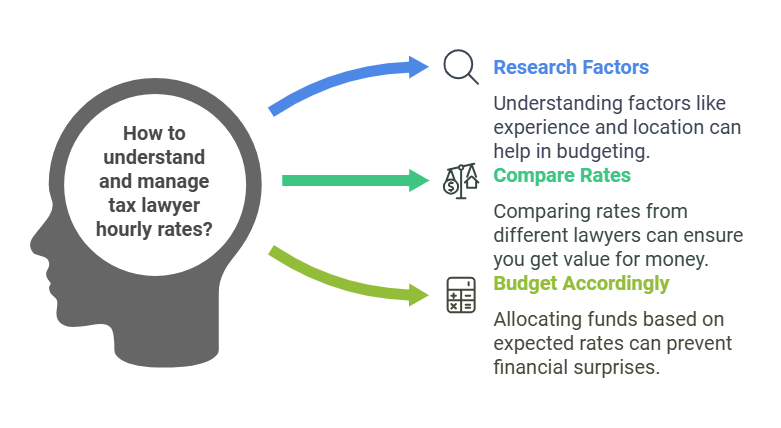
Hourly billing is common when the lawyer cannot predict the amount of work at the beginning. The firm records the time spent reviewing documents, researching law, speaking with you, communicating with the IRS, preparing filings, negotiating, and attending conferences or hearings.
Average Hourly Fees
A practical budgeting range is about $200 to $600 or more per hour. That range is not a national price schedule. A small-firm attorney in a lower-cost area may charge less, while a highly specialized partner handling a major business or criminal tax matter may charge substantially more.
The hourly rate alone does not reveal the final cost:
- Five hours at $300 per hour equals $1,500.
- Twenty hours at $400 per hour equals $8,000.
- Forty hours at $550 per hour equals $22,000.
Ask whether calls, emails, travel, internal conferences, document scanning, and work by other staff members are billable. Also ask whether the firm uses minimum billing increments, such as one-tenth or one-quarter of an hour.
Factors Affecting Hourly Rates
- Experience and specialization: A lawyer with extensive tax controversy or litigation experience may charge more.
- Geographic market: Rates vary substantially by state and city.
- Firm overhead: Larger firms may have higher rates but may also provide access to associates and specialized support staff.
- Type of work: Research, negotiation, litigation, criminal defense, and international tax work require different skills.
- Time pressure: A lawyer who must reorganize other work to meet an urgent deadline may charge a premium where permitted.
Clio’s current legal-rate data reports a 2025 average hourly billed rate of $349 across U.S. lawyers. A tax attorney’s actual rate may be above or below that broader benchmark.
Flat Fees
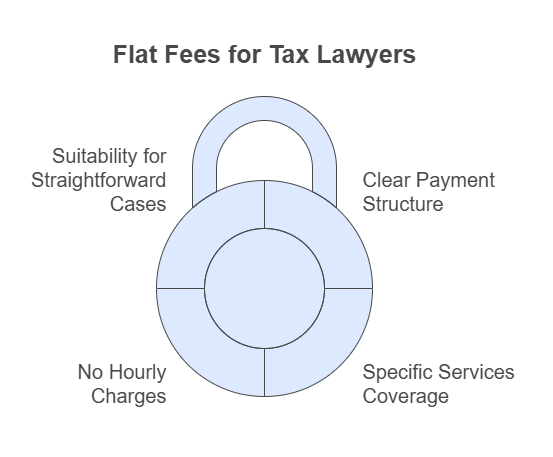
A flat fee is one stated price for a defined scope of work. It can make budgeting easier when the lawyer can reasonably predict the steps required. A flat fee does not automatically include every future notice, appeal, hearing, or court filing.
Common Flat-Fee Services
A tax lawyer may offer a fixed price for services such as:
- Reviewing a specific IRS notice and advising on a response.
- Preparing a written tax opinion on a defined question.
- Requesting a straightforward installment agreement.
- Preparing a penalty-abatement request.
- Submitting an Offer in Compromise for a taxpayer with a defined financial profile.
- Drafting a protest or appeal involving a limited issue.
- Preparing a particular tax or business document.
Routine tax return preparation may be available through some tax-law firms, but a CPA, enrolled agent, or qualified return preparer is often a more economical choice when no legal dispute or privilege-sensitive issue exists.
Advantages and Limits of Flat Fees
The main benefit is cost certainty. You know the agreed price for the listed work. The main risk is assuming that the quoted amount covers more than the engagement letter says.
Before paying, confirm whether the flat fee includes:
- IRS calls and written correspondence.
- Financial-statement preparation.
- Revisions requested by the IRS.
- An administrative appeal.
- Court filings or appearances.
- Travel, experts, copying, mailing, and government charges.
- Work caused by newly discovered tax years, businesses, assets, or missing records.
Pro Tip: Ask the lawyer to list both the included work and the exclusions in the engagement agreement. Also request the price or billing method that will apply if the matter moves beyond the original scope.
Retainer Fees
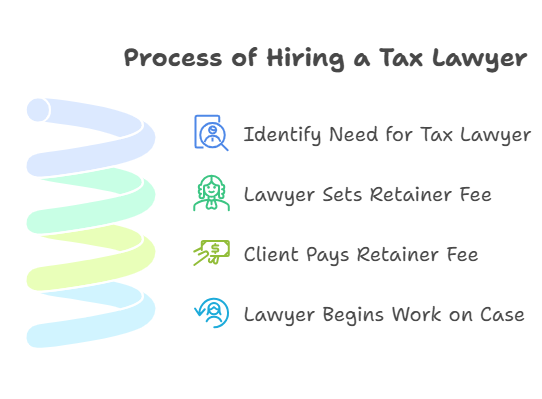
The word retainer is used for several different payment arrangements. It may describe an advance-fee deposit that secures payment for future hourly work, a flat fee for specified services, or a true availability retainer paid to reserve the lawyer’s time. These arrangements do not have identical accounting or refund rules.
Understanding Advance-Fee Deposits
Under ABA Model Rule 1.15, advance legal fees are ordinarily placed in a client trust account and withdrawn as the lawyer earns them or incurs authorized expenses. State rules may differ, so the engagement agreement and the rules governing that lawyer control.
A typical hourly retainer works like this:
- You deposit an agreed amount before work begins.
- The lawyer sends itemized invoices showing the work performed.
- Earned fees are transferred from the trust balance.
- You may be required to replenish the balance when it falls below a stated amount.
- Any remaining unearned balance is handled under the agreement and applicable state rules.
A contract’s use of the word “nonrefundable” does not, by itself, answer whether the fee was earned, reasonable, or refundable under local law. Ask the lawyer to explain the type of payment and when ownership of the money changes.
Retainer Fee Structures
- Security or advance-fee retainer: Funds secure payment for future work and are applied to invoices as fees are earned.
- Evergreen retainer: The client must restore the account to an agreed minimum after invoices are paid.
- Flat fee paid in advance: One price covers a defined service, subject to the jurisdiction’s rules on when the fee is earned.
- True availability retainer: A payment reserves the lawyer’s availability rather than paying for specific future tasks. This arrangement is less common and should be clearly documented.
- Hybrid fee: A fixed amount covers an initial phase, followed by hourly billing if the case expands.
ABA Model Rule 1.5 states that the scope of representation and the basis or rate of fees and expenses should be communicated to the client, preferably in writing.
Contingency Fees
Contingency fees are unusual and legally complicated in tax matters. The fee depends partly or entirely on the result, such as a refund recovered or an amount saved. The current text of Circular 230 §10.27 restricts contingent fees for matters before the IRS and lists exceptions involving specified examinations, interest or penalty claims, and judicial proceedings.
That is not the complete legal picture. A federal court barred the IRS from enforcing the rule against certain ordinary refund claims prepared before an examination or adjudication began. In December 2024, Treasury and the IRS issued proposed Circular 230 amendments intended to address intervening court decisions. State professional-conduct rules and the exact nature of the work may impose separate requirements.
Warning: Do not assume a percentage-based fee is permitted merely because a firm offers it. Request a written explanation of the legal basis, the percentage, covered services, case expenses, refund calculation, and what happens if no recovery is obtained.
When a Contingency Arrangement May Arise
A percentage-based arrangement may be discussed in connection with certain refund claims, interest or penalty disputes, whistleblower matters, or judicial proceedings. Whether it is permitted depends on federal rules, court decisions, state ethics rules, and the specific stage and character of the matter.
There is no dependable national percentage that applies to all tax cases. Any permitted contingency agreement should clearly state:
- The percentage or formula used.
- Whether the percentage changes if litigation or an appeal is required.
- Whether expenses are deducted before or after calculating the fee.
- Which costs you must pay even if there is no recovery.
- How the lawyer defines a successful result.
- Your rights if the representation ends early.
Potential Advantages and Disadvantages
Possible advantages:
- A qualifying client may avoid a large hourly deposit.
- The lawyer accepts some risk that no fee will be earned.
- The fee may align part of the lawyer’s compensation with the recovery.
Possible disadvantages:
- A percentage fee can exceed what hourly work would have cost.
- You may still owe filing fees, experts, travel, or other expenses.
- The arrangement may not be permitted for the proposed service.
- Disputes can arise over how the recovery or tax savings are calculated.
Additional Costs
The attorney’s quoted fee may not include every expense. Request a written estimate that separates legal fees, government charges, third-party expenses, and optional services.
Consultation Fees
An initial consultation may be free or may cost up to several hundred dollars. A paid consultation often includes document review, a discussion of deadlines and risks, and an initial strategy. A free intake call may be limited to deciding whether the firm accepts the type of case.
Ask these questions before booking:
- How long is the consultation?
- Will the lawyer review documents beforehand?
- Will I receive legal advice or only a case evaluation?
- Is the consultation fee credited toward future work?
- Does the meeting create an attorney-client relationship, or is a separate engagement agreement required?
Government and Case Expenses
- Offer in Compromise fee: The IRS generally charges a $205 application fee, plus the required initial offer payment. Qualifying low-income applicants do not pay those amounts, and doubt-as-to-liability offers do not require an application fee.
- Tax Court filing fee: The U.S. Tax Court petition fee is $60. A taxpayer may apply for a waiver.
- Payment-plan fees: IRS installment-agreement setup fees vary by plan, payment method, and low-income status. Some online options have no setup fee.
- Expert witnesses or consultants: Valuation, accounting, forensic, appraisal, or industry experts may bill separately.
- Travel: The agreement may make you responsible for transportation, lodging, and travel time.
- Administrative expenses: Copying, postage, transcripts, service fees, research charges, and secure document hosting may be added.
- Local or state charges: State tax agencies and courts may impose their own filing or application fees.
Note: Attorney fees do not pay the underlying tax, penalties, interest, or required settlement payments unless the written agreement expressly says otherwise.
The IRS warns taxpayers about Offer in Compromise mills that promise dramatic “pennies on the dollar” reductions, charge large fees, and fail to deliver the advertised result.
When You May Need a Tax Lawyer
A lawyer is not required for every tax question. Attorney training is most valuable when the matter involves legal strategy, possible litigation, privilege-sensitive communications, or serious financial or criminal consequences.
Consider consulting a tax attorney when:
- The IRS or another agency alleges fraud, evasion, willfulness, or false statements.
- A special agent or criminal investigator contacts you.
- You receive an administrative summons or subpoena.
- The dispute involves payroll or trust-fund recovery penalties.
- You own several businesses or have complex entity, transaction, estate, or international issues.
- You need a legal opinion about a proposed transaction or uncertain tax position.
- An audit could lead to a major assessment or litigation.
- You are considering an administrative appeal or court petition.
- You need advice protected by the attorney-client privilege or attorney work-product doctrine.
- A response, levy, collection, appeal, or petition deadline is approaching.
Federal law provides a limited confidentiality privilege for qualifying communications with federally authorized tax practitioners in certain noncriminal federal tax matters. However, IRC §7525 is narrower than the traditional attorney-client privilege. It does not apply to criminal tax matters and has other statutory limits.
Tax Attorney vs. CPA or Enrolled Agent
The IRS states that attorneys, certified public accountants, and enrolled agents have unlimited representation rights before the agency. They may represent clients in audits, payment and collection matters, and administrative appeals.
| Professional | Often a Good Fit For | Important Consideration |
|---|---|---|
| Tax attorney | Legal opinions, litigation strategy, criminal exposure, privilege-sensitive advice, contracts, business transactions, and major controversies | Confirm tax experience, state-bar status, and admission to any court involved |
| CPA | Accounting, financial statements, complex returns, business records, audit support, and tax planning | Legal and courtroom experience varies |
| Enrolled agent | Federal tax preparation, audits, collection matters, payment plans, appeals, and tax-resolution work | Licensed by the IRS rather than a state bar or accountancy board |
Price should not be the only factor. The professional should have recent experience with the exact issue, tax type, agency, and procedural stage involved.
How to Estimate the Total Bill
Ask the lawyer for a realistic range rather than focusing only on the hourly rate. A simple estimate can be built from four parts:
- Expected professional time: Ask for a low and high estimate of attorney, associate, and paralegal hours.
- Billing rates: Multiply the estimated hours for each person by that person’s rate.
- Government and third-party costs: Add filing fees, application fees, experts, travel, and other expected expenses.
- Contingency reserve: Budget for extra work if the IRS requests more information, rejects the initial proposal, or the case moves to appeal or court.
For example, ten hours at $350 per hour equals $3,500. If the matter also requires a $205 Offer in Compromise application fee, the initial combined total would be $3,705 before any required offer payment, copying, postage, or additional legal work.
A more involved matter requiring 25 hours at $500 per hour plus a $60 Tax Court filing fee would start near $12,560. Discovery, motions, experts, trial preparation, and settlement work could raise that figure substantially.
Cost-Saving Tips
You cannot control every development in a tax dispute, but you can reduce avoidable billable work.
Comparing Lawyers
- Speak with two or three professionals who regularly handle the specific type of case.
- Compare scope, staffing, billing method, likely strategy, and experience—not just the lowest advertised fee.
- Verify the lawyer’s license and public disciplinary history through the appropriate state bar.
- Use the ABA Lawyer Referral Directory to locate state and local referral programs.
- Ask who will actually perform the work and which tasks may be assigned to lower-rate associates or paralegals.
- Request a written estimate and ask what facts could cause the estimate to change.
Negotiating and Controlling Fees
- Ask whether a defined part of the case can be handled for a flat fee.
- Consider limited-scope representation when ethically permitted and practical.
- Request phased pricing for investigation, submission, negotiation, appeal, and litigation.
- Ask for budget alerts when fees reach agreed amounts.
- Discuss a payment plan before signing, rather than after the retainer is depleted.
- Ask whether the initial consultation fee will be credited toward the engagement.
- Confirm whether you must replenish an advance-fee deposit and how quickly.
Prepare Before the Lawyer Starts Work
- Collect all IRS and state notices in date order.
- Provide complete tax returns and amendments for every relevant year.
- Organize income records, bank statements, payroll records, and business documents.
- Create a timeline of filings, payments, calls, audits, and prior representation.
- List your questions in one document rather than sending many short emails.
- Respond promptly when the lawyer asks for information.
- Do not hide bad facts. Late disclosure can force the lawyer to redo work and change strategy.
Pro Tip: Send one organized document package with a short timeline and numbered questions. Paying a tax attorney to sort duplicates, identify missing pages, or reconstruct basic dates can add hundreds or thousands of dollars to the bill.
Questions to Ask Before Hiring a Tax Lawyer
- How much of your practice involves this type of tax issue?
- Who will be my main contact?
- Who will perform the work, and what are their billing rates?
- What work is included in the quoted fee?
- What work is specifically excluded?
- What government charges and third-party expenses should I expect?
- How often will I receive itemized invoices?
- Do you use minimum billing increments?
- Will I have to replenish the retainer?
- What developments could cause the estimate to increase?
- Will you notify me before exceeding a stated budget?
- What is the likely strategy, and what alternatives should I consider?
- What deadlines apply right now?
- What happens to unused funds if the representation ends?
- Can you promise a result? A trustworthy answer should explain that no outcome is guaranteed.
Red Flags to Avoid
Warning: Be cautious when a firm guarantees a settlement before reviewing your financial information, promises that everyone qualifies for “pennies on the dollar,” pressures you to pay immediately, or refuses to identify the licensed professional responsible for your case.
Other warning signs include:
- No written engagement agreement.
- Vague descriptions such as “tax relief package” without defined services.
- A large nonrefundable payment with no explanation of when it is earned.
- Refusal to provide itemized bills.
- Instructions to sign blank forms.
- Advice to ignore IRS notices or deadlines.
- Claims of a special relationship with the IRS.
- Failure to discuss less expensive options you may qualify for.
- Guarantees that penalties, interest, levies, or tax debt will be removed.
Lower-Cost and Free Alternatives
Professional representation can be valuable, but not every taxpayer needs to hire a private tax attorney.
Low Income Taxpayer Clinics
Low Income Taxpayer Clinics can represent qualifying taxpayers in audits, appeals, collection matters, and other disputes. Services are free or available for a small fee. Income must generally fall below the applicable clinic threshold, and the amount in dispute is usually less than $50,000. Each independent clinic makes its own acceptance decision.
IRS Self-Service Options
You may be able to request a payment plan, check Offer in Compromise eligibility, review account information, or respond to a simple notice directly through the IRS. Using a professional does not create eligibility for a program that the law and your financial facts do not support.
CPAs and Enrolled Agents
A CPA or enrolled agent may charge less than an attorney for return preparation, routine audit representation, payment plans, penalty requests, or collection work. Compare the person’s direct experience with your issue and confirm the full scope of service.
Return-Preparation Programs
For taxpayers who need return preparation rather than controversy representation, the IRS provides information about Volunteer Income Tax Assistance and Tax Counseling for the Elderly. These programs do not replace legal representation in a major dispute.
Frequently Asked Questions
What is the average cost of a tax lawyer?
There is no official national average specifically for tax attorneys. A practical hourly planning range is about $200–$600 or more. Total fees may be a few hundred dollars for limited advice or tens of thousands of dollars for a complex audit, appeal, criminal matter, or court case.
Do tax lawyers charge a flat fee?
Many tax lawyers offer flat fees for defined services such as notice responses, penalty requests, installment agreements, Offers in Compromise, or written opinions. Read the scope carefully because appeals, hearings, court work, extra tax years, and new issues may cost more.
Are tax lawyer fees tax-deductible?
Ordinary and necessary legal fees directly related to operating a business may be deductible, although costs connected with buying or improving a business asset may need to be capitalized. Personal fees for determining, collecting, or obtaining a refund of tax are generally miscellaneous itemized deductions and are not deductible under current federal law for taxable years beginning after 2017. State rules and special exceptions may differ.
How can I find an affordable tax lawyer?
Compare several professionals, ask for a written scope and estimate, consider limited or phased representation, organize your records, and check bar referral programs. Qualifying taxpayers may receive free or low-cost help from a Low Income Taxpayer Clinic.
Is a tax lawyer better than a CPA or enrolled agent?
It depends on the problem. Attorneys are often preferred for litigation, criminal exposure, legal opinions, contracts, and privilege-sensitive advice. CPAs and enrolled agents may be more economical for return preparation, accounting, audits, payment plans, and routine IRS representation.
Does the retainer cover the entire case?
Not necessarily. An hourly retainer is often an advance deposit from which earned fees are paid. You may have to replenish it as work continues. A flat-fee retainer may cover only the services listed in the engagement agreement.
Can a tax lawyer guarantee an IRS settlement?
No reputable professional should guarantee that the IRS will accept an Offer in Compromise, remove penalties, stop collection permanently, or reduce a balance by a stated amount. Results depend on the law, evidence, financial facts, deadlines, and the agency or court’s decision.
Conclusion
A tax lawyer may charge about $200–$600 or more per hour, while flat-fee matters can range from several hundred dollars to well over $10,000. The most useful quote is not simply the lowest hourly rate. It is a written estimate that identifies the work, staffing, likely hours, exclusions, government charges, and events that could increase the bill.
Compare the potential legal and financial risk with the expected cost. A tax attorney may be worth the expense for litigation, criminal exposure, payroll-tax problems, complex business matters, or urgent disputes. For routine returns, straightforward collection issues, or limited-income cases, a CPA, enrolled agent, LITC, or direct IRS option may provide appropriate help at a lower cost.
Sources
- Internal Revenue Service — Offer in Compromise FAQs — application fee, required payments, and low-income exceptions.
- Internal Revenue Service — Tax Professional Credentials and Qualifications — representation rights of attorneys, CPAs, and enrolled agents.
- Internal Revenue Service — Low Income Taxpayer Clinics — qualifying disputes and free or low-cost representation.
- U.S. Code, Title 26, §67 — current treatment of miscellaneous itemized deductions.
- Federal Register — Proposed Circular 230 Amendments — current regulatory background for tax-practitioner contingent fees.
- American Bar Association Model Rule 1.5 — communication and reasonableness of lawyer fees and expenses.