Student loan lawyer cost ranges from a few hundred dollars for limited advice to several thousand dollars for full representation. The final cost depends on the loan type, the problem, the lawyer’s experience, your location, and whether the matter involves negotiation, a lawsuit, or bankruptcy.
Quick Answer
A student loan lawyer may charge about $200 to $500+ per hour, $500 to $5,000 for many limited or flat-fee matters, and much more for contested litigation or a bankruptcy adversary proceeding. Rates vary widely, so request a written scope, compare quotes, and ask which expenses are included.
Key Takeaways
- Hourly billing, flat fees, and advance fee deposits are the most common arrangements.
- Routine federal repayment applications are free through StudentAid.gov and may not require a lawyer.
- Legal help is more valuable when you are sued, face collection action, dispute a private loan, or consider bankruptcy.
- A lawyer cannot guarantee forgiveness, settlement, discharge, or a specific reduction in your balance.
At a Glance
| Time Required | About 30–90 minutes for an initial consultation; longer for document review or litigation |
| Difficulty | Low for routine repayment questions; high for lawsuits, private-loan disputes, and bankruptcy |
| Documents Needed | Loan statements, promissory notes, payment history, notices, correspondence, income records, and court papers |
| Typical Cost | Free legal aid when eligible; otherwise a few hundred dollars for limited advice to several thousand dollars or more for full representation |
Note: This article provides general U.S. legal and financial information, not legal advice for a specific case. Fees vary by state and provider, and all figures are estimates. Student loan rules, deadlines, and available repayment programs can change. A licensed lawyer can advise you about your state, loan documents, and court deadlines.

The 2025 average hourly rate for a U.S. lawyer was $349, but state averages ranged from $196 to $492. Student loan cases may cost more or less depending on the work required.
What Student Loan Lawyers Do
Student loan lawyers handle consumer-law, debt-collection, contract, administrative, and bankruptcy issues connected to education debt. Their role is different from that of a loan servicer, financial counselor, or document-preparation company.
Role and Importance
A lawyer can review loan records, identify legal defenses, explain federal and state rights, communicate with a lender or collector, negotiate a private-loan settlement, answer a lawsuit, or represent a borrower in court. A lawyer may also review eligibility for forgiveness or discharge, but the final decision belongs to the lender, court, or government agency.
For a federal loan, many routine tasks—such as comparing repayment plans, applying for a plan, or consolidating eligible loans—can be completed without charge through the Federal Student Aid Repayment Calculator and your official loan servicer.
When to Consider Hiring
Legal help is most useful when the problem involves legal rights, disputed facts, a deadline, or the risk of losing by default. Consider speaking with a lawyer when:
- You received a summons, complaint, garnishment notice, or other court paper.
- A private lender or debt collector is demanding payment on a disputed balance.
- You believe a collector violated federal or state collection law.
- Your servicer repeatedly failed to correct a documented error.
- You are evaluating settlement terms that could create tax or credit consequences.
- You are considering bankruptcy and want to pursue a student-loan discharge.
- Your case involves identity theft, school misconduct, fraud, disability, or another fact-heavy discharge claim.
Warning: Do not ignore a lawsuit or collection notice while you compare lawyers. Response deadlines can be short, and missing one may lead to a default judgment. Keep the envelope, record the date received, and contact a consumer-law attorney or legal aid office promptly.
When Free Help May Be Enough
You may not need to pay a lawyer merely to understand a federal payment plan or submit a standard application. Start with your official servicer and StudentAid.gov. If the servicer does not resolve a documented federal-loan problem, submit feedback through the Federal Student Aid Feedback Center. You may also submit a student-loan complaint to the Consumer Financial Protection Bureau.
Factors That Affect Student Loan Lawyer Cost
No national fee schedule controls what a student loan lawyer charges. The price usually reflects the lawyer’s experience, local market, billing model, scope of work, urgency, and case complexity.
Experience and Expertise
Experience matters, but years in practice alone do not prove that a lawyer understands student loans. Look for meaningful work in consumer law, debt collection defense, student loan disputes, administrative claims, or bankruptcy—whichever matches your problem.
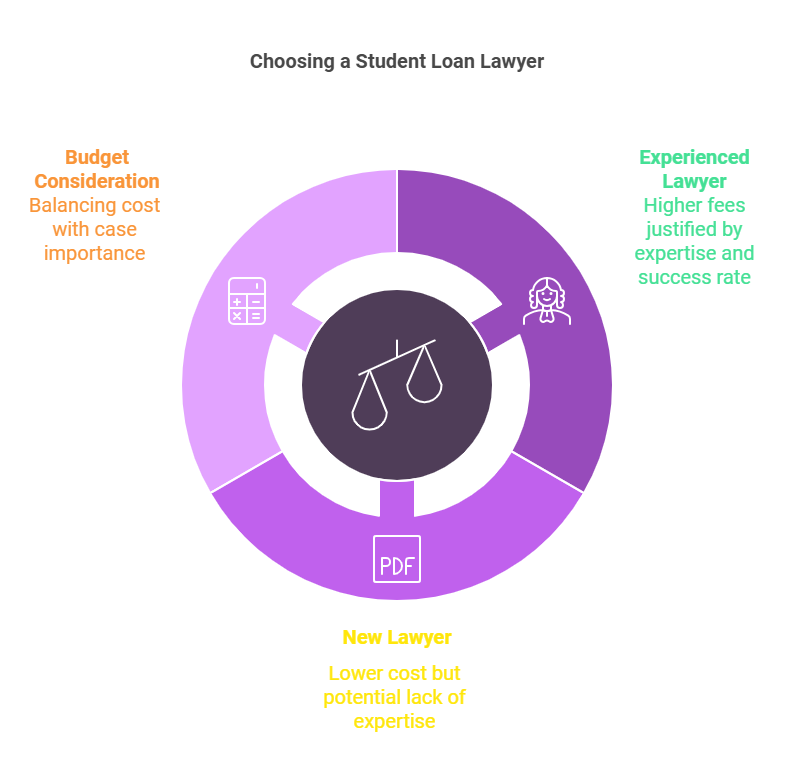
A specialist may charge more per hour but need fewer hours to identify the issue. Ask how many similar matters the lawyer has handled, what work will be delegated to a paralegal, and whether the quoted price includes follow-up questions.
Geographical Location
Location affects legal rates. Clio’s nationwide billing data reported a 2025 average lawyer rate of $349 per hour, with state averages from $196 in West Virginia to $492 in the District of Columbia. These figures cover many practice areas, so they are a market benchmark—not a student-loan price list.
| Local Market | What to Expect |
| Lower-cost market | Rates may fall below the national average, especially for limited-scope advice |
| Major city or specialized practice | Rates may be higher because of overhead, demand, and specialized experience |
| Remote consultation | May expand your choices, but the lawyer must be licensed and able to handle the relevant jurisdiction |
Complexity of the Case
The complexity of your case often matters more than the size of your balance. A document review or strategy session may take only a few hours. Litigation can require pleadings, discovery, hearings, expert evidence, and trial preparation.
- Usually simpler: reviewing loan records, explaining options, drafting a demand letter, or advising on a standard federal application.
- Usually more complex: defending a collection lawsuit, negotiating several private loans, litigating fraud claims, or seeking discharge in bankruptcy.
The U.S. Department of Justice and Department of Education introduced a standardized process in 2022 for certain federal student-loan bankruptcy discharge cases. The current guidance, updated in March 2026, uses an attestation form to help evaluate undue hardship. The procedure can make government positions more consistent, but an adversary proceeding remains litigation and may still be costly.
Scope, Urgency, and Extra Expenses
A quote may cover only a consultation, or it may include all work through settlement or trial. Urgent court deadlines can increase the fee. Ask whether the price includes filing fees, service costs, transcripts, credit reports, travel, expert witnesses, appeals, and work by paralegals.
A low quote is not a bargain if it excludes the work you actually need. Compare the written scope, not only the headline price.
Average Fees and Billing Structures
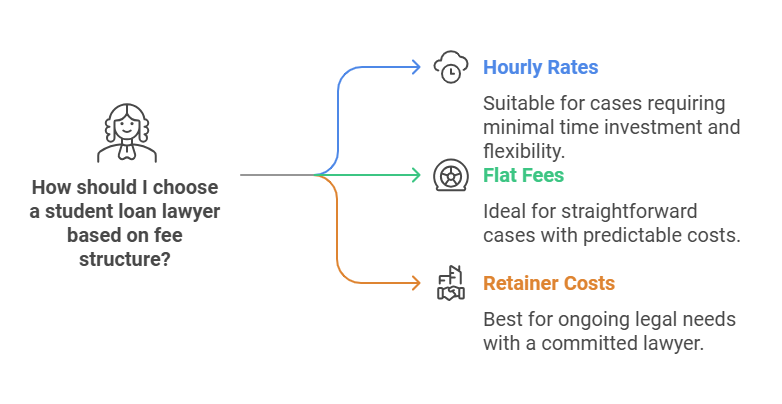
Student loan attorneys may use hourly billing, a flat fee, limited-scope pricing, or an advance fee deposit. The ranges below are our planning estimates for typical consumer-law billing, not figures from a published fee survey or guaranteed averages. A complex case can cost far more.
| Service or Fee Type | Planning Range | What It May Cover |
| Initial consultation | Free to about $500 | Issue spotting, basic document review, and next-step advice |
| Hourly representation | About $200–$500+ per hour | Research, calls, letters, negotiation, pleadings, and court work |
| Limited-scope flat fee | About $500–$2,500 | A defined task such as a file review, demand letter, or settlement analysis |
| Negotiation or lawsuit defense | About $1,500–$5,000+, depending on scope | Creditor communication, pleadings, settlement, and selected hearings |
| Bankruptcy adversary proceeding | Several thousand dollars; contested cases can exceed $20,000 | A separate lawsuit within bankruptcy to determine dischargeability |
Hourly Rates
With hourly billing, you pay for the time spent on your matter. Ask whether the firm bills in six-minute, ten-minute, or fifteen-minute increments. Also ask for the rates of each lawyer, paralegal, and other professional who may work on the file.
Flat Fees
A flat fee can make the total cost easier to predict, but only when the agreement clearly defines what is included. Find out whether the fee covers document review, calls, revisions, negotiation, hearings, and follow-up work. Ask what event triggers an additional fee.
Advance Fee Deposits and Retainers
People often use the word retainer for money paid before work begins. In many arrangements, the payment is actually an advance deposit from which the lawyer earns fees as work is completed. The amount varies with the expected workload. Review the agreement for refund rules, replenishment requirements, and where the money will be held.
Before work begins, ask for the scope of representation, fee basis, billing method, and expected expenses in writing.
Affordable Solutions
Paying a private lawyer is not the only way to get help. Free government tools, nonprofit resources, legal aid, state bar referrals, and limited-scope representation can lower the cost.
Nonprofit Organizations
The Student Loan Borrower Assistance Project, operated by the National Consumer Law Center, publishes borrower resources and directs people to legal help. It is a useful information and referral source, but borrowers should not assume that the organization will provide individual representation.
For federal-loan issues, contact your servicer first and keep records. If the problem remains unresolved, use the Federal Student Aid Feedback Center. State student-loan ombudsman or advocate offices may also be available in some states.
Legal Aid Services
Legal aid programs may provide free civil legal help to people who meet income or other eligibility rules. Coverage differs by location and funding, so ask whether the program handles student loans, debt collection, or bankruptcy.
| Resource | What It Offers |
| Legal Services Corporation | A locator for LSC-funded civil legal aid organizations |
| LawHelp.org | State-by-state legal information, forms, and legal aid referrals |
| ABA Find Legal Help | Links to free legal help, lawyer referrals, and licensing information |
Pro Tip: Ask whether the lawyer offers “limited-scope representation.” Paying for a file review, written strategy, demand letter, or hearing preparation can be cheaper than hiring the firm for the entire matter.
DIY Options
Some borrowers can handle routine federal-loan tasks themselves. Self-representation costs less, but it requires careful recordkeeping and may be risky when a court deadline or disputed legal issue is involved.
Self-Representation

Self-representation means handling the matter without a lawyer. It may be reasonable for gathering records, contacting a servicer, comparing federal repayment plans, or filing a complaint. It is less suitable for a lawsuit, contested bankruptcy matter, or complex private-loan dispute.
Steps for handling a routine issue yourself:
- Identify every loan. Separate federal loans from private loans and confirm the owner and servicer.
- Gather documents. Save statements, promissory notes, payment histories, notices, emails, and screenshots.
- Write a timeline. List dates, payments, calls, disputes, and promises made by the servicer or collector.
- State the requested correction clearly. Use dates, account numbers, and supporting documents.
- Keep proof of delivery. Save confirmation numbers and copies of every submission.
- Escalate through official channels. Use StudentAid.gov for federal-loan feedback and the CFPB for consumer complaints.
- Get legal help when the issue becomes adversarial. A lawsuit, garnishment, settlement release, or bankruptcy claim deserves prompt legal review.
Online Resources
Use official and nonprofit sources instead of paying a company merely to submit a free federal form:
- Federal Student Aid: Current federal loan balances, repayment tools, consolidation information, forgiveness and discharge guidance, and complaint channels.
- Student Loan Borrower Assistance: Borrower education, default and collection information, and referrals to legal help.
- Consumer Financial Protection Bureau: Debt-collection rights, complaint filing, and guidance on finding a consumer lawyer.
- U.S. Department of Justice: Current federal student-loan bankruptcy discharge guidance and attestation materials.
Note: Federal repayment options are changing under 2025 federal legislation, with new plans scheduled to begin on July 1, 2026. Use the current StudentAid.gov Repayment Calculator and official notices from your servicer rather than relying on older repayment-plan articles or screenshots.
Payment Plans and Financial Assistance

Many firms know that a borrower seeking student loan help may have limited cash. Ask about payment timing before signing the agreement, but do not assume that every lawyer offers installments or income-based fees.
Negotiating Payment Terms
Possible arrangements include:
- Monthly installments: Dividing a flat fee or advance deposit into scheduled payments.
- Limited-scope work: Paying for only the most important task instead of full representation.
- Capped fees: Hourly billing up to a stated maximum unless you approve more work.
- Sliding-scale fees: Reduced pricing based on income, when the firm or nonprofit offers it.
- Phased representation: A separate price for consultation, negotiation, litigation, and appeal.
Ask what happens if you miss a payment and whether the lawyer may withdraw from the case. Court rules may limit withdrawal after litigation begins.
Reduced-Fee and Pro Bono Help
Legal aid societies, law-school clinics, bar-association programs, nonprofit consumer-law organizations, and volunteer lawyers may provide free or reduced-fee services. Eligibility and available case types vary. A school financial aid office may know local resources, but ordinary student-aid grants usually are not designed to pay private attorney fees.
Questions to Ask Before Hiring
- How much of your practice involves consumer law or student loans?
- How many matters like mine have you handled?
- What result is realistic, and what can you not promise?
- Is the fee hourly, flat, capped, or an advance deposit?
- Exactly what work is included and excluded?
- Who will work on my case, and what are their rates?
- What additional costs could I owe?
- Will I owe the fee if the case is unsuccessful?
- How often will I receive bills and case updates?
- Can you provide the fee agreement before I decide?
The right comparison is not “Which lawyer is cheapest?” It is “Which written scope gives me the help I need at a cost I can manage?”
Pros and Cons of Hiring a Lawyer
Hiring a lawyer can protect your rights and reduce confusion, but it also adds cost and does not guarantee success.
Benefits
- Legal analysis: A lawyer can identify defenses, deadlines, and claims that a borrower may miss.
- Representation: The lawyer can communicate with a collector, negotiate, draft filings, and appear in court.
- Risk review: Legal advice can help you evaluate settlement releases, tax issues, credit effects, and litigation risks.
- Case strategy: A specialist can separate realistic options from programs or services that do not fit your loan type.
- Reduced stress: Having a professional manage deadlines and communications can make a difficult dispute easier to handle.
Potential Drawbacks
- Cost: Hourly work and litigation can become expensive quickly.
- Limited availability: Student loan law is specialized, and local legal aid resources may be scarce.
- Delay: Agency reviews, negotiations, and court proceedings can take months or longer.
- No guaranteed outcome: A lawyer cannot promise forgiveness, settlement, or discharge.
- Possible duplication: Paying a lawyer for a routine federal form may add little value when official help is free.
Contingency fees are uncommon in ordinary student-loan counseling because there may be no cash recovery from which to pay a percentage. They may be possible in certain consumer claims, subject to the fee agreement, professional rules, and applicable law.
Related Legal Cost Guides
Student debt problems often overlap with other legal issues. See our guides to bankruptcy lawyer cost, debt settlement lawyer cost and consumer protection lawyer cost.
Frequently Asked Questions
What is the cost of hiring a student loan lawyer?
A limited consultation may be free or cost a few hundred dollars. Hourly rates often fall around $200 to $500 or more, while many defined flat-fee matters may cost about $500 to $5,000. Contested litigation or a bankruptcy adversary proceeding can cost substantially more.
Do student loan lawyers offer payment plans?
Some do. A firm may allow installments, phased work, capped billing, or a replenished advance deposit. Ask for the payment schedule, late-payment terms, refund rules, and full scope in writing before hiring the lawyer.
Can a student loan lawyer reduce my debt?
Possibly, but not in every case. A lawyer may negotiate a private-loan settlement, challenge an incorrect balance, pursue a legal claim, or seek discharge in bankruptcy. Federal repayment and forgiveness programs follow legal eligibility rules, and no lawyer can guarantee a reduction.
Is hiring a student loan lawyer worth it?
It may be worth the cost when you face a lawsuit, collection action, disputed private loan, serious servicing error, or bankruptcy question. It may not be necessary for a routine federal repayment application that you can complete free through StudentAid.gov.
Can a lawyer guarantee student loan forgiveness or bankruptcy discharge?
No. A lawyer can assess eligibility, prepare evidence, correct errors, and advocate for you, but the government agency, lender, or court makes the final decision.
How can I find a qualified student loan lawyer?
Look for a licensed consumer-law, debt-collection, or bankruptcy attorney with experience in your type of case. Use a state bar referral service, ABA Find Legal Help, the National Association of Consumer Advocates, or a local legal aid program. Verify the lawyer’s license and disciplinary history.
Conclusion
A student loan lawyer may cost a few hundred dollars for focused advice, $500 to $5,000 for many defined matters, or much more for contested litigation. The best way to control the price is to identify the exact problem, organize your records, compare written scopes, and ask about every likely expense.
Start with free official resources for routine federal-loan questions. Seek legal help promptly when you receive court papers, face collection action, dispute a private loan, or consider bankruptcy. A qualified lawyer can explain your options and protect your rights, but no lawyer can promise a particular financial result.
Sources
- Clio Legal Trends: Average Lawyer Hourly Rates — national and state billing benchmarks updated in March 2026
- American Bar Association Model Rule 1.5 — factors affecting fees and written fee communication
- Federal Student Aid Repayment Calculator — current federal repayment comparisons and applications
- Consumer Financial Protection Bureau — finding a consumer lawyer and questions to ask
- U.S. Department of Justice Student Loan Guidance — federal bankruptcy discharge process and attestation materials
- Legal Services Corporation — locator for federally funded civil legal aid organizations