
A California lifetime fishing license is a one‑time, age‑based permit you can buy to avoid annual renewals; fees range from about $691.75 (young children and seniors) to $1,131.75 (ages 10–39) with a $467.25 optional privilege package and mandatory handling/application charges. You must be a California resident six months, provide age/residency proof, and follow report‑card and validation rules; military, veteran, disability, and low‑income exceptions apply — continue for application, fees, and documentation specifics.
What Is a Lifetime Fishing License and How It Works
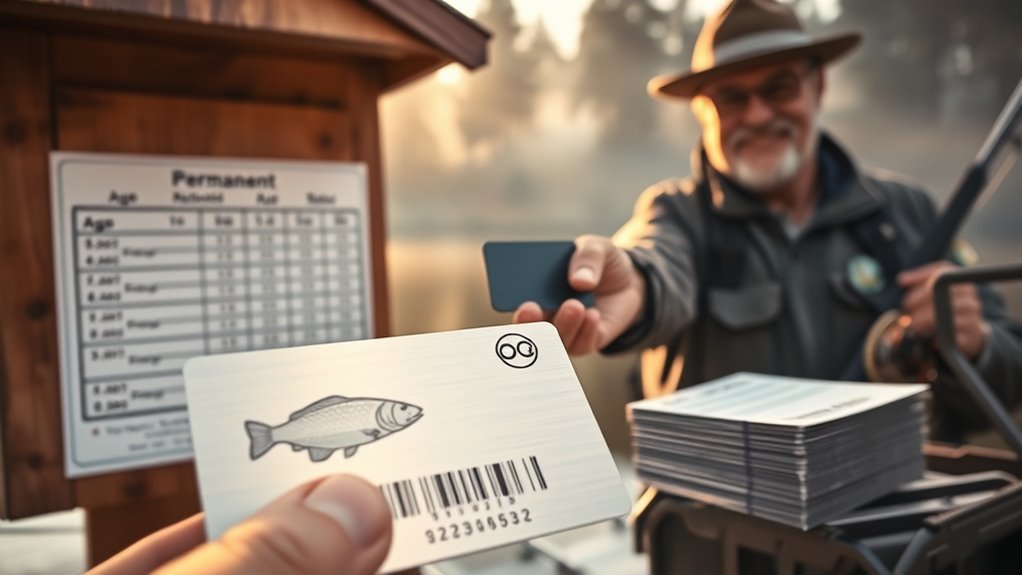
A Lifetime Fishing License is a one-time, nonrenewable credential that lets you legally fish for the rest of your life without annual renewals, streamlining compliance and recordkeeping for frequent anglers.
You’ll find it functions as a single purchase that removes recurring transaction costs and administrative burden; prices vary by age cohort ($691.75 for ages 0–9 and 62+, $1,131.75 for 10–39, $1,019.50 for 40–61). You must provide proof of age, and the license covers both freshwater and saltwater fishing in California.
You can optionally add a Fishing Privilege Package (validations and report cards) for $467.25.
From a regulatory perspective, the model consolidates revenue collection and stabilizes funding streams: proceeds support fishing conservation, habitat restoration, and education programs.
When you compare long-term costs, the license benefits are quantifiable for frequent anglers and supply predictable conservation funding, aiding planners and policy-makers who need reliable, evidence-based projections for resource management.
Who Is Eligible to Purchase a Lifetime Fishing License
To qualify for a California Lifetime Fishing License, you’ll need to meet clear residency and age criteria and provide proof such as a valid driver’s license.
You should also check specific provisions that reduce or alter eligibility and fees for veterans, active military personnel, people with disabilities, and low‑income applicants.
I’ll outline the age‑tiered fee structure, documentation requirements, and any veteran/disability or income‑based exceptions you should expect.
Residency and Age Requirements
Because residency and age determine eligibility and fee tiering, you must meet California residency of at least six months and choose the age-based cost that applied when you bought the license.
You’ll need residency verification and age verification to complete the application; staff will compare IDs and documentation against statutory requirements. Evidence shows fees are fixed by age band at purchase and aren’t adjusted later.
- Ages 0–9: $691.75 — submit proof for minor status and residency verification.
- Ages 10–39: $1,131.75 — provide valid ID showing birthdate and six-month residency.
- Ages 40–61: $1,019.50; 62+ seniors: $691.75 — document age verification and continuous California residency.
You’ll retain lifetime privileges while supporting conservation funding.
Military and Veteran Eligibility
When you’re an honorably discharged service member or a recovering active-duty individual, you qualify for a Lifetime Fishing License under clearly defined conditions and reduced-fee provisions:
disabled veterans with a VA letter showing a 50%+ disability rating and recovering service members with verification from a commanding officer or physician can purchase the license for $10.29 through CDFW or authorized agents, while other applicants still pay age-based fees (for example, residents 10–39 pay $1,131.75); documentation is examined against statutory criteria before issuance.
You’ll need to submit verifiable proof to access military benefits tied to veteran fishing; CDFW treats the documentation as dispositive for eligibility.
The reduced-fee pathway is evidence-based, administratively clear, and supports conservation funding while recognizing service-related status.
Disability and Low‑Income Qualifiers
Although eligibility rules vary by circumstance, the Department applies clear, document-based criteria for reduced-fee and free lifetime fishing licenses so you can determine whether you qualify and what proof you’ll need.
You’ll find the program differentiates by disability type, service status, and income, and requires specific documentation tied to disability benefits or low income documentation. Expect a 15-business-day eligibility review after you submit materials.
- Disabled veterans: 50%+ disability rating qualifies for a $10.29 Disabled Veteran Sport Fishing License with a Veterans Administration letter.
- Recovering service members: Reduced-fee $10.29 option with commanding officer or physician verification for active medical treatment.
- Low-income seniors and severe disabilities: Reduced-fee $9.79 or free licenses require certified income proof or medical certification of blindness/severe impairment.
Lifetime Fishing License Fees by Age Group
Five clear age brackets determine the lifetime fishing license fees, and you should pick the category that matches your birth year to calculate your cost precisely.
You’ll evaluate age based pricing against your expected lifetime participation and the lifetime license advantages: youth (0–9) and seniors (62+) are set at $691.75, reflecting policy intent to lower entry cost for early and late life stages.
For primary working-age cohorts, fees rise: ages 10–39 are $1,131.75, while ages 40–61 are $1,019.50, indicating actuarial adjustments for remaining expected angling years.
These figures exclude optional administrative add-ons: the Fishing Privilege Package (validations and report cards) is an additional $467.25.
You should compare the present-cost outlay to projected annual permit purchases to determine net benefit.
Use the explicit brackets and dollar amounts above when modeling break-even points and budget impacts; regulators and analysts will expect transparent, evidence-based cost comparisons before recommending purchase.
Products Worth Considering

【Material】Our License Plate Frame Is Made Of Stainless Steel, Strong And Durable.
ALUMINUM FRAME: This License Plate Frame is crafted from high-quality aluminum that is resistant to corrosion, rust, and harsh weather conditions. Its rugged reliability design ensures a long lifespan, making it capable of withstanding car washes and extreme weather, providing you with a reliable and stylish solution for your vehicle.

The size of the license plate frame is: 12.3" x 6.3" , it fits all standard size US and Canada vehicle license plates.the stylish design frame fits ly on your car license plate.
What the Lifetime License Covers and Additional Privileges
Having chosen the correct age bracket and weighed fee alternatives, you should next examine exactly what a Lifetime Fishing License authorizes and which supplementary privileges you may still need to buy.
You get lifetime authorization to fish without annual renewals, a clear regulatory benefit that simplifies compliance with fishing regulations. Fees vary by age at purchase, and once paid you’re exempt from recurring license purchases. Evidence shows proceeds support conservation efforts and habitat restoration, linking your payment to resource stewardship.
- Validations and report cards: some activities still require specific yearly validations or report cards even for lifetime holders, so verify activity-specific endorsements.
- Species- or area-specific permits: certain fisheries impose extra permits or tags beyond the lifetime license; check regulatory notices.
- Enforcement and recordkeeping: carry proof of lifetime status; you’re still subject to on-site inspections and reporting obligations under state law.
Assess these elements against local regulations before assuming full coverage.
How to Apply for a Lifetime Fishing License

Start by gathering the required documents and the correct application form from the California Department of Fish and Wildlife (CDFW) website or a CDFW office, since you’ll need proof of age and any category-specific paperwork (for example, disabled veteran or low‑income verification) before submitting. You’ll complete the form, include proof of age (fees vary by age bracket), and add documentation for any eligibility category. Applications may be sent by mail or fax to CDFW for processing.
| Step | Requirement | Evidence |
|---|---|---|
| 1 | Application form | Download or office copy |
| 2 | Proof of age | Birth certificate/ID |
| 3 | Eligibility docs | Disabled veteran/low‑income |
| 4 | Submission | Mail or fax to CDFW |
Follow the stated application process and retain copies. CDFW reviews applications within up to 15 business days. This procedural approach clarifies requirements, supports compliance, and highlights lifetime license benefits tied to correct documentation and timely submission.
Products Worth Considering

USA, License, plate, Vintage, tag, lot, set, plates, number, wall, decor, art, bar, restaurant, design, gift, cool, nice, american, america, hawaii, alaska, california, texas
Product Material:made of Stainless steel. Personalized Car Frame Can Perfect to Put on Your Front of Car,Decorate your car to make it look more beautiful and unique,just wipe with a damp cloth

The size of the license plate frame is: 12.3" x 6.3" , it fits all standard size US and Canada vehicle license plates.the stylish design frame fits ly on your car license plate.
Payment Methods, Fees, and Handling Charges
When you apply for a Lifetime Fishing License, you’ll need to plan for the base fee that varies by age (from $691.75 to $1,131.75) plus mandatory add‑ons: a 5% handling charge and a 3% nonrefundable application fee, all of which are applied to the total cost.
Payments are accepted by check, money order, or Visa/Mastercard (cash isn’t accepted at CDFW offices), and applications may be submitted by mail or fax for processing.
You should evaluate payment options against regulatory requirements and budget for transaction fees embedded in the price structure. The evidence-based approach is to compute totals before submission, documenting the check or card reference and retaining proof of mailing or fax transmission.
- Choose payment option: check, money order, or Visa/Mastercard; note that cash isn’t accepted.
- Calculate total: base fee + 5% handling charge + 3% nonrefundable application fee; treat these as transaction fees.
- Submit application by mail or fax and retain receipts for audit or duplicate-license requests.
Products Worth Considering

FISHING LICENSE HOLDER W/ZIP CLOSURE
Validations, Report Cards, and Add-On Privilege Packages
When you evaluate lifetime license costs, account separately for required report cards like the North Coast Salmon Report Card ($8.90) and species-specific cards that children under 16 must obtain even without a license.
Also factor in optional privilege packages and standalone validations—e.g., Ocean Enhancement ($7.05) and Second Rod ($19.70)—which expand fishing options but carry their own fees and reporting deadlines.
Check regulatory requirements and submission dates (for example, the Spiny Lobster Report Card return due January 31) to avoid noncompliance and unexpected costs.
Required Report Cards
Although a general fishing license covers many activities, specific report cards and validations are mandatory for particular species and areas and you must purchase and return them as required to remain compliant.
You’ll need to follow report card requirements that target particular fishing species and geographic zones; exemptions for license possession don’t remove report card obligations for children under 16.
Key regulatory points and costs are clear:
- North Coast Salmon Report Card: $8.90, required for salmon in designated rivers.
- Spiny Lobster Report Card: must be purchased and returned by April 30 (January 31 return applies in some areas) to avoid non-return fees.
- Ocean Enhancement Validation: $7.05, required south of Point Arguello for expanded ocean privileges.
Optional Privilege Packages
Because you may want expanded access or must meet species- and area-specific reporting rules, optional privilege packages let you add the exact validations and report cards required for compliant, permitted fishing activity. You’ll evaluate costs and obligations: Ocean Enhancement Validation ($7.05) is mandatory for ocean fishing south of Point Arguello; North Coast Salmon Report Card ($8.90) tracks catch data; Second Rod Validation ($19.70) allows two rods inland. The extensive Fishing Privilege Package ($467.25) bundles these elements for broader coverage. Assess packages against fishing regulations and intended activity to avoid noncompliance. Below is a concise reference to compare core options.
| Item | Purpose | Cost |
|---|---|---|
| Ocean Enhancement | ocean fishing area access | $7.05 |
| Salmon Report Card | species catch reporting | $8.90 |
| Second Rod | inland equipment allowance | $19.70 |
Replacing, Renewing, or Updating a Lifetime License
If you lose, damage, or need to change information on your lifetime fishing license, the California Department of Fish and Wildlife provides clear, documented procedures for replacement, renewal, and updates. You can request services online through the CDFW Online License Service or in person at CDFW offices and authorized agents.
You’ll follow the license replacement process or use online renewal options depending on the task. Fees apply for replacement; renewals require proof of age and residency. Updating personal data, like an address change, is available via the CDFW Online License Service and doesn’t void validity if the physical card remains readable.
- Replacement: submit identification (birth certificate, driver’s license), pay the small fee, choose online or agent processing.
- Renewal: supply proof of age/residency; use agents or online renewal options to complete documentation.
- Updates: amend contact or address through the online portal; the lifetime license stays valid while legible.
Follow documentation requirements to guarantee regulatory compliance.
Benefits of Choosing a Lifetime License Vs Annual Licenses
When you compare lifetime and annual fishing licenses analytically, the lifetime option clearly reduces administrative burden and long-term cost exposure by eliminating yearly renewals and vulnerability to price increases and inflation adjustments.
For anglers who fish frequently or plan a lifelong pursuit, an up-front fee (ranging by age from about $691.75 to $1,131.75) amortizes over time and removes the need for additional validations like ocean or second-rod permits, while also directing funds to conservation programs that sustain fisheries.
You’ll realize measurable lifetime savings because you avoid repeated purchases and future fee escalations that erode the value of annual permits.
From a regulatory perspective, one transaction simplifies compliance, record keeping, and proof-of-privilege issuance.
You also gain practical fishing freedom: no annual administration means fewer barriers to on-water activity.
Finally, by choosing the lifetime option you provide predictable revenue for habitat and enforcement programs, aligning personal convenience with public resource stewardship.
Products Worth Considering

Add a touch of humor and flair to your car with this funny "Weekend Hooker" front license plate. Perfect for the bass fishing enthusiast, this custom car tag is a great gift for men, especially for dads, husbands, or any fishing fanatic. Whether you're an outdoorsman or just enjoy a good laugh, this novelty license plate is sure to bring a smile to your face and enhance your fishing-themed car decor. Let your personality shine on the road with this fun and unique accessory.

Enough to Use: you will receive 6 pieces of fishing license holders, and 6 pieces of safety pins, abundant in quantity, enough for you to choose and replace, can meet your different needs; You can also share them with your friends

Enough to Use: you will receive 6 pieces of fishing license holders, and 6 pieces of safety pins, abundant in quantity, enough for you to choose and replace, can meet your different needs; You can also share them with your friends
Common Questions About Lifetime Fishing License Policies
Curious about how a Lifetime Fishing License actually works in practice? You’ll want clear answers on cost, documentation, and policy impacts.
California’s fee structure is age-tiered: $691.75 for ages 0–9 and 62+, $1,131.75 for ages 10–39, and $1,019.50 for ages 40–61. You can apply online, by mail, or fax with proof of age (birth certificate or driver’s license).
Purchase supports fishing conservation efforts through funding for hatcheries, habitat restoration, and wildlife programs, a key lifetime license benefits argument.
- Who pays what? Fees depend strictly on your age at purchase and are nonrefundable, so verify eligibility before you buy.
- What extras exist? Additional privilege packages (validations, report cards) are optional and priced separately to expand access.
- How’s it regulated? Lifetime licenses remove annual renewals, reducing administrative load while creating long-term conservation revenue that regulators track and report.
Frequently Asked Questions
Can Nonresidents Buy a California Lifetime Fishing License?
No, you can’t; California regulations restrict lifetime fishing licenses to residents who meet fishing residency requirements, so nonresidents aren’t eligible. Review official Fish and Wildlife documentation for evidence, residency proofs, and any regulatory exceptions.
Are Lifetime Licenses Transferable to Another Person?
No, lifetime licenses generally aren’t transferable; transfer policies restrict reassignment and require meeting eligibility criteria for the original purchaser. You should review state regulations and documented evidence to confirm exceptions or administrative procedures.
Does a Lifetime License Expire if I Move Out of State?
Generally, your lifetime license doesn’t expire if you move, but you’ll face changed residency requirements and altered lifetime license benefits; check the issuing state’s statutes and agency regulations for specific evidence-based conditions and transfer or use limitations.
Are Lifetime Licenses Valid for Commercial Fishing Activities?
No, lifetime licenses typically don’t authorize commercial fishing; you’ll need separate permits and must follow commercial fishing regulations, since lifetime license restrictions usually limit you to recreational take and require compliance with quota, gear, and reporting rules.
Is There a Refund if I Never Use My Lifetime License?
No, you typically won’t get a refund; about 90% of agencies treat lifetime licenses as nonrefundable. You should review the specific refund policy and license usage terms, since statutes and agency regulations determine exceptions.
Conclusion
Choosing a lifetime fishing license gives you predictable long-term costs and fewer administrative hassles, acting like an insurance policy against rising fees. If you meet eligibility and can front the one-time fee, evidence shows you’ll often break even within a few years compared with annual purchases. Still, weigh age-based pricing, covered privileges, and add‑on requirements against your expected fishing frequency and regulatory changes before committing—document the decision and confirm validation procedures ahead of purchase.
