

You’ll recruit certified welders by offering competitive, market‑aligned pay and clearly defined skill bands (MIG/TIG/Stick, AWS/CWI, aluminum). Use technical job specs, practical weld tests with scoring rubrics, and certification verification to vet candidates. Source talent from vocational schools, unions, and targeted online listings, then build apprenticeships and documented career ladders. Factor true labor cost — add 10–30% for specialty skills plus benefits and contingencies — into shop billing, and keep processes auditable to learn more.
Why Competitive Pay Matters for Hiring Welders
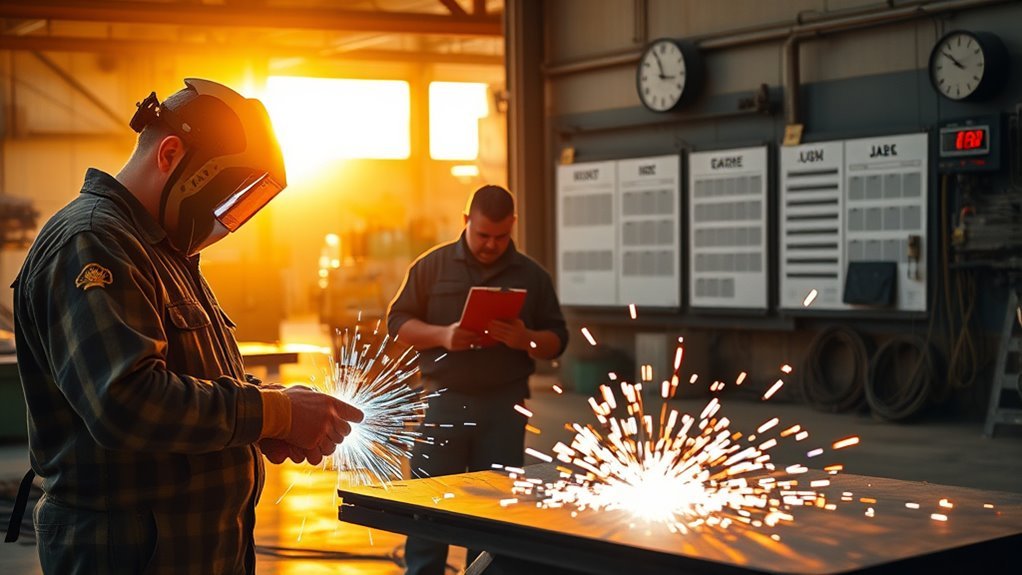
Because skilled welders can command $60,000–$70,000+ in high-demand states, your pay scale directly shapes who you’ll hire and keep.
You’ll prioritize competitive pay to attract certified TIG and aluminum specialists whose expertise reduces rework and liability.
Implement clear wage transparency so candidates and supervisors assess pay bands against required certifications and scope-of-work standards.
During salary negotiations, present documented pay ranges, competency criteria, and measurable progression steps tied to certification milestones.
Paying above industry averages has empirical impact—firms report roughly 20% lower attrition—so model compensation projections against projected skill shortages and vacancy costs.
Maintain auditable pay policies aligned with regional industrial benchmarks to guarantee hiring effectiveness and retention while complying with internal and external quality controls.
Understanding Local Labor Market Rates for Welding
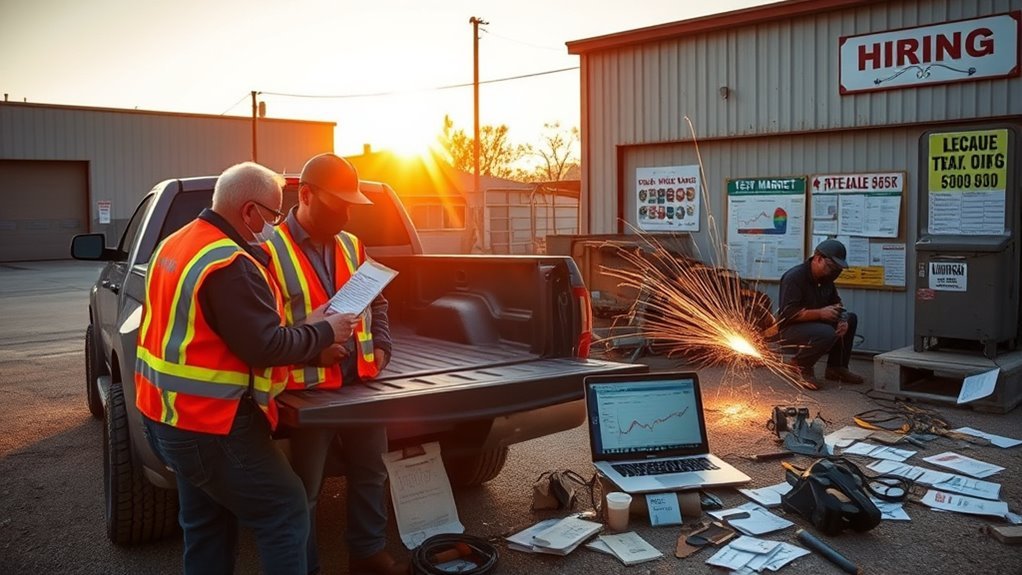
You should map local wage ranges so you can benchmark pay against area standards and account for extremes like Alaska or North Dakota where averages exceed $70,000.
Compare union versus nonunion rates and contract structures to understand prevailing wage floors, benefits obligations, and hiring flexibility.
Monitor seasonal demand shifts in construction and manufacturing so your pricing and staffing plans reflect short-term rate volatility.
Local Wage Ranges
When evaluating local wage ranges for welding, consider that geographic location and industry mix drive wide variation—from rural areas paying $15–$25/hr to metro industrial centers offering $25–$40/hr and certain states (e.g., Alaska, North Dakota) averaging over $70,000 annually.
Specialty skills like TIG or aluminum welding typically add 10–30% to base pay and certifications further improve compensation and benefits.
You should map wage disparities against cost-of-living and industry presence to set competitive offers. Use local labor data, job postings, and employer surveys to quantify demand for specific processes.
Factor certification premiums and skill differentials into role bands. Adjust offers where high-demand sectors (oil, manufacturing, shipbuilding) create upward pressure.
Track trends quarterly to maintain parity and reduce turnover.
Union Vs Nonunion
Although local market structure dictates much of the pay picture, choosing between union and nonunion welders changes how you budget for labor and manage project risk.
You’ll pay higher standardized wages where unions are strong; collective bargaining drives consistent rates, scope of work, and required certifications. Union benefits often include employer-funded training and apprenticeships, reducing your responsibility for upskilling but increasing fixed labor costs and contract constraints.
Nonunion flexibility lets you negotiate per-job rates and schedules, which can lower immediate costs but increases variability and administrative oversight for vetting skills.
In some jurisdictions, project specifications mandate a quota of union labor, which affects bid strategy and availability. Assess local union penetration, certification standards, and project contract clauses when forecasting labor budgets.
Seasonal Demand Shifts
Because demand for welding spikes with construction seasons and industry cycles, you should factor predictable seasonal surges into labor-rate models and staffing plans.
You’ll model seasonal fluctuations by mapping historical monthly workloads, regional infrastructure timelines, and sector-specific booms (oil and gas, heavy fabrication).
Use demand forecasting to adjust hourly rates—expect $30–$50+ in high-demand specialties—and to schedule overtime, temp hires, or subcontracting.
Incorporate local labor-market indicators: state-level wage baselines, unemployment, and competing contractor activity in Texas, California, or lower-cost regions.
Set minimum staffing thresholds to maintain capacity during peaks and define ramp-down procedures for slow months.
Embed these parameters in your hiring SOPs and cost-estimation templates so bids and recruitment match measurable market conditions.
Defining Skills and Certifications to Target

Any employer seeking reliable welders should target candidates with recognized certifications and demonstrable technical breadth.
You should require AWS Certified Welder or CWI credentials to meet certification requirements and verify competence against industry codes.
Prioritize formal training or completed apprenticeships that deliver hands‑on proficiency.
Seek technicians skilled in specialized techniques such as TIG and MIG welding for precision assemblies in aerospace and automotive sectors.
Require experience with multiple base metals — steel, aluminum, stainless steel — to guarantee assignment flexibility.
Assess applicants’ familiarity with welding codes, specifications, and inspection criteria to ensure regulatory compliance and quality control.
Use practical welding tests and documentation reviews to confirm certifications, technique proficiency, and the ability to interpret applicable standards.
Products Worth Considering

Keep your first aid kit full so you always have what you need in an emergency

Fast Heating & Dual Power: Our plastic welder features 60W/100W dual power setting, and heats up in seconds, providing flexible adjustments to suit different plastic types and ensure precise repair control.
Crafting Job Descriptions That Attract Qualified Candidates

Having defined the certifications, techniques, and inspection knowledge you need, you should now translate those requirements into a job description that speaks directly to qualified welders.
Use crafting clarity: list required proficiencies (MIG, TIG, Stick), specific certification levels, and measurable inspection skills.
List required proficiencies (MIG, TIG, Stick), exact certification levels, and measurable inspection skills with crafting clarity.
State the work environment (shop, field, portable equipment) and physical demands so candidates know conditions upfront.
Provide a competitive salary range—e.g., $60,000–$70,000+ where applicable—and summarize benefits.
Emphasize safety standards, essential responsibilities, and quality tolerances in concise bullet-equivalent sentences.
Describe training and advancement pathways, including paid certification opportunities, to show career progression.
This technical, standards-focused approach reduces applicant mismatch and improves success in attracting talent.
Recruiting Channels: Schools, Unions, and Online Platforms

When you want consistent access to trained welders, prioritize channels that align with the skill level and certifications you need: recruit directly from technical schools and community colleges for newly trained candidates, join local unions to tap into experienced journeymen and referral lists, and post targeted openings on general and specialized job platforms (Indeed, LinkedIn, Welders.com) to broaden reach. Use welding programs to source apprentices and internships, leverage union networks for certified tradespeople, and collaborate with industry associations for job fairs and cohort training.
| Channel | Strength | Ideal Use |
|---|---|---|
| Technical Schools | Entry-level, certified grads | Apprenticeships, bulk hires |
| Unions | Experienced, vetted labor | Project staffing, referrals |
| Online Platforms | Broad reach, targeted ads | Specialized openings, passive candidates |
Products Worth Considering

Richard Finch, Welder's Handbook: A Complete Guide to MIG, TIG, Arc & Oxyacetylene Welding, "Completely Revised and Updated Edition!" paperback
Screening and Interview Techniques for Welding Candidates
You should start with skill-focused practical tests that confirm proficiency in MIG, TIG and Stick techniques against defined acceptance criteria.
During interviews, use behavioral questions to assess teamwork, communication and adaptability in shop scenarios.
Verify certifications like AWS credentials and perform reference checks to confirm work history and standards compliance.
Skill-Focused Practical Tests
Because weld quality can’t be judged reliably from a resume alone, implement skill-focused practical tests during interviews to observe candidates performing MIG, TIG, or Stick welds under supervision. Use practical assessment techniques and a standardized scoring rubric for welding skill evaluation: assess bead profile, penetration, speed, setup, and safety compliance. Run tests in a controlled booth mirroring job conditions so you can measure problem-solving and adaptability. Require candidates to demonstrate equipment setup, maintenance checks, and PPE protocols. Ask concise questions about past projects to verify material familiarity and technique breadth. Record scores and notes immediately for objective comparison. The table below summarizes core assessment domains, target metrics, and pass thresholds.
| Domain | Metric | Pass Threshold |
|---|---|---|
| Weld quality | Visual/UT | ≥ 85% |
| Process control | Travel speed | ±10% |
| Setup | Machine settings | Accurate |
| Safety | PPE/procedure | Compliant |
| Documentation | Job record | Complete |
Behavioral Interview Questions
Although practical tests show what a candidate can do, behavioral interview questions reveal how they handle real-world problems, interact with others, and follow procedures under pressure.
You should use behavioral insights to structure interview strategies that probe problem-solving: ask candidates to describe a technical challenge they overcame, the steps they took, and measurable outcomes.
Assess teamwork and communication with scenarios about resolving conflict on a job and documenting handoffs.
Evaluate attention to detail by requesting examples of following strict safety protocols or quality standards and the verification methods used.
Test time management by having them recount completing a welding project under a tight deadline and how they prioritized tasks.
Finally, request concrete examples of using specific welding techniques or tools and the resulting quality metrics.
Certification and Record Checks
Behavioral responses give context to a candidate’s methods, but you still need documented proof of their qualifications and history before hiring.
You’ll perform certification verification for AWS, ASME, and other relevant credentials, confirming scope, expiration, and any limitations.
Use practical weld tests aligned to your project codes to validate hands-on competence.
Conduct a structured record assessment: background checks focused on prior welding roles, employment gaps, incident reports, and safety training records.
Contact listed references and previous employers to confirm work quality, adherence to procedures, and teamwork.
Document all findings in a standardized file linked to the applicant.
Reject or remediate candidates whose certifications don’t match job requirements or whose records reveal safety or reliability concerns.
Offering Training, Apprenticeships, and Career Paths
When you implement structured training, apprenticeships, and clear career ladders, you create a predictable pipeline of competent welders who meet industry standards and safety requirements.
You should measure training effectiveness by tracked competency metrics, weld-test pass rates, and production error reduction; firms investing in training report 24% higher profit margins.
Leverage apprenticeship benefits: documented on-the-job hours, certified skill development, and median earnings near $50,000 post-completion.
Leverage apprenticeships: documented on-the-job hours, certified skill development, and median earnings around $50,000 after completion
Define career ladders with skill checkpoints, certification requirements, and pay bands to reduce turnover by up to 20%.
Partner with vocational schools and community colleges for curriculum alignment and access to new technologies.
Pair apprentices with experienced mentors for controlled exposure to critical procedures, accelerating skill acquisition and improving throughput while maintaining safety and quality controls.
Calculating True Labor Costs and Shop Billing Rates
Because payroll figures alone understate the real cost of a welder, you need to roll payroll taxes, benefits, workers’ comp, paid time off, and shop overhead into an effective hourly labor rate before setting prices.
Calculate a complete cost breakdown: base wage plus payroll burdens and allocated overhead typically yields an effective labor cost near $55–$60 per hour.
Convert that to a billable shop rate using (Labor Rate + Overhead per Hour) x Markup.
Apply a standard markup—20% is recommended—to protect margins while staying competitive.
Document assumptions, rates, and utilization factors; audit quarterly.
Use these figures in your pricing strategies and job estimates to guarantee bids cover direct labor, fixed shop costs, and target profit without relying on optimistic wage-only math.
Products Worth Considering

FAST TWO-COLOR PRINTING – Prints at 2.0 lines per second with dual-color output (black/red) for easy distinction between positive and negative values.

EXTRA-LARGE 10-DIGIT DISPLAY – Clear, oversized screen allows for easy viewing of multi-digit numbers, reducing input and reading errors.

LARGE 12-DIGIT DISPLAY – Extra-large screen clearly displays up to 12 characters for easy, error-free viewing during fast-paced calculations.
Retention Strategies: Culture, Benefits, and Scheduling
You need to build a retention plan that starts with a measurable, positive workplace culture emphasizing teamwork and regular recognition.
Pair that culture with competitive compensation packages—salary, health benefits, and retirement—that meet industry benchmarks.
Provide flexible shift scheduling options to maintain productivity while preserving welders’ work-life balance.
Positive Workplace Culture
Although weld shops face tight labor markets and demanding schedules, cultivating a positive workplace culture directly reduces turnover by making employees feel valued, supported, and motivated to perform. You should standardize practices that promote employee engagement and workplace recognition: set measurable feedback cycles, document achievements, and align training paths with certification requirements. Offer flexible scheduling for operational needs, institute targeted development modules, and maintain transparent policies so welders see progression and stability. Use objective metrics to evaluate morale and skill retention, and address deficiencies with corrective coaching. Below is a concise implementation matrix:
| Focus Area | Action |
|---|---|
| Recognition | Public acknowledgment, documented awards |
| Development | Skill modules, certification pathways |
| Scheduling | Staggered shifts, administrative remote options |
Competitive Compensation Packages
Building on a positive workplace culture, competitive compensation packages reinforce retention by aligning pay, benefits, and scheduling with skill levels and certification requirements.
You should set base wages above industry averages and document clear pay bands tied to certifications and performance metrics. Use wage transparency so candidates and incumbents understand progression criteria and reduce disputes during salary negotiation.
Include standardized benefits—health insurance, retirement contributions, paid time off—and quantify employer cost-share and eligibility timelines. Offer training stipends and paid certification pathways to convert development into measurable compensation value.
Define overtime incentives and shift premiums in written policy (without detailing shift patterns here). Audit compensation annually against market benchmarks and certification requirements to guarantee technical roles remain financially competitive and compliant with labor standards.
Flexible Shift Scheduling
When welders can align work hours with personal commitments, retention and productivity improve measurably; implement staggered shifts, compressed workweeks, and flexible administrative hours to reduce burnout and broaden your candidate pool.
You should standardize processes that capture employee preferences, documenting availability, commute constraints, and skill-specific peak hours. Use shift flexibility matrices to match certified welders to appropriate tasks while maintaining coverage for quality control and safety inspections.
Offer remote or flexible hours for administrative duties to decrease downtime and commuting risk. Track metrics: retention rate, overtime hours, and productivity per shift to quantify impact (companies report ~20% retention gains).
Communicate scheduling changes transparently and audit schedules quarterly to guarantee compliance with labor standards and continuous improvement.
Using Estimation Tools to Price Jobs and Inform Hiring Decisions
If you want accurate quotes and smarter hiring choices, use estimation tools that let you input labor rates, material costs, project specs, and contingency to produce repeatable, auditable estimates.
You’ll conduct disciplined cost analysis and improve estimation accuracy by standardizing templates and maintaining version-controlled spreadsheets for real-time tracking of materials, labor hours, and expenses.
Pre-built welding cost templates speed quoting and let you model scenarios to determine required headcount and skill mixes.
Update your tools and assumptions regularly to reflect wage changes, productivity metrics, and material pricing, and embed a 10–20% contingency to protect margins.
Use the output to set bid thresholds, define hiring needs, and create traceable documentation for audit and continuous improvement.
Frequently Asked Questions
How Do I Verify Weld Quality On-Site Without Destroying Parts?
Use visual inspection, weld inspection techniques like dye penetrant and magnetic particle testing, and ultrasonic or radiographic non destructive testing. You’ll follow standards, document acceptance criteria, calibrate equipment, and record traceable results on-site.
Can I Use Remote Welding Technicians or Subcontractors?
Measure twice, cut once. You can use remote welding technicians and subcontractors, but you’ll need robust remote oversight, documented procedures, and strict subcontractor reliability checks—certifications, audits, traceability—to guarantee standards, weld procedure compliance, and consistent quality.
What Insurance and Liability Coverages Do Welders Need?
You need general liability, professional liability, workers’ compensation, equipment coverage, and commercial auto insurance; guarantee welding safety clauses, pollution and excess liability options, and certificate requirements are in place to meet contractual and regulatory liability coverage standards.
How Do Seasonality and Weather Affect Welding Labor Costs?
Welding labor costs rise ~15% in winter due to slower welding demand and weather delays; you’ll face higher overtime and labor shortages, so you’ll schedule indoors, use heaters, and adjust rates to meet technical quality standards.
Are There Tax Incentives for Hiring Apprentices or Veterans?
Yes — you can get tax credits and use veteran programs; you’ll qualify for federal and state hiring credits, apprenticeship tax incentives, and veteran-specific wage subsidies if you meet documentation, training standards, and eligibility requirements.
Conclusion
You’ll need competitive pay, clear skill targets, and reliable hiring channels to secure hard-to-find welders; think of your shop as a calibrated instrument — every pay rate, certification, and scheduling choice adjusts the output. Use local labor data, defined job specs, apprenticeships, and precise labor-cost calculations to set billing rates. Combine training, measurable retention practices, and estimation tools to align hiring with project margins and maintain consistent quality and throughput.
