Published: 2026 Academic Catalog Cycle · Last Updated: 2026
ArcLabs Welding School charges $23,575 in published tuition and mandatory fees for its 900-hour Advanced Welding program and $31,775 for its 1,300-hour Master Welder program in 2026. Adding optional school tool kits raises direct charges to $25,225 and $33,525, respectively. Total attendance costs also depend on off-campus housing, food, transportation, personal safety equipment, and financial aid.
Quick Answer
Attending ArcLabs Welding School in 2026 requires $23,575 in direct school charges for the 900-hour Advanced Welding program ($22,500 tuition + $1,000 lab fee + $75 application fee). The 1,300-hour Master Welder program totals $31,775 ($29,500 tuition + $2,200 lab fee + $75 application fee). Purchasing the school’s optional gear kit adds $1,650 to $1,750, bringing total direct costs to $25,225 or $33,525 before off-campus living expenses.
Key Takeaways
- Base published tuition ($22,500 for Advanced Welding; $29,500 for Master Welder) excludes required lab fees ($1,000 or $2,200) and the $75 application fee.
- Total direct school charges are $23,575 (900 hours) and $31,775 (1,300 hours) without tool kits, and $25,225 to $33,525 with tool kits.
- Students may supply their own approved welding tools or purchase the nonrefundable school kit ($1,650 for Advanced; $1,750 for Master).
- Programs operate across four campuses: Hanahan/Charleston, Columbia, and Piedmont/Greenville in South Carolina, and Houston in Texas.
- Federal financial aid (Pell Grants, Direct Loans) is available for eligible students in 900-hour and 1,300-hour programs; 70-hour seminars are not Title IV eligible.
- ArcLabs provides career placement assistance and booth practice, but does not guarantee employment, AWS certification, or specific starting wages.
ArcLabs Welding School Cost at a Glance
Evaluating the true cost of ArcLabs requires separating mandatory school charges from optional supplies and living costs. Figures below reflect the official 2026 ArcLabs Course Catalog and Student Handbook.
| Program | Tuition | Required Lab Fee | Application Fee | Published Direct Charges | Optional School Tool Kit | Total With Kit |
|---|---|---|---|---|---|---|
| Advanced Welding (900 hrs) | $22,500 | $1,000 | $75 | $23,575 | $1,650 | $25,225 |
| Master Welder (1,300 hrs) | $29,500 | $2,200 | $75 | $31,775 | $1,750 | $33,525 |
The $75 application fee is waived for qualifying military veterans holding an honorable/non-dishonorable discharge, as well as active-duty service members and National Guard personnel presenting a valid military ID. Your specific signed enrollment agreement governs the final binding figures for your campus and start date.
The published direct school cost for the 900-hour program is $23,575 before tool kits and living expenses, while the 1,300-hour program starts at $31,775.

Stay organized with a durable 1-subject notebook set designed for school, note-taking, and digital study support. The college ruled pages resist ink bleed, tear out cleanly, and work with the Five Star Study App to create flashcards and sync notes to Google Drive. Tough pockets, a water-resistant cover, and Spiral Lock wire help protect your work throughout the year.

This interactive sentence building set helps children practice early reading, writing, and grammar through hands-on play. Color-coded word cards, photo cards, and punctuation pieces make it easy to build simple sentences while reinforcing capitalization, parts of speech, and sentence structure. It is a versatile learning tool for homeschool and classroom use, with included game ideas and teaching suggestions to support multiple skill levels.

These colorful answer buzzers turn lessons, review games, and family activities into lively game-show style challenges that boost participation and make learning more interactive. Each buzzer has a distinct sound to clearly identify who buzzed in first, while the durable, palm-sized design makes them easy for kids and adults to use in classrooms, homeschools, and group settings.
Tuition, Fees, and What the Price Includes
Tuition includes all standard textbooks, digital learning modules, and institutional training materials. However, mandatory fees and external gear must be factored into your budget.
Required school charges
- Advanced Welding Tuition (900 Hours): $22,500
- Advanced Welding Lab Fee: $1,000 (covers metal coupons, shielding gases, grinding discs, and standard filler metals)
- Master Welder Tuition (1,300 Hours): $29,500
- Master Welder Lab Fee: $2,200 (includes specialty pipe coupons, aluminum/stainless consumables, and purge gases)
- Application Fee: $75 (one-time nonrefundable charge, unless military-waived)
Tool kit options: School package vs. Self-sourcing
ArcLabs offers two optional tool packages tailored to its programs:
- Advanced Welding Tool Kit ($1,650): Includes an auto-darkening helmet, 4.5-inch angle grinder, flowmeter regulator, GTAW (TIG) torch assembly and adapter, welding leads/ground clamps, chipping hammer, wire brushes, tip cleaners, measuring tools, and basic PPE.
- Master Welder Tool Kit ($1,750): Contains everything in the Advanced kit plus dedicated stainless steel wire brushes, aluminum hand tools, specialized pipe layout tools, and tungsten electrodes.
Should you buy the kit or bring your own? Students are permitted to source tools independently. Purchasing tools on your own through retail or commercial welding supply distributors can save $300 to $600 if you shop sales or already own standard tools. However, every tool must precisely match the school’s approved equipment checklist and pass inspection by lab instructors on day one. Opting for the school kit allows students to bundle tool costs directly into their financial aid package.
Warning: School-issued tool kits are completely nonrefundable once opened or issued. If you plan to bring your own equipment, request the complete tool checklist from admissions and have your gear inspected prior to your official start date.
Short-term continuing education seminars
For certified welders looking to add specific qualifications or beginners testing the trade, ArcLabs provides non-degree continuing education:
- Introduction to Welding Seminar (70 Hours): $1,925
- Welder Upskill Seminar (70 Hours): $1,925
Seminar students must supply their own safety gear and PPE. Specialty alloy coupons (such as inconel, titanium, or thick-wall stainless) may incur supplemental material fees. Seminars do not qualify for Title IV federal financial aid.
Program Length, Schedule Tracks, and Career Pathways
ArcLabs structures its curriculum around clock-hour hands-on training. The core distinction between the two long-format programs is structural plate fabrication versus specialized pipe welding.
| Program | Clock Hours | Core Processes & Scope | Target Career Pathway |
|---|---|---|---|
| Advanced Welding | 900 | SMAW (Stick), GMAW (MIG), FCAW (Flux-Core), GTAW (TIG) plate, blueprint reading, cutting, fabrication safety | Structural steel fabrication, manufacturing, shipyard production, equipment repair |
| Master Welder | 1,300 | Complete 900-hr curriculum plus 2G/5G/6G pipe welding (carbon and stainless steel), sanitary tube TIG, advanced alloys | Industrial pipefitting, refinery & petrochemical shutdowns, pressure vessel fabrication, pipeline work |
| Specialty Seminars | 70 | Focused one-on-one shop instruction in a single chosen welding process or position | Skill upgrades, pre-employment weld test prep, hobbyist training |
Published class schedules and completion timeframes
ArcLabs offers three shift options to accommodate working students:
- Day Schedule (Full-Time, ~34.5 hrs/week): Monday–Thursday, 7:00 a.m. to 3:30 p.m.; Friday, 7:00 a.m. to 1:00 p.m.
- 900-Hour Advanced: Approx. 6 to 6.5 months
- 1,300-Hour Master: Approx. 9 to 9.5 months
- Night Schedule (Full-Time, ~28 hrs/week): Monday–Thursday, 3:45 p.m. to 11:00 p.m.; Friday, 2:00 p.m. to 11:00 p.m.
- 900-Hour Advanced: Approx. 7.5 to 8 months
- 1,300-Hour Master: Approx. 11 to 12 months
- Evening Schedule (Part-Time, ~25 hrs/week): Monday–Friday, 6:00 p.m. to 11:00 p.m.
- 900-Hour Advanced: Approx. 9 to 10 months
- 1,300-Hour Master: Approx. 13 to 14 months
Program completion dates can vary based on campus holiday closures, scheduled breaks, and required make-up hours for missed lab sessions.
Living Expenses and Real Budgeting for Off-Campus Students

Because ArcLabs operates as a commuter trade school without on-campus dormitories, housing and personal expenses form a significant share of your total investment. The school operates in four distinct regional rental markets: Charleston/Hanahan, Columbia, and Piedmont/Greenville in South Carolina, and Houston in Texas.
Estimated monthly student budget
Depending on location and living arrangements (independent apartment vs. shared housing with roommates), off-campus students should budget between $1,300 and $2,100 per month:
- Housing & Utilities (shared or 1-bed): $800 – $1,300/month
- Food & Groceries: $300 – $450/month
- Commute & Fuel: $150 – $250/month (varies based on campus distance)
- Mandatory Safety Apparel: $200 – $350 (one-time purchase of 8-inch leather steel-toe boots and 100% cotton/denim/FR workwear)
- Personal Expenses & Emergency Buffer: $100 – $200/month
Financial Aid Budget Note: Your official “Cost of Attendance” (COA) established by the financial aid office includes these estimated living and transit allowances. However, this figure represents your legal borrowing limit—not an amount billed directly by ArcLabs.
The comprehensive net price formula
[Direct School Charges ($23,575 or $31,775)] + [Tools ($1,650–$1,750)] + [Monthly Living Costs × Program Months] − [Grants & Scholarships] = Total Out-of-Pocket Cost.
Student loans do not reduce this total cost; they defer payment and add interest charges over your repayment term.
Financial Aid, Grants, Loans, and Payment Options
Students enrolled in the 900-hour and 1,300-hour diploma programs may participate in Title IV Federal Student Aid programs. Options include:
- Federal Pell Grants: Need-based awards that do not require repayment (up to federal annual limits).
- Federal Supplemental Educational Opportunity Grants (FSEOG): Limited campus-based funding for students with high financial need.
- Direct Subsidized Loans: Federal loans where the government covers interest while you remain enrolled at least half-time.
- Direct Unsubsidized Loans: Federal loans that accrue interest from the initial disbursement date.
- Direct Parent PLUS Loans: Credit-based federal loans available to parents of dependent students.
Eligibility is calculated via the Free Application for Federal Student Aid (FAFSA). ArcLabs also participates in VA Education Benefits (such as the Post-9/11 GI Bill and VR&E), interest-free institutional payment plans, and offers an internal Welding Now Scholarship of up to $1,000 for qualifying applicants.
Pro Tip: Utilize ArcLabs’ official net-price calculator to model your expected Pell Grant eligibility and federal loan debt before signing an enrollment agreement. Aim to exhaust all grant and scholarship options before taking unsubsidized student debt.
Admissions, Transfer Credit, and Refund Policies

Q-tips Original Cotton Swabs are a versatile everyday essential for home, beauty, and first aid tasks. Made with 100% cotton and soft tips at both ends, they provide gentle care for sensitive skin while helping with makeup touch-ups, small cleaning jobs, and hard-to-reach spaces. Their trusted quality and recyclable packaging guidance make them a practical choice for daily use.

This daily devotional helps parents pray purposefully for their children through a full year of Scripture readings, reflections, and guided prayer prompts. Written to encourage faithful family discipleship, it offers practical, biblically grounded support for parents who want to shape their prayers around God's Word. A foreword by Sinclair B. Ferguson adds trusted theological insight and encouragement.

The OXO Good Grips Mini Angled Measuring Cup makes liquid measuring easier with a patented angled surface that lets you read measurements from above, so you can fill accurately without lifting or adjusting. It includes clear standard and metric markings, plus tablespoon and ounce measurements for added convenience in everyday cooking and baking. Dishwasher safe and BPA free, it's a practical, easy-to-use kitchen tool for precise recipe prep.
Admissions requirements
Applicants for diploma programs must hold a valid high school diploma or recognized equivalency (GED), be at least 18 years of age (or 17 with formal parental/guardian consent), demonstrate physical and visual capability for welding operations, and complete an in-person campus tour. Seminar students do not need a high school credential.
Five-day trial enrollment period
First-time students at ArcLabs benefit from a mandatory five-consecutive-instructional-day trial period. If you withdraw within these first five class days, you are classified as a “no-start.” Under this policy, all tuition obligations are canceled, though application fees and opened tool kit charges remain nonrefundable.
Transfer credit rules
ArcLabs evaluates prior technical coursework and OSHA-10 cards under strict guidelines:
- Prior coursework must have been completed within the past 10 years at an accredited technical institution with a grade of “C” (70%) or better.
- Hands-on welding competency must be demonstrated through practical testing for each process ($25 administrative testing fee per test).
- Transfer credits cannot exceed 50% of total program clock hours (maximum 450 hours for Advanced Welding; 650 hours for Master Welder).
- Approved transfer hours reduce tuition on a prorated basis, but will also reduce total federal financial aid disbursements proportionally.
Accreditation, Welding Safety, and Certification Realities
ArcLabs is institutionally accredited by the Accrediting Council for Continuing Education and Training (ACCET). State licensing and oversight are maintained through:
- South Carolina Campuses (Hanahan, Columbia, Piedmont): Licensed by the South Carolina Commission on Higher Education.
- Texas Campus (Houston): Approved and regulated by the Texas Workforce Commission, Career Schools and Colleges section.
Mandatory personal protective equipment (PPE)
Welding environments involve extreme ultraviolet radiation, molten metal spatter, toxic metal fumes, and electrical hazards. In compliance with OSHA safety standards, ArcLabs enforces strict shop floor PPE policies:
- ANSI Z87.1-approved safety glasses worn continuously inside shop bays.
- Full-coverage welding helmet with appropriate shade lenses (Shade 9–13 depending on amperage).
- Heavy-duty leather welding gloves tailored to the process (thick split-cowhide for Stick/Flux-Core; supple goatskin/deerskin for TIG).
- 100% heavy cotton, denim, or flame-resistant (FR) long-sleeve shirts and pants (zero synthetic fibers).
- 8-inch minimum height leather work boots with ASTM-certified steel or composite safety toes.
- Clear face shields during all grinding operations and tinted Shade 5 shields for oxy-fuel/plasma cutting.
American Welding Society (AWS) certification testing
Graduating from ArcLabs awards an institutional diploma; it does not automatically confer an AWS Certified Welder card. Official AWS certification requires taking a standardized destructive bend test or radiographic (X-ray) examination evaluated by a Certified Welding Inspector (CWI) at an AWS Accredited Test Facility (ATF).
Standard tuition does not include external AWS testing fees or card registration costs. Ask campus admissions whether qualification tests taken during class include CWI inspection sign-offs, and budget approximately $150 to $350 per test if taking independent external certification exams.
Career Services, Welding Wages, and ROI Analysis
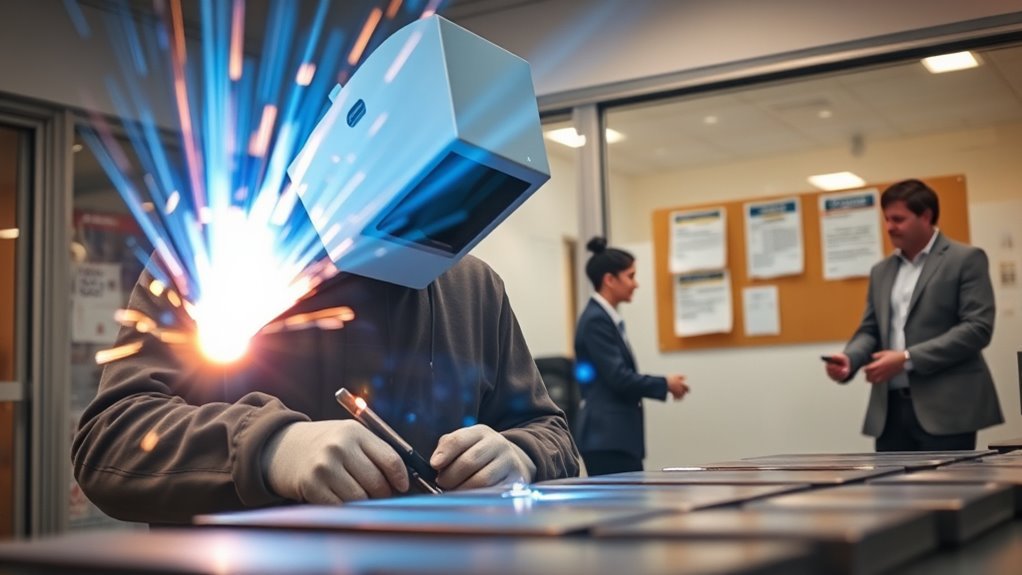
ArcLabs maintains an active career services department providing resume building, direct employer test days on campus, and job board access. Furthermore, graduates in good academic standing receive up to 20 hours of free shop booth practice within six months of graduation to prepare for pre-employment weld tests (carbon steel included; specialty metals require coupon purchase).
Welding industry wage realities
According to the U.S. Bureau of Labor Statistics (BLS), median national earnings for welders, cutters, solderers, and brazers stand at $51,000 annually (~$24.52/hour). However, prospective students should budget against realistic entry-level earning bands:
- Entry-Level / 10th to 25th Percentile: $36,000 – $42,500 ($17.30 – $20.40/hour) — typical starting pay for structural fabrication, shop assembly, or junior production welders.
- National Median: $51,000 ($24.52/hour) — reached after 3–5 years of proven field experience and multi-process certifications.
- Top 10th Percentile: $72,000+ ($34.60+/hour) — earned by specialty alloy TIG welders, traveling pipeline welders, rig welders, and union boilermakers/pipefitters.
Evaluating whether ArcLabs is worth the investment
To determine if private trade school tuition fits your financial goals, evaluate these decision criteria:
- Compare Local Public Options: Research regional community and technical colleges (e.g., Trident Technical College in Charleston, Greenville Tech, or Lone Star College in Houston). Public technical colleges often cost $4,500 to $9,000 for equivalent certificate hours, though program completion schedules often span 12 to 24 months compared to ArcLabs’ accelerated 6 to 9-month timeframe.
- Explore Union Apprenticeships: Local unions (UA Pipefitters, Ironworkers, Boilermakers) offer debt-free, earn-while-you-learn apprenticeships, though admission is competitive and tied to union hiring cycles.
- Calculate Your Debt-to-Income Ratio: If borrowing the full $23,575–$31,775, a standard 10-year federal loan payment will run approximately $270 to $370 per month. Ensure starting wages in your target market can support this alongside rent and living expenses.
Questions to Ask ArcLabs Before Enrolling
- What is the final itemized balance on my enrollment agreement after subtracting all confirmed grants?
- Which specific AWS or ASME code qualification tests (e.g., AWS D1.1 structural plate or ASME Section IX pipe) are administered before graduation?
- Are independent CWI test fees and AWS registration cards included in my tuition?
- Can an instructor inspect my personally owned tools to verify compliance before I buy the $1,650–$1,750 kit?
- What are the verified completion and job placement percentages for my specific campus over the last 12 months?
- What local companies regularly visit the campus for direct hiring and weld testing?
- What is the exact schedule timeline for my cohort, and how are missed lab hours made up?
Frequently Asked Questions
Is $22,500 the complete cost of the Advanced Welding program?
No. While base tuition is $22,500, mandatory school charges total $23,575 due to a $1,000 lab fee and a $75 application fee. Purchasing the optional school tool kit brings total direct costs to $25,225 before off-campus housing, food, and safety apparel.
Are part-time or evening class options available?
Yes. ArcLabs offers full-time day classes (~34.5 hrs/week, taking ~6 months), full-time night classes (~28 hrs/week, taking ~7.5 months), and part-time evening classes (~25 hrs/week, taking ~9–10 months). Availability varies across the Charleston, Columbia, Piedmont, and Houston campuses.
What safety equipment is required, and is it provided?
Students must wear Z87.1 safety glasses, an auto-darkening welding helmet, process-appropriate leather gloves, flame-resistant work clothing, and 8-inch leather steel-toe boots. These items are included in the optional $1,650–$1,750 school kits, or students may supply their own approved equipment.
Can I transfer credits from another technical school?
Yes, but restrictions apply. Prior coursework must have been completed within the past 10 years with a grade of “C” or better. Students must pass a hands-on welding test ($25 fee per attempt), and transfer credits cannot exceed 50% of total program hours (450 hours for Advanced; 650 hours for Master).
Does ArcLabs offer apprenticeships or employer partnerships?
ArcLabs hosts employer presentations, hiring events, and on-campus weld test days. Accelerated students in good standing may also qualify for a 150-hour internship module where scheduling allows, though placement and wages are not guaranteed.
Are AWS certification exams included in the program cost?
Standard tuition covers internal diploma testing, but third-party AWS Certified Welder testing and card registration fees through an Accredited Test Facility are generally not included. Students should confirm specific certification testing fees with campus staff.
Does ArcLabs provide student housing?
No. ArcLabs does not offer dormitory facilities. Commuting students must arrange off-campus housing, transportation, and living expenses, which typically range from $1,300 to $2,100 per month depending on the campus city.
Summary and Final Verdict
ArcLabs’ published 2026 direct charges start at $23,575 for the 900-hour Advanced Welding diploma and $31,775 for the 1,300-hour Master Welder diploma. Factoring in optional tool packages raises baseline educational expenses to $25,225 and $33,525, respectively.
Because ArcLabs is an accelerated, proprietary institution, students pay a premium for fast-tracked completion (6 to 9 months) compared to 1–2 year public community college programs. Before enrolling, review your itemized financial aid package, calculate your monthly debt burden, evaluate off-campus living costs, and confirm whether your career goals require structural certifications or advanced pipe welding skills.
Sources
- 2026 ArcLabs Course Catalog and Student Handbook — Official tuition schedules, mandatory lab fees, refund calculations, and campus safety regulations.
- ArcLabs Welding Programs Overview — Course hours, shift schedules, and structural vs. pipe training tracks.
- ArcLabs Financial Aid Portal — Title IV Pell Grants, Direct Loan eligibility, and veterans benefit guidelines.
- ArcLabs Official Net Price Calculator — Personalized cost of attendance and estimated grant aid modeling tool.
- U.S. Bureau of Labor Statistics (BLS): Welders, Cutters, Solderers, and Brazers — National wage percentiles, industry employment trends, and occupational outlook.
- American Welding Society (AWS) Certified Welder Program — Code qualification standards, Accredited Test Facility guidelines, and six-month continuity rules.

This versatile cookware set equips home cooks with essential pots, pans, and a steamer insert for everyday meals and larger gatherings. The aluminum-encapsulated base promotes quick, even heating, while Cool Grip handles and tight-fitting glass lids support comfortable, controlled cooking. Designed for stovetop, oven, broiler, and dishwasher use, it offers reliable performance across a wide range of recipes.

BIC Cristal Xtra Smooth Blue Ball Pens deliver dependable everyday writing with a medium 1.0mm point and fluid Easy-Glide System Ink. Designed to create clear, dark lines, these pens are ideal for notes, lists, journaling, schoolwork, and office tasks. The convenient 10-count pack offers reliable performance for home, work, or classroom use.

Coghlan's Magnetic Bear Bell helps alert bears and other wildlife to your presence while hiking, walking, or exploring outdoors. The built-in magnetic silencer lets you quiet the bell when it is not needed, and the hook-and-loop closure makes it easy to attach to clothing, boots, hats, packs, or pet collars. It is a simple safety accessory designed to add peace of mind on the trail.