

Welding gas costs depend on more than cylinder size. The gas type, whether you buy or lease the cylinder, your supplier’s exchange policy, local fees, and your welding flow rate can all change the final price. Published prices also vary sharply between national retailers and independent welding suppliers, so use online figures as comparison points rather than guaranteed local rates.
Quick Answer
As of July 2026, published examples range from about $239 for a full 55-CF C25 cylinder at one local supplier to $529.99 for an 80-CF argon cylinder at a national retailer. Contents-only examples include $59.99 for 40 CF and $69.99 for 80 CF, before taxes or added fees.
Key Takeaways
- Published welding gas prices are local examples, not reliable national averages.
- Separate the cylinder acquisition price from the gas contents, exchange, rental, delivery, and hazardous-material fees.
- A larger cylinder usually reduces exchanges and may lower the gas cost per cubic foot, but it is heavier and costs more upfront.
- Estimate annual cost from your arc-on hours and actual flow rate instead of assuming a fixed number of refills.
- Confirm that a nearby supplier will fill or exchange the cylinder before buying one online.
At a Glance
| Time Required | About 10–20 minutes to compare local quotes and calculate annual use |
| Difficulty | Easy once you know the gas, cylinder capacity, and flow rate |
| Tools Needed | Welder manual, flowmeter setting, calculator, and written supplier quotes |
| Cost | Current examples include roughly $239–$529.99 for a full small or medium cylinder and $59.99–$69.99 for 40- or 80-CF argon contents only |
Note: Prices in this guide were checked on July 28, 2026. They are published examples, not national averages. Gas type, location, customer account, cylinder program, taxes, and added fees can change your out-the-door cost.
Common Welding Gases and Their Uses
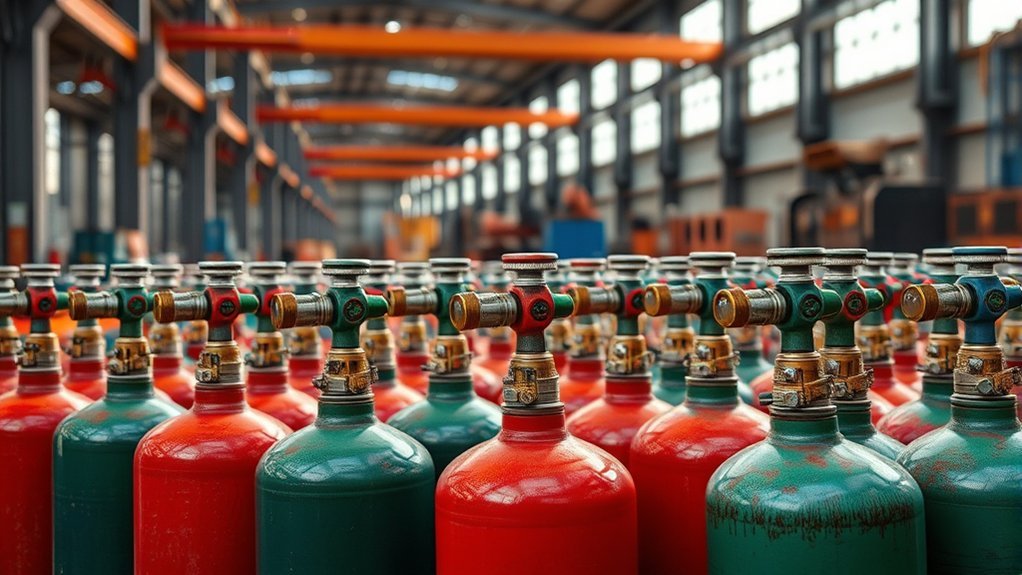
The right gas depends on the welding process, base metal, transfer mode, and desired bead profile. Price matters, but choosing a cheaper gas that does not match the job can increase spatter, cleanup, porosity, or rework.
| Process or Material | Common Gas Choice | Cost and Performance Notes |
|---|---|---|
| TIG welding | 100% argon for many steel, stainless-steel, and aluminum jobs | Argon provides stable arc starts and good control. Argon-helium blends can add heat for thicker or highly conductive material but normally cost more. |
| MIG welding mild steel | 75% argon/25% CO2, often called C25 | Miller identifies C25 as a very common mild-steel blend with good arc characteristics and relatively low spatter. |
| Lower-cost mild-steel MIG | 100% CO2 | CO2 can reduce gas cost and provide deeper penetration, but it generally produces more spatter and a harsher arc than C25. |
| MIG welding aluminum | 100% argon for many applications | Argon is the common starting point. Argon-helium blends may be selected for thicker material or greater heat input. |
| MIG welding stainless steel | An application-specific argon-rich or helium-containing blend | The proper blend depends on wire, transfer mode, thickness, and equipment. Follow the wire and welder manufacturer’s chart rather than assuming C25 is suitable. |
| Oxy-fuel cutting, heating, brazing, or welding | Oxygen plus acetylene or another approved fuel gas | This is a separate fuel-gas system, not a shielding-gas substitute. It requires compatible regulators, hoses, flashback protection, and fuel-gas safety procedures. |
Gas selection should begin with the welder manual, filler-wire data, and the requirements of the job. The cheapest cylinder is not economical if it creates defects or forces you to grind and reweld the joint.

The COWAY Mighty air purifier is designed to help clean large home spaces with a four-stage filtration system that captures fine particles, allergens, smoke, odors, and VOCs. Its real-time air quality monitor, auto mode, eco mode, timer, and filter alerts make it easy to maintain fresher indoor air with less effort. The washable pre-filter and HEPA filtration help support long-term performance for bedrooms, living rooms, and other busy areas.

This hardcover cookbook offers fast, approachable recipes designed for busy days and low-energy nights. Caroline Chambers focuses on simple, flavorful meals that help you get dinner on the table without overthinking it. It's a practical pick for home cooks who want quick weeknight inspiration and minimal-fuss cooking.

OFF! Backyard Mosquito Repellent Coil Refills help create a more comfortable outdoor space by repelling mosquitoes in semi-confined areas like porches, patios, and similar spots with minimal breeze. Each coil provides up to four hours of protection and helps cover an area up to 10 ft x 10 ft while leaving a Country Fresh scent behind.
Welding Gas Tank Cost: Current Price Examples
Welding gas listings can describe very different purchases. A “cylinder-only” price may include no gas. A “full cylinder” generally includes the cylinder and its first fill. A “contents-only” listing usually applies when you already have an eligible cylinder for the retailer’s fill or exchange program.
Published Price Examples Checked in July 2026
| Published Product | Listed Price | What the Listing Represents |
|---|---|---|
| 40-CF argon | $59.99 | Contents-only price shown by Tractor Supply |
| 40-CF argon cylinder | $399.99 | Published national-retailer cylinder listing |
| 80-CF argon | $69.99 | Contents-only price shown by Tractor Supply |
| 80-CF argon cylinder | $529.99 | Published national-retailer cylinder listing |
| 55-CF C25 cylinder | $239 | Full outright-purchase example from a Colorado supplier |
| 92-CF argon or C25 cylinder | $329 | Full outright-purchase example from the same local supplier |
| 132-CF argon or C25 cylinder | $369 | Full outright-purchase example from the same local supplier |
The large differences show why one fixed “average” is not dependable. The national-retailer and local-supplier examples use different brands, capacities, gases, programs, and service areas. Shipping a full cylinder can also trigger hazardous-material restrictions or added charges.
Should You Buy, Lease, or Exchange a Cylinder?
You may encounter three common supply arrangements:
- Outright purchase: You pay a larger upfront amount for an owner cylinder. Confirm that local suppliers will fill or exchange its size, specification, valve, ownership marking, and gas type.
- Lease or rental: You pay a recurring fee while the supplier retains ownership. The supplier normally controls maintenance and requalification, but you may be locked into its locations and exchange terms.
- Deposit or exchange program: You obtain an eligible cylinder and swap it for another inspected cylinder when empty. You may not receive the same physical cylinder back.
Pro Tip: Call the supplier before purchasing a cylinder online. Give the supplier the cubic-foot capacity, DOT specification, valve type, gas, current test marking, and any ownership stamp. Ask whether it will fill the exact cylinder or only exchange cylinders from its own program.
Cylinder Testing and Condition
A low purchase price may not be a bargain if the cylinder is out of test, damaged, improperly marked, or rejected by nearby suppliers. Federal cylinder-requalification requirements depend on the cylinder specification, service, and markings. Under 49 CFR 180.209, many common cylinders follow a five-year schedule, while certain qualifying cylinders may carry markings that permit a longer interval.
Before buying a used cylinder, inspect the test-date markings and ask a qualified gas supplier whether requalification, a valve replacement, or another service will be required. Never grind off, alter, or obscure cylinder markings.
Welding Gas Refill, Exchange, and Hidden Fees
Gas contents are only one part of an exchange invoice. A supplier may also charge for cylinder rental, delivery, environmental or hazardous-material handling, account service, testing, or taxes. Some businesses publish a low gas price but add fixed fees that make a small-cylinder exchange expensive.
Compare the Cost per Cubic Foot
To compare two cylinders, divide the contents price by the rated gas capacity:
Cost per cubic foot = contents or exchange price ÷ cylinder capacity in cubic feet.
Using the published Tractor Supply examples, $59.99 for 40 CF is about $1.50 per cubic foot. The listed $69.99 for 80 CF is about $0.87 per cubic foot. That example shows why a larger cylinder can provide better gas value even though the exchange invoice is slightly higher.
Cost per cubic foot is not the only concern. A larger cylinder is heavier, needs secure storage, and may be difficult to transport safely. It may also fall under a different supplier ownership or rental program.
Fees to Include in Every Quote
- Gas contents or exchange charge
- Cylinder lease, rental, or daily charge
- Deposit or cylinder-acquisition price
- Hazardous-material or environmental fee
- Delivery, route, or fuel surcharge
- Hydrostatic testing, inspection, or valve service for an owner cylinder
- Sales tax and local charges
Note: Ask each supplier for an out-the-door price for the same gas, purity, cylinder capacity, and ownership arrangement. A low advertised gas charge may not be the lowest final invoice.
How to Calculate the Real Cost of Welding Gas
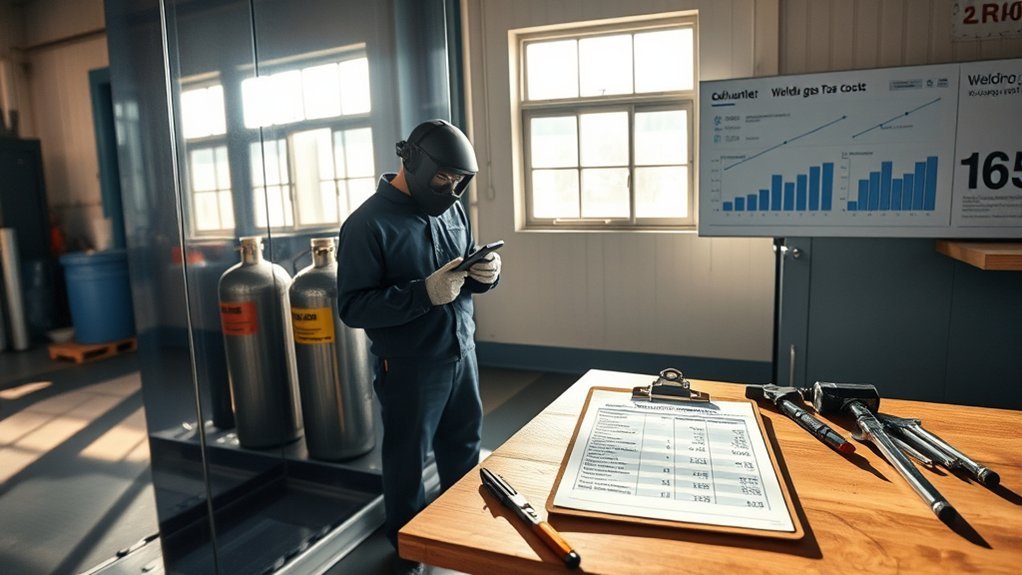
The most useful estimate starts with your actual arc-on time. Do not count all the hours spent cutting, fitting, clamping, grinding, or repositioning material as gas-flow hours.
Annual Cost Formula
- Estimate annual arc-on hours. Add the minutes during which shielding gas is flowing while you weld.
- Record your normal flow rate. Use the setting recommended by the machine, torch, wire, cup, and working conditions.
- Calculate annual gas volume. Multiply arc-on hours by cubic feet per hour.
- Include purge and post-flow use. TIG post-flow, line purging, leak testing, and accidental losses consume gas beyond arc time.
- Divide by cylinder capacity. Round up to the next full exchange.
- Multiply by the complete exchange price. Include recurring fees and transportation.
- Add the cylinder cost or lease. Keep one-time and recurring expenses in separate lines.
Annual gas volume: Arc-on hours × flow rate in CFH
Estimated exchanges: Annual gas volume ÷ cylinder capacity, rounded up
Recurring annual cost: Exchanges × out-the-door exchange price + lease and delivery charges
First-year cost: Recurring annual cost + cylinder acquisition or deposit + regulator or flowmeter equipment you still need
First-Year Example Using Published 80-CF Prices
Suppose a TIG welder uses about 20 CFH for 20 arc-on hours per year. The theoretical gas requirement is 400 cubic feet, before extra purging or post-flow:
- 20 hours × 20 CFH = 400 CF
- 400 CF ÷ 80 CF = five cylinder contents
- Published 80-CF argon cylinder example: $529.99
- Four additional 80-CF contents charges at $69.99: $279.96
- Illustrative first-year total: $809.95 before taxes, fees, travel, and extra gas loss
- Illustrative later-year contents cost: five × $69.99 = $349.95 before added fees
This is a calculation example based on one retailer’s published figures, not a prediction of your local cost. A lease, independent supplier, larger cylinder, different gas, account discount, or delivery fee can change the result substantially.
How Long Will Welding Gas Last?
Estimate theoretical gas-flow time by dividing the cylinder’s rated capacity by the flow rate:
Theoretical gas-flow hours = cylinder capacity in cubic feet ÷ flow rate in cubic feet per hour.
Miller gives a broad TIG range of approximately 10–35 CFH, depending on the torch setup and surrounding conditions. MIG flow can be higher; Lincoln Electric notes that MIG flow varies with wire size, amperage, transfer mode, and wind.
| Cylinder Capacity | 15 CFH | 20 CFH | 30 CFH | 40 CFH |
|---|---|---|---|---|
| 40 CF | 2.7 hours | 2.0 hours | 1.3 hours | 1.0 hour |
| 80 CF | 5.3 hours | 4.0 hours | 2.7 hours | 2.0 hours |
| 125 CF | 8.3 hours | 6.3 hours | 4.2 hours | 3.1 hours |
| 300 CF | 20.0 hours | 15.0 hours | 10.0 hours | 7.5 hours |
These figures are theoretical. Actual arc-on time can be lower because of pre-flow, TIG post-flow, purging, leaks, or leaving the valve open. Do not raise the flow unnecessarily: excessive flow can create turbulence and draw surrounding air into the shielding zone.
Do Not Assume Every Full Cylinder Reads 2,015 PSI
A high-pressure gauge can help you follow the remaining contents of many compressed inert-gas cylinders after the cylinder reaches a stable temperature. However, there is no universal full-cylinder reading. Service pressure depends on the cylinder specification. One currently listed 125-CF DOT cylinder, for example, has a 2,265-psi service-pressure specification.
Check the permanent cylinder markings and supplier information. Do not apply an argon-cylinder pressure rule to every gas. Carbon dioxide is commonly sold by weight and behaves differently because it is stored as liquefied gas under pressure.
How to Reduce Welding Gas Cost Without Hurting Weld Quality
- Use the lowest effective flow recommended for the setup. Too little gas causes poor shielding, while too much can create turbulence and waste gas.
- Check fittings and hoses for leaks. Use a leak-detection method approved for the gas and equipment. Never test an oxygen system with oil-based products.
- Close the cylinder valve after use. Bleed the downstream pressure according to the equipment manufacturer’s procedure.
- Protect the weld from drafts. A welding screen can reduce shielding-gas loss, but it must not block required ventilation.
- Set TIG post-flow correctly. Enough post-flow protects the hot tungsten and weld; excessive post-flow wastes gas.
- Choose a practical cylinder size. A larger cylinder can reduce trips and cost per cubic foot, provided you can store and transport it safely.
- Compare complete invoices. Ask about account pricing, multi-cylinder arrangements, delivery routes, and lease terms.

Die With Zero offers a fresh perspective on personal finance by encouraging readers to use money intentionally to create memorable life experiences instead of simply accumulating wealth. Written by Bill Perkins, this book combines practical guidance with a motivating philosophy to help readers align spending, saving, and life goals for a more fulfilling future.

This versatile cookware set equips home cooks with essential pots, pans, and a steamer insert for everyday meals and larger gatherings. The aluminum-encapsulated base promotes quick, even heating, while Cool Grip handles and tight-fitting glass lids support comfortable, controlled cooking. Designed for stovetop, oven, broiler, and dishwasher use, it offers reliable performance across a wide range of recipes.

The COOK'S CHOICE XL Better Breader Bowl makes coating chicken, fish, vegetables, and more fast, tidy, and consistent. Its extra-long tray helps prevent overcrowding, while the integrated sifter promotes even coverage with less waste. Designed for easy cleanup and convenient storage, it is a practical choice for home cooking, air frying, frying, and outdoor meal prep.
Welding Gas Cylinder Safety
Warning: Argon, helium, and carbon dioxide can displace oxygen and create a fatal atmosphere in confined or poorly ventilated areas. Do not weld in a confined space unless the work is evaluated and controlled by trained personnel using the ventilation, atmospheric testing, and entry procedures required for that space.
OSHA warns that common shielding gases can displace oxygen. Good ventilation is necessary even though argon and helium are not flammable.
Follow the cylinder supplier’s instructions and applicable workplace rules. Core precautions include:
- Keep cylinders upright and secured with a suitable chain, cart, rack, or other approved restraint.
- Close the valve when work is complete, when the cylinder is empty, and before moving it.
- Remove the regulator and install the valve-protection cap before transport when the cylinder is designed for a cap and is not secured on a suitable special carrier.
- Keep cylinders away from sparks, hot slag, flames, electrical circuits, and locations where they may be struck or damaged.
- Transport cylinders in a properly secured position and comply with vehicle, ventilation, and hazardous-material rules.
- Store cylinders in a protected, dry, ventilated location rather than an unventilated locker or cupboard.
- Keep oxygen away from oil, grease, fuel gas, and combustible material.
- For construction storage, follow OSHA’s oxygen and fuel-gas separation requirements, including the specified distance or approved barrier.
- Never lift a cylinder by its valve-protection cap, strike an arc on a cylinder, or use a damaged cylinder.
Where to Buy or Refill Welding Gas
You can obtain welding gas from independent welding-supply shops, national industrial-gas companies, farm and home retailers with exchange programs, and online cylinder sellers. The most convenient seller is not always the best long-term supplier.
Before paying for a cylinder, ask:
- Do you fill customer-owned cylinders, or do you exchange only cylinders from your program?
- Which cubic-foot capacities and valve types do you support?
- Is the quoted price for the cylinder, the gas contents, or both?
- Does the cylinder come full, and is the first fill included?
- What are the lease, deposit, hazardous-material, environmental, delivery, and tax charges?
- Will I receive the same cylinder back, or will it be exchanged?
- What happens if the cylinder is due for requalification?
- Can I exchange the cylinder at another branch?
- Do you stock the exact gas or blend required by my welder and filler wire?
Avoid buying a cylinder with unclear ownership, unreadable markings, severe rust, heat damage, dents, an unknown valve, or a supplier name that suggests it may still be leased property. Ask the named supplier to verify ownership before completing the purchase.
Alternatives to External Shielding Gas
Some arc-welding processes do not require an external shielding-gas cylinder, but they are not direct replacements for every MIG or TIG application.
- Self-shielded flux-cored welding: The wire contains flux that reacts during welding to produce protective gas and slag. Miller confirms that self-shielded FCAW does not require an external argon or CO2 cylinder. It works well for many outdoor and structural mild-steel jobs but creates slag, smoke, and more cleanup.
- Stick welding: The electrode coating supplies shielding during the weld. Stick equipment is portable and wind-tolerant, but it also produces slag and may be less convenient for thin sheet or appearance-sensitive work.
- Gas-shielded flux-core: Some flux-cored wire still requires an external shielding gas. Read the wire classification and data sheet before assuming a cylinder is unnecessary.
The phrase “gasless MIG” is commonly used for self-shielded flux-core, but the process still creates shielding gas from the flux. It is not a substitute for ordinary TIG welding, most aluminum work, or every procedure that specifies a particular gas, filler, or welding process.
Frequently Asked Questions
What factors influence welding gas prices in different regions?
Prices vary with the gas and purity, cylinder capacity, local competition, transport distance, supplier contract, cylinder program, account volume, taxes, and added delivery or hazardous-material fees. Compare the same gas, capacity, and ownership arrangement when requesting quotes.
How can I find the best local welding gas supplier?
Call at least three welding or industrial-gas suppliers. Ask for the complete exchange or refill price, all fixed fees, supported cylinder sizes, ownership rules, requalification policy, hours, and branch-exchange options. Confirm that the required gas is normally in stock.
Are there discounts for buying welding gas in larger quantities?
Some suppliers offer account, volume, route-delivery, or multi-cylinder pricing. Larger cylinders may also reduce the cost per cubic foot. Compare the complete annual cost because rental, delivery, and account fees can offset the lower gas rate.
What safety precautions should I take when handling welding gas?
Secure cylinders upright, protect the valve, close it after use, keep cylinders away from heat and electrical circuits, provide suitable ventilation, and follow the supplier’s transport instructions. Oxygen and fuel-gas cylinders require additional separation and contamination precautions.
Do welding gas prices fluctuate seasonally or annually?
They can change with energy, transportation, cylinder, labor, and gas-production costs, as well as supplier contracts and local demand. Because pricing is highly regional, request a current written quote instead of relying on an old national estimate.
Is it cheaper to buy or lease a welding gas cylinder?
Buying can be economical for long-term, low-volume use when local suppliers accept the cylinder. Leasing reduces the initial payment and places maintenance with the supplier, but recurring fees can cost more over many years. Compare the break-even point using the actual lease and purchase quotes.
How can I tell how much welding gas is left?
For many compressed inert gases, the high-pressure gauge provides a rough indication after temperature stabilizes, but the full pressure depends on the cylinder specification. Do not assume every cylinder starts at 2,015 psi. CO2 is commonly tracked by weight rather than by applying an argon pressure rule.
Conclusion
The real cost of welding gas is the combined cost of the cylinder, gas contents, exchanges, recurring rental, fees, transportation, and the amount of gas your process consumes. Current published prices show that supplier and program differences can be larger than the difference between nearby cylinder sizes. Start with the correct gas for the weld, calculate annual use from your flow rate, and compare written out-the-door quotes before choosing a cylinder.
Sources
- OSHA 29 CFR 1926.350 — Gas Welding and Cutting — cylinder storage, securing, transport, valve, and oxygen-separation requirements.
- OSHA — Controlling Hazardous Fume and Gases During Welding — ventilation and oxygen-displacement hazards.
- Miller Electric — Proper Shielding Gas in TIG Welding — TIG gas selection, flow ranges, and turbulence guidance.
- Miller Electric — Gas for MIG Welding — C25 and CO2 guidance for mild steel.
- Electronic Code of Federal Regulations — 49 CFR 180.209 — compressed-gas cylinder requalification schedules.
- Tractor Supply welding-gas listings and Welders Warehouse published prices — dated purchase and contents-price examples checked July 28, 2026.

This versatile Cuisinart cookware set provides essential pots and pans for everyday cooking, from sauces and soups to sautéing, simmering, and frying. The aluminum-encapsulated base promotes fast, even heating, while cool-grip handles and tight-fitting glass lids support comfortable, efficient cooking. Designed for broad compatibility, it is dishwasher safe and oven safe for flexible use across many recipes.

OGX Extra Strength Damage Remedy + Coconut Miracle Hair Oil helps hydrate dry, coarse hair while smoothing frizz and flyaways for a silky finish. This nourishing leave-in treatment blends coconut oil, vanilla bean extract, and tiare essence to add softness, shine, and a pleasant scent. It is paraben-free and designed to support a restorative hair care routine for medium to coarse hair types.

The DEWALT TSTAK Mobile Storage unit delivers a spacious, stackable solution for organizing and transporting tools with ease. Its telescopic handle, durable 7-inch wheels, and bi-material top handle make moving loads more comfortable, while rust-resistant metal latches and side latches support secure stacking with other TSTAK units. Built for convenience and mobility, it is ideal for professionals and DIY users who need dependable on-the-go storage.
