
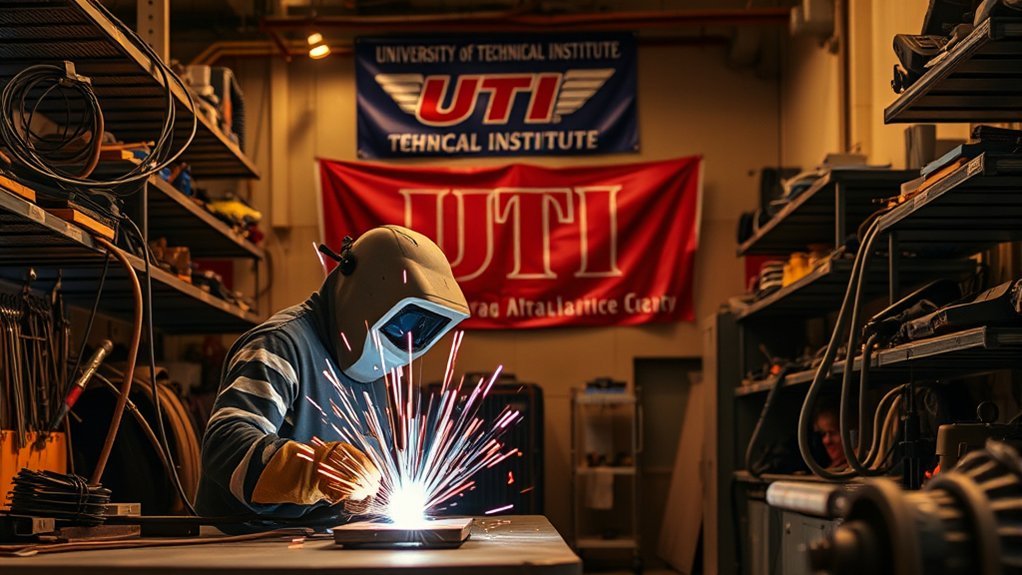
UTI’s Welding Technology program typically costs about $25,255 to $27,755 in total listed tuition and required fees across the current 2026 campus examples reviewed here, before housing, food, transportation, personal expenses, and financing costs. The standard catalog program is 36 weeks and 900 clock hours. Your actual net price depends on the campus, start date or session, and the grants or scholarships you qualify for.
By Logan Barrett · Last updated: August 10, 2026
Quick Answer
UTI’s standard Welding Technology program is 36 weeks and 900 clock hours. Current 2026 campus tables reviewed for this update show listed tuition plus required fees from about $25,255 to $27,755. Housing, food, transportation, personal expenses, and borrowing costs are extra. Your final net price depends on campus, start date or session, and financial aid eligibility.
Key Takeaways
- The standard Welding Technology program is generally 36 weeks and 900 clock hours, although UTI describes the overall range as 9–10 months depending on location.
- Tuition and required fees vary by campus. Current 2026 examples reviewed here range from about $25,255 to $27,755 before living costs.
- Course books, shirts, and safety glasses are included in listed tuition, while registration, lab, and welding equipment fees are shown separately in campus tables.
- UTI reported awarding more than $27 million in scholarships and grants during 2025 across its schools; this was not a welding-only fund, and awards are not guaranteed.
- Complete the FAFSA, compare aid offers, and use UTI’s campus-specific cost tools before borrowing.
At a Glance
| Program Length | Usually 36 weeks; UTI lists 9–10 months depending on location |
| Training Volume | 900 clock hours and 36 semester credits in the standard catalog program |
| Published Direct Cost Examples | About $25,255–$27,755 in selected current 2026 campus tables reviewed |
| Extra Costs | Housing, food, transportation, personal expenses, and possible financing costs |
How Much Does the UTI Welding Program Cost in 2026?

UTI does not publish one nationwide price for every Welding Technology student. Its official tuition page says cost depends on the program, campus, and financial aid. The standard welding curriculum is typically 36 weeks, while UTI’s main program page describes it as a 9–10 month program depending on location.
For a realistic starting point, compare the tuition-and-fee table for the campus where you plan to enroll. As of August 10, 2026, current published examples reviewed for this update include:
- Houston, Texas: $24,500 tuition and $25,255 total listed direct charges.
- Bloomfield, New Jersey: $25,000 tuition and $25,755 total listed direct charges.
- Mooresville, North Carolina: $25,200 tuition and $25,955 total listed direct charges.
- Sacramento, California: $26,600 tuition and $27,355 total listed direct charges.
- Rancho Cucamonga, California: $27,000 tuition and $27,755 total listed direct charges.
These are published examples, not a guaranteed national range. Prices can change, and a different campus may charge a different amount. Check the UTI tuition page and the current catalog for your campus before making a deposit or signing an enrollment agreement.
Also check your exact start date and class session. Some campus catalogs publish session-specific tuition adjustments. For example, the Long Beach, California catalog states that students starting the Welding Technology evening session on September 14, 2026, are billed at 95% of the listed tuition rate. That kind of session-specific adjustment is one reason the campus table is a starting point rather than a guaranteed final bill.
Warning: Do not use “about $25,000” as your final budget. It may leave out campus-specific tuition differences, required fees, living expenses, session-specific pricing, and interest if you borrow.
If you are comparing UTI with other training options, use the same direct-cost method across schools and browse our Welding Costs guides for other program cost breakdowns.
Breakdown of Tuition and Fees

UTI campus catalogs separate tuition from several required charges. The exact numbers can change, but the 2026 examples reviewed list a registration fee of up to $50, a $195 lab fee, and a $510 welding equipment fee.
The campus total—not tuition alone—is the better number to use when comparing direct program costs.
What Tuition Includes
UTI’s campus tuition notes say welding tuition includes course books or workbooks, one work shirt, two T-shirts, and safety glasses. The lab and equipment fees appear separately. Personal protective equipment or tools beyond the listed items should be confirmed with the campus before classes begin.
Published 2026 Campus Cost Examples
| Campus | Tuition | Listed Fees | Published Total |
|---|---|---|---|
| Houston, TX | $24,500 | $755 | $25,255 |
| Bloomfield, NJ | $25,000 | $755 | $25,755 |
| Mooresville, NC | $25,200 | $755 | $25,955 |
| Sacramento, CA | $26,600 | $755 | $27,355 |
| Rancho Cucamonga, CA | $27,000 | $755 | $27,755 |
The listed fees in these examples are the registration, lab, and welding equipment fees shown in the campus tables. They do not include housing, food, transportation, or personal expenses. Some catalogs may also apply start-date or session-specific tuition adjustments, so verify the table and notes for your exact enrollment date.
Additional Expenses to Consider

Your total cost of attendance is broader than the amount billed by the school. UTI describes cost of attendance as a combination of direct and indirect costs.
- Direct costs: Tuition, registration and lab fees, books, course materials, supplies, and equipment.
- Indirect costs: Housing, food, transportation, and personal expenses while you attend.
- Financing costs: Interest and fees can increase the total amount repaid if you use student loans.
Living costs vary by city and living arrangement. A student who stays with family may spend much less than someone who relocates and signs an apartment lease.
Pro Tip: Build two budgets: one for school charges and one for monthly living costs. Then subtract grants and scholarships—not loans—to estimate the amount you must pay or borrow.
Products Worth Considering

Richard Finch, Welder's Handbook: A Complete Guide to MIG, TIG, Arc & Oxyacetylene Welding, "Completely Revised and Updated Edition!" paperback
Financial Aid Options Available

Financial aid may reduce your out-of-pocket cost if you qualify. UTI lists federal and state grants, federal and private student loans, internal and external scholarships, employer programs, military education benefits, and in-school cash payment plans among the options students may explore.
The Free Application for Federal Student Aid is not only for loans. Schools use FAFSA information to determine eligibility for federal grants, work-study, and federal student loans. For the 2026–27 award year, the maximum Federal Pell Grant is $7,395, but each student’s actual award depends on eligibility and enrollment.
Note: Financial aid is not guaranteed. Compare the school’s aid offer with the full cost of attendance and the amount you would need to repay after leaving school.
Products Worth Considering

Premium welding kit training steel, makes 1 dice and 1 Cube

Multi-size: The suit contains four common sizes, which are suitable for beginners to practice: rectangle: 127×76mm(5.0×3.0 inches), 102×50mm(4.0×2.0 inches), square: 76×76mm(3.0×3.0 inches) and 51×51mm(2.0×2.0 inches)

Scholarships and Grants for Welding Students

UTI reports that it awarded more than $27 million in scholarships and grants during 2025. That figure applies across UTI’s schools and programs; it is not a fund reserved only for welding students. Award amounts, deadlines, eligible campuses, start dates, and other rules vary.
Scholarships and grants usually do not need to be repaid when you continue to meet their terms. However, some aid may have to be returned if eligibility changes or a student withdraws. Read each award agreement before accepting it.
Available Scholarship Opportunities
UTI identifies merit-based, need-based, and industry-sponsored awards. Outside organizations such as trade associations, local foundations, unions, community groups, and employers may also offer welding-related scholarships.
- Check eligibility: Match the campus, program, start date, residency, financial need, and application rules.
- Track deadlines: Some awards have limited funds or narrow application windows.
- Submit complete documents: Missing transcripts, essays, references, or FAFSA information can delay a decision.
- Ask about stacking rules: Find out whether one award changes another part of your aid package.
Grant Application Process
Start by completing the FAFSA for the correct award year. UTI states that many grants require FAFSA information to determine eligibility. After submission, review your FAFSA Submission Summary, respond to any school requests for documents, and compare the final aid offer with the full cost of attendance.
Do not assume that the largest advertised scholarship or grant figure is the amount you will receive. Your offer depends on the rules of each program and your own eligibility.
Financial Aid Resources
Useful places to check include:
- UTI Financial Aid Advisors: Help with FAFSA, school aid, and payment options.
- Federal Student Aid: Official information on Pell Grants, work-study, federal loans, and repayment.
- Employer programs: Tuition reimbursement, hiring incentives, tool assistance, or loan repayment may be available through participating employers.
- Military and VA education benefits: Eligible service members, veterans, and family members should verify benefit approval for the specific campus and program.
Payment Plans and Loan Information
UTI’s catalog says students may receive guidance on federal and private loans as well as in-school cash payment plans. Borrow only after you have reviewed grants, scholarships, savings, employer assistance, and military benefits.
| Payment Option | What to Know |
|---|---|
| Scholarships and grants | Usually do not require repayment if you remain eligible; amounts and rules vary. |
| Federal Pell Grant | Need-based federal grant determined through the FAFSA; the 2026–27 maximum is $7,395. |
| Direct Subsidized or Unsubsidized Loans | Federal student loans that must be repaid with interest. Direct Subsidized and Direct Unsubsidized Loans do not require a credit check; Direct PLUS Loans use a credit check for adverse credit history. |
| Parent PLUS Loan | A federal parent loan that does require a credit check for adverse credit history. |
| In-school cash payment plan | Terms come from the campus Financial Aid department; ask for the payment schedule in writing. |
| Employer or military support | Eligibility and covered costs depend on the employer or benefit program. |
Private loans may require a credit check or co-signer and may offer fewer protections than federal loans. Compare interest rates, fees, repayment start dates, and hardship options before signing.
Products Worth Considering

🧲 Sticks to Toolboxes & Welders – Heavy-duty magnetic welding chart adheres to metal surfaces like your welding table, toolbox, or wall for instant reference while working.

Used Book in Good Condition
Cost of Living and Indirect Expenses
Housing and food can add a large amount to your total budget. Transportation, health insurance, phone service, work clothes, laundry, and personal expenses can also matter during a 9–10 month program.
Housing and Food Costs
UTI offers housing assistance at many campuses, often through third-party providers that help students find shared or independent apartments. This should not be described as standard on-campus housing. Rent, deposits, utilities, furniture, roommate arrangements, and lease terms vary by location and provider.
- Compare living arrangements: Staying with family, sharing an apartment, or renting independently can produce very different totals.
- Ask what rent includes: Some shared-housing arrangements may include furniture or a basic utility allowance.
- Budget for move-in costs: Deposits, application fees, travel, household items, and the first month’s rent may be due before aid is available.
- Set a weekly food limit: Meal planning and cooking at home can make the monthly cost easier to control.
Transportation and Miscellaneous Expenses
Estimate your commute before choosing a campus or apartment. Include fuel, public transit, parking, insurance, maintenance, and repairs. Then add a monthly amount for toiletries, laundry, clothing, phone service, and emergencies.
If you plan to work while enrolled, do not assume every class schedule will fit your job. Ask the campus for the exact class schedule and attendance policy before committing to work hours.
How to Estimate Your Total Cost of Attendance
Use this process to build a realistic estimate:
- Choose the exact campus and start date. Tuition and fees differ by location and may change by enrollment date.
- Record the campus-published direct charges. Include tuition, registration, lab, equipment, and any other required fees.
- Estimate living costs for the full program. Add housing, food, transportation, and personal expenses for 9–10 months.
- Subtract gift aid. Deduct confirmed scholarships and grants, not loans or work-study earnings you have not yet received.
- Add borrowing costs. Review interest and fees to understand the total amount you may repay.
- Compare the result with your budget. Decide whether savings, income, aid, and affordable borrowing can cover the gap.
UTI provides a cost-of-attendance tool and a net price calculator. A net price estimate is more useful than sticker price because it considers expected grant and scholarship aid, but it is still only an estimate until you receive an official aid offer.
Financial Aid Application Process
- Create a StudentAid.gov account. Students and required contributors need their own accounts.
- Complete the FAFSA for the correct award year. The FAFSA is free.
- Add the correct UTI campus school code. Verify the code with the campus or UTI’s official financial aid pages.
- Review the FAFSA Submission Summary. Correct errors and respond to requests for more information.
- Apply separately for scholarships and grants. FAFSA submission does not automatically complete every scholarship application.
- Compare the aid offer line by line. Separate grants and scholarships from work-study and loans.
- Complete required loan counseling. First-time student Direct Loan borrowers generally must complete entrance counseling before receiving loan funds; confirm your school’s requirements.
Apply early enough to handle document requests, but rely on published deadlines rather than assuming an early application guarantees aid.
Resources for Financial Support
Start with these sources:
- UTI scholarships and grants: Review current institutional and outside opportunities.
- UTI Financial Aid: Ask for a written breakdown of direct charges, aid, remaining balance, and payment deadlines.
- Federal Student Aid: Use official information for FAFSA, grants, work-study, federal loans, and repayment.
- Employer tuition programs: Ask whether benefits apply before enrollment, after course completion, or only after a work commitment.
- Military education benefits: Confirm program approval and remaining benefit eligibility before enrolling.
- Housing assistance: Compare third-party shared housing with independent rental options and commuting from home.
What the UTI Welding Program Includes
Cost makes more sense when you know what the program covers. The standard catalog curriculum totals 900 clock hours, including 501 lecture hours and 399 lab hours. It is designed to prepare graduates for entry-level welding and fabrication work.
Curriculum Structure
The 12-course sequence begins with safety and welding principles, then moves through fabrication, pipe welding, and application courses. Students train in four major arc welding processes:
- GMAW: Gas Metal Arc Welding, commonly called MIG.
- SMAW: Shielded Metal Arc Welding, commonly called stick.
- FCAW: Flux-Cored Arc Welding.
- GTAW: Gas Tungsten Arc Welding, commonly called TIG.
The curriculum also covers thermal cutting, blueprint and welding-symbol interpretation, measurement, fabrication, project planning, and welding in different plate and pipe positions.
Admissions Prerequisites
UTI’s catalog says applicants must generally be at least 16 years old and provide acceptable proof of education. Common routes include a recognized high school diploma, a state-issued GED or equivalent, an eligible postsecondary credential or credit history, or recognized homeschool completion. Students under 18 need a parent or guardian to sign the enrollment agreement.
Basic math and reading skills are useful for measurements, blueprints, and safety instructions, but the catalog does not list a separate welding math test as a universal entrance requirement.
Certifications and Graduation Credential
Completing the program does not automatically mean you have earned separate “MIG, TIG, and stick certifications.” Graduates receive the diploma or certificate listed for their campus. UTI states that successful graduates should be prepared to take relevant industry welding tests or pursue American Welding Society certifications. Those credentials have their own testing requirements.
Working While Attending
Many students may be able to work, but the article should not promise that every schedule is flexible. Class times, attendance rules, commute time, and study demands vary. Eligible students at many campuses can also ask Career Services about UTI’s Early Employment Program, which may connect them with part-time industry opportunities while enrolled.
Career Services and Employment
UTI Career Services offers résumé help, interview preparation, job-search support, employer connections, and assistance identifying opportunities before or after graduation. These services are useful, but UTI states that it cannot guarantee employment or salary. Review the current program disclosures for the campus you are considering.
Frequently Asked Questions
How much does the UTI welding program cost in 2026?
Current 2026 campus tables reviewed for this update show listed tuition plus required registration, lab, and welding equipment fees from about $25,255 to $27,755. Your exact amount can differ by campus, enrollment date, class session, and financial aid. Housing, food, transportation, personal expenses, and borrowing costs are additional.
How long does UTI welding school take?
The standard Welding Technology catalog program is 36 weeks and 900 clock hours. UTI’s main welding page describes the program as taking about 9–10 months depending on location.
Are there prerequisites for enrolling in the UTI Welding Program?
Applicants generally must be at least 16 and provide accepted proof of education, such as a recognized high school diploma, GED or equivalent, qualifying college education, or recognized homeschool completion. Students under 18 need a parent or guardian to sign the enrollment agreement. Check the current campus catalog for exceptions and document rules.
What welding certifications can I earn at UTI?
UTI trains students in GMAW, SMAW, FCAW, and GTAW and awards a diploma or certificate depending on the campus. The program is designed to prepare graduates for relevant industry tests and AWS certifications, but those certifications require separate testing and are not automatically awarded just for completing the program.
Can I work while attending the welding program?
It may be possible, but do not assume every campus schedule will fit a job. Ask for the exact class and attendance schedule. Eligible students at many campuses can also ask Career Services about the Early Employment Program and part-time industry opportunities.
How is the curriculum structured?
The standard catalog program includes 12 courses, 36 semester credits, and 900 clock hours. It starts with safety and welding principles, then covers GMAW, SMAW, FCAW, GTAW, engineering and fabrication, pipe welding, and two welding application courses.
What job placement assistance does UTI provide?
Career Services can help with résumés, interviews, job-search strategy, employer networking, and identifying openings before or after graduation. UTI does not guarantee employment or salary, so review campus outcome disclosures and local job conditions.
Does UTI welding tuition include books and equipment?
Campus tuition notes say course books or workbooks, one work shirt, two T-shirts, and safety glasses are included. Registration, lab, and welding equipment fees are listed separately. Ask the campus whether you need any additional personal protective equipment or tools.
How much financial aid will I receive?
There is no standard amount. Complete the FAFSA and any separate scholarship applications, then wait for an official aid offer. Compare grants and scholarships, work-study, and loans separately so you know which funds do not need repayment and which create debt.
Conclusion
The UTI Welding Technology program is generally a 36-week investment, but its cost is not one flat $25,000 price. Current 2026 campus examples reviewed here show about $25,255 to $27,755 in listed tuition and required fees before living expenses. Campus, enrollment date, class session, and aid can change what you actually pay. Use the exact campus catalog, UTI’s cost calculator, and your official aid offer to build your final budget.
Financial aid may help, but eligibility and award amounts vary. Separate gift aid from loans, verify what the program includes, and understand that training and Career Services can support an entry-level job search without guaranteeing employment or salary.
Sources
- UTI Tuition and Costs — campus and program pricing guidance and net price tools.
- UTI Cost of Attendance — direct and indirect cost categories.
- UTI Welding Technology Catalog — curriculum, hours, credits, program objectives, and certification preparation.
- UTI Scholarships and Grants — current institutional scholarship and grant information.
- UTI Admissions Procedures and Entrance Requirements — age and education-document requirements.
- Federal Student Aid — official FAFSA, grant, work-study, and federal loan guidance.
- Federal Pell Grant Guidance — 2026–27 maximum award and eligibility guidance.
