
You’ll pay roughly $100 for a basic stick welder and $300–$2,000 for common MIG or TIG units; multiprocess and industrial systems range from $1,000 to $20,000+ depending on power and duty cycle. Inverter, digital controls, brand, and portability raise price. Also budget for gas, consumables, PPE, and maintenance — typically $200–$1,000 yearly. Match machine specs to your application for best value, and continue to learn how features and lifecycle costs affect total price.
Key Takeaways on Welding Machine Pricing
Although prices vary widely by type and capability, you can expect welding machines to range from under $300 for basic consumer models to well over $20,000 for industrial systems.
Expect welding machines from under $300 for hobbyists to over $20,000 for heavy industrial systems.
You’ll choose by process: stick units start near $100 and run to $1,000; MIG units typically fall between $300–$1,000; TIG units span $500 to $5,000+; multiprocess systems commonly cost $1,000–$10,000 or more.
Evaluate features, duty cycle, and included accessories; discounts (for example deep markdowns on popular welding machine brands) can materially lower acquisition cost.
Don’t neglect operating expenses: shielding gas, consumables, maintenance, and mandatory safety equipment factor into lifecycle cost.
Match expected application to total cost to avoid overspecifying or underbuying your system.
Overview of Welding Machine Types and Uses
You’ll compare MIG and TIG to match speed and finish requirements: MIG is fast and forgiving for thicker materials, while TIG gives precise control for thin or stainless applications.
You’ll use stick welding for outdoor, rusty, or heavy-penetration jobs where portability and simplicity matter.
You’ll consider multiprocess machines when you need one unit that economically covers MIG, TIG, and stick across varied projects.
Products Worth Considering
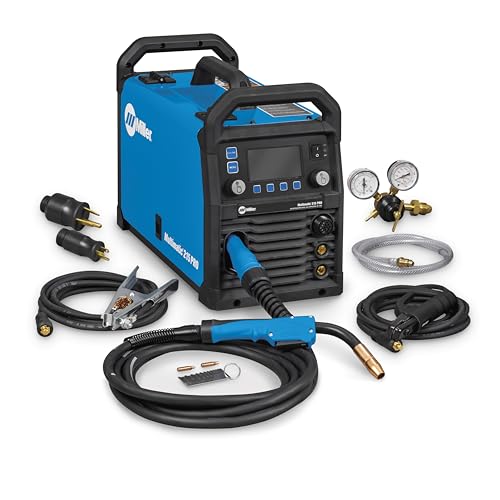
Versatile Performance: Powerful multiprocess welder for MIG, TIG, and Stick welding; Auto-Set technology provides fast, easy settings for multiple materials; Smooth-Start technology ensures spatter-free welds with professional results
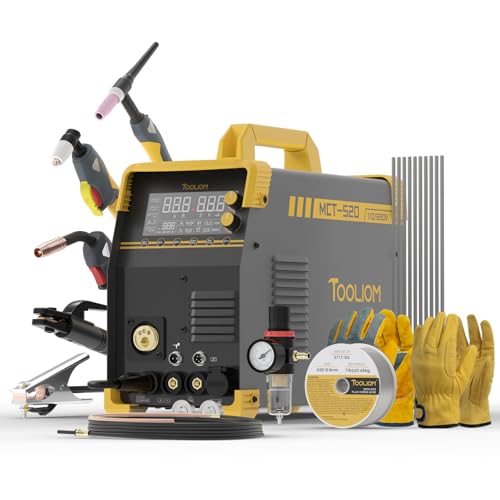
6-IN-1 Multiprocess Welders: Experience true versatility with a machine that does it all—MIG, Flux Core, Spool Gun, Plasma Cutter, TIG, and Stick. Whether you're a weekend warrior or a seasoned fabricator, this all-in-one powerhouse adapts to your workflow, letting you switch from cutting thick metal to welding thin sheets without missing a beat

TOOLIOM Welder: 4-in-1 Versatility TL-MIG-180M welder machine combines Gas MIG, Flux MIG, Stick, and Lift TIG (with included torch) – more convenient and cost-effective than separate tools. And this mig welding kit includes 1LB flux core welding wire and welding gloves is included—just load and weld.
MIG Vs TIG
Which process fits your project: fast, forgiving MIG or precise, controlled TIG?
You’ll choose MIG when speed, ease, and cost-efficiency matter: MIG benefits include continuous wire feed, semi‑automatic operation, and effectiveness on thicker materials; typical machines run $300–$1,000.
Pick TIG when control and finish are critical: TIG precision comes from a non‑consumable tungsten electrode and manual filler feed, delivering clean, intricate welds on thin stainless steel or aluminum; expect $500 to over $5,000 for equipment.
If you need both workflows, consider multiprocess units ($1,000–$10,000) that provide flexibility.
Match process to material thickness, joint detail, and budget. Your skill level also matters: MIG’s learning curve is gentler; TIG demands steady hand control.
Stick Welding Uses
Stick welding (Shielded Metal Arc Welding, SMAW) is a rugged, portable process you’ll reach for when joining ferrous metals in construction, repair, and maintenance because it handles dirty surfaces, works in all positions, and tolerates outdoor conditions that foil other methods.
You’ll use stick welding applications for structural steel, pipeline repair, farm equipment, and maintenance where surface prep is limited and access is constrained. The electrode’s flux protects the arc from wind and contamination, so you can weld outdoors without elaborate shielding.
Equipment is simple and portable; entry machines run about $100 and professional units approach $1,000, making the process accessible. Stick welding benefits include positional versatility, contamination tolerance, and field service suitability for remote or rugged jobs.
Multiprocess Advantages
Flexibility matters: a multiprocess welder lets you switch among MIG, TIG, and Stick modes so you can match the process to the joint, material, and operator skill.
You get clear multiprocess benefits: one machine reduces tooling, shop footprint, and training overhead while delivering versatility advantages across projects.
Expect entry pricing around $1,000; professional units exceed $10,000 based on features.
Inverter-based models improve arc stability and cut weight for portability.
Dual voltage, pulsing, and model-specific controls enhance control and penetration for thin or exotic metals.
Consider cost-to-capability tradeoffs: popular units like the Miller Multimatic 215 lower total ownership cost for many users.
Evaluate duty cycle, portability, and control features against your workload.
- Confidence
- Efficiency
- Savings
- Capability
Factors That Drive Welding Machine Costs
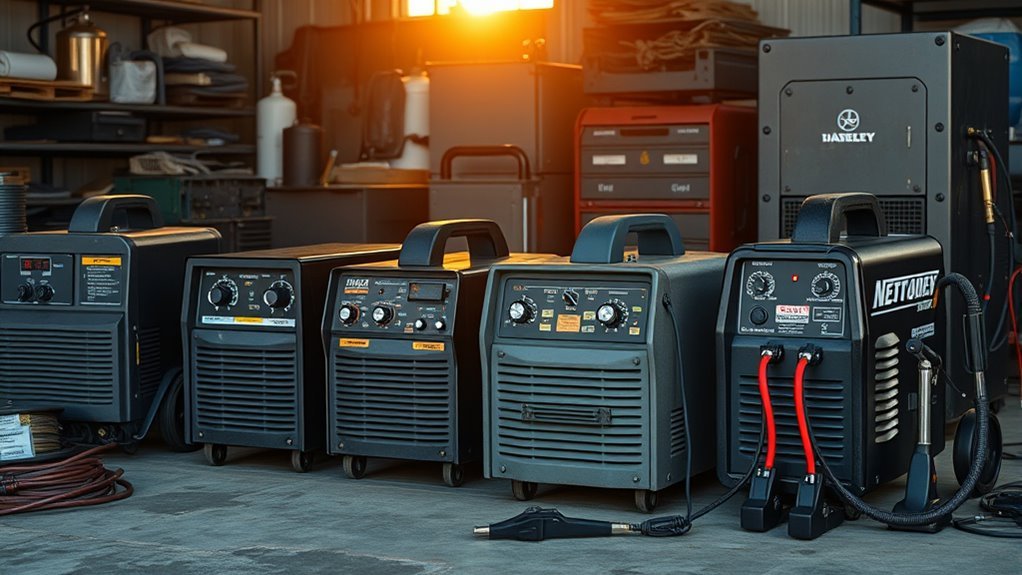
Because welding equipment spans simple hobby units to industrial multiprocess systems, several key factors determine what you’ll pay. You should evaluate power output, inverter/digital features, brand, and lifecycle costs against welding safety and machine portability requirements. Higher output raises cost; inverter and dual-voltage add premium. Trusted brands command higher prices for reliability. Consider maintenance, consumables, and total cost of ownership, not just purchase price.
| Factor | Impact on Cost |
|---|---|
| Power output | Higher output = higher price |
| Electronics (inverter, digital) | Adds significant premium |
| Brand reputation | Price uplift for established makers |
| Lifecycle costs | Maintenance/consumables affect long-term expense |
Balance performance, portability, and safety to match application and budget.
Products Worth Considering
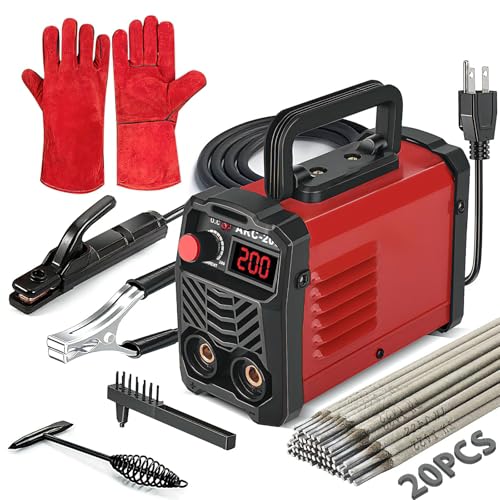
【𝐔𝐏𝐆𝐑𝐀𝐃𝐄𝐃 𝟐𝟎𝟎𝐀𝐦𝐩 𝐒𝐓𝐈𝐂𝐊 𝐖𝐄𝐋𝐃𝐄𝐑 𝟏𝟏𝟎𝐕】Welder machine 110V Adjustable Current: 20-200A. Comes with 20 welding rods, can weld metal materials with 0.06-0.2 inch thickness, such as cast iron, mild steel, etc. Ideal for home repairs and DIY projects.

Dual Battery Power for Unmatched Flexibility: Introducing dual battery power with a game-changing twist. Power your welding projects with endurance, leveraging either our high-capacity 8000mAh Li-Ion batteries or hook up to a compatible battery bank for extended runtime. Freely switch from convenience to extended runtime, welding without limits. And to enhance the machine's runtime, we've added 2 extra batteries, bringing the total to 4, for longer and uninterrupted use.

Easy to Use:compatible with AWS E6013,E7018,E7014,and E6011 electrodes in 1/16"-1/8" (1.6mm-3.2mm) sizes.This arc welding machine is easy enough for beginners to use and ideal for both DIY projects and professional applications
Price Ranges by Welding Process (MIG, TIG, Stick, Multiprocess)
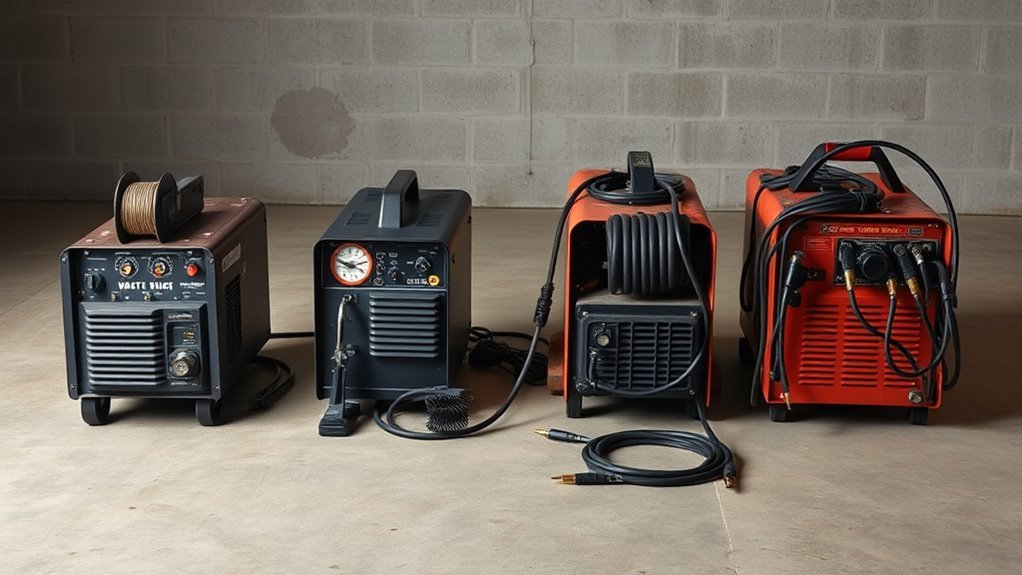
After weighing power, electronics, brand, and lifecycle costs, you’ll next compare price bands by welding process so you can match budget to application.
You’ll perform a direct cost comparison across processes and welding machine brands to select the right tool.
- MIG: $300–$1,000 common; entry models ≈ $300; industrial units exceed $1,000.
- TIG: $500–$5,000+; basic precision setups start near $500; advanced systems climb past $5,000.
- Stick: $100–$1,000; cheapest entry at ~$100; feature-rich units approach $1,000.
- Multiprocess: $1,000–$10,000+; consolidates MIG/TIG/Stick capability, price scales with feature set and duty cycle.
Use this concise matrix to align process, expected duty, and brand reputation to your procurement budget.
Products Worth Considering
![ARCCAPTAIN 165A MIG Welder 110V/220V [Large LED Display] 4 in 1 Gasless/Gas MIG/Lift TIG/Stick Welding Machine Multiprocess Welder Machine, IGBT Inverter Welder with Synergy, 2T/4T](https://m.media-amazon.com/images/I/51GW2TUAy1L._SL500_.jpg)
4-IN-1 MIG Welder: The welder machine offers GAS MIG/Flux Core MIG/Lift TIG/ MMA welding modes (Note: WP-17V TIG torch must be purchased separately). It can easily handle welding stainless steel, carbon steel, and even thicker steel materials, meeting diverse welding requirements.

MULTIFUNCTIONAL: A 4-in-1 welder, capable of Flux Core MIG/Gas MIG/ Stick/Lift TIG (need to purchase extra tig lift torch). This unit caters to a wide range of welding applications and meets your various welding needs.

4 IN 1 MULTIFUNCTIONAL: Enjoy the convenience of a 4-in-1 welding machine that masterfully handles Gasless Flux Core MIG/Gas MIG/Stick/Lift TIG (additional lift TIG torch required). This unit suits a wide range of welding applications and meets your various welding needs.
Comparing Entry-Level, Professional, and Industrial Models
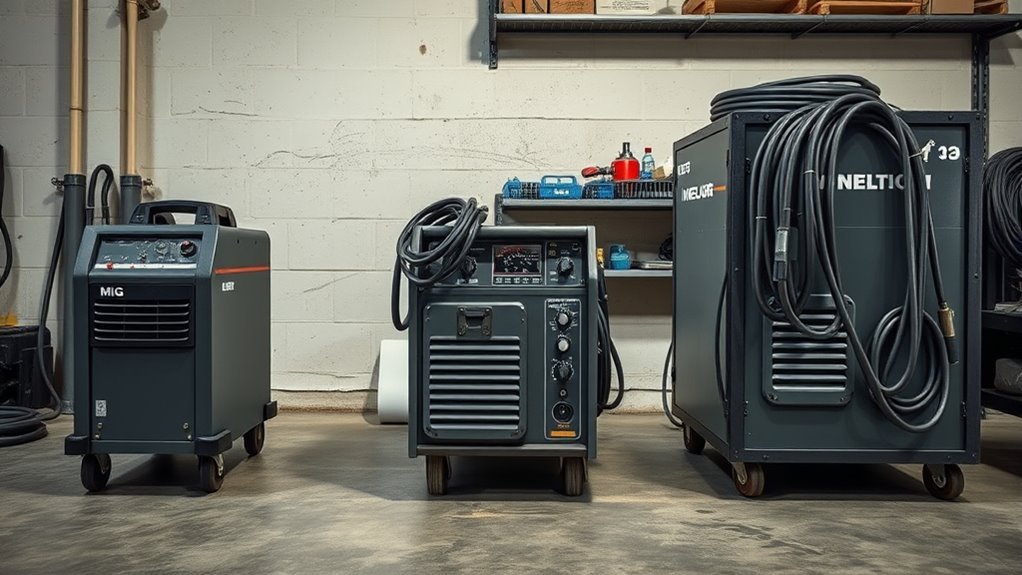
You’ll find entry-level stick and basic MIG units priced from about $100 to $1,000, suited for beginner and hobby use.
Professional MIG/TIG machines typically run $500–$5,000, adding advanced controls and higher duty cycles for complex work.
Industrial and multiprocess systems start around $1,000 and can exceed $10,000 for high-output, feature-rich models required in heavy-duty production.
Products Worth Considering

【4-in-1 Multifunctionality & Superior Welding Performance】The BESTMIG MIG145 supports dual voltage of 110/220V and combines Gas/Gasless MIG,Stick and Lift TIG in one unit.Compatible with solid steel wire and stainless steel wire from .030"~0.03" diameter (MIG welding,“GMAW”), with .030"~.040" flux-cored wire and with .030"~.040" Silicon. Offering a 30% increase in work efficiency compared to traditional MIG welders.Featuring a smooth arc, excellent penetration, and minimal spatter, easily handles stainless steel, carbon steel, and mild steel up to 3mm (2/5") thick, meeting diverse welding needs.


【2-in-1 Welder】 Unleash Your Welding Potential! Experience ultimate versatility with our 2-in-1 welder featuring both Flux Core MIG and MMA modes. Whether you’re tackling different materials or project types, this machine is designed to meet all your welding needs
Entry-Level Price Range
One clear way to start is by defining the entry-level spectrum: machines aimed at beginners and hobbyists typically range from very low-cost stick units around $100 to basic MIG models at $300–$1,000, with entry TIGs beginning near $500 and multiprocess units spanning roughly $1,000–$2,500.
You’ll find practical entry level features and beginner considerations in this range: affordable stick welders (~$100) suit basic practice; MIGs ($300–$1,000) balance ease and usability; TIGs (starting ~$500) require more control but offer precision; multiprocess units ($1,000–$2,500) let you adapt without buying separate machines.
- Low capital entry reduces financial risk.
- Simpler controls accelerate learning.
- Limited duty cycles constrain production.
- Upgrade paths preserve investment.
Industrial/Professional Costs
Across the cost spectrum, you’ll see clear trade-offs: entry-level machines ($100–$1,000) give affordable, simple performance for hobbyists. Mid-range professional units (around $2,000–$3,000) add multiprocess capability and better duty cycles for skilled users. Industrial systems (often $10,000+, with some diesel-driven units exceeding $20,000) deliver sustained high power, rugged duty cycles, and advanced controls for heavy production.
You’ll choose based on intended use: entry units suffice for basic repairs and learning. Professional models like the Miller Multimatic 215 expand process flexibility (MIG/TIG/Stick), improve arc control, and support professional training outcomes.
Industrial-grade systems prioritize continuous operation, high amperage output, engine-driven portability, and certified reliability for demanding industrial applications; expect higher serviceability and total cost of ownership.
Accessories, Maintenance, and Long-Term Ownership Costs
Although the sticker price covers the welder itself, accessories, consumables, and upkeep quickly add to your total cost of ownership; budget $50–$200 for PPE and accessories, $100–$500 per year for routine maintenance, and $200–$1,000 per year for consumables depending on usage and process.
You’ll apply accessory selection to prioritize durable helmets, gloves, and leads that reduce replacement frequency. Use maintenance budgeting to schedule cleaning, inspections, and parts replacement to avoid costly failures. Higher initial quality lowers lifecycle cost via fewer repairs.
Training and safe procedures cut accident-related expenses. Plan consumable consumption by process and throughput, tracking usage monthly.
- Anxiety: unexpected failures hurt profits.
- Relief: planned upkeep prevents downtime.
- Confidence: quality gear lasts longer.
- Control: budgeting keeps costs predictable.
Products Worth Considering

【 Clear True Color Field of View 】 The lenses of this welding helmet use the latest true color technology to provide a highly clear picture in a 3.66 "x 1.69" field of view. Extreme elevation improves the visual experience of welders and relieves eye pressure. The welded helmet lens is 1/2/1/2 optical clarity.
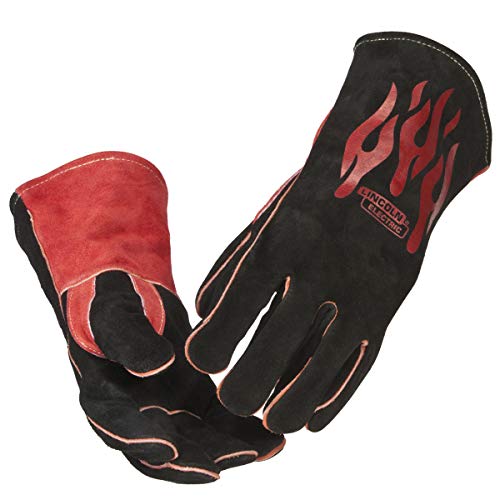
GREAT HEAT RESISTANCE – Made of a high grade leather and soft cotton liner which is designed to withstand and protect against high temperatures.

Liner Ingredients: 100% DuPont Kevlar Fiber
Tips for Finding the Best Value and Financing Options
Looking for the best value means balancing features, durability, and total cost of ownership: prioritize multiprocess machines (for example, the Miller Multimatic 215 at $2,199) or entry-level units near $300 depending on your workload.
Check for manufacturer rebates and package discounts (the Multimatic 215 TIG package can save $650), compare prices across multiple suppliers, and factor in shipping thresholds (free shipping over $300) and available retailer financing to spread payments without exceeding your maintenance and consumable budgets.
Evaluate needs: duty cycle, duty at amperage, and process flexibility determine value per dollar.
Use structured cost comparisons: initial price, rebates, shipping, accessories, and expected consumable/maintenance spend.
Explore financing options with fixed terms to avoid balloon interest and preserve cash flow.
Frequently Asked Questions
Are Welding Machine Prices Negotiable at Local Shops?
Yes — you can negotiate welding machine prices at local shops. You should perform price comparison, present competing offers, request bundled discounts or service credits, and document local negotiations to secure precise, verifiable reductions and warranty adjustments.
What Warranties Typically Cover Welding Machines?
You might doubt warranty value, but welding machine warranties usually cover defects in materials and workmanship, limited parts and labor, and sometimes electronics; warranty coverage specifics define term length, exclusions, and required maintenance or registration.
Can I Rent a Welding Machine Instead of Buying?
Yes—you can rent a welding machine; welding machine rental offers flexibility, lower upfront cost, and access to specialized gear. Renting benefits include maintenance, warranty coverage, and ability to test models before committing to purchase.
How Do Import Taxes Affect Welding Machine Cost?
Import duties increase landed price and cash outlay; you’ll face additional import duties and VAT, altering tax implications, compliance paperwork, and total cost-of-ownership. You should model duty rates, brokerage fees, and reclaim or credit options.
Are There Subscription Services for Welding Equipment Updates?
Like clockwork, yes — you’ll find subscription models offering firmware patches, parts replacement, and equipment upgrades; you’ll pay recurring fees, receive scheduled updates, and can scale tiers for maintenance, support, and lifecycle extension.
Conclusion
You’ve seen how machine type, duty cycle, amperage, and features drive price — from budget stick units to multiprocess industrial rigs. Think about upfront cost versus productivity, consumables, and service life when choosing. Want reliability or just an occasional hobby welder? Balance specs with warranty, safety, and total cost of ownership. Use rebates, financing, or certified used gear to stretch your budget without compromising needed performance.
