In the UK, car sill welding costs typically range from £200 to £700 per side for localised patch repairs, and £800 to £1,500+ per side for full inner and outer sill reconstruction. Minor non-welded surface rust treatment costs £80–£300, while complex two-sided repairs involving floor pans and jacking points can exceed £1,500–£3,000. Prices vary significantly based on vehicle construction, regional garage labour rates, and unseen structural corrosion revealed during strip-down.
Quick Answer: UK Sill Welding Costs (2026)
For standard UK passenger cars, budget £200–£700 for localized outer sill patch welding and £800–£1,500+ per side when inner structural sills, reinforcements, or jacking points require cutting and fabrication. Non-welded surface rust treatment runs £80–£300. Structural repairs near suspension or seatbelt mountings are MOT-critical and require continuous seam welding.
Key Takeaways
- A sill repair can range from a small welded patch to replacement of the inner sill, outer sill, reinforcement, floor edge, or jacking point.
- Sill rust is not automatically an MOT failure, but corrosion within a 30cm “prescribed area” of load-bearing mountings causes immediate failure.
- Ask whether quotes are per side, include 20% UK VAT, replacement repair panels, paint refinishing, seam sealer, cavity wax, and an MOT retest.
- Obtain a written estimate setting a pre-approved authorization cap for extra work, as hidden inner-sill rust is only visible after cutting back steel.
- Structural sill welding is safety-critical work. Body repairers should follow manufacturer repair standards, use minimum 1.2mm steel, and adhere to DVSA MOT guidance.
At a Glance
| Time Required | About 1–3 working days for a local repair; around 3–7 days or longer for inner-and-outer sill work, paint, and corrosion protection |
| Difficulty | Advanced and safety-critical when the sill is structural or close to seat-belt, suspension, steering, or braking mountings |
| Tools Needed | Professional lifting equipment, cutting and panel-forming tools, MIG welding equipment, measuring tools, fume extraction, fire protection, and finishing materials |
| Cost (inc. VAT) | Roughly £80–£300 for non-welded surface treatment, £200–£700 for localised welding, and £800–£1,500+ per side for major sill reconstruction |
What Affects Sill Welding Cost?
The visible rust patch is only one part of the quote. A workshop must identify how far the corrosion extends, what the sill does in that vehicle’s structure, and whether nearby panels have also weakened.
- Repair scope: Treating surface rust costs less than cutting out perforated steel and fabricating a replacement section.
- Inner versus outer sill: An outer skin repair is usually simpler than rebuilding the inner sill, reinforcement, floor edge, or jacking point.
- Access and strip-down: Seats, carpets, trim, wiring, fuel lines, plastic foam, and underseal may need removal or protection before hot work.
- Vehicle design: Some models have readily available pressed repair panels. Others need hand-formed sections or manufacturer-specific joining methods.
- Finish level: An MOT-focused structural repair may cost less than a restoration-quality repair with invisible joins and colour-matched paint.
- Corrosion protection: Primer, seam sealer, paint, underbody coating, and cavity wax add cost but help protect the new metal.
- Regional Labour Rates & VAT: Body shop hourly rates range from £55–£85/hr in Northern England, Wales, and Scotland to £85–£130/hr in London and the South East. Ensure quotes state whether 20% VAT is included.
Regional UK Body Shop Labour Rate Benchmarks (2026)
- London & South East: £85 – £130 + VAT per hour
- Midlands, East Anglia & South West: £65 – £95 + VAT per hour
- Northern England, Wales & Scotland: £55 – £85 + VAT per hour
The hourly rate alone does not predict the bill. Access, strip-down, fabrication, paint, and hidden inner-sill corrosion often matter more than the welding time.
Is Sill Rust Cosmetic or Structural?
A sill can include a visible outer skin, an inner sill, reinforcements, jacking-point structure, and adjacent floor sections. Whether corrosion is cosmetic or structural depends on which part is affected and how the vehicle is built. A plastic sill cover may be cosmetic, while the steel behind it can still be load-bearing.
Surface vs Structural Rust
Surface rust affects the coating and the top layer of metal. The steel remains firm, with no perforation or major loss of thickness. A body shop may be able to remove the corrosion, treat the metal with rust converter, prime it, and repaint it without welding.
Structural corrosion has caused holes, soft metal, swelling between joined panels, failed seams, or a serious reduction in section thickness. The damaged steel must usually be removed back to sound metal before a suitable repair section is installed.
Hidden Sill Damage
Sills often corrode from the inside because moisture and debris collect in seams and cavities. Bubbling paint may therefore hide damage to the inner sill or reinforcement. A proper assessment may include a lift inspection, removal of trim or plastic covers, examination of drain holes and jacking points, and a small borescope where access allows.
Do not stab a rusty sill with a screwdriver or rely on a household magnet as a diagnosis. Paint thickness, filler, plastic covers, aluminium panels, and panel shape can all affect a magnet test. The current DVSA method uses visual inspection, finger-and-thumb pressure, and careful use of an approved corrosion assessment tool by the tester.
Warning: Never lift the vehicle from a jacking point that is swollen, perforated, cracking, or visibly distorted. Use the manufacturer’s alternative lifting point or arrange recovery and professional inspection.
Will Sill Rust Fail an MOT?
Not every rusty sill fails an MOT. Under the DVSA structural integrity and corrosion guidance, the result depends on the location, extent, and structural function of the affected metal.
A load-bearing or supporting area within 30cm of certain brake, steering, suspension, axle, seat-belt mounting points, pillar bases, or towbar attachments is a prescribed area. A hole, soft metal, or an inadequate repair in such an area leads to an automatic MOT refusal (Major or Dangerous defect). Corrosion outside a prescribed area can also fail if it significantly reduces the strength or continuity of the overall vehicle structure.
A repair does not receive an automatic pass merely because fresh metal covers the hole. Structural work must be properly carried out, extend to sound metal, use suitable materials (minimum 1.2mm mild steel sheet), and appear as strong as the original structure. Patch repairs normally require continuous seam welding unless an approved original or manufacturer-recommended spot/plug method applies.
MOT Retest Policy Note: If your vehicle fails its MOT on structural sill corrosion, you have 10 working days to have the repair completed and submitted for a partial retest at the original station. Missing this window requires a full retest at standard cost (£54.85 max).
Signs Your Sill Needs Welding
These signs justify a professional inspection. They do not all prove that welding is required, but the risk rises when several appear together.
| Sign | What It May Mean | Next Step |
|---|---|---|
| Brown staining or light scaling | Early coating failure or surface corrosion | Book rust treatment before it spreads |
| Bubbling paint or swollen seams | Corrosion may be developing behind the outer skin | Inspect the inner sill and drainage path |
| Flaking metal, pinholes, or perforation | Metal thickness and strength have been lost | Arrange structural assessment promptly |
| Crushed or collapsing jacking point | The reinforcement or adjacent sill may be weak | Do not jack there; have the area inspected |
| Cracked seam sealer or fresh underseal over a lumpy repair | Moisture entry or a previous repair that needs checking | Ask for an underside and cavity inspection |
| Door opening distortion or unusual creaking | Possible structural movement, although hinges or accident damage can cause similar symptoms | Stop guessing and obtain a body-structure assessment |
Note: A damp footwell can come from door membranes, windscreen seals, heater drains, roof drains, or floor corrosion. Learn more in our damp footwell troubleshooting guide.
How Sill Welding Is Done & Estimated Labour Hours
A lasting repair removes weakened metal, restores the original load path, seals the joins, and protects both sides of the new steel. The exact process depends on the vehicle manufacturer’s repair information and the construction of the sill.
| Repair Stage | Technical Work Included | Estimated Hours |
|---|---|---|
| 1. Strip-Down & Prep | Interior trim, carpet, seats, fuel/brake line isolation, underseal removal | 1.0 – 2.5 hrs |
| 2. Cutting & Fabrication | Cutting back to sound metal, template making, forming 1.2mm sheet steel | 1.5 – 4.0 hrs |
| 3. Structural Welding | MIG continuous seam welding, spot/plug welding inner reinforcements | 1.5 – 5.0 hrs |
| 4. Protection & Paint | Grinding, zinc primer, seam sealer, stone-chip undercoat, paint, cavity wax | 2.0 – 4.0 hrs |
1. Inspection and Strip-Down
The repairer checks the outer sill, inner sill, reinforcement, jacking points, floor edge, wheel arch, and nearby mounting areas. Trim, carpets, wiring, sealant, and coatings may need to be moved so the full repair area and fire risks are visible.
Before hot work, a competent workshop assesses nearby fuel lines, the fuel tank, upholstery, plastic foam, underseal, and other flammable materials. The Health and Safety Executive’s vehicle welding guidance highlights fire, explosion, electric-shock, ultraviolet-radiation, and harmful-fume risks.
2. Cutting and Fabrication
The technician marks the full corrosion boundary and cuts back to firm, clean metal. Covering rust with a plate, body filler, or underseal does not restore structural integrity. A repair panel is then selected or fabricated using appropriate gauge steel to match the shape, thickness, overlaps, drainage, and load path of the original section.
3. Joining the New Metal
MIG welding is standard for mild-steel body repairs. The correct process may include spot welding, plug welding, continuous seam welding, or manufacturer-specified joining methods. DVSA MOT guidance requires continuous seam welding on all structural patch repairs in prescribed areas.
4. Protection and Finishing
After structural inspection, welds are dressed, sealed with polyurethane seam sealer, primed with zinc-rich primer, repainted, and coated with underbody wax. Internal cavities receive anti-corrosion wax injection once cooled. Factory drain holes must remain clear.
Car Sill Welding Cost by Damage Level
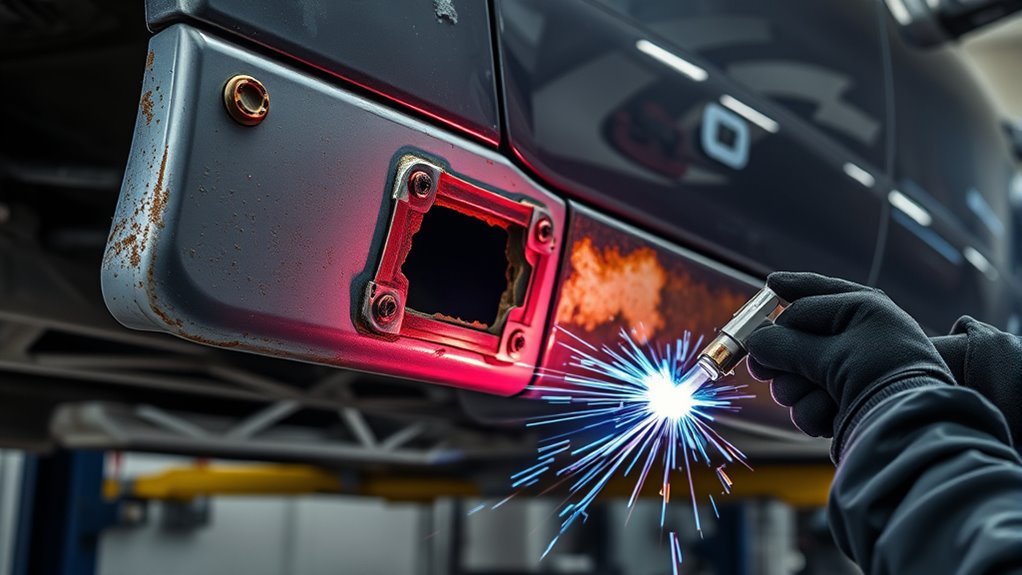
The following bands are practical budgeting estimates including 20% UK VAT. Vehicle model, region, access, finish, parts supply, and hidden corrosion can move a quote outside these ranges.
| Damage Level | Likely Work | Indicative UK Cost (inc. VAT) |
|---|---|---|
| Surface rust only | Clean, treat, prime, and repaint; no welding | About £80–£300 |
| Small perforation or patch | Cut out a local area and weld in a small repair section | About £125–£400 |
| Localised sill repair | Larger outer-sill section, fabrication, sealing, and local refinishing | About £200–£700 per side |
| Inner and outer sill damage | Rebuild reinforcement, inner sill, outer sill, or jacking-point structure | About £800–£1,500+ per side |
| Multi-panel structural corrosion | Both sides or linked repairs to arches, floor edges, pillars, and jacking points | About £1,500–£3,000+ total |
What Should a Sill Welding Quote Include?
A low headline price can become expensive if it excludes paint, VAT, or corrosion protection. Compare written scopes rather than comparing one number.
- Whether the price is for one side or both sides
- Whether it covers the outer sill only or the inner sill and reinforcement
- Repair-panel cost, custom fabrication, weld consumables, and clips or trim
- Removal and refitting of seats, carpet, plastic covers, wiring, and other components
- Paint preparation, colour matching, seam sealer, and underbody coating
- Internal cavity wax and clearing of drain holes
- VAT (20%) and any diagnostic or strip-down charge
- The expected completion time and whether an MOT retest is included
- A written limit above which the garage must contact you for approval
- Photos of hidden corrosion before extra work and photos of the completed bare-metal repair before it is covered
Why Sill Welding Quotes Change
Corrosion can spread between layers where it is not visible during initial inspection. Once trim, underseal, or outer panel sections are removed, the technician may find no solid edge remaining to weld onto.
A changing estimate can be reasonable, but extra work must be explained and authorized. Citizens Advice explains quotes vs estimates, while The Motor Ombudsman provides repair dispute guidance.
DIY vs Professional Sill Welding
Clearing drain holes, washing road salt, and treating light surface rust are reasonable DIY tasks. Structural sill welding is safety-critical. It affects structural rigidity, seatbelt/suspension mounting points, crash load paths, jacking points, fuel-system safety, and MOT compliance.
Professional body repairers use MIG welding setups (typically 100–150A with Argon/CO2 shielding gas), 1.2mm minimum gauge steel, dedicated fume extraction, and lift access to execute continuous structural seams safely. HSE health guidelines warn against hazardous welding fumes and toxic underseal combustion products.
Is Sill Welding Worth the Cost? (Decision Matrix)
Compare total repair costs with the vehicle’s market value post-repair, not its current damaged value. Use the 50% Vehicle Value Rule: if total structural welding costs exceed 50% of the car’s healthy market value, carefully evaluate overall mechanical condition before proceeding.
| Scenario | Vehicle Condition | Recommended Action |
|---|---|---|
| Repair < 30% Car Value | Good mechanical history, low mileage, rest of floor pan solid | Proceed with Professional Repair |
| Repair 30% – 50% Value | Upcoming maintenance due (tyres, clutch, timing belt) | Get Detailed Underside Inspection First |
| Repair > 50% Car Value | High mileage, widespread corrosion on arches/subframe | Consider Scrap / Replacement |
How to Stop Sill Rust Returning
A strong weld can rust again if internal cavities are unsealed. After welding work:
- Confirm that zinc primer, seam sealer, underbody wax, and internal cavity wax were applied.
- Ensure factory drain holes remain open so condensation escapes freely.
- Wash road salt and mud build-up from lower sills and wheel arches regularly.
- Read our underbody rust proofing guide for detailed cavity wax injection steps.
Frequently Asked Questions
How do you calculate a sill welding repair price?
A garage calculates prices by combining strip-down time, labour hours, replacement panel or steel fabrication costs, weld consumables, paint, underseal/wax injection, VAT (20%), and any MOT retest fees.
What is usually the most expensive part of sill repair?
Labour and custom panel fabrication dominate the bill. Stripping interior trim, cutting back to clean metal, forming steel shapes, and multi-stage anti-corrosion coating require significant skilled technician time.
How much should car sill welding cost in the UK?
Localised patch repairs average £200–£700 per side. Rebuilding corroded inner and outer sills with jacking points ranges from £800 to £1,500+ per side including VAT.
Should I spend £4,000 fixing sill corrosion?
Spending £4,000 makes economic sense for valuable classics or rare cars. For standard daily vehicles, spending over 50% of the car’s healthy market value is rarely advisable.
Can you drive with rusty sills?
Minor surface rust is safe, but perforated holes or collapsed jacking points pose safety risks. Vehicles failing the MOT with dangerous structural defects must not be driven.
Can a rusty sill pass an MOT?
Yes, if corrosion is surface-level or further than 30cm from prescribed structural mountings. Holes or structural weakness within a 30cm prescribed area cause an automatic failure.
Is a patch repair acceptable on a car sill?
Yes, provided the patch reaches sound metal and is fully continuous-seam welded according to DVSA MOT inspection standards.
How long should a sill welding repair last?
A properly welded sill protected with seam sealer, primer, paint, and internal cavity wax can easily last 5 to 10+ years.
Conclusion
Car sill welding requires removing damaged metal back to sound steel, restoring structural load paths, and protecting internal cavities against future moisture. Budget £200–£700 for localized patch repairs and £800–£1,500+ per side for major inner/outer sill rebuilds. Always obtain a written quote with an authorization limit for unexpected inner-sill corrosion.
Sources
- DVSA MOT inspection manual: structural integrity and corrosion
- DVSA MOT inspection manual: body, structure and attachments
- Health and Safety Executive: welding and flame cutting in vehicle repair
- Health and Safety Executive: motor vehicle repair health risks
- Citizens Advice: problems with a car repair
- The Motor Ombudsman: disputing a car repair bill