
You need a plasma cutter that matches your metal thickness, available power, air supply, and workload. The right machine can reduce edge cleanup, make setup easier, and give you more predictable results. This guide compares seven relevant plasma-cutting options for DIY work, repair, fabrication, portable 120V use, multi-process shops, and CNC setups.
Affiliate disclosure: This article contains affiliate links. If you buy through them, we may earn a commission at no extra cost to you.
Quick Verdict
Choose the Hypertherm Powermax30 XP if cut quality, portability, and manufacturer-backed specifications matter most. Pick the Forney 251 when you specifically need a simple 120V cutter for sheet metal and thin plate. The Everlast PowerPlasma 62i is the strongest fit here for a 240V shop that wants CNC capability. Budget and multi-process buyers can compare the ZENY, Amico, and LOTOS options based on power requirements, cut capacity, consumables, and support.
Top Picks
|
Category |
Product |
Why It Stands Out |
|---|---|---|
|
🏆 Best Overall |
Refined cut quality and portable 120/240V operation |
|
|
⭐ Best LOTOS Standalone |
Standalone LOTOS option for general shop cutting |
|
|
🔰 Best Multi-Process |
Plasma cutting plus TIG and stick functions |
|
|
💼 Best Portable 120V |
Simple 120V operation and generator-friendly portability |
|
|
🚀 Best Value Power |
Wide-voltage value for repair and small-shop work |
|
|
💰 Best Budget Buy |
Budget-focused dual-voltage DIY cutting |
|
|
🎨 Best for CNC |
240V CNC capability and higher output |
Selection Criteria
You want a plasma cutter that balances cut quality, durability, and fit for your workshop. We prioritized machines that produce clean kerfs at claimed thicknesses, consistently light dross, and reliable arc starts including non-touch or pilot arc systems for rusted or painted surfaces.
Power delivery and duty cycle matter for continuous work, so dual-voltage capability and rated amperage were key. Portability and user safety shaped picks for home and mobile use, while multi-process capability and CNC friendliness earned machines placement for shops that need welding or automated cutting.
Finally, we considered consumable availability, manufacturer support, published specifications, and practical use cases so you can compare each machine on the factors that affect ownership.
Before You Buy
- Match the cutter’s recommended capacity—not only its maximum severance claim—to your normal material thickness.
- Confirm whether your workspace provides 120V, 230/240V, or both.
- Check the required compressed-air pressure and flow, plus moisture-control requirements.
- Compare replacement tips, electrodes, torch parts, warranty terms, and service support.
- For CNC use, verify the exact interface, torch configuration, pierce capacity, and table compatibility.
Safety note: Plasma cutting creates intense heat, sparks, fumes, and electrical hazards. Follow the machine manual, use appropriate eye/face and body protection, provide suitable ventilation, and keep combustible materials away from the cutting area.
LOTOS 55A
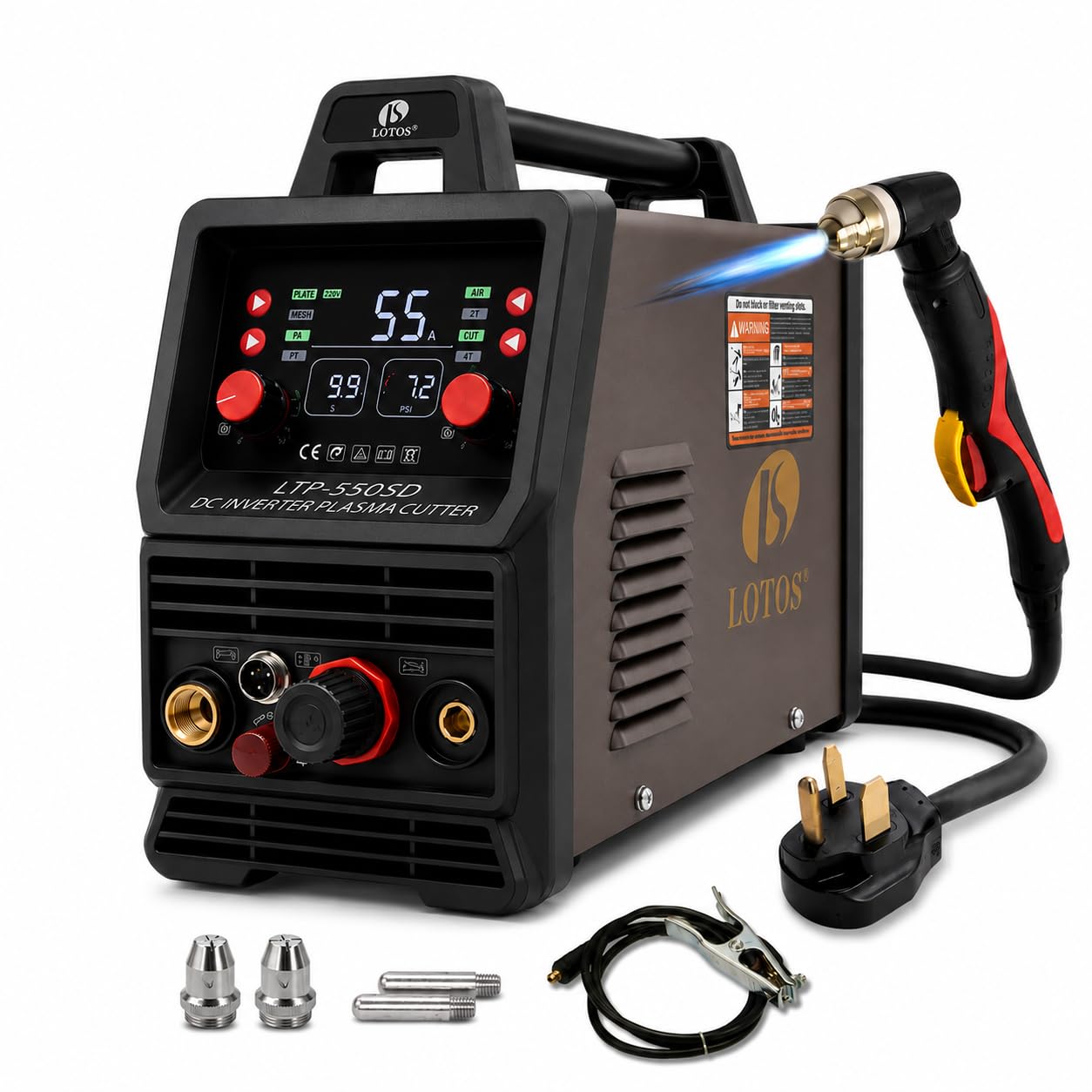
This LOTOS option is aimed at buyers who want a standalone plasma cutter for general repair and fabrication work. The source listing describes pilot-arc and dual-voltage capability, which can be useful when cutting less-than-perfect material or moving between different power sources.
Current model-specific manufacturer documentation was not easy to verify, so treat exact amperage, cut-capacity, regulator, and specialty-mode claims as details to confirm on the current Amazon listing before ordering.
Review Sentiment Snapshot
Note: This sentiment chart is included for context, but its collection date and methodology are not documented. Treat it as a historical snapshot rather than a current rating or review-count claim.

When To Use It
|
Situation |
How It Helps |
|---|---|
|
You can cleanly cut patched panels and exhaust sections without constantly touching up the torch, and the pilot arc helps with awkward contours. |
|
|
Farm And Fence Repair |
You’ll slice through corroded posts and painted materials faster, while a pilot-arc setup can help reduce repeated torch contact. |
|
Metal Art And Fabrication |
The stable arc and good cut geometry reduce dross and filing, so you spend more time assembling and less time grinding. |
|
Mobile Or On-Site Work |
If the current model supports both household and higher-voltage shop power, that flexibility can make on-site setup easier; confirm the exact input range before ordering. |
Versatility
This is a focused plasma cutter rather than a multi-process welder. Its value is straightforward cutting in a compact format, but verify the current voltage range, regulator arrangement, and published cut ratings because model-specific LOTOS documentation was not independently confirmed.
Key Benefits
- Pilot arc listed for more consistent starts
- Pilot-arc-focused setup intended for practical repair work
- Confirm the current listing for exact input-voltage support
- Confirm the current listing for regulator configuration
- Check the current listing for clean-cut and severance ratings
Check Product Details on Amazon
ZENY 50A

You get surprisingly strong cutting performance for a compact unit that’s aimed at home shops and DIY projects. It handles thin to moderate plate well when you dial in air pressure and amperage, and the dual-voltage input lets you use either 110V or 220V feeds. Expect to spend a little time on setup and consumable selection to get the cleanest kerfs, but once tuned it makes quick work of routine metal cutting tasks. If you want budget power and you don’t mind swapping tips and tweaking settings, this is a practical option to keep on your bench.
Review Sentiment Snapshot
Note: This sentiment chart is included for context, but its collection date and methodology are not documented. Treat it as a historical snapshot rather than a current rating or review-count claim.

When To Use It
|
Situation |
How It Helps |
|---|---|
|
Home Shop Projects |
You can cut panels, brackets, and small plates quickly once you learn the right speed and air pressure settings. |
|
Hobby Fabrication |
Its compact size fits a garage workspace and makes light sculpting or art pieces easier without a big footprint. |
|
School Or Training Use |
It’s simple enough for beginners to learn plasma basics while still offering enough power to demonstrate real cuts. |
|
Occasional Jobsite Work |
Dual-voltage capability and portability let you jump between household outlets and 220V circuits when needed. |
Versatility
This is a focused cutting tool rather than a multi-process machine. It’s versatile for hobbyists, small shops, and training environments, but less suited to heavy industrial duty cycles or workflows that demand long continuous runtime.
Key Benefits
- Dual-voltage 110/220V flexibility
- Manufacturer lists a maximum cutting thickness of 1–12 mm
- Compact, shop-friendly footprint
- Simple controls that are easy to learn
- Strong performance for a budget-minded buyer
Check Product Details on Amazon
Amico CUT-50

You get a straightforward, capable cutter that’s built for hobbyists and small shops who need reliable cuts without fuss. The CUT-50 handles thin sheet work and moderate plate well when you manage air pressure and travel speed, and the dual-voltage input makes it easy to move between garage outlets and 230V shop circuits.
Setup is simple and the controls are approachable, so you can get productive quickly. If your work is mainly fabrication, repair, or making parts for projects, this machine gives a solid balance of cutting power and user-friendly operation.
Review Sentiment Snapshot
Note: This sentiment chart is included for context, but its collection date and methodology are not documented. Treat it as a historical snapshot rather than a current rating or review-count claim.

When To Use It
|
Situation |
How It Helps |
|---|---|
|
You can make brackets, panels, and structural pieces quickly with predictable kerfs once you dial in settings. |
|
|
Repair And Maintenance |
Dual-voltage flexibility means you can use household power for light tasks or switch to 230V for heavier cuts on-site. |
|
Learning And Practice |
Controls are intuitive enough for newcomers to learn cut speed and pressure while still offering enough power for real projects. |
|
Small Shop Production |
Handles repeated moderate cuts without a large footprint, making it useful for short-run fabrication and repair work. |
Versatility
This is a focused cutter that excels at plate and sheet work rather than multi-process welding. It’s versatile for hobbyists, contractors doing occasional site work, and small shops that need a reliable standalone plasma cutter.
Key Benefits
- Dual-voltage 110/230V flexibility
- Manufacturer lists 1/2 in. cutting and up to 1 in. maximum severance
- User-friendly controls and carry handles
- Solid build quality for everyday shop tasks
- Simple setup with a visible regulator
Check Product Details on Amazon
Hypertherm Powermax30
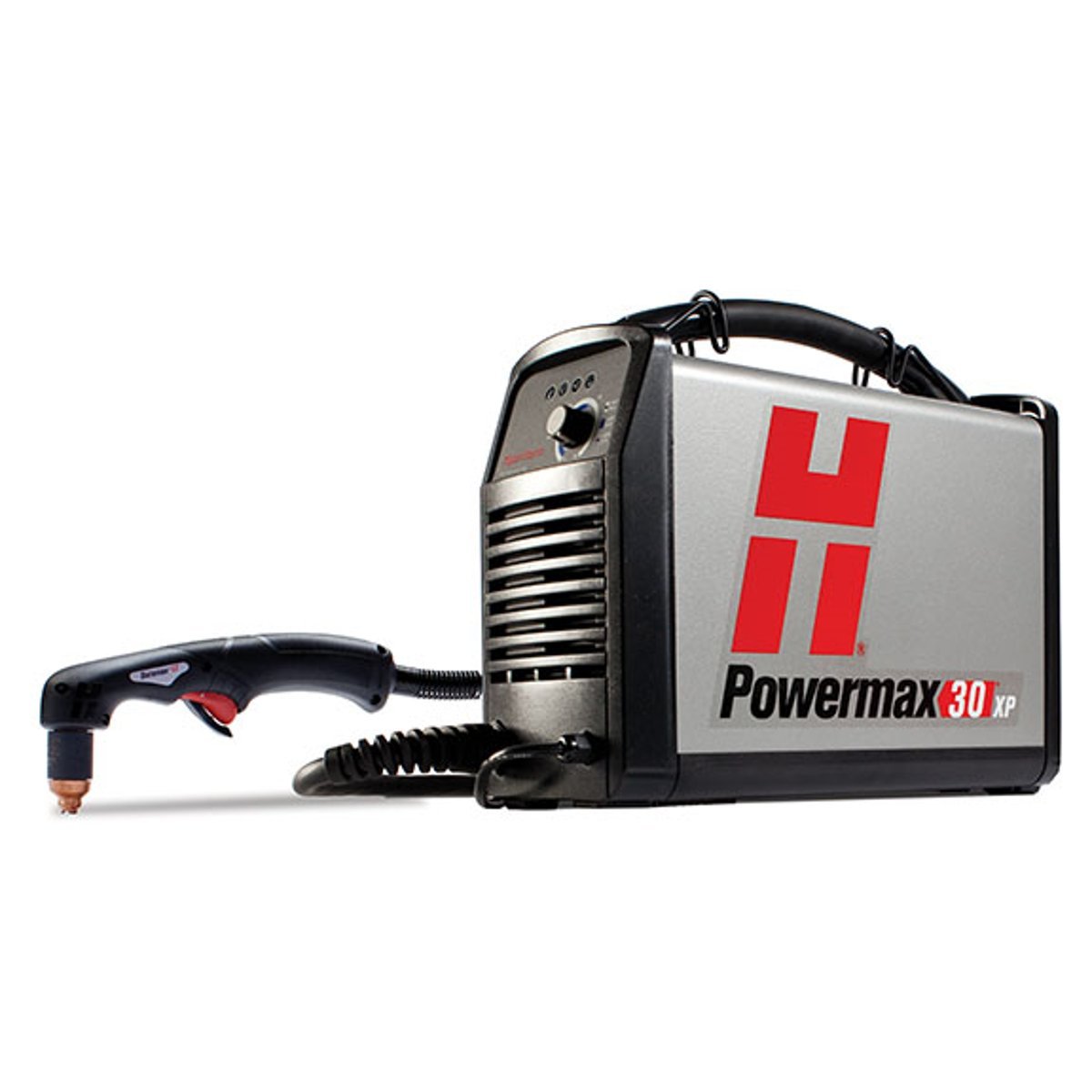
You get a small powerhouse that balances raw cutting ability with fine-detail control. The two-in-one approach lets you switch from high-power cuts to precise, low-dross fine cutting without swapping machines, and the durable Duramax LT torch and long lead make it easy to move around the shop or take on-site. Its auto-voltage capability means you can plug into 120V or 240V circuits and start cutting quickly, and the supplied case and accessories make transport and setup straightforward.
If you value consistent edge quality and portability for both everyday repairs and more detailed fabrication, this one earns a spot on your bench.
Review Sentiment Snapshot
Note: This sentiment chart is included for context, but its collection date and methodology are not documented. Treat it as a historical snapshot rather than a current rating or review-count claim.

When To Use It
|
Situation |
How It Helps |
|---|---|
|
Shop Fabrication |
You can run repeated clean cuts on sheet and angle iron with minimal edge prep, speeding up assembly and finishing. |
|
Precision Detail Work |
Fine Cut consumables let you produce neat kerfs on thin metal for art, HVAC, or detailed repair tasks. |
|
Mobile Or On-Site Jobs |
Lightweight design, carry case, and auto-voltage make it simple to move between locations and plug into available power. |
|
Teaching And Demonstration |
Ease of use and consistent results make it a good tool for showing students practical cutting techniques. |
Versatility
This unit covers precise thin-gauge work and portable fabrication. Hypertherm rates the Powermax30 XP for recommended cuts up to 1/2 in. at lower travel speed, with 5/8 in. listed as severance capacity.
Key Benefits
- Two-in-one high-power and Fine Cut consumables
- Auto-voltage for 120V or 240V use
- Durable Duramax LT torch and long 15′ lead
- 21.4 lb system weight with 15 ft torch; highly portable
- Superior edge quality with minimal cleanup
Check Product Details on Amazon
Forney 251

You get a straightforward, portable cutter that’s easy to move around the jobsite and friendly to generator power. It’s built for sheet metal and thin plate work, with a published 1/4 in. mild-steel cutting capacity, 120V input, and 21.5 lb weight. You will want to tune your travel speed and air pressure to tighten the kerf, but once you learn the settings it becomes a reliable daily tool for contractors, hobbyists, and on-site work.
Review Sentiment Snapshot
Note: This sentiment chart is included for context, but its collection date and methodology are not documented. Treat it as a historical snapshot rather than a current rating or review-count claim.

When To Use It
|
Situation |
How It Helps |
|---|---|
|
Garage Repair |
You can handle exhaust work, patch panels, and small fabrication without needing heavy infrastructure, using household power. |
|
Mobile Jobs |
Generator compatibility and light weight let you move between sites and keep cutting when mains power isn’t available. |
|
HVAC And Plumbing |
Fast, precise cuts on ductwork and thin plate reduce fitting time and minimize edge cleanup for faster installs. |
|
Learning And Practice |
Intuitive controls and forgiving behavior at lower amperage make it a sensible choice for newcomers building cutting skills. |
Versatility
Focused on cutting rather than welding, this model shines where portability and simple operation matter most. It’s suitable for hobbyists, contractors doing on-site repairs, and anyone who needs a reliable 120V cutter without a large footprint.
Key Benefits
- Generator-friendly and runs on household 120V
- Lightweight and portable for on-site work
- Trigger guard reduces accidental arcs
- Good performance on sheet and thin plate
- Responsive customer support for setup issues
Check Product Details on Amazon
LOTOS 3-in-1

You get a workshop all-rounder that combines plasma cutting with TIG and stick functions in one chassis. That makes it relevant for mixed repair and fabrication workflows where you would otherwise need separate cutting and welding machines.
The source listing describes pilot-arc, dual-voltage, and integrated-regulator features, but current model-specific manufacturer documentation was not independently confirmed. Verify the exact input range, output ratings, torch configuration, and included accessories on the current listing before ordering.
Review Sentiment Snapshot
Note: This sentiment chart is included for context, but its collection date and methodology are not documented. Treat it as a historical snapshot rather than a current rating or review-count claim.

When To Use It
|
Situation |
How It Helps |
|---|---|
|
Industrial Maintenance |
You can cut corroded panels and then switch to stick welding for heavy repairs without swapping machines, saving setup time. |
|
Automotive Restoration |
Pilot-arc cutting handles rusted body panels and TIG provides the control needed for thin-sheet welds and patch work. |
|
Garage Fabrication |
Dual-voltage flexibility and integrated regulator let you jump between household and shop circuits while producing clean cuts for parts. |
|
Small Shop Production |
Combining cutting and two welding processes reduces floor space and streamlines mixed workflows like exhaust repair and custom fabrication. |
Versatility
This machine is highly versatile for mixed workflows where cutting and welding are both required. It’s a smart choice if you need plasma cutting plus TIG or stick welding without dedicating space to separate machines, though heavy continuous industrial duty may still favor dedicated high-duty units.
Key Benefits
- Three processes in one portable chassis
- Plasma cutting function for repair and fabrication work
- TIG and stick functions in the same chassis
- Source listing describes dual-voltage capability; verify current input range
- Verify the current regulator and air-fitting configuration
Check Product Details on Amazon
Everlast 62i

You get a 60 amp, 220/240V cutter with a CNC interface and a handheld torch configuration. Everlast lists a 60% duty cycle at 60A, pilot arc, blowback start, and CNC mode, making it suitable for both manual shop cutting and plasma-table workflows.
Construction is solid and the unit feels purpose-built for automation, but expect to check lead lengths and grounding for your setup. If you want a shop-focused cutter with CNC capability and more output than the 120V-oriented options, this is the clearest fit in this roundup.
Review Sentiment Snapshot
Note: This sentiment chart is included for context, but its collection date and methodology are not documented. Treat it as a historical snapshot rather than a current rating or review-count claim.

When To Use It
|
Situation |
How It Helps |
|---|---|
|
CNC Cutting |
You can mount it to a CNC table for automated parts production, where its control output and cut range handle many hobby and light-industrial tasks. |
|
Manual Bench Work |
It doubles as a hand cutter for finish work and one-off parts, keeping your workflow consistent between automated and manual jobs. |
|
Prototype And Short Runs |
You’ll be able to iterate quickly on part shapes without needing an industrial plasma system, making small batch runs practical. |
|
Shop Upgrades |
If you’re moving from hobby gear toward production, it offers a step up in capability without a full investment in top-tier equipment. |
Versatility
This cutter sits between hobby and light industrial use: versatile enough for CNC tables and manual cutting, with manufacturer-published 60% duty cycle at 60A and 100% at 50A. It fits shops that need automated capability without dedicating floor space to larger machines.
Key Benefits
- CNC-compatible design for automated cutting
- Solid construction suitable for shop or bench use
- Manufacturer lists up to 3/4 in. daily use, 1 in. clean cut, and 1-1/4 in. severance
- Good value relative to premium industrial units
- Serviceable parts and straightforward setup
Check Product Details on Amazon
FAQ
What Should I Look For When Choosing A Plasma Cutter?
Focus on the cutting capacity and the features that match the work you do. Look for a unit with the amperage to cut the thickness you need, reliable arc-starting (pilot arc or high-frequency), and dual-voltage if you plan to switch between garage and shop power.
Check duty cycle and cooling if you expect long runs, confirm consumable availability for the model, and consider portability and connector layout so setup is fast on the bench or at a jobsite. Finally, compare manufacturer support and spare-parts access so downtime is easier to manage.
How Does Pilot Arc Help On Rusty Or Painted Metal?
A pilot arc can help establish the arc without repeatedly touching the torch tip to the workpiece, which is useful on painted, rusty, expanded, or uneven conductive material. Exact behavior varies by torch and machine, so confirm the start method and operating instructions for the model you buy. Air quality, pressure, amperage, and travel speed still have a major effect on kerf quality and consumable life.
What Setup And Maintenance Steps Improve Cut Quality?
Start with clean, dry compressed air and a quality moisture/water separator to avoid inconsistent arcs and premature consumable wear. Set your regulator and test cut on scrap to dial in the right air pressure and travel speed for the material and amperage. Keep spare consumables on hand, check torch and work-clamp connections regularly, and follow manufacturer duty-cycle limits to reduce overheating and downtime.
What Is The Difference Between Recommended Cut Capacity And Severance Capacity?
Recommended cut capacity is the more useful number for routine work because it reflects a thickness the manufacturer expects the machine to cut at a practical speed and quality. Severance capacity is a slower maximum-through-cut figure. Do not compare two plasma cutters by the biggest thickness number alone.
Do I Need 240V For A Plasma Cutter?
Not always. The Forney 251 is a 120V machine, while several other models support dual-voltage input. Higher-output cutters such as the Everlast PowerPlasma 62i are 220/240V-only. Match the machine to the circuits available in your shop and the thickness you cut most often.
Wrapping Up
When cut quality, portability, and well-documented specifications are your priority, choose the Hypertherm Powermax30 XP. If you prefer a lower-cost standalone LOTOS option, verify the current LOTOS 55A listing for exact cut capacity, power input, and torch-start details before buying.
Select the LOTOS Combo if you want a single machine that adds TIG and stick welding to your cutting capability. For lightweight, generator-friendly portability on standard 120V circuits the Forney 251 is a pragmatic choice. The Amico CUT-50 and ZENY 50A target value-focused cutting, while the Everlast 62i makes the most sense when you have 220/240V power and plan to use a CNC table.
Match the cutter to your normal metal thickness, available electrical circuit, air supply, duty-cycle needs, and consumable budget rather than choosing only by the largest advertised thickness number.
Specification note: Cut-capacity terms are not standardized across marketing pages. Where current manufacturer documentation was available, this table distinguishes recommended/regular cutting from severance capacity. LOTOS model-specific figures should be rechecked on the current listing before purchase.
| Product Name | Image | Best For | Published Cut Capacity | Weight | Power Type |
|---|---|---|---|---|---|
| LOTOS LTP5505D 55A Pilot Arc Plasma Cutter |
|
General standalone cutting | Verify current model listing | Verify current model listing | Verify current model listing |
| ZENY DC Inverter Plasma Cutter 50AMP CUT-50 |
|
Budget DIY and repair | 1–12 mm maximum (manufacturer listing) | 22.05 pounds | Dual Voltage (110V/220V) |
| Amico CUT-50 Plasma Cutter |
|
Repair and small-shop value | 1/2 in. cutting; 1 in. max severance (manufacturer listing) | 21.56 pounds | 115V/230V; auto-voltage design |
| Hypertherm Powermax30 XP |
|
Cut quality and portability | Up to 1/2 in. recommended; 5/8 in. severance | 21.4 pounds with 15 ft torch | 120V/240V |
| Forney 251 Easy Weld 20 P Plasma Cutter |
|
120V portable cutting | Up to 1/4 in. mild steel | 21.5 pounds | 120V AC |
| LOTOS LTPDC2000D 3-in-1 Plasma Cutter |
|
Cutting plus TIG/stick workflows | Verify current model listing | Verify current model listing | Verify current model listing |
| PowerPlasma 62i 60 Amp Plasma Cutter |
|
CNC and higher-output shop use | 3/4 in. daily use; 1 in. clean; 1-1/4 in. severance | 53 pounds | 220/240V, 1-phase |
This roundup is reader-supported. When you click qualifying affiliate links, we may earn a referral commission at no extra cost to you.