
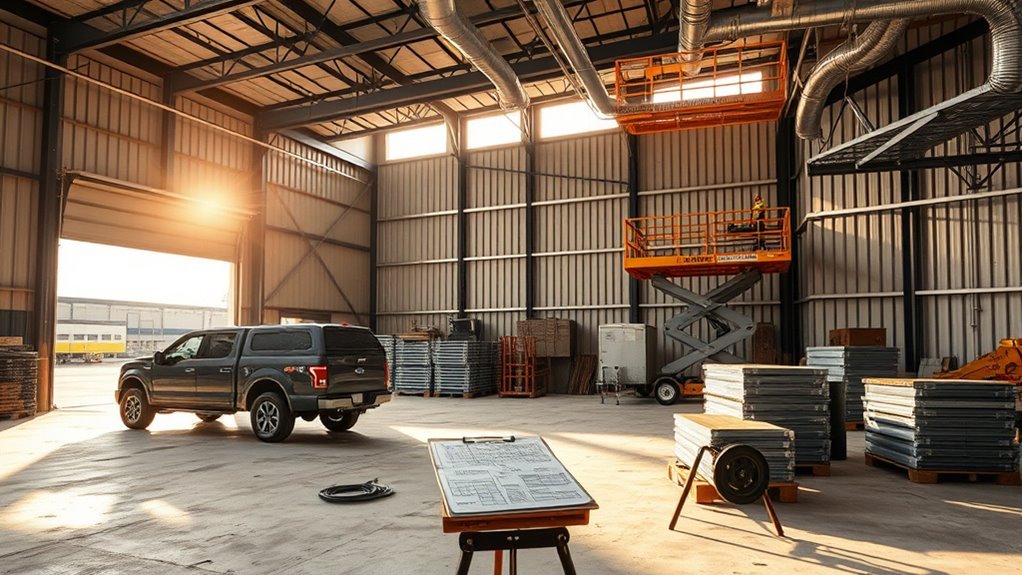
The cost to build a welding shop can range from about $20,000–$100,000 for a lean home-based or mobile setup to $85,000–$500,000 for a small leased commercial shop and $300,000–$1 million-plus for a ground-up or heavily automated facility. These are planning scenarios, not national averages. The biggest cost swings usually come from the site, electrical service, ventilation, fire protection, utility work, equipment, and the cash reserve needed before sales become steady.
Last updated: August 11, 2026 — refreshed with current 2026 SBA and AWS program information and the latest May 2025 BLS national wage data available.
This guide focuses on the facility build and build-out budget. If you are planning the entire business launch, including marketing, pricing, and customer acquisition, see our welding shop startup cost guide.
Quick Answer
Plan roughly $20,000–$100,000 for a home-based or mobile welding setup, $85,000–$500,000 for a small leased commercial shop, and several hundred thousand to more than $1 million for a ground-up facility. These are planning scenarios—not national averages—because power, ventilation, fire-code work, property, and staffing vary sharply by location.
Key Takeaways
- Treat every dollar figure as a planning range until you have local bids for the site, electrical service, ventilation, fire protection, and insurance.
- A leased industrial unit with suitable power and existing code-compliant systems can cost far less than converting a garage or constructing a new building.
- Budget for more than welding machines. Fume control, gas-cylinder storage, material handling, PPE, permits, testing, and working capital can equal or exceed the equipment bill.
- Keep at least three months of projected fixed and variable expenses in the funding plan; six months gives a safer cushion for a new shop.
At a Glance
| Time Required | Usually several months for site review, permits, bids, installation, and inspections; a ground-up project can take much longer. |
| Difficulty | High—site, code, electrical, mechanical, insurance, and production decisions are connected. |
| Tools Needed | Startup-cost worksheet, floor plan, equipment schedule, utility-load list, local permit checklist, and written contractor quotes. |
| Cost | About $20,000–$100,000 for a lean home/mobile setup, $85,000–$500,000 for a leased commercial shop, and $300,000–$1 million-plus for a ground-up facility. |
Note: This guide provides budgeting scenarios, not a contractor quote, appraisal, legal opinion, engineering design, or insurance recommendation. Local codes, utility requirements, labor markets, and property conditions control the real cost.
What Does It Cost to Build Out a Welding Shop Facility?
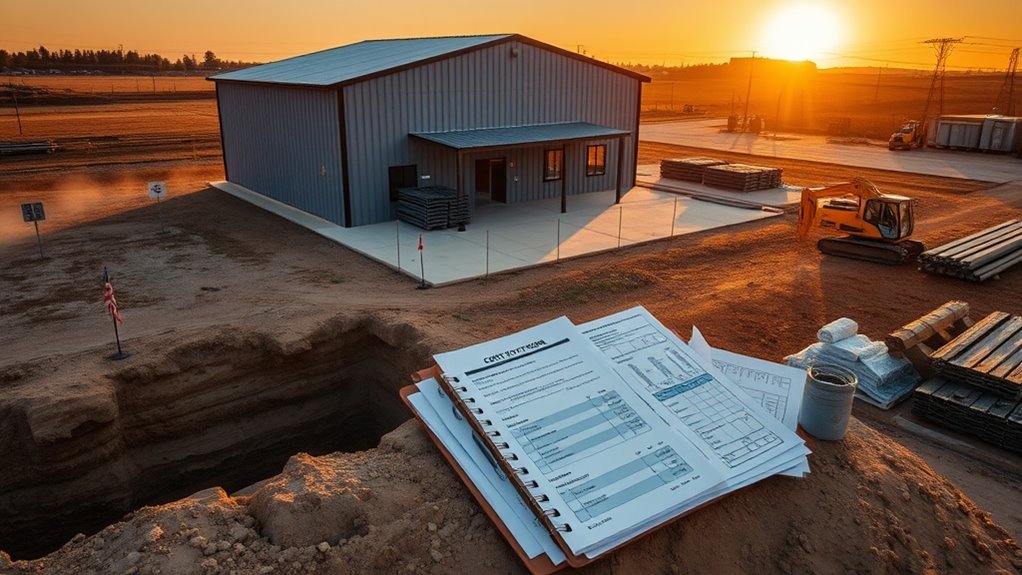
Start with the site because it can lock in your largest expenses. The U.S. Small Business Administration recommends separating one-time startup expenses from monthly operating expenses. For a welding business, that means pricing the property and build-out separately from payroll, utilities, consumables, and debt payments.

This hardcover book celebrates the art of gathering with inspiring table settings, thoughtful traditions, and practical ideas for hosting memorable meals. Written by Shea McGee, it offers beautiful design inspiration alongside approachable guidance for creating warm, welcoming spaces for family and friends. It's a charming resource for anyone who loves entertaining, home styling, and making everyday moments feel special.

The Armor All AA255W wet/dry utility vac delivers strong 2 peak HP suction in a compact, portable design for quick cleanup of wet and dry messes. Its 2.5-gallon tank, wheel base, top handle, and built-in storage make it easy to move, organize, and use around the garage, car, or jobsite. It also converts to a blower and comes with multiple accessories for versatile cleaning tasks.

This daily devotional helps parents pray purposefully for their children through a full year of Scripture readings, reflections, and guided prayer prompts. Written to encourage faithful family discipleship, it offers practical, biblically grounded support for parents who want to shape their prayers around God's Word. A foreword by Sinclair B. Ferguson adds trusted theological insight and encouragement.
Use a Complete Startup-Cost Formula
A practical budget uses this formula:
Total cash needed = site and build-out + utility upgrades + equipment + safety systems + permits and insurance + opening inventory + working-capital reserve.
Do not add only the purchase price of the welders. A low-cost building can become an expensive choice if it needs a new electrical service, roof penetrations for exhaust, make-up air, gas storage, fire separation, drainage, or major accessibility work.
Lease, Buy, or Build
| Site Strategy | Main Cost Drivers | Best Fit |
|---|---|---|
| Home-based or mobile | Garage modifications, portable power, trailer or truck, noise control, storage, and local home-occupation rules | Repair, field work, and low-volume fabrication |
| Leased industrial unit | Deposit, tenant improvements, power capacity, ventilation, fire review, and restoration obligations | Most first commercial shops |
| Purchased or ground-up facility | Land, design, site work, construction, utility extensions, financing, and a longer pre-revenue period | Established businesses with stable demand |
How Should You Estimate Welding Shop Cost Per Square Foot?
A single national cost-per-square-foot number can hide the expenses that make welding facilities unusually site-sensitive. Build the estimate from separate local quotes instead: property or lease costs, shell or tenant improvements, electrical service, ventilation and make-up air, fire protection, gas storage, equipment foundations, loading access, permits, and professional design. Then add welding equipment and working capital as separate budget lines.
This method also makes two sites easier to compare. A higher-rent industrial unit with suitable power, loading access, and code-compliant systems can require less total cash than a cheaper building that needs major utility, roof, fire, or ventilation work.
Before signing a lease or purchase agreement, confirm industrial use, outdoor storage, noise limits, hazardous-material rules, parking, loading access, and operating hours. The SBA notes that license and permit requirements and fees depend on the activity, location, and issuing agency. A home shop may be prohibited even when the welding itself is small-scale.
Electrical and Utility Upgrades
List every major load before an electrician prices the project: welders, plasma cutters, air compressor, dust or fume collectors, HVAC, make-up air, lighting, saws, positioners, office equipment, and future expansion. Then confirm the available voltage, amperage, panel capacity, and whether three-phase service is present.
Three-phase power is not mandatory for every welding shop. Many light-duty machines run on single-phase power. However, larger production equipment, compressors, CNC tables, and multiple simultaneous welding stations may make three-phase service more practical. The cost depends on the building, utility, service distance, transformer capacity, and local electrical code, so a national flat estimate is not reliable.
Pro Tip: Ask the landlord and utility for written confirmation of service voltage, phase, amperage, and demand limits before you commit to the site. A panel label or listing description is not enough.
Hidden Site and Build-Out Costs
- Architectural or engineering drawings required for permit review
- Roof curbs, ductwork, make-up air, and structural support for ventilation
- Fire-rated walls, spark containment, extinguishers, alarms, or suppression changes
- Gas-cylinder cages, bollards, restraints, and separated storage areas
- Concrete repair, anchors, floor leveling, and equipment foundations
- Crane, forklift, loading-door, rack, and material-flow improvements
- Security, lighting, accessibility, restrooms, office space, and signage
- Environmental testing, waste handling, or remediation when the property has prior industrial use
Purchasing Welding Equipment and Shop Tools
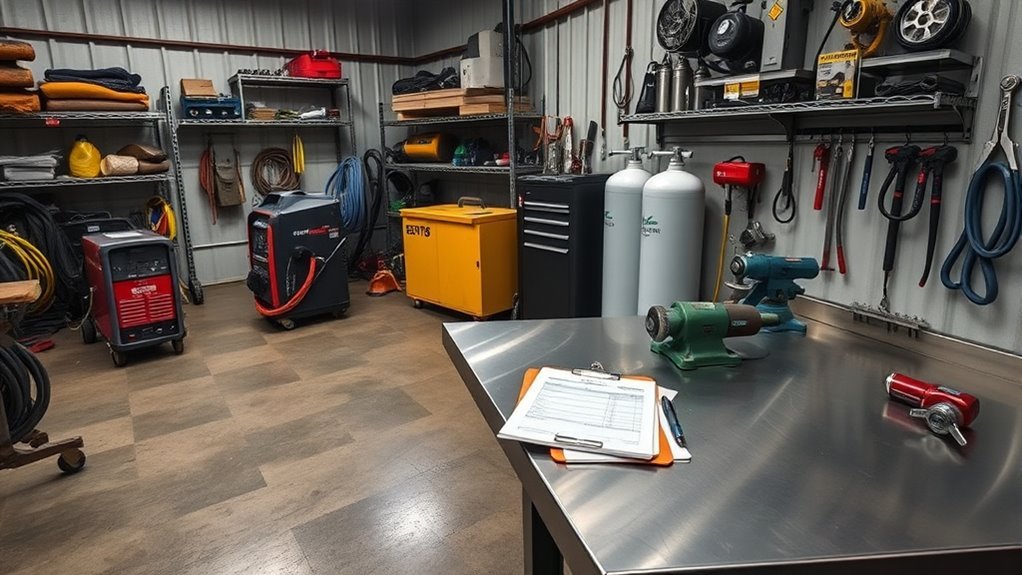
Equipment should match the work you plan to sell during the first year. A structural fabrication shop, automotive repair shop, pipe shop, and mobile repair business need different machines, fixtures, power, and quality-control tools. Buying every process at launch ties up cash and raises maintenance costs.
Build the Equipment List by Work Type
- Core welding processes: MIG, TIG, stick, flux-cored, or multiprocess machines sized for the expected material and duty cycle
- Cutting and preparation: plasma cutter, oxy-fuel equipment, bandsaw, cold saw, grinders, beveling tools, drill press, and abrasives
- Fabrication and handling: welding tables, fixtures, positioners, clamps, racks, carts, hoists, forklift, or pallet jack
- Air and power: compressor, dryers or filters, extension systems, distribution piping, and backup or engine-driven power for mobile work
- Inspection and quality: calibrated measuring tools, weld gauges, lighting, procedure documents, and any customer-required testing equipment
- PPE and housekeeping: helmets, gloves, protective clothing, hearing protection, screens, respirators when required, vacuums, and metal-safe waste containers
Illustrative Equipment Budget
| Equipment Group | Lean Setup | Small Commercial Shop |
|---|---|---|
| Welding and cutting machines | $6,000–$25,000 | $20,000–$100,000+ |
| Tables, saws, tooling, and material handling | $4,000–$20,000 | $15,000–$100,000+ |
| PPE, screens, gauges, and shop supplies | $2,000–$10,000 | $5,000–$30,000+ |
| Mobile vehicle, trailer, or engine drive | Optional; highly variable | Optional; highly variable |
These are planning allowances, not retail quotes. Machine capacity, brand, automation, used-equipment condition, freight, installation, and accessories can move the total far outside the table. Get written quotes that include leads, torches, feeders, coolers, regulators, carts, software, freight, taxes, commissioning, and training.
New Versus Used Equipment
Used tables, racks, clamps, and simple machine tools can reduce startup cost with limited risk when inspected carefully. Used welders, compressors, lifts, CNC equipment, and fume systems need a deeper review. Check electrical compatibility, service history, parts support, safety guards, calibration needs, warranty transfer, and the cost to bring the equipment into compliance.
Safety, Ventilation, and Workshop Setup Costs
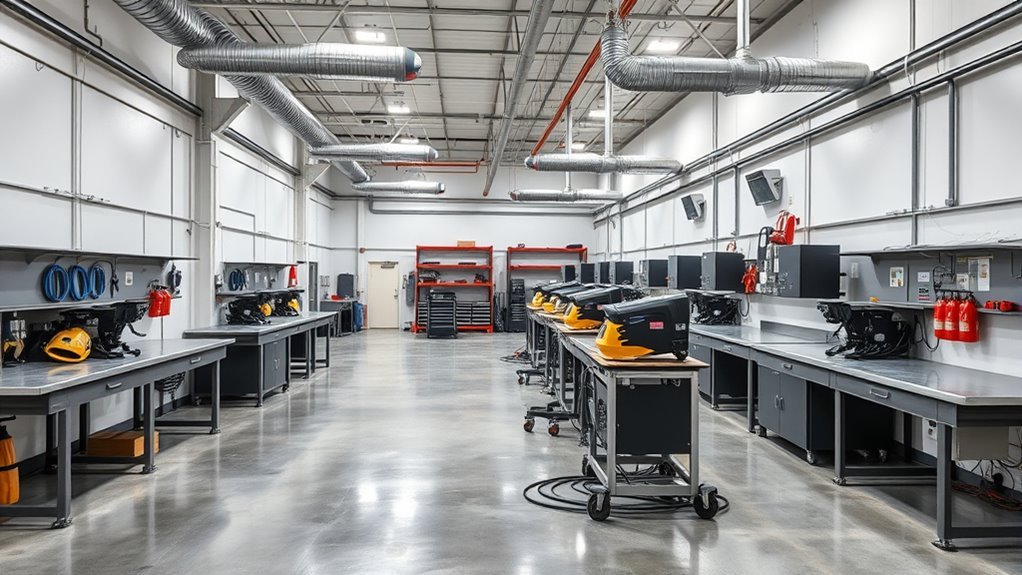
Safety systems are core production infrastructure, not optional add-ons. The correct design depends on the welding processes, base metals, coatings, consumables, production rate, building volume, worker position, and other contaminants in the shop.
Ventilation and Respiratory Protection
OSHA’s welding, cutting, and brazing requirements address ventilation, fire prevention, confined spaces, screens, and hot-work hazards. Local exhaust ventilation should capture fumes close to the arc without disrupting shielding gas. General building ventilation may still be needed for heat and background contaminants.
Do not assume a disposable mask is an acceptable substitute for fume control. Under OSHA’s respiratory protection standard, employers must evaluate respiratory hazards, use feasible engineering controls first, select suitable NIOSH-certified respirators when needed, and operate a respiratory protection program that includes medical evaluation, fit testing, training, cleaning, and maintenance.
Fire Prevention and Cylinder Storage
Separate hot work from paint, solvents, fuel, cardboard, wood dust, and other combustibles. Provide suitable fire-extinguishing equipment, control sparks and slag, and establish hot-work procedures for areas not designed as permanent welding stations.
Gas storage also affects the layout. OSHA’s oxygen-fuel gas standard requires protected, dry, ventilated cylinder storage. For oxygen cylinders in storage, OSHA specifies separation from fuel-gas cylinders or combustible materials by at least 20 feet, or by a noncombustible barrier at least 5 feet high with at least a one-half-hour fire-resistance rating. Local fire codes may add permit, quantity, barrier, alarm, or outdoor-cage requirements.
Warning: Do not design fume extraction, make-up air, fire suppression, or compressed-gas storage from a generic online price list. Use qualified local professionals and obtain approval from the authority having jurisdiction before installation.
Safety and Fit-Out Planning Allowances
| Item | Illustrative Range | What Changes the Cost |
|---|---|---|
| Local exhaust and make-up air | $8,000–$75,000+ | Number of stations, duct length, filtration, roof work, controls, and conditioned make-up air |
| Fire protection and hot-work controls | $2,000–$30,000+ | Existing building systems, occupancy classification, alarms, suppression, separation, and local review |
| Cylinder storage and gas distribution | $1,500–$20,000+ | Gas types, quantities, outdoor cage, barriers, piping, manifolds, and monitoring |
| PPE, screens, signage, and training | $1,000–$5,000+ per worker | Respiratory program needs, specialty clothing, hearing protection, replacement rate, and task hazards |
The table is useful for early budgeting only. A small shop with existing compliant systems may spend less; a high-production shop, stainless or coated-metal operation, or difficult building retrofit may spend far more.
What Do Welding Shop Permits, Insurance, and Certifications Cost?
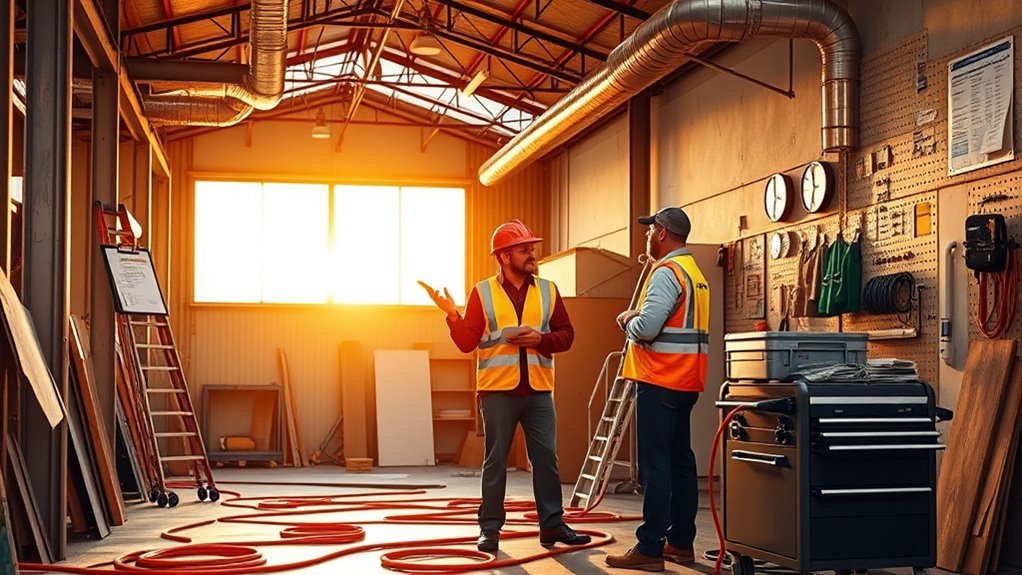
There is no dependable national permit package or flat legal-fee range for welding shops. The SBA states that requirements and fees vary by business activity, location, and government rules. Start with the city or county planning, building, fire, environmental, and business-license offices before ordering major equipment.
Permits and Approvals to Check
- Zoning or land-use approval, including home-occupation rules where applicable
- Building and tenant-improvement permits
- Electrical, mechanical, gas, plumbing, and fire permits
- Sign, occupancy, and business-license approvals
- Air-emissions, hazardous-material, stormwater, wastewater, or waste-generator requirements when triggered by the shop’s processes
- Vehicle, contractor, or trade licenses for services regulated by the state or locality
Some metal fabrication and finishing operations may fall under federal, state, Tribal, or local environmental rules. Review the shop’s welding, grinding, blasting, coating, solvent, and waste streams rather than assuming that “welding only” creates no environmental obligations.
Insurance to Price
General liability alone may not cover the shop’s full risk. Ask a licensed commercial agent about property coverage, workers’ compensation, commercial auto, inland marine or tools-in-transit coverage, equipment breakdown, product or completed-operations liability, umbrella coverage, and business interruption. Premiums depend on payroll, revenue, services, claims history, limits, location, fire protection, and mobile work, so a universal $600–$2,500 annual estimate is not dependable.
Welding Certifications and Quality Requirements
Certification cost depends on the credential, code, process, test position, test facility, and whether training is included. The American Welding Society’s price list effective January 1, 2026 shows a $70 Certified Welder application fee and a $105 yearly maintenance subscription, while the hands-on exam fee is set by the Accredited Test Facility. Inspector and facility credentials have different fees.
Do not purchase certifications simply for marketing. Start with customer and code requirements. Contract work may require qualified welding procedures, welder performance qualifications, inspection records, material traceability, calibration, or a formal quality program in addition to an individual welder card.
What Does a Welding Shop Cost to Operate?
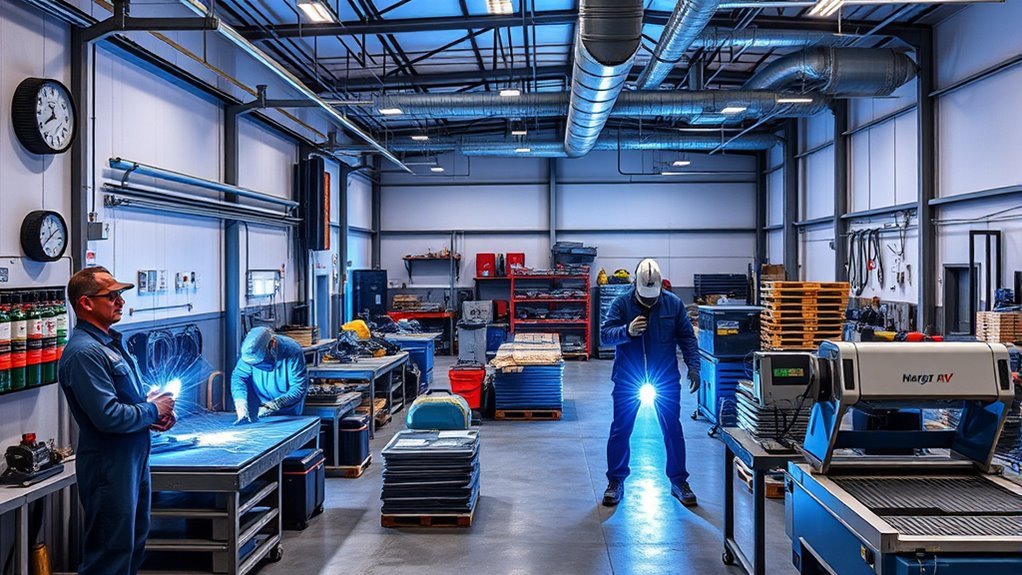
Opening the doors is only the first funding milestone. A shop can be fully equipped and still fail if receivables arrive later than payroll, rent, gas, and material bills.
Build a Monthly Operating Budget
- Occupancy: rent or mortgage, property tax, common-area charges, security, and waste service
- Utilities: electricity, demand charges, gas, water, compressed air, heating, cooling, and ventilation energy
- Labor: wages, overtime, payroll taxes, workers’ compensation, benefits, training, and paid nonproductive time
- Materials: plate, tube, bar, sheet, fasteners, gases, wire, rods, tungsten, abrasives, tips, nozzles, and packaging
- Maintenance: planned service, calibration, filters, extraction-system cleaning, repairs, spare parts, and equipment rental during downtime
- Administration: software, phones, bookkeeping, banking, licenses, marketing, vehicles, and professional services
- Debt and taxes: loan payments, equipment leases, sales or use taxes, and income-tax reserves
Use Current Local Wage Data
A flat $15–$30 hourly range is too broad to serve as a staffing budget. In its May 2025 national Occupational Employment and Wage Statistics table, the U.S. Bureau of Labor Statistics lists a $25.84 median hourly wage and a $56,760 mean annual wage for welders, cutters, solderers, and brazers. Pay still varies by industry, skill, location, shift, and specialty. Use local wage data and add employer payroll taxes, insurance, benefits, overtime, recruiting, training, and supervision.
Plan Working Capital
A practical reserve is three to six months of projected cash expenses, adjusted for customer payment terms and the sales ramp. A shop that invoices commercial customers on net-30 or net-60 terms may need more cash than a repair business paid at pickup.
The amount needed to open the shop is not the same as the amount needed to survive the first slow months.
Control Material and Utility Volatility
Do not hard-code a single national price for steel, shielding gas, or electricity into a long-term budget. Request current supplier quotes, record the quote date and freight terms, and update high-value materials before each major bid. Where contracts allow, use material-expiration dates or escalation language.
Track electricity by machine and shift when possible. Ventilation, compressors, heating, and idle equipment can create large bills even when arc-on time is low. Review demand charges, repair air leaks, shut down unused equipment, and compare actual consumption with the job-cost estimate.
Total Welding Shop Build Cost Estimates
The ranges below combine site work, equipment, safety, compliance, and initial working capital. They are budgeting scenarios for early planning, not published national averages.
| Shop Type | Planning Range | Typical Scope |
|---|---|---|
| Lean home-based or mobile operation | $20,000–$100,000 | One owner, limited processes, modest property work, portable or existing power, and a small reserve |
| Small leased commercial shop | $85,000–$500,000 | One to several stations, tenant improvements, ventilation, material handling, permits, insurance, and working capital |
| Ground-up or heavily automated facility | $300,000–$1 million-plus | Land or major construction, utility infrastructure, engineered safety systems, automation, and a longer pre-revenue period |

Post-it Super Sticky Easel Pads are designed to keep ideas visible and organized during meetings, training sessions, brainstorming, and project planning. The large premium paper resists marker bleed-through and sticks securely to many surfaces, then repositions without surface damage. A sturdy backcard and portable handle make them easy to move between rooms and use with most easel stands.

This compact Bible study guide helps readers explore Scripture with clarity and confidence. Written by Matt Whitman, it offers a fast, approachable companion for understanding key themes, context, and practical insights from the Bible. Its paperback format makes it easy to carry, reference, and use for personal study or group discussion.

The KitchenArt Buttermate makes it easy to measure, slice, dispense, and store butter in one handy kitchen tool. With adjustable portions, clear tablespoon and teaspoon markings, and cup conversions, it helps you serve the exact amount needed for cooking, baking, and everyday use. It also keeps butter fresh in the refrigerator or cabinet, reducing mess and simplifying prep.
Example: Small Leased One-Bay Shop
| Lease deposit, design, and basic build-out | $25,000 |
| Electrical, ventilation, and fire-related work | $45,000 |
| Welding, cutting, tables, tools, and handling equipment | $55,000 |
| PPE, screens, inspection tools, and opening consumables | $12,000 |
| Permits, professional fees, insurance deposits, and testing | $13,000 |
| Three-month working-capital reserve | $60,000 |
| Illustrative total | $210,000 |
This sample is a budgeting exercise, not a promise that a one-bay shop will cost $210,000. Replace each line with local written quotes and your own monthly cash forecast before applying for financing.
How to Reduce Welding Shop Build Costs
- Choose an industrial space that already supports hot work. Existing power, ventilation paths, fire protection, loading access, and gas storage can save more than a lower monthly rent.
- Buy for confirmed services. Start with the processes and capacity required by signed work or a researched target market.
- Stage automation. Add CNC, positioners, robotic equipment, or specialized inspection systems when utilization supports the payment.
- Buy low-risk items used. Tables, racks, clamps, and carts are often safer used purchases than unsupported electronic or safety-critical equipment.
- Negotiate the lease. Seek tenant-improvement allowances, free-rent periods, utility-upgrade terms, and clear responsibility for roof penetrations and restoration.
- Protect working capital. Separate the equipment budget from the cash reserve so the last machine purchase does not consume payroll money.
- Track job costs from day one. Record labor hours, material, gas, abrasives, freight, rework, and machine time so estimates improve quickly.
How Can You Finance a Welding Shop Build?
Match the financing term to the asset. Long-lived property and major machinery generally need longer financing than consumables or short-term payroll needs. The SBA loan-program overview includes 7(a), 504, microloan, and other options delivered through participating lenders and Certified Development Companies.
For a current 2026 funding detail, the SBA says a policy effective July 4, 2026 allows qualified borrowers to combine 7(a) and 504 financing for up to $10 million in SBA-backed financing. That is a program limit, not a recommended welding-shop budget; eligibility, project structure, lender approval, and repayment capacity still control what a business can borrow.
- SBA 7(a): may support real estate, building improvements, working capital, machinery, equipment, furniture, fixtures, and supplies, subject to eligibility and lender approval.
- SBA 504: is designed for eligible major fixed assets such as land, facilities, and qualifying long-term machinery; it is not a general working-capital loan.
- Equipment financing or leasing: can preserve cash but may cost more over time and may require guarantees, insurance, or liens.
- Bank term loan or line of credit: can fund build-out or timing gaps when the business has adequate credit, collateral, cash flow, and repayment capacity.
- Owner equity: reduces debt service but should not leave the business without an emergency reserve.
Prepare a business plan, startup-cost schedule, monthly cash-flow forecast, customer pipeline, owner resume, tax records, personal financial statement, equipment quotes, construction bids, and contingency allowance before approaching lenders.
Frequently Asked Questions
How long does it take to build a welding shop from start to finish?
A leased unit with suitable utilities may take several months to review, permit, modify, inspect, and equip. A ground-up facility can take much longer because land-use approval, design, financing, utility coordination, construction, and final occupancy occur in sequence. Do not commit to customer deadlines until the local permitting team and contractors confirm the schedule.
Can a welding shop operate in a residential zoning area?
Sometimes, but never assume it is allowed. Home-occupation and zoning rules may restrict industrial activity, employees, customers, noise, fumes, outdoor storage, deliveries, signage, compressed gases, fire hazards, and operating hours. Obtain written approval from the local planning, building, and fire authorities before modifying the property or accepting work.
What financing options are available for a new welding shop?
Common options include owner equity, bank term loans, business lines of credit, equipment financing, SBA-backed 7(a) loans, and SBA 504 financing for eligible fixed assets. Approval depends on the business plan, credit, equity contribution, collateral, repayment ability, project type, and lender requirements.
How much value does a welding shop add to a property?
There is no dependable percentage. Value depends on zoning, market demand, building condition, utility capacity, code compliance, the usefulness of the improvements to future buyers, and whether specialized systems become an asset or a removal cost. A local commercial appraiser should evaluate the property before major construction.
Are there eco-friendly or energy-efficient welding shop upgrades?
Yes. Useful options can include inverter-based equipment, LED lighting, efficient motors and compressors, demand-controlled ventilation designed by a qualified professional, compressed-air leak repair, improved insulation, scrap segregation, reusable fixtures, and solar power where the site and economics support it. Safety and required ventilation must never be reduced simply to save energy.
Does a welding shop need three-phase power?
Not always. A small shop may operate with adequate single-phase service, while larger welders, compressors, CNC systems, and several simultaneous stations may favor three-phase power. Have an electrician calculate the connected load and expected demand from the actual equipment schedule.
How much working capital should a new welding shop keep?
Three to six months of projected operating expenses is a practical starting target. Increase the reserve when customers pay slowly, the shop has long project cycles, materials must be purchased before deposits arrive, or the first months are likely to have low utilization.
Conclusion
A realistic welding shop budget covers the building, power, equipment, ventilation, fire protection, gas storage, permits, insurance, qualifications, materials, payroll, and the months before cash flow becomes steady. Use the planning ranges in this guide to set an initial funding target, then replace every major allowance with local written quotes. The best build plan is not the cheapest one—it is the one that opens safely, passes inspection, supports the work you intend to sell, and leaves enough cash to keep operating.
Sources
- U.S. Small Business Administration — Calculate Your Startup Costs — supports separating one-time and monthly business expenses.
- U.S. Small Business Administration — Apply for Licenses and Permits — explains that requirements and fees vary by activity, location, and government rules.
- OSHA 29 CFR 1910.252 — welding, cutting, brazing, ventilation, and fire-prevention requirements.
- OSHA 29 CFR 1910.134 — respiratory-hazard evaluation, engineering controls, respirator selection, fit testing, and training.
- OSHA 29 CFR 1910.253 — oxygen-fuel gas cylinder storage and separation requirements.
- U.S. Bureau of Labor Statistics — May 2025 National Occupational Employment and Wage Statistics — current national wage data used in the staffing section.
- American Welding Society — Certification and Education Price List — 2026 AWS application and maintenance fees.
- U.S. Small Business Administration — 7(a) Loans — eligible uses include real estate, working capital, machinery, equipment, fixtures, and supplies.
- U.S. Small Business Administration — 504 Loans — long-term financing for eligible major fixed assets; working capital and inventory are not eligible uses.
- U.S. Small Business Administration — July 7, 2026 Financing Update — documents the policy allowing qualified borrowers to combine 7(a) and 504 financing up to $10 million.

The DeLonghi Water Filter helps reduce scale buildup and unwanted impurities that can affect your coffee machine's performance and taste. Its active carbon and ion-exchange technology helps improve brew consistency, maintain flavor, and reduce the need for frequent descaling. Designed as an OEM authorized replacement part, it fits select DeLonghi models for reliable everyday maintenance.

Wishy Washy (Water Reveal Edition) is a reusable activity book designed to help young children learn first words and colors through interactive water-reveal play. It encourages hands-on learning, repeated practice, and early language development in a fun format that kids can use again and again. Spiral binding makes it easy for little hands to work through the pages at home or on the go.

The TENS 7000 Digital TENS Unit delivers drug-free pain relief with multiple therapy modes designed to help ease back, neck, shoulder, sciatica, elbow, and nerve pain. This consumer-favorite electrotherapy device doubles as a muscle stimulator and massager, making it a versatile option for recovery and everyday pain management. It includes the essentials to get started right away, along with a portable carrying case for convenient use at home or on the go.
