
As an Amazon Associate I earn from qualifying purchases. This article may contain affiliate links, at no extra cost to you.
Sticky carbon buildup, varnish, and oil grime around a carburetor or throttle body restrict airflow and cause rough idling or sluggish throttle response—but grabbing the wrong aerosol can ruin sensitive coatings or leave an oily film behind. Many DIYers mistakenly reach for ordinary WD-40 Multi-Use lubricant, which is not a residue-free intake solvent.
This guide focuses on WD-40 Specialist Carb/Throttle Body & Parts Cleaner—a dedicated, fast-drying 13.5 oz solvent aerosol built for carburetors, throttle bodies, and compatible unpainted metal parts—and explains exactly where it works best and where you should use a specialty sensor or electronics cleaner instead.
Quick Verdict: Best Carburetor & Throttle-Body Cleaner
#1 Top Pick — WD-40 Specialist Carb/Throttle Body & Parts Cleaner (13.5 oz): Best for DIY maintenance on carburetors, throttle bodies, and unpainted metal parts on cars, motorcycles, lawn mowers, and generators when you want fast-drying, residue-free cleaning with an attachable precision straw. Do not confuse it with WD-40 Multi-Use lubricant or use it as a dedicated MAF sensor cleaner.
Top Pick at a Glance
| Category | Product | Can Size & Formula | Key Trade-Off | Check Price |
|---|---|---|---|---|
| Best Carb & Throttle-Body Cleaner | WD-40 Specialist Carb/Throttle Body & Parts Cleaner | 13.5 oz fast-drying, residue-free solvent | Not for MAF sensors, paint, plastics, or unknown bore coatings | Check Price → |
WD-40 Specialist Carb/Throttle Body & Parts Cleaner
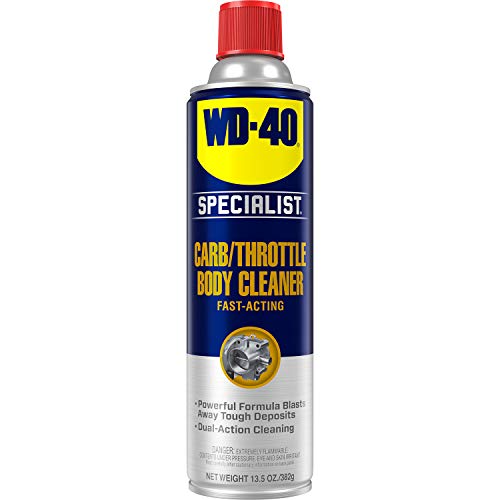
Best For: DIY mechanics performing routine carburetor and throttle-body maintenance on cars, trucks, motorcycles, tractors, boats, lawn mowers, and generators who want a fast-drying solvent that leaves no oily film behind.
Unlike general-purpose lubricants, WD-40 Specialist Carb/Throttle Body & Parts Cleaner is formulated specifically to dissolve carbon deposits, oil, dirt, and gum on unpainted metal intake components. Its attachable precision straw directs spray into tight linkages and ports, and the 50-state VOC-compliant formula dries cleanly without leaving residue behind.
Verified Key Specs
- Can Size: 13.5 wt oz aerosol with attachable precision straw
- Intended Surfaces: Carburetors, throttle bodies, gas-powered equipment, and compatible unpainted metal parts
- Drying & Residue: Fast-drying solvent formulated to leave no residue after drying
- Compliance & Sensor Note: 50-state VOC compliant; manufacturer states it will not affect oxygen sensors or catalytic converters upon incidental contact
| Real-World Strengths | Honest Limitations |
|---|---|
| Purpose-built solvent breaks up carbon, oil, and grime on intake parts | Not a substitute for dedicated MAF sensor or electrical-contact cleaners |
| Fast-drying formula leaves no oily lubricating film after evaporation | Incidental O2-sensor safety does not allow spraying sensors, plastics, or paint |
| Attachable precision straw improves control around small mechanical passages | Will not fix mechanical, electrical, fuel-delivery, ignition, or vacuum faults |
Buying & Safe-Use Guide
Carburetor cleaner, throttle-body cleaner, brake cleaner, electrical-contact cleaner, and mass-air-flow (MAF) sensor cleaner are not interchangeable. If you are comparing options specifically for electronic or modern fuel-injected intakes, see our throttle-body-cleaner guide.
- Cool the engine and ventilate: Turn the engine off, let it cool completely, and work outdoors or in a well-ventilated area away from sparks, pilot lights, or open flames.
- Wear protective gear: Use safety glasses and chemical-resistant mechanic gloves, and avoid breathing concentrated solvent vapors.
- Apply with control: On throttle bodies, spray the cleaner onto a clean, lint-free cloth and wipe the throttle plate and bore surfaces rather than flooding nearby sensors or electronics.
- Protect electronic throttle plates: Do not force an electronically controlled throttle plate open by hand unless your vehicle’s service procedure explicitly permits it.
- Dry completely before reassembly: Let all solvent evaporate fully before reconnecting intake hoses, clamps, and starting the engine.
WD-40 Specialist Specifications & Compatibility
| Attribute | Verified Detail | Check Price / Reference |
|---|---|---|
| Product & Size | WD-40 Specialist Carb/Throttle Body & Parts Cleaner (13.5 oz) | Check Price → |
| Intended Areas | Carburetors, throttle bodies, and compatible unpainted metal parts | Manufacturer Page → |
| Formula & Applicator | Fast-drying, residue-free solvent with attachable precision straw (50-state VOC compliant) | Safe for unpainted metal |
| Not Interchangeable With | WD-40 Multi-Use lubricant, MAF sensor cleaner, or electrical-contact cleaner | Verify material compatibility |
Frequently Asked Questions
Is WD-40 Specialist designed for throttle bodies?
Yes. This specific WD-40 Specialist formula is sold as a Carb/Throttle Body & Parts Cleaner—different from standard WD-40 Multi-Use Product. Always follow both the can label and your vehicle’s service procedure.
Does WD-40 Specialist Carb/Throttle Body Cleaner leave residue?
No. WD-40 describes the formula as fast-drying and engineered to leave no residue after drying.
Can I use it on a lawn mower or small engine?
Yes, it is suitable for carburetors and compatible unpainted metal parts on lawn mowers, generators, motorcycles, and other gasoline-powered equipment. Check your equipment manual before use.
Can I use it to clean a mass-air-flow (MAF) sensor?
No. MAF sensors are delicate electronic components and require a dedicated MAF sensor cleaner approved for that application.
Will it harm an oxygen sensor or catalytic converter?
WD-40 states the cleaner will not affect oxygen sensors or catalytic converters upon incidental contact, but that does not mean you should intentionally spray sensors or electronics.
Should I spray the cleaner directly into the throttle body?
Not automatically. For controlled throttle-body cleaning, spraying cleaner onto a clean lint-free cloth and wiping the bore and plate limits unwanted exposure to nearby sensors and coatings.